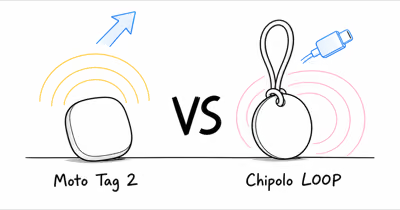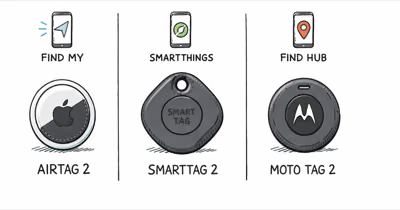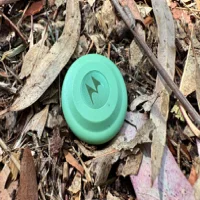
If you own an Android phone and want a Bluetooth tracker with UWB precision finding, the Moto Tag vs SmartTag 2 decision comes down to one thing: your phone brand. Both trackers cost around $29, both use CR2032 batteries, and both support UWB. But they run on completely different networks with different device requirements.
Quick Decision: Moto Tag, Moto Tag 2, or Samsung SmartTag 2?
If you searched for “Moto Tag 2 vs Samsung Tag 2,” don’t treat the original Moto Tag and Moto Tag 2 as the same buy. The phone-brand rule is the same, but Moto Tag 2 is the newer Google Find Hub option with the better battery and water resistance.
| Your phone / search intent | Buy this | Why | Read next |
|---|---|---|---|
| Pixel, OnePlus, Motorola, Xiaomi, or mixed Android household | Moto Tag 2 | Google Find Hub support without a Samsung lock-in, plus the newer more-than-600-day battery and IP68 rating. | Moto Tag 2 review |
| Samsung Galaxy-only household | Samsung SmartTag 2 | SmartThings Find relays run everywhere by default on Galaxy hardware, the keyring hole is built in, and battery life is strongest. | SmartTag review |
| You found the original Moto Tag for $20-$25 | Original Moto Tag | Still the cheaper Google Find Hub UWB option if you can accept the shorter 365-day battery and case requirement. | Original Moto Tag review |
| You want one tracker that can work with iPhone or Android | Neither | Moto Tag is Android-only and SmartTag 2 is Galaxy-only; use a dual-network Chipolo or Pebblebee model instead. | Find Hub tracker picks |
- Phone compatibility is the dealbreaker — Moto Tag works with any Android 9+ phone, while the SmartTag 2 requires a Samsung Galaxy device
- SmartTag 2 battery lasts 37-92% longer — up to 500 days in normal mode or 700 days in power saving, versus the Moto Tag’s 365 days
- Both trackers support UWB — but Samsung reportedly drops third-party tags to a reduced UWB Lite mode on Galaxy phones, giving the SmartTag 2 a UWB advantage on Samsung hardware
- SmartThings Find has a dense, Galaxy-only network — Samsung’s most recent official count puts it at over 300 million opted-in find nodes
- Moto Tag lacks a built-in keyring hole — you’ll need a $10 case or holder, adding to the $29 price tag
The Core Question: Your Phone Brand Decides
This comparison has one hard filter no spec sheet can override. The SmartTag 2 requires a Samsung Galaxy phone with the SmartThings app. No Samsung phone, no tracking. A Pixel, OnePlus, or Xiaomi owner can’t use it at all.
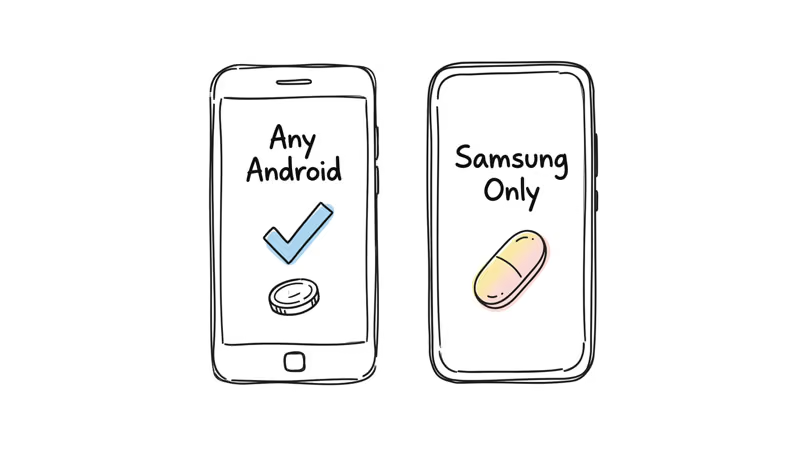
The Moto Tag connects through Google Find Hub, which supports any Android 9+ device. That includes Samsung Galaxy phones. So Samsung owners can use either tracker, but everyone else is limited to the Moto Tag.
That eliminates the SmartTag 2 for roughly 55% of Android users worldwide.
Moto Tag vs SmartTag 2 at a Glance
⇄ Head-to-head
Moto Tag vs SmartTag 2
- +Works with any Android 9+ phone, not just Samsung
- +UWB precision finding via Google Find Hub on UWB-capable phones
- +Lightest tracker in the category at 7.5 g
- +IP67 submersion rating for outdoor and dog-collar use
- +$99 4-pack matches Samsung's pricing tier
- +500-day battery in normal mode, up to 700 days in power saving
- +SmartThings Find's 300M+ Galaxy nodes relay everywhere by default
- +Built-in keyring hole; no extra case needed
- +89 dB speaker noticeably louder than Moto Tag
- +Doubles as a SmartThings smart-home button
- −No built-in keyring hole; case adds ~$10 to total cost
- −365-day battery is 37-92% shorter than SmartTag 2
- −Standard speaker, quieter than SmartTag 2's 89 dB ringer
- −Find Hub relays default to busy places only, thinning quiet-area coverage
- −No smart home / button automation features
- −Samsung Galaxy phone required; no Pixel/OnePlus/Xiaomi support
- −Heavier 13.75 g pill body
- −Reported UWB Lite fallback restricts third-party UWB on Galaxy phones
- −Locked into Samsung's ecosystem — no Google Find Hub fallback
- −$99.99 4-pack barely cheaper per tag than singles
You use a Pixel, OnePlus, Xiaomi, or any non-Samsung Android phone, or you want the smaller, lighter form factor at 7.5 g.
You own a Samsung Galaxy phone and want a default-on tracking network, longer battery, smart-home button, or built-in keyring hole.
The battery gap is significant. Samsung rates the SmartTag 2 at 500 days in normal mode, stretching to 700 days in power saving. The Moto Tag maxes out at 365 days. Both use the same CR2032 coin cell, so the difference comes down to firmware efficiency and how aggressively each tracker pings its network.
When the SmartTag 2 finally dies, our guide to replacing a SmartTag 2 battery walks through opening the case and seating a fresh cell.
The SmartTag 2’s 89 dB ringer gives it the louder published speaker spec. The Moto Tag is better treated as a UWB-first tracker, with sound as a short-range aid.
Build quality differs in one practical way: keyring attachment. The SmartTag 2 has a built-in clip-through hole. The Moto Tag’s smooth coin design looks clean but forces you to buy a Motorola-branded case or third-party holder for about $10, pushing the real cost closer to $39.
How Google Find Hub and SmartThings Find Compare
Network reach is two numbers: phones that could relay a ping, and phones that actually do.
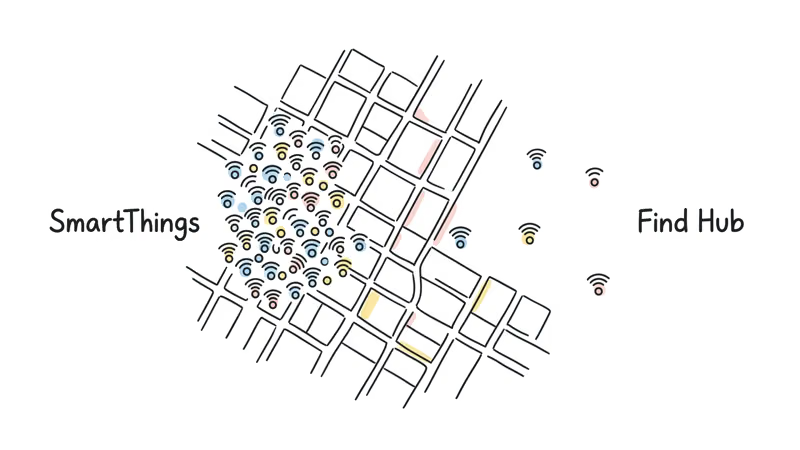
The Moto Tag’s Find Hub wins the first count; the SmartTag 2’s SmartThings Find often wins the second. SmartThings Find runs on Samsung’s installed base of Galaxy phones, tablets, and watches, and Samsung’s newsroom confirms that the pool passed 300 million find nodes. Those nodes relay everywhere by default, so a SmartTag 2 gets consistent coverage wherever Galaxy owners pass.
Google Find Hub spans a far larger base: any Android 9+ device can participate, over a billion phones. Google’s official Find Hub overview explains that nearby Android devices use Bluetooth to report where a lost item was last detected. The catch is the default setting: Android Authority’s analysis notes Find Hub ships set to work in busy places only, which thins coverage outside high-traffic areas because most users never change defaults.
Google is closing that gap. In August 2025, 9to5Google reported that Google was preparing to enroll more devices automatically to raise participation.
What this means in practice: at a busy airport, either tracker surfaces quickly. In quiet suburbs a SmartTag 2 tends to update sooner when Galaxy phones pass by, while a Moto Tag depends more on opted-up Find Hub users. In areas with few Samsung phones, the SmartTag 2 has almost no relays at all; there, the Moto Tag’s broader base is the only option.
Does UWB Precision Finding Actually Work on Android?
Both trackers include Ultra-Wideband chips for directional finding. Get within Bluetooth range and UWB kicks in, showing an on-screen arrow pointing toward your lost item. But does it work equally well on both?
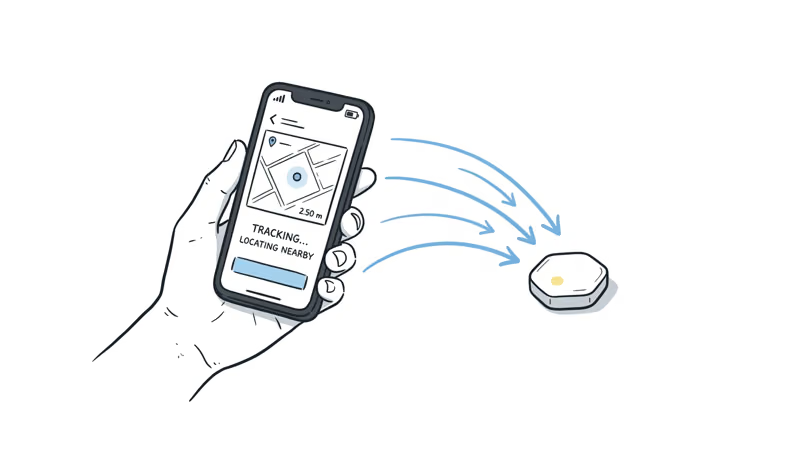
On a UWB-equipped Pixel, the Moto Tag’s precision finding activates once you are within Bluetooth range and draws an on-screen arrow that points toward the tag. The experience mirrors Apple’s Precision Finding on an AirTag: the arrow tightens as you close the gap, which makes short-range pinpointing inside a room far quicker than blind proximity beeping. That parity with AirTag-style UWB is the bar most Android trackers aim for.
The SmartTag 2’s UWB works best on Samsung Galaxy phones with UWB hardware (Galaxy S24 Ultra, S25 Ultra, Z Fold series). Android Authority’s investigation describes third-party tags falling back to a reduced, community-dubbed UWB Lite mode on Galaxy phones, with full precision reserved for Samsung’s own tags.
Since the SmartTag 2 only works with Samsung phones anyway, this restriction doesn’t eliminate potential buyers. But it means the SmartTag 2’s UWB on compatible Galaxy phones is optimized in ways the Moto Tag can’t match on that same hardware.
For non-Samsung Android users, the Moto Tag is the only UWB option in this matchup.
Form Factor and Mounting
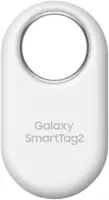
The two trackers take different physical approaches. The Moto Tag is a 7.5 g coin at 31.9 mm across — about the size of an American nickel and small enough to disappear inside a wallet card slot. The SmartTag 2 is a 13.75 g pill with a built-in keyring loop on one end. The SmartTag is almost double the weight, but the loop saves you the $10 case purchase the Moto Tag effectively requires.
For backpacks, dog collars, and luggage where weight matters less than attachment durability, the SmartTag 2’s loop is the more practical design. For wallet card slots, slim pockets, or sewn-in luggage liner pouches, the Moto Tag’s coin shape is the better fit.
≡ Size comparison
True-scale shape, side, and carry setup
Published millimetre dimensions stay visible while the models share one scale. Use Compare 3D for synchronized rotation, or Inspect 3D for one device, finish, and accessory.
Phone network first. Google Find Hub, Samsung SmartThings Find do not cross-register these trackers.
Exterior envelope only. Dimensions are source-backed. Surfaces are procedural reconstructions, not manufacturer CAD.
Motorola Moto Tag 2
31.9 W ×31.9 H ×8.0 D mm
8.5 g · Accessory required for keys or straps
Samsung Galaxy SmartTag2
28.8 W ×52.44 H ×8.0 D mm
13.75 g · Integrated metal-lined opening
Exact published specs continue in the table below.
Drag to rotate · click a product to select · published dimensions remain below
Selected product
Motorola Moto Tag 2
Its published outer envelope matches AirTag 2, but button, seams, and holder tolerances make cases non-interchangeable.
- Published size
- 31.9 × 31.9 × 8.0 mm
- Weight
- 8.5 g
- Network
- Google Find Hub
- Surface cues
- Stepped matte shell, front button and pinhole, rear rotating battery cover, and rear buzzer opening.
Selected product
Samsung Galaxy SmartTag2
The body is narrower but much taller; the built-in opening can avoid the extra bulk of a basic holder.
- Published size
- 28.8 × 52.44 × 8.0 mm
- Weight
- 13.75 g
- Network
- Samsung SmartThings Find
- Surface cues
- Rounded loop body, metal-lined opening, front button, rear speaker opening, and pull-out battery-tray cue.
One device, one setup
Pick the product first. Finish and carry options only apply to that model.
Measured view is ready. Compare 3D and Inspect 3D load the interactive reconstruction on demand.
3D unavailable. Continue with the published dimensions below. Verified device links remain in the purchase region.
SmartThings vs Find Hub: Ecosystem and Smart Home Features
The SmartTag 2 doubles as a SmartThings smart home trigger. Program the button to control lights, lock doors, or activate scenes through Samsung’s SmartThings ecosystem. Press once to toggle a light, press twice to run a routine.
The Moto Tag has no smart home integration. Its button triggers the phone’s ringer for reverse finding, and that’s it.
If you already live in Samsung’s smart home ecosystem with SmartThings hubs and sensors, the SmartTag 2 slots in as both a tracker and a wireless button. That dual-purpose value is hard to match.
Google Find Hub integrates with the broader Find Hub tracker ecosystem of Android devices and Nest products. The advantage here is cross-brand compatibility. A Moto Tag lost near someone’s Pixel, Samsung, or OnePlus phone can still report its location. The SmartTag 2 can only report through Samsung devices.
Samsung-only households get more from the SmartTag 2. Mixed-brand households get more from the Moto Tag.
Bottom Line
For most Android users, the Moto Tag is the right call. It works across all Android phones, offers reliable UWB precision finding, and costs $29 for a single unit. Samsung Galaxy owners have a harder choice: the SmartTag 2’s longer battery life, default-on network, and smart home triggers make it the stronger tracker on Samsung hardware specifically.
If you’re weighing either tracker against Apple’s ecosystem, our AirTag vs SmartTag comparison and Find Hub vs Find My breakdown cover those angles.
One note for anyone considering the Moto Tag: Motorola announced the Moto Tag 2 at CES 2026 in January and shipped it in Q2 2026; its June 2026 U.S. launch set pricing at $29.99. The current US page confirms Bluetooth 6.0 with Channel Sounding, an IP68 rating, and more than 600 days of battery life. The chassis and lack of a keychain hole carry over from the original.
If you’re deciding whether to upgrade, our Moto Tag 2 upgrade comparison breaks down what changes from the original Motorola tag.
FAQ
Does the Moto Tag work with Samsung phones?
Yes. The Moto Tag uses Google Find Hub, which supports all Android 9+ devices including Samsung Galaxy phones. Samsung owners can use either the Moto Tag or the SmartTag 2, though the SmartTag 2 benefits from Samsung’s optimized UWB and SmartThings Find relays that run everywhere by default on Galaxy hardware.
Should I compare Moto Tag 2 or the original Moto Tag against Samsung SmartTag 2?
If you are buying new in 2026, compare the Moto Tag 2 against Samsung SmartTag 2 first. Moto Tag 2 keeps the Google Find Hub and non-Samsung Android advantage while improving battery life and durability. The original Moto Tag is still worth considering only if the lower street price matters more than the newer hardware.
Can the Samsung SmartTag 2 work with non-Samsung Android phones?
No. The SmartTag 2 requires a Samsung Galaxy phone with the SmartThings app. Pixel, OnePlus, Xiaomi, and other Android phone owners can’t set up or track a SmartTag 2. If you don’t have a Samsung phone, the Moto Tag is the UWB tracker to consider.
Which has better battery life, the Moto Tag or SmartTag 2?
The SmartTag 2 wins on battery life. Samsung rates it at approximately 500 days in normal mode and up to 700 days in power saving mode. The Moto Tag is rated at around 365 days. Both use the same CR2032 coin cell battery, so the difference comes from Samsung’s more efficient firmware and less aggressive network pinging.
Does the Moto Tag have UWB precision finding?
Yes. The Moto Tag includes an Ultra-Wideband chip that provides directional arrows on-screen when you are within Bluetooth range. It works with UWB-equipped Android phones like the Pixel 8 Pro and Pixel 9 Pro. That makes it the non-Samsung option for directional finding inside Google’s Find Hub ecosystem.
What is the range of the Moto Tag vs SmartTag 2?
Both trackers depend on short-range Bluetooth first, then on their crowd-sourced networks once they’re out of direct range. Walls, bags, and cars reduce Bluetooth reach, so the practical difference depends more on nearby relay phones than on a single open-air range number. Our range comparison guide covers the broader range trade-offs across multiple trackers.
Is the Moto Tag being discontinued now that the Moto Tag 2 is out?
No. Motorola has not announced plans to discontinue the original Moto Tag. The Moto Tag 2, released in Q2 2026, is positioned as an upgrade with Bluetooth 6.0 Channel Sounding, IP68 water resistance, and more than 600 days of rated battery life. The original Moto Tag remains available at $20-25 street price and continues receiving Google Find Hub network support.
Can the SmartTag 2 work without a Samsung account?
No. Setting up the SmartTag 2 requires both a Samsung account and the SmartThings app on a Samsung Galaxy phone. You can’t bypass the Samsung account requirement. The tracker is tightly integrated into Samsung’s ecosystem, which enables its smart home features but limits its usability to Samsung device owners.