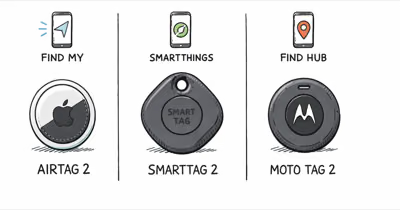
The Moto Tag is Motorola’s first Bluetooth tracker and the first non-Samsung device to support UWB on Google’s Find My Device network.
This review weighs whether it actually delivers on that promise for non-Samsung Android users.
- UWB precision finding works — directional arrow within 10 meters on supported Pixel and Samsung phones
- Widest Android compatibility — pairs with any Android 9+ device, not locked to one brand
- Battery lasts about a year — standard CR2032 coin cell, replaceable in 30 seconds
- No keychain hole — you need a $10 case to attach it to anything
- Find Hub network is opt-in — crowd-sourced tracking slower than Apple’s passive Find My
Motorola Moto Tag: Complete Buying Summary
The Moto Tag is a coin-shaped Bluetooth tracker that works with Google’s Find My Device network (now called Find Hub). Motorola launched it in August 2024 at $29.99. Street price has since dropped to around $20 at most retailers, making it one of the cheapest UWB-equipped trackers you can buy today.
§ Review summary
Motorola Moto Tag
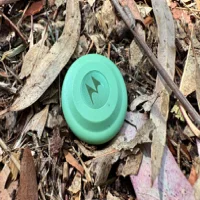
≡ Specs
- Dimensions
- 31.9mm diameter × 8.0mm thick
- Weight
- 7.5g
- Connectivity
- Bluetooth 5.4 and UWB
- Battery
- Replaceable CR2032; about 365 days stated
- Water resistance
- IP67
- Network
- Google Find Hub; Android 9+
- Colors
- Starlight Blue and Jade Green
- Attachment
- Accessory case required
- Subscription
- None
✓ Pros
- +UWB directional finding works on supported Android phones
- +Google Find Hub supports Android 9+ across phone brands
- +Replaceable CR2032 battery avoids charging downtime
- +IP67 body handles rain, splashes and brief immersion
- +AirTag-sized body fits many existing accessory cases
✗ Cons
- −No built-in keychain hole, so most uses require a case
- −Find Hub recovery can lag behind Apple's denser Find My network
- −UWB support depends on a compatible certified phone
- −Stated 365-day battery trails newer Moto Tag 2 hardware
- −iPhone users can't pair with or manage the tracker
§ Buy if
- ·Buy when a non-Samsung Android phone needs UWB direction
- ·Buy only when original Moto Tag stock is meaningfully discounted
- ·Choose SmartTag 2 for deeper Galaxy and SmartThings integration
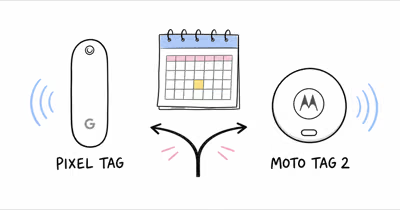
- ·Choose Moto Tag 2 for the newer battery and water-resistance package
At 7.5 grams, the Moto Tag is lighter than both the Apple AirTag (11 g) and the Samsung SmartTag 2 (13.75 g). The disc shape matches the AirTag form factor, which means existing AirTag accessory cases fit the Moto Tag without modification.
How Does Precision Finding Work on the Moto Tag?
UWB (Ultra-Wideband) is the technology that turns a Bluetooth tracker from “somewhere nearby” into “three steps to your left.”
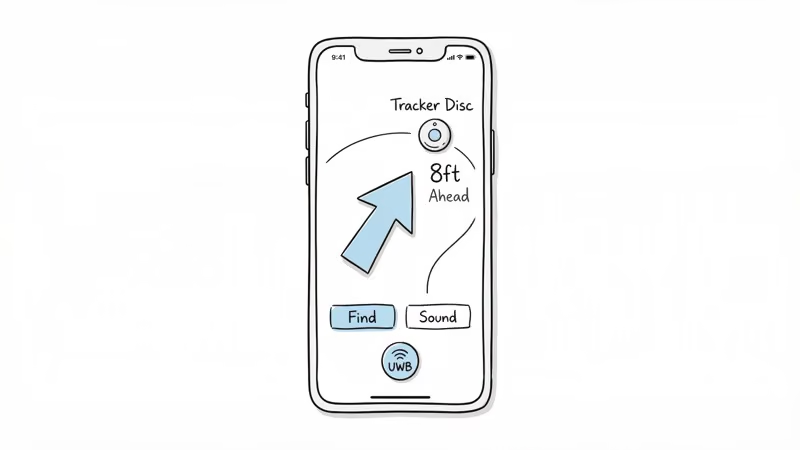 The Moto Tag includes a UWB chip that communicates with compatible phones to provide directional guidance when you are within about 10 meters of the tracker.
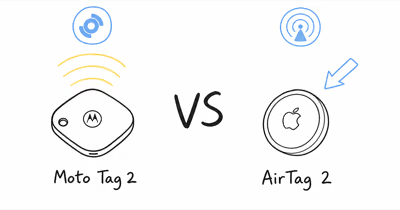
On a supported phone, precision finding gives a directional arrow that guides you to the tag within the last few meters, much like Apple’s Precision Finding on an AirTag.
There’s a catch: your phone needs UWB hardware, and not every UWB-equipped phone is certified for Moto Tag precision finding — it works on select recent Pixel, Galaxy, and other flagship models. On phones without UWB support, you get Bluetooth proximity only. It still works, but you lose the directional arrow and distance estimate.
Google initially shipped the Find Hub network without UWB precision enabled. According to Google, the UWB precision feature rolled out in late 2024 through a software update that added support for a set of compatible Android phones, and the certified list has grown since. Pocket-lint’s review confirms that the UWB experience, once active, is on par with what Samsung offers on Galaxy phones.
Design and Build Quality
PCMag’s hands-on review rated build quality at 4 out of 5, and the matte plastic housing is made to resist visible wear from daily carry.
The IP67 rating is real protection: rain, splashes, and a brief drop in water are no problem for the housing.
The biggest design flaw is the missing keychain hole. Apple’s AirTag has the same problem, but Motorola could have differentiated here and didn’t. You’ll need a third-party case or adhesive mount to attach it to anything. The silver lining: AirTag-compatible cases fit because the dimensions are nearly identical.
Battery replacement is a quick twist-off, swap, twist-on with the CR2032. The cover can be stiff to grip at first; a rubber jar opener or grip pad can help loosen it.
Colors: Starlight Blue and Jade Green.
Battery Life and Maintenance
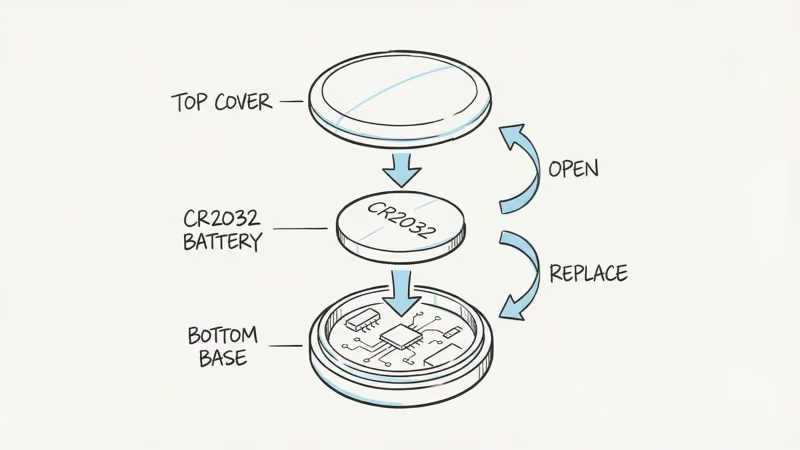
Motorola rates the Moto Tag at roughly 365 days on a single CR2032. Treat that as a manufacturer estimate: cold weather, frequent ringing, and heavy relay activity can shorten any coin-cell tracker.
A CR2032 costs about $1.50 at any pharmacy. That’s the total annual maintenance cost.
Rechargeable trackers like the Chipolo Pop need USB-C charging every few months. If you’re deciding between the two, our Moto Tag vs Chipolo Pop head-to-head covers the key trade-offs. The Moto Tag’s replaceable cell trades that recurring hassle for a once-a-year 30-second swap.
Samsung’s SmartTag 2 claims 500 days on the same cell. Our battery life comparison across 12 trackers points to Samsung’s more efficient power management as the main reason for the longer rating.
How Does the Find Hub Network Compare?
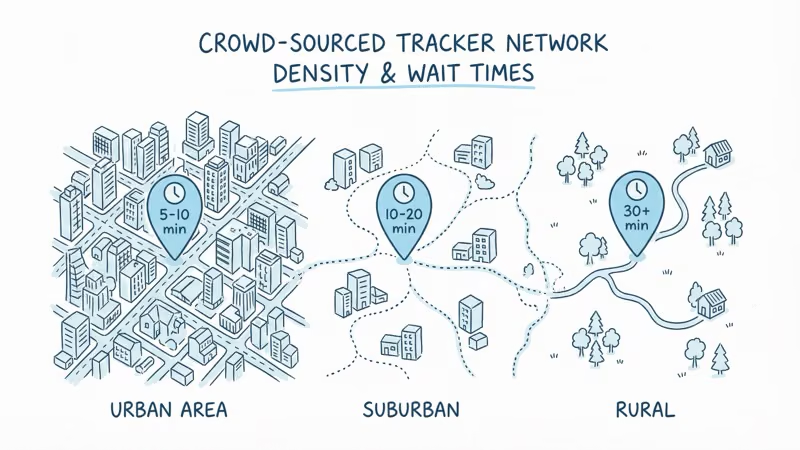
This is where the Moto Tag’s biggest limitation surfaces.
Google’s Find Hub network relies on Android users actively opting in to share their location for crowd-sourced tracking. Apple’s Find My network works differently: it’s opt-out by default, meaning over a billion iPhones participate without their owners lifting a finger.
The speed difference is measurable. As documented in How-To Geek’s comparative testing, the Moto Tag can take 15 minutes or more to report its location after separation, while an AirTag reports almost instantly.
The pattern is network-density driven: dense areas with many Android phones report sooner, while suburbs and rural areas can lag when fewer relay devices pass nearby.
More Android phones nearby means faster finds. Rural areas expose the network’s biggest weakness.
An AirTag has the structural network advantage here because Apple’s Find My relay is denser and opt-out by default.
The good news: Google is expanding quickly. As noted in the Find Hub vs Find My ecosystem comparison, Google and OEM partners are expanding Find Hub availability and participation across the Android base.
The density gap is closing, but it remains the Moto Tag’s most significant disadvantage today.
Anti-stalking protections are built in. Apple’s tracker detection documentation confirms that the cross-platform unwanted tracking standard works in both directions.
Who Should Buy the Moto Tag
The Moto Tag makes sense for one specific audience: non-Samsung Android users who want UWB. If you own a Pixel, OnePlus, Motorola, or any other Android phone and want directional precision finding, this is your only option right now. Samsung’s SmartTag 2 locks its UWB features to Galaxy devices, and the broader Google Find Hub tracker ecosystem is still small.
Samsung Galaxy owners should get the SmartTag 2 instead. Better battery life (500 days vs 365), a built-in keychain loop, and deeper SmartThings integration.
Also skip it if you need the most reliable crowd-sourced network today. Apple’s Find My still covers more ground, and for high-value items like luggage on international trips, that network density difference matters. Check our dual-network tracker guide for alternatives that work across both ecosystems.
At $20 street price, the Moto Tag is worth trying for Android users who want to test the Find Hub ecosystem without a big investment. The 4-pack at $100 brings the per-unit cost to $25.
Bottom Line
The Motorola Moto Tag is a solid first-generation tracker that fills a real gap for non-Samsung Android users. UWB precision finding is the reason to buy it when your phone supports it, the CR2032 battery is rated around a year, and at $20 street price you’re not risking much to try it. The Find Hub network remains the weak link, but it’s improving with every Android update.
If you want the latest hardware instead, the Motorola Moto Tag 2 is now available with Bluetooth 6.0 Channel Sounding, an IP68 rating, and more than 600 days of battery life at $29.99 since its June 2026 U.S. launch. At that price the original’s value edge has mostly disappeared unless you find gen-1 stock discounted below $20.
FAQ
Does the Moto Tag work with Samsung phones?
Yes. The Moto Tag pairs with any Android 9+ device, including Samsung Galaxy phones. However, Samsung users get better integration with the SmartTag 2, which ties into the SmartThings app and Samsung’s own tracker network.
Can iPhones detect a Moto Tag?
iPhones can detect a Moto Tag as an unknown tracker for anti-stalking purposes. They can’t pair with, locate, or manage one. The Moto Tag only works with Android devices.
How loud is the Moto Tag speaker?
The built-in speaker is audible in a quiet room but easy to miss in noisy environments. It’s noticeably quieter than the AirTag’s speaker. For finding items in crowded or loud settings, rely on UWB directional guidance instead of sound.
Is the Moto Tag waterproof?
It carries an IP67 rating, handling submersion in up to 1 meter of water for 30 minutes. It survives rain, splashes, and brief drops in water. It’s not rated for swimming or prolonged underwater exposure.
What is the difference between the Moto Tag and Moto Tag 2?
The Moto Tag 2 released in Q2 2026 as the successor to the original Moto Tag. It upgrades to Bluetooth 6.0 with Channel Sounding, IP68 water resistance, and more than 600 days of rated battery life. The original Moto Tag uses Bluetooth 5.4, IP67, and a 365-day battery. The Moto Tag 2 launched in the U.S. at $29.99 in June 2026, matching the original’s $29.99 launch MSRP.
Does the Moto Tag have a keychain hole?
No. The Moto Tag has no built-in attachment point. You need a third-party case or adhesive mount. AirTag-compatible accessories fit the Moto Tag because the two devices share nearly identical dimensions.
How does the Moto Tag find lost items without GPS?
The Moto Tag uses Bluetooth and the Google Find Hub crowd-sourced network. When your tag is out of Bluetooth range, nearby Android phones with Find Hub enabled anonymously relay its location to you. This works similarly to Apple’s Find My network but requires Android users to opt in.