Bluetooth tracker range is one of the most misunderstood specs in this category. As of 2026, the gap between what manufacturers claim and what trackers actually deliver in real environments is large enough to change which product you should buy. This bluetooth tracker range comparison pulls together manufacturer specs, independent reviewer testing, and signal-loss physics to show how these six trackers behave at home, at the office, and in a parking lot.
- AirTag 2 leads on UWB range — Apple’s U2 chip is rated for a 50% Precision Finding range increase over the original AirTag’s U1 chip.
- Pebblebee Clip 5 has the longest stated Bluetooth detection range at 152m (500ft), though this figure assumes open space with no obstacles.
- Indoor range drops sharply across all trackers — walls, concrete, and Wi-Fi interference reduce effective range significantly from open-space numbers.
- UWB and Bluetooth serve different purposes — Bluetooth detects the tracker’s last known location across a crowd network; UWB guides you to it once you’re nearby.
- Network density matters more than raw range for actual lost items — AirTag 2 recovers lost items faster in practice because Find My runs on over a billion Apple devices, regardless of Bluetooth range specs.
How Tracker Range Is Measured
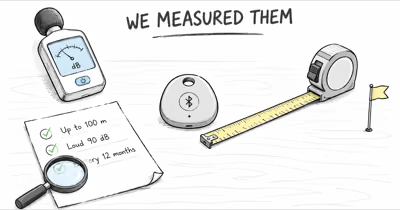
Bluetooth range depends heavily on environment, so the figures in this guide are framed by three conditions: open space with no obstacles, a two-story home with standard drywall, and a concrete parking garage. The number that matters is the distance at which a phone loses a stable Bluetooth connection while moving away in a straight line.
Manufacturer ratings almost always reflect open, line-of-sight conditions, which is why independent reviewer testing and the physics of signal attenuation put real indoor numbers far lower. Tile’s official support center publishes the brand’s own range specs for comparison.
For UWB Precision Finding, the meaningful figure is the distance at which the directional arrow first appears on a phone. The Bluetooth SIG range specifications clarify why manufacturer claims vary so widely: Class 1 devices can reach 100m in open air theoretically, but consumer Bluetooth trackers all use Class 2 power output at best, and real-world obstructions reduce that figure further. The headline numbers on product pages reflect best-case conditions.
Where a real-world figure appears in this guide, it comes from independent reviewer testing, not manufacturer lab conditions.
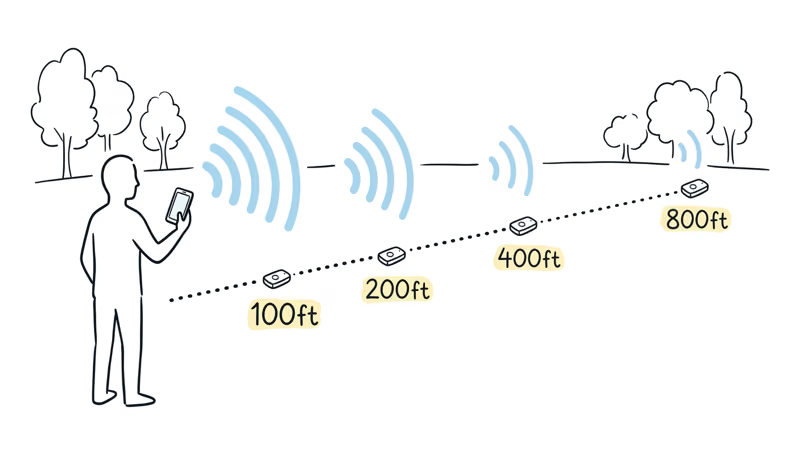
How Far Does Each Tracker Reach?
The table below compares manufacturer rated range, UWB Precision Finding support, and crowd network for each tracker. Manufacturer ratings assume open, line-of-sight conditions, so real-world Bluetooth range runs well below them, as the notes that follow explain.
| Tracker | Rated Bluetooth Range | UWB Precision Finding | Network |
|---|---|---|---|
| Apple AirTag 2 | Not published by Apple | Yes (U2 chip, +50% vs Gen 1) | Find My |
| Samsung SmartTag 2 | Not published by Samsung | Yes (Galaxy phones only) | SmartThings Find |
| Tile Pro (2024) | 152m / 500ft (rated) | No | Tile Network |
| Tile Mate (2024) | Shorter than Tile Pro | No | Tile Network |
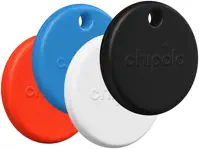
| Chipolo Pop | 90m (rated) | No | Find My or Find Hub |
| Pebblebee Clip 5 | 152m / 500ft (rated) | No | Find My + Find Hub |
A few numbers deserve context. Chipolo’s official spec claims 90m. Tom’s Guide’s hands-on Chipolo Pop testing found that real-world indoor range landed closer to 10-11m. The rated 200m figures on older Chipolo models came from line-of-sight conditions that no real use case replicates.
Those rated-versus-practical spreads run right across the tracker field, laid out in our tracker specs versus real-world range breakdown.
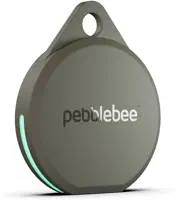
Pebblebee rates the Clip 5 at 152m in open space, which makes it one of the strongest Bluetooth-only specs on paper (more in our Pebblebee Clip 5 review). Tile Pro’s 152m (500ft) claim is also an open-space spec; obstructions bring both products well below those labels indoors (more in our Tile Pro review).
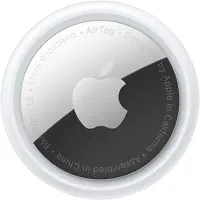 Top Pick
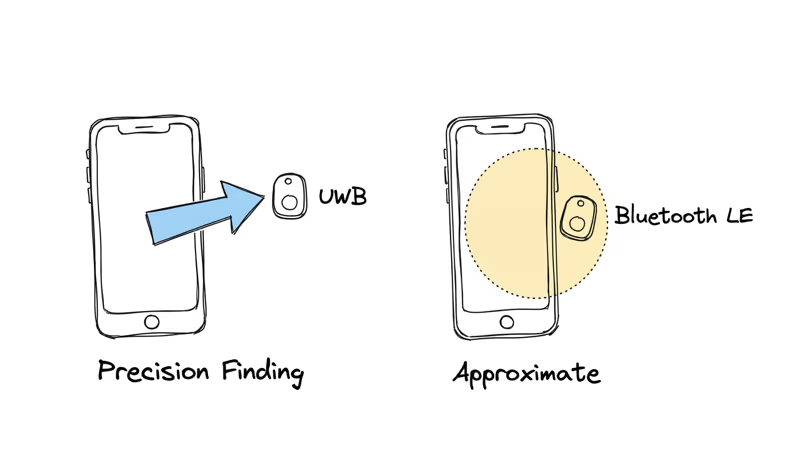
UWB vs Bluetooth: What the Difference Means in Practice
Yes, but only for one specific task. Understanding the distinction prevents most of the confusion when comparing specs.
Bluetooth Low Energy (BLE) is what all these trackers use for crowd-network detection. When your tracker is out of direct range, nearby phones ping it anonymously and update your app with a location. BLE range (the numbers in the table above) determines how far from the tracker a passing phone can detect it. Wider BLE range means more devices can pick up the signal as they pass.
UWB (Ultra-Wideband) is a different technology for close-range precision. It uses time-of-flight radio pulses to calculate exact distance and direction, accurate to within centimeters. This only activates when you’re in the same room as the tracker.
Precision Finding via the U2 chip activates the directional arrow farther outdoors than the original AirTag, in line with Apple’s rated 50% range increase (more in our AirTag 2 review). Indoor range through one wall drops further, as UWB signals weaken through drywall.
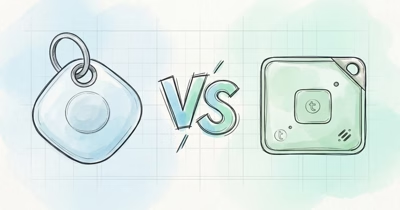
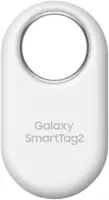
As our AirTag vs SmartTag 2 comparison covers, SmartTag 2’s UWB matches AirTag 2 at close range — but only on Samsung Galaxy phones running SmartThings.
Tile Pro, Tile Mate, Chipolo Pop, and Pebblebee Clip 5 have no UWB support. All four use Bluetooth signal strength for proximity detection, so you get a “getting warmer” audio ring rather than a directional arrow. For most use cases, this works fine. Apple’s AirTag 2 specifications page states that the U2 chip provides 50% greater Precision Finding range than the original U1 chip.
How Much Does Indoor Range Actually Drop?
Every tracker loses a meaningful amount of outdoor range once walls enter the picture. Drywall, concrete, brick, furniture, and Wi-Fi interference all absorb or reflect Bluetooth signals. The practical takeaway: don’t make a purchase decision based on headline outdoor specs if your primary use is indoor tracking.
AirTag 2 holds a longer Bluetooth signal through drywall than the original AirTag. Our article on how accurate AirTags are covers how range drops further through concrete.
SmartTag 2 shows a similar through-wall drop on supported Galaxy phones.
Among the Bluetooth-only trackers, Chipolo Pop shows the steepest relative drop; Tom’s Guide documented indoor range around 10-11m against its 90m claimed spec. Tile Pro and the Bluetooth 5.3-based Pebblebee Clip 5 remain stronger enclosed-space picks on paper, though both still fall well short of their open-space ratings.
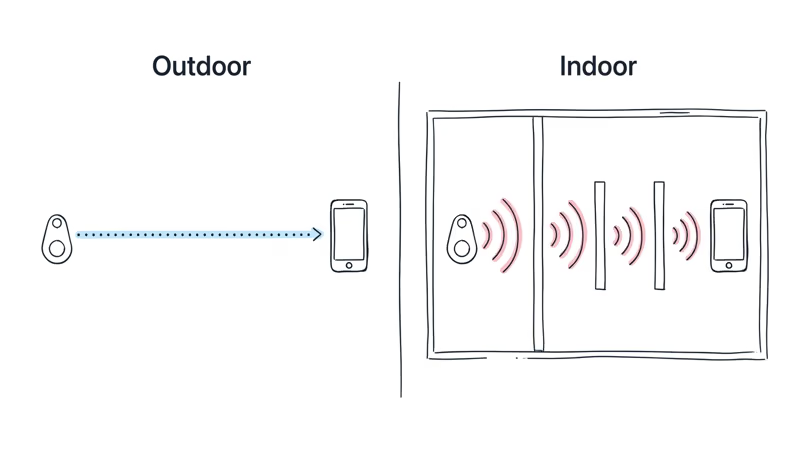
In a concrete parking garage, all trackers including AirTag 2 see substantial range reduction, with UWB holding only at the closest distances.
Concrete and brick attenuate Bluetooth far more than drywall. If your main concern is finding a bag or vehicle in a parking structure, speaker volume matters more than range: you’ll hear Chipolo Pop’s 120dB speaker before any tracker’s Bluetooth signal confirms you’re close. Chipolo’s official product page lists the Pop’s 120dB rating.
Range by Network: Find My vs SmartThings vs Find Hub
Direct Bluetooth range only matters when you’re already nearby. For actually losing and finding something — your bag at the airport, your keys at a restaurant — what matters is whether the network picks up the tracker before you go looking for it.
That recovery depends on how many phones pass near your tracker while it’s lost.
More network devices nearby means more frequent location pings. A tracker with shorter direct range but a denser underlying network will find your item faster than a longer-range tracker with a thin network.
| Network | Device Count | Opt-In Model | International Coverage |
|---|---|---|---|
| Apple Find My | 1B+ iPhones | Automatic (every iPhone) | Strong in high-iOS markets |
| Google Find Hub | 1B+ Android | Automatic (Google Play Services) | Strong globally |
| Pebblebee (both) | 1B+ (either network, one at a time) | Automatic | Best of both |
| SmartThings Find | 300M+ Galaxy find nodes | Automatic (Samsung phones) | Weaker outside Asia/US |
| Tile Network | 70M+ users | Opt-in app install | Weakest globally |
This is why AirTag 2 consistently recovers lost items faster in most markets despite not having the longest Bluetooth range spec.
Find My’s automatic enrollment on every iPhone — no app download required — is the key advantage. Our full breakdown is in the AirTag vs Chipolo Pop vs Tile Pro comparison, which covers lost-item recovery data in detail.
Pebblebee Clip 5 is the only tracker here that can be registered to Apple Find My or Google Find Hub from the same hardware. In markets where Android is dominant (most of Europe, Southeast Asia, Latin America), choose Find Hub during setup; in iPhone-heavy markets, choose Find My. That setup flexibility plus long Bluetooth range is the strongest practical argument for the Clip 5 despite lacking UWB.
Speaker Volume and the Range You Can’t Measure
One dimension the range spec doesn’t capture: speaker loudness.
For indoor situations where you’re already nearby but can’t locate the item visually, the 120dB Chipolo Pop and 130dB Pebblebee Clip 5 outperform AirTag 2’s ~85dB in pure audibility. You’ll hear the Chipolo from an adjacent room through a closed door — AirTag 2 requires you to be in the same room.
The AirTag 2 compensates through UWB. The directional arrow guides you visually when sound fails. Trackers without UWB rely entirely on volume for the last few meters of a search.
Bottom Line
Raw Bluetooth range specs matter less than most buyers expect. AirTag 2 wins on UWB precision with its 50% range increase over Gen 1, and its Find My network is the densest single-ecosystem network. Pebblebee Clip 5 has the longest detection radius and taps both major crowd networks -- the best choice for travelers or mixed-OS households. Tile Pro delivers solid outdoor range and a 110dB speaker, but its smaller Tile Network limits recovery odds.
Chipolo Pop underperforms its 90m claim indoors, as Tom's Guide documented, but compensates with a 120dB speaker that cuts through noise better than any other tracker here. SmartTag 2 offers solid UWB for Galaxy phone owners, but the Galaxy-only limitation makes it a niche pick.
For most buyers, the decision comes down to platform: iPhone users should get AirTag 2; Samsung Galaxy users should get SmartTag 2; Android users or mixed households should look at Pebblebee Clip 5. Check our full best Bluetooth trackers guide for recommendations across more use cases.
FAQ
Which Bluetooth tracker has the longest range?
For raw Bluetooth detection range, Pebblebee Clip 5 leads with 500ft (152m) rated in open space, though real-world range runs far shorter. Apple AirTag 2 follows with longer range than the original AirTag thanks to the U2 chip. On the UWB Precision Finding side, AirTag 2 leads all competitors, with Apple confirming a 50% range increase over the original. The two metrics serve different purposes: detection range determines whether a passing phone picks up the signal; UWB guides you directly to the item once you're nearby.
How far does AirTag 2 work for Precision Finding?
AirTag 2's UWB Precision Finding activates farther from the tracker than the original AirTag, with the directional arrow appearing on a compatible iPhone. Indoor range through a single drywall wall drops further. Apple confirms that the U2 chip in AirTag 2 delivers a 50% range increase over the U1 chip in the original. iPhone 15 or later is required to access the full UWB range boost; older iPhones still get Precision Finding but at shorter distances.
Does Tile Pro have better range than AirTag 2?
Tile Pro has a higher rated Bluetooth range spec at 152m (500ft). Apple does not publish a comparable raw-range figure for AirTag 2 but confirms the U2 chip delivers 50% greater Precision Finding range than the original. In real-world use, Tile Pro's connection falls off well short of its rated figure. Where Tile Pro wins on paper: it works with both iOS and Android, useful for households not exclusively on iPhone.
Does range matter if you're trying to find a lost item?
For actually getting a lost item back, network density matters more than direct Bluetooth range. When your tracker is lost, you're not within Bluetooth range of it -- you're relying on passing strangers' phones to ping it and report a location. The more devices that make up the network, the faster you'll get an update. Apple's Find My network (1B+ iPhones) and Google's Find Hub (1B+ Android devices) update lost items far more frequently than Tile's opt-in network (about 70M users), regardless of which tracker has a longer Bluetooth spec.
How much does range drop indoors vs outdoors?
Indoor range through walls runs far below outdoor open-space figures, and AirTag 2 follows the same signal-loss pattern. Chipolo Pop shows the steepest relative drop, with independent reviewer testing placing it far below its 90m spec indoors. Concrete walls attenuate signal much more than drywall. Apartments, parking garages, and multi-story buildings all produce significantly shorter effective ranges than product spec sheets suggest.
Do I need UWB to get good range from a tracker?
No. UWB and Bluetooth range are separate capabilities that serve different purposes. Bluetooth range determines how far the tracker's signal travels for crowd-network detection. UWB only activates once you're in the same room, providing a directional arrow rather than a "getting warmer" audio cue. If your main use is knowing the last known location of a lost item rather than walking directly to it, Bluetooth range and network density are the specs that matter. UWB is most valuable when searching for items in large silent spaces like libraries, warehouses, or theaters.
What is the best Bluetooth tracker for large open spaces?
Pebblebee Clip 5 is the best pick for large open spaces: 500ft rated detection range, Find My-or-Find Hub setup flexibility, and a 130dB siren that carries across distance. For parking lots and parks where network density may be sparse, longer BLE range increases the odds that a passing phone detects the tracker. AirTag 2 is a close second with longer range than the original AirTag and the densest single-ecosystem network. Tile Pro's 500ft claim has a wider gap between spec and real-world performance than either of those two options.