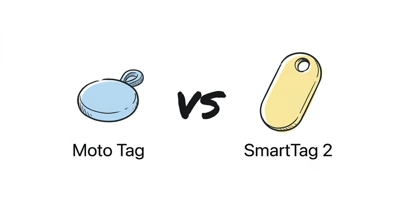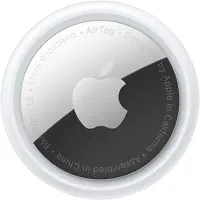
Buy AirTag 2 for iPhone, SmartTag 2 for Galaxy, and Moto Tag 2 for Pixel or Android. Each tag locks to one network, so your phone decides the winner.
These three flagship coin trackers all use Ultra Wideband precision finding, but each one pairs to a single, incompatible network. Apple’s January 2026 newsroom states the new AirTag’s second-generation Ultra Wideband chip reaches “up to 50 percent farther away than the previous generation,” which is the kind of platform-locked upgrade that makes this a phone-first decision rather than a spec-sheet race.
- Your phone picks the tag: AirTag 2 is Find My only, SmartTag 2 is SmartThings Find only, Moto Tag 2 is Google Find Hub only
- Prices converged in June 2026: AirTag 2 $29, SmartTag 2 $30, and Moto Tag 2 $29.99 after its U.S. launch price cut
- Battery runs 12 to 500 days: AirTag 2 rates 12+ months, SmartTag 2 hits 700 days, Moto Tag 2 hits 500 days
- All three carry UWB precision finding: AirTag 2 and Moto Tag 2 add second-gen radios, SmartTag 2 needs a UWB Galaxy phone
- Water resistance splits at IP67 vs IP68: AirTag 2 and SmartTag 2 are IP67, Moto Tag 2 steps up to IP68
AirTag 2 vs SmartTag 2 vs Moto Tag 2: Spec Comparison
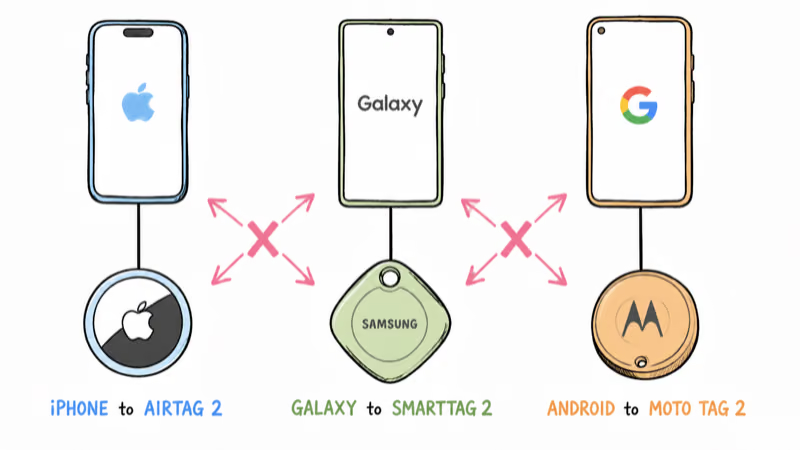
The three pucks are close in size and identical in coin-cell design, but the network row is the one that decides everything. According to Samsung’s SmartTag 2 newsroom, the tag’s battery “now lasts up to 700 days,” and its UWB Compass View only works on a UWB-supported Galaxy phone such as the Galaxy S23 Ultra.
Each tag registers only on its native phone, and none will pair, ring, or report location on a rival ecosystem. The only cross-platform signal is an unknown-tracker alert, which lets a rival phone detect and disable a tag but never claim it.
| Spec | AirTag 2 | SmartTag 2 | Moto Tag 2 |
|---|---|---|---|
| Price (single) | $29 | $30 | $29.99 (U.S. launch) |
| Price (4-pack) | $99 | $100 | $69.99 |
| Network | Apple Find My | SmartThings Find | Google Find Hub |
| Precision radio | Second-gen U2 UWB | UWB (Galaxy phones) | UWB + Bluetooth 6.0 Channel Sounding |
| Companion watch | Apple Watch Series 9 / Ultra 2+ | Galaxy Watch (via app) | Pixel Watch (via Find Hub) |
| Battery | CR2032, 12+ months | CR2032, ~700 days | CR2032, ~500 days |
| Water resistance | IP67 (1m, 30 min) | IP67 (1m, 30 min) | IP68 (1.5m, 30 min) |
| Weight | ~11g | 13.75g | Coin puck |
| Subscription | None | None | None |
The network row hides the whole buying decision. A SmartTag 2 is useless to an iPhone owner and an AirTag 2 is dead weight to a Pixel owner, because none of these tags cross networks. The only practical workaround for a household that spans Apple and Android is a dual-network tag, which we cover in our best dual-network trackers guide.
AirTag 2 vs SmartTag 2 vs Moto Tag 2: Head-to-Head
⇄ Head-to-head
Apple AirTag 2 vs Samsung SmartTag 2 vs Motorola Moto Tag 2
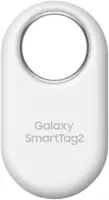
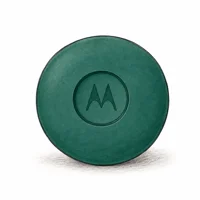
- +Second-generation U2 chip extends Precision Finding up to 50% farther than the original AirTag
- +Apple Watch Precision Finding on Series 9 and Ultra 2 or newer
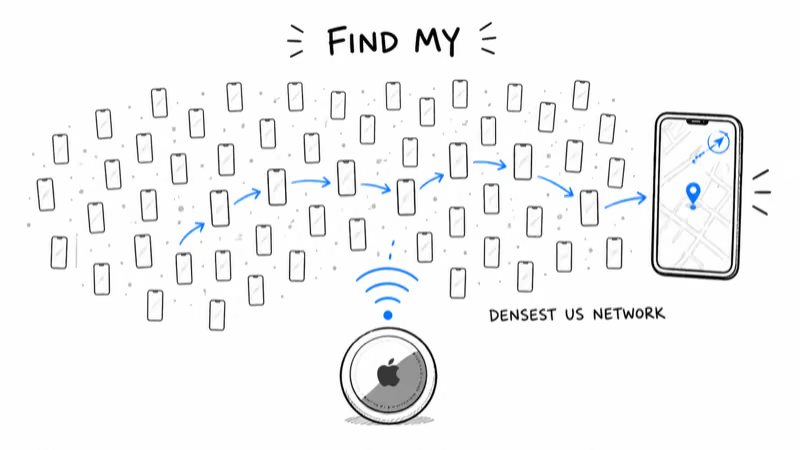
- +Find My spans over a billion Apple devices, the densest tracker network in the US
- +Cheapest single tag at $29 and the best per-tag price via the $99 4-pack
- +Share Item Location works with 50+ airlines for lost-luggage recovery
- +700-day battery is the longest CR2032 cycle of the three flagships
- +UWB Compass View points an arrow straight to the item on a Galaxy phone
- +Built-in keyring loop means no extra holder to buy
- +SmartThings Find covers hundreds of millions of Galaxy devices worldwide
- +IP67 water resistance plus a rugged ring-style body
- +First tracker to ship Bluetooth 6.0 Channel Sounding for sub-meter precision
- +500-day CR2032 cycle, far longer than the AirTag 2's 12-month rating
- +IP68 water resistance survives 1.5 meters submerged for 30 minutes
- +Google Find Hub works across every Android 9+ phone, not just Pixel
- +Standard CR2032 coin cell costs about $1 to swap from any drugstore
- −iPhone-only; no Android or Galaxy registration or tracking
- −No built-in attachment hole; keychain holders cost $9 to $35 extra
- −UWB Precision Finding needs an iPhone 15 or newer with the U2 chip
- −IP67 rating is one tier below the Moto Tag 2's IP68
- −12-month battery rating is the shortest of the three
- −Galaxy-centric; UWB precision needs a UWB-supported Galaxy phone
- −No tracking on iPhone or non-Samsung Android in any meaningful way
- −13.75g body is the heaviest and bulkiest of the three
- −Network is thinner outside Samsung-heavy regions than Apple's Find My
- −Compass View limited to recent UWB Galaxy flagships
- −Channel Sounding only activates on Android 16 plus a supported Bluetooth 6.0 phone
- −Google Find Hub only; no Apple Find My or SmartThings pairing
- −No built-in attachment hole, same as the AirTag 2
- −4-pack list price is the highest per tag in this comparison
- −Find Hub network is younger than Apple's Find My
- ·You carry an iPhone and use Precision Finding daily
- ·You want the airline Share Item Location workflow for travel
- ·You want the lowest per-tag cost via the $99 4-pack
- ·You value the largest finding network in the United States
- ·You own a UWB-capable Galaxy phone like the S23 Ultra or newer
- ·You want the longest battery life at 700 days per coin cell
- ·You prefer a tag with a built-in keyring loop
- ·You are already inside the SmartThings ecosystem
- ·You carry a Pixel or any modern Android phone on Find Hub
- ·You want the IP68 water resistance tier for outdoor carry
- ·You want Bluetooth 6.0 Channel Sounding on a supported Android 16 phone
- ·You want a Find Hub tag that works beyond just Pixel hardware
AirTag 2: Apple’s Refreshed UWB Champion
AirTag 2 is Apple’s first hardware refresh of the puck since 2021, and it leans on the same silicon Apple ships in its newest phones. Apple’s newsroom confirms the new tag is “50 percent louder than the previous generation,” and that Precision Finding now works on Apple Watch Series 9 or later for the first time.
The headline change is the second-gen U2 chip’s longer Precision Finding range, which lets an iPhone 15 or newer pick up the direction arrow from farther across a room.
The daily-use story is network density. Apple’s Find My is the largest crowdsourced finding network in the United States, so a lost AirTag 2 pings off far more passing phones than a Galaxy or Pixel tag in most American neighborhoods. For the platform-versus-platform math, our Find Hub vs Find My breakdown covers the density tradeoffs in detail.
The trade-off is the one AirTag has always had: it’s iPhone-only. An Android user can detect a stranger’s AirTag 2 through the cross-platform anti-stalking standard, but can’t register, pair, or track one of their own. For a head-to-head against Samsung’s tag specifically, see our AirTag vs SmartTag comparison.
SmartTag 2: The Galaxy Endurance Pick
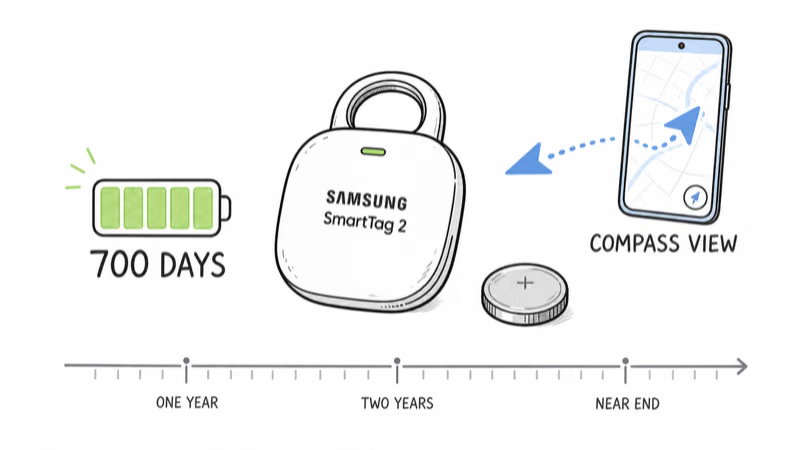
SmartTag 2 is the battery champion of this trio. Samsung’s newsroom states that its battery lasts up to 700 days per coin cell, “more than twice as long as previous Galaxy SmartTag models,” and adds an improved Compass View feature, “providing arrows to show” the direction to your item on a UWB Galaxy phone. That 700-day rating makes the SmartTag 2 the lowest-maintenance battery pick of the three on paper.
Reviewers back up the daily-use case beyond the spec sheet. Tom’s Guide’s hands-on review found that the Compass View arrow makes close-range finding faster on a UWB Galaxy phone.
The catch is the same network lock-in the other two have, pointed at Samsung. SmartTag 2 pairs only to SmartThings Find, and its UWB Compass View only fires on a UWB-supported Galaxy phone such as the Galaxy S23 Ultra. On a non-UWB Galaxy or any non-Samsung phone you lose the arrow and fall back to proximity ringing. If you’re weighing it against the Google option, our Moto Tag vs SmartTag 2 comparison covers that matchup.
Moto Tag 2: Find Hub’s Bluetooth 6.0 Flagship
Moto Tag 2 is the precision-first Android pick, and the first tracker of any brand to ship Bluetooth 6.0 Channel Sounding. The Motorola CES 2026 newsroom states the tag “includes UWB, Bluetooth Channel Sounding and is compatible with the Google Find Hub network,” and that Channel Sounding “requires a supported Bluetooth 6.0 Android phone running Android 16+.” That same page rates it at “more than 500 days of battery life,” a big jump over the AirTag 2’s 12-month figure.
What makes Moto Tag 2 the broadest Android pick is that Find Hub is not Pixel-only. It works across modern Android phones, so a Samsung owner who prefers Google’s network over SmartThings can use a Moto Tag 2 instead of a SmartTag 2. For the full carry breakdown, see our Moto Tag 2 review, and for the broader category our best Bluetooth tracker guide covers all three side by side.
Which Wins on Precision Finding?
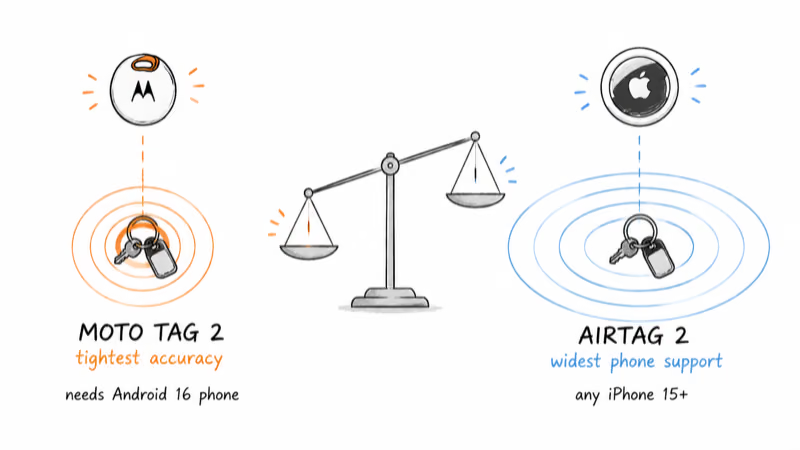
Precision splits into two questions: how tight is the ranging, and which phones can use it today. On the first question, Moto Tag 2 has the highest ceiling. The Bluetooth SIG technical overview states that Channel Sounding offers “centimeter-level accuracy,” far tighter than first-gen UWB’s 1 to 3 meter resolution. AirTag 2’s second-gen U2 improves range but stays in the UWB ranging model, and SmartTag 2’s UWB Compass View matches that older tier.
On the second question, AirTag 2 has the broadest installed base. Any iPhone 15 or newer unlocks Precision Finding out of the box, while Moto Tag 2 needs Android 16 plus a supported Bluetooth 6.0 phone for Channel Sounding, and SmartTag 2 needs a UWB Galaxy flagship for Compass View. So the tag with the best ceiling also has the narrowest phone support, and the tag with the widest support sits one radio generation behind.
Which Network Is Densest Where You Live?
The most overlooked spec is not on any box: how many strangers’ phones will relay your lost tag’s location. In the United States, Apple’s Find My is the densest network by a wide margin thanks to the iPhone install base, so AirTag 2 typically reports back fastest in American cities and suburbs.
Outside the US the picture shifts. SmartThings Find is strong in Samsung-heavy markets like South Korea, and Google Find Hub rides every modern Android phone worldwide, which is most of the planet. If you travel internationally or live in an Android-dominant region, the Moto Tag 2 or SmartTag 2 network gap shrinks or even reverses. Match the tag to where your stuff actually goes, not just to your phone.
Who Should Buy Each Tracker
Buy AirTag 2 if you carry an iPhone. It’s the cheapest single tag at $29, has the densest US finding network, works with Apple Watch Precision Finding, and unlocks the airline Share Item Location workflow for travel. For most American iPhone owners it’s the default pick and the best value via the $99 4-pack.
Buy SmartTag 2 if you own a UWB-capable Galaxy phone and want the longest battery in the category. The 700-day cycle and built-in keyring loop make it the set-and-forget choice for Samsung owners, as long as you have a UWB Galaxy phone for the Compass View arrow.
Buy Moto Tag 2 if you carry a Pixel or any modern Android phone on Google Find Hub. It’s the only one with Bluetooth 6.0 Channel Sounding, the IP68 water resistance tier, and a network that works across Android broadly rather than one brand. For mixed iPhone-and-Android households, skip all three single-network tags and step up to a dual-network design like the Chipolo LOOP, which pairs to either network at setup.
Bottom Line
These aren’t really three competitors so much as one tracker for each phone ecosystem. iPhone owners pick AirTag 2 for the cheapest entry price and the densest US network. UWB Galaxy owners pick SmartTag 2 for the 700-day battery and Compass View arrow. Pixel and broad-Android owners pick Moto Tag 2 for Bluetooth 6.0 Channel Sounding and IP68 durability.
Because none of the three cross networks, the buying decision is almost entirely about the phone in your pocket. The only time you should override the phone-first rule is a mixed-OS household sharing the same bag, where a dual-network tag beats any of these single-network flagships.
FAQ
Can these three trackers work across iPhone and Android?
No. AirTag 2 pairs only to Apple Find My, SmartTag 2 only to SmartThings Find, and Moto Tag 2 only to Google Find Hub. None of them will register, ring, or report location on a rival ecosystem. A phone on the wrong platform can only detect a stranger’s tag through the cross-platform anti-stalking standard and disable it, never claim or track one. For true cross-platform tracking, use a dual-network design like the Chipolo LOOP or Pebblebee Clip 5.
Which tracker has the longest battery life?
SmartTag 2 wins at up to 700 days per CR2032 coin cell, which Samsung says is more than twice as long as previous Galaxy SmartTag models. Moto Tag 2 rates about 500 days, and AirTag 2 rates 12-plus months. All three use the same standard $1 CR2032 coin cell that you can swap in under 30 seconds, so battery life is a convenience difference rather than a running cost difference.
Which one is the most accurate?
On the spec sheet Moto Tag 2 has the highest ceiling because it ships Bluetooth 6.0 Channel Sounding, which quotes sub-meter accuracy versus first-gen UWB’s 1 to 3 meter range. But that precision only activates on Android 16 plus a supported Bluetooth 6.0 phone. AirTag 2’s second-gen U2 and SmartTag 2’s UWB Compass View both deliver solid arrow-guided finding on supported phones, just without the centimeter-class headline figure.
Which is cheapest?
Single-tag prices are now nearly identical: AirTag 2 at $29, SmartTag 2 at $30, and Moto Tag 2 at $29.99 since its June 2026 U.S. launch. Multi-packs flip the order: Moto Tag 2 is $69.99 for four, well below AirTag 2 at $99 and SmartTag 2 at $100. None of the three charge a subscription, so the sticker price is the total cost of ownership aside from the occasional $1 battery swap.
Do any of them require a subscription?
No. AirTag 2, SmartTag 2, and Moto Tag 2 are all one-time purchases with no monthly fee. Every cloud, network, and app feature is included for life. This sets all three apart from Tile, which gates Smart Alerts and similar premium features behind a paid subscription tier.
Which network finds a lost item fastest?
In the United States, Apple’s Find My is the densest network because of the iPhone install base, so AirTag 2 usually reports a lost item fastest in American cities and suburbs. Outside the US the gap narrows: SmartThings Find is strong in Samsung-heavy markets, and Google Find Hub rides every modern Android phone worldwide. Match the tag to where your items travel, not only to your own phone.
What should I buy for a mixed iPhone and Android household?
None of these three single-network tags is ideal, since each one locks to one ecosystem. A dual-network tracker like the Chipolo LOOP, Chipolo Pop, or Pebblebee Clip 5 pairs to either Apple Find My or Google Find Hub at first setup and is the better fit for a mixed household. If you insist on these flagships, pair an AirTag 2 and a Moto Tag 2 on opposite sides of the same bag so both networks cover it.