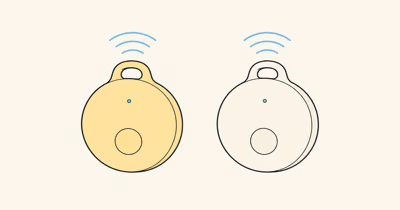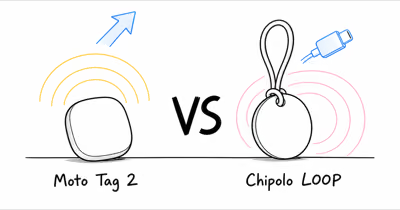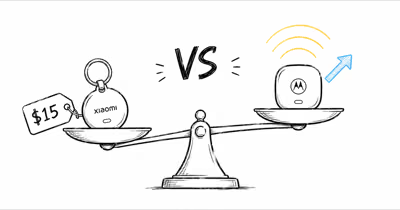
The Moto Tag vs Chipolo Pop decision comes down to one question: do you value pinpoint directional finding or network flexibility? Both trackers run on Google’s Find Hub network, cost around $29, and use the same CR2032 battery. The technology inside each one targets a different type of lost-item recovery.
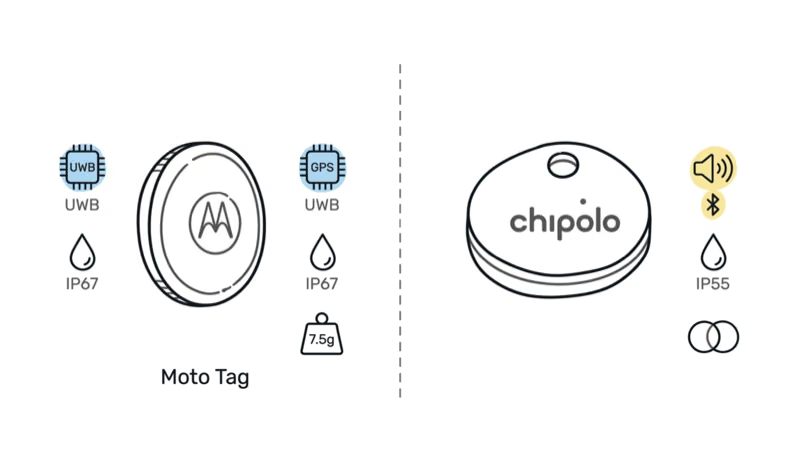
- Moto Tag has UWB precision finding — the directional arrow guides you precisely to the tracker on a UWB-compatible Pixel phone
- Chipolo Pop is one of the loudest trackers on the market — its 120dB speaker gives it a stronger sound-finding margin through doors and bags
- Chipolo Pop supports dual networks — it works on Google Find Hub or Apple Find My, but only one at a time with a factory reset to switch
- Moto Tag has stronger water resistance — IP67 (submersible) vs Chipolo Pop’s IP55 (splash-proof only)
- Both cost $29 for a single tracker — 4-packs run $60 for Moto Tag and $99 for Chipolo Pop
Moto Tag vs Chipolo Pop at a Glance
Both trackers share the same basic blueprint: coin-shaped, CR2032-powered, and built for Google’s Find Hub network. The differences show up in the details. Motorola’s spec page confirms the Moto Tag weighs just 7.5g with IP67 water resistance, while Chipolo’s listing states that the Pop hits 120dB from its built-in speaker.
Wirecutter’s best Bluetooth tracker guide recommends matching the tracker to your phone platform first, since a Find Hub tag and a Find My tag draw on completely separate finding networks.
If you need the pairing steps first, follow our Moto Tag pairing guide before comparing specs.
⇄ Head-to-head
Moto Tag vs Chipolo Pop
- +UWB precision finding with directional arrow on UWB-capable phones
- +IP67 submersion-rated for rain, puddles, dog collars, and outdoor gear
- +Lightest tracker in the category at 7.5 g
- +Best 4-pack value at $60 ($15/tag) on the Find Hub network
- +Pixel 6+ / Galaxy S21+ get the full directional UI
- +120 dB speaker with stronger sound-finding margin through doors and bags
- +Dual-network: switches between Google Find Hub and Apple Find My
- +Bluetooth 6.0 for improved connection stability
- +Works with any Android phone, no UWB hardware required
- +Fits mixed iPhone + Android households on a single SKU
- −Standard speaker, quieter than Chipolo Pop behind walls and doors
- −Find Hub only; no Apple Find My fallback
- −UWB requires a compatible Android phone (Pixel 6+ or Galaxy S21+)
- −No iPhone setup path
- −No UWB precision finding; speaker-led recovery only
- −IP55 splash-only, not submersible
- −Network switch requires a factory reset, not a toggle
- −$99 4-pack is more expensive than Moto Tag's $60
Your household runs Android, you have a UWB-capable Pixel or Galaxy, and you want the fastest directional recovery plus IP67 durability.
You need the loudest ring, your household mixes iPhones and Androids, or your Android phone lacks UWB hardware.
The spec sheet reveals two fundamentally different approaches. Moto Tag invests in UWB hardware for directional finding. Chipolo Pop invests in a dual-network radio and a speaker that can be heard across a parking lot.
For Android users who prioritize directional accuracy over speaker volume, the Moto Tag is the strongest UWB option of the two, since Chipolo Pop has no ultra-wideband radio and relies on Bluetooth proximity plus its loud speaker instead.
Network Coverage: Find Hub Only vs Dual-Network Flexibility
Moto Tag runs exclusively on Google’s Find Hub network, which Google’s Find My Device network announcement confirms is powered by over one billion Android devices worldwide. Recovery speed tracks network density: quick in busy downtown areas, slower in the suburbs, and unreliable in rural settings where few Android phones pass nearby.
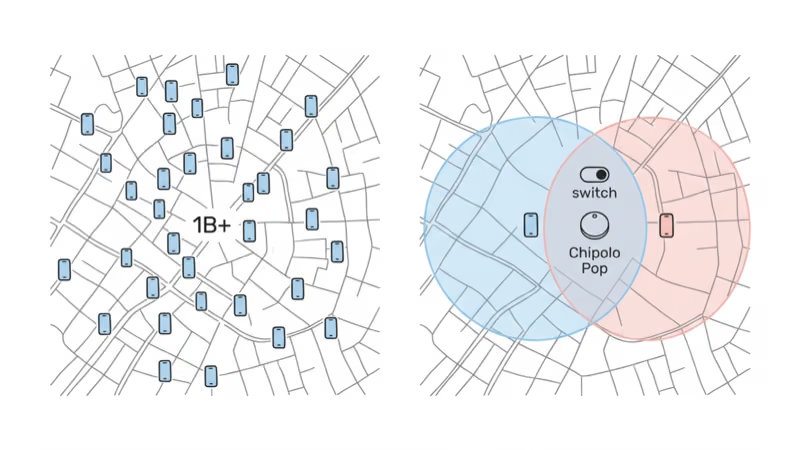
Chipolo Pop also works on Find Hub by default, but it can switch to Apple’s Find My network. This isn’t simultaneous dual-network access. You must factory reset the tracker to change networks, and it can only be active on one at a time. For a household with both Android and iPhone users, that flexibility matters, especially if you want one tracker that survives a phone platform switch down the road. For a pure Android household, you’ll never use it.
Tile’s official support center documents the third major tracker ecosystem, for wider comparison.
Our Google Find Hub trackers roundup covers the full lineup, and Find Hub vs Find My breaks down the network differences.
Does UWB Precision Finding Actually Matter?
UWB (Ultra-Wideband) is what separates the Moto Tag from every other Android tracker except the Samsung SmartTag 2. When you get within Bluetooth range, your phone displays a directional arrow that guides you to the tracker within inches.
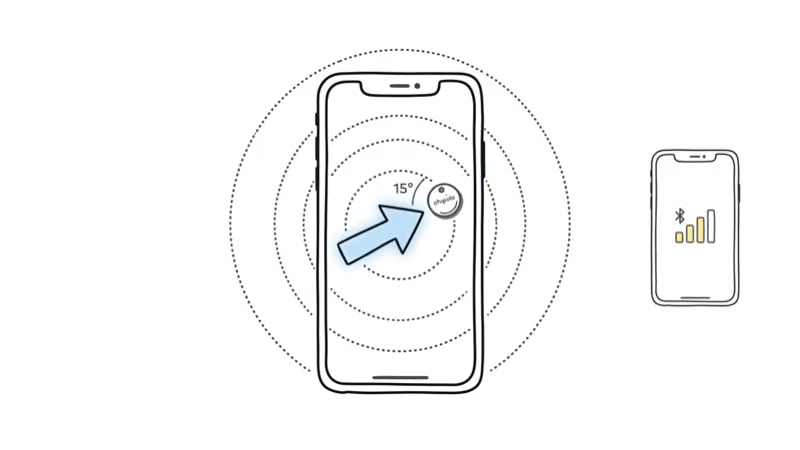
That accuracy matters when you’re digging through a couch, searching behind a car seat, or rifling through a packed suitcase. It turns a 5-minute hunt into a 30-second grab.
Without UWB, you’re relying on Bluetooth signal strength alone. That tells you the tracker is “nearby” without showing you exactly where. Chipolo Pop compensates with its 120dB speaker, so your strategy shifts from “follow the arrow” to “listen for the ring.” Both approaches work. The question is whether your lost items tend to be in the same room (speaker wins) or somewhere you can’t hear (UWB wins).
UWB compatibility note: Precision finding requires a compatible phone. Pixel 6 and newer, Samsung Galaxy S21 and newer, and select other Android devices support it. If your phone lacks UWB hardware, the Moto Tag still works as a standard Bluetooth tracker, but you lose the directional arrow.
How Loud Is Each Tracker on the Spec Sheet?
Chipolo Pop’s 120dB speaker isn’t marketing fluff — it’s among the loudest consumer trackers available. For context, 120dB is roughly the volume of a chainsaw.
At 120dB, the ring carries through a closed car door or an interior wall — see our Chipolo vs Pebblebee comparison. That’s a real advantage when your keys end up in a jacket pocket hanging in the closet.
Moto Tag’s speaker is noticeably quieter. It works in the same room but drops off fast behind barriers.
Practical impact: The speaker gap matters most for everyday misplacement around the house. Chipolo Pop gives you more sound margin when keys are behind a door, inside a bag, or under soft furniture. With the Moto Tag, the quieter speaker makes UWB directional guidance more important once barriers muffle the ring.
Pricing and 4-Pack Math
Single-tracker pricing lines up: $30 for the Moto Tag, $29 for the Chipolo Pop. The 4-pack is where the gap opens. Motorola’s 4-pack lists at $60 ($15/tag), which makes Moto Tag the cheapest UWB-compatible Find Hub tracker by a wide margin. Chipolo’s 4-pack runs $99 ($24.75/tag), closer to AirTag 4-pack pricing.
That $39 gap matters if you’re tagging keys, wallets, bags, and luggage at the same time.
App Experience and Setup
Both trackers connect through the Google Find Hub app on Android (formerly Find My Device). Moto Tag setup takes seconds: hold it near your phone, tap to pair, done.
The UWB precision finding interface appears automatically when you’re within range of a paired Moto Tag on a compatible device.
Chipolo Pop also pairs through Find Hub, but it has a secondary app for managing the dual-network feature. If you want to switch networks, you open the Chipolo app, factory reset the tracker, and re-pair it on an iPhone. According to Chipolo’s product page, the tracker retains all functionality regardless of which network you choose.
Day-to-day tracking feels the same on both. Both show last known location on a map, let you ring the device, and send separation alerts. Moto Tag adds the UWB arrow. Chipolo adds firmware updates and network-switching tools.
For Android users exploring all their options, our best Bluetooth tracker for Android roundup compares these two against every other Find Hub-compatible tracker.
Bottom Line
The Moto Tag is the better tracker for anyone with a UWB-compatible Android phone who wants the fastest, most precise way to locate lost items. The directional arrow on a UWB-compatible Pixel points you straight to the tracker, and IP67 means you can clip it to a backpack or dog collar without worrying about rain. At $60 for a 4-pack, it’s also the more cost-effective option for covering multiple items.
Chipolo Pop earns its spot for mixed-ecosystem households. That 120dB speaker is loud enough to locate a tracker through a car door, and the ability to switch to Apple Find My gives you an escape hatch if you ever change phone platforms. Just know that the switch requires a factory reset, not a toggle.
FAQ
Can Chipolo Pop connect to both Find My and Google Find Hub at the same time?
No. Chipolo Pop supports both networks, but it can only be active on one at a time. Switching from Google Find Hub to Apple Find My requires a factory reset through the Chipolo app and re-pairing the tracker on the new platform. The process takes about 5 minutes.
Does the Moto Tag work with Samsung phones?
Yes. The Moto Tag works with any Android phone running Android 9 or later for basic Bluetooth tracking through Google Find Hub. UWB precision finding requires a phone with UWB hardware, which includes Samsung Galaxy S21 and newer models. Older Samsung phones will still locate the tracker but without the directional arrow.
Which tracker is louder when you ring it?
Chipolo Pop at 120dB is significantly louder than the Moto Tag, giving it more margin through closed doors and walls. The Moto Tag’s speaker is better treated as a same-room aid, with UWB guidance doing the precision work on compatible phones.
Is UWB precision finding available on all Android phones?
No. UWB precision finding on the Moto Tag requires a phone with UWB hardware. Compatible devices include Pixel 6 and newer, Samsung Galaxy S21 and newer, and select other flagships. If your phone lacks UWB, the Moto Tag still works as a standard Bluetooth tracker through Google Find Hub, but you won’t see the directional arrow.
How long do the batteries last in each tracker?
Both trackers use a standard CR2032 coin cell and last approximately one year under normal use. Battery life varies based on how often you ring the tracker and how frequently it communicates with nearby devices. Replacements cost under $3 and take about 30 seconds to swap.
Can I use Moto Tag with an iPhone?
No. The Moto Tag is exclusively a Google Find Hub tracker and doesn’t work with Apple devices. If you need a tracker that works across both platforms, Chipolo Pop is the better choice since it can be factory reset to switch between Find Hub and Apple Find My.
Which tracker is better for international travel?
Both trackers rely on crowd-sourced networks that work globally wherever Android or Apple devices are present. The Moto Tag uses Google Find Hub, which has over one billion Android devices in its network. Chipolo Pop adds the option to switch to Apple Find My, giving you access to a second network with over a billion devices. In practice, both networks provide strong international coverage in populated areas. Rural or remote locations may see slower recovery times regardless of which tracker you choose.