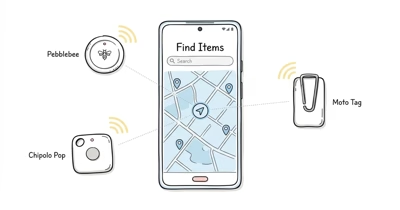
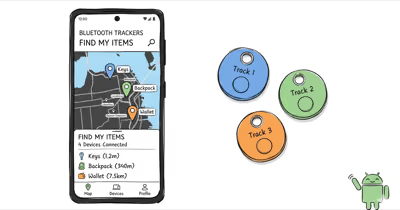
Google’s rebrand of Find My Device to Find Hub in May 2025 created something the tracker market had never really had before: a genuine second mainstream network.
For the first time, hardware makers had a reason to build trackers that speak to both Apple and Google platforms. Within eight months, a new product category emerged, dual-network trackers that work on both Find My and Find Hub, regardless of which phone you carry. This guide covers the leading options across 2025 and early 2026 — which ones are worth buying and where each falls short.
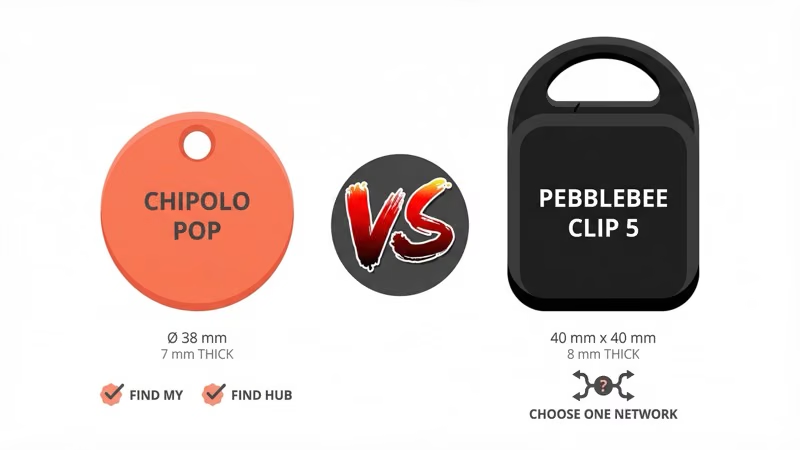
- Chipolo Pop ($29) supports Find My or Find Hub — you choose one network at setup, and switching requires a factory reset
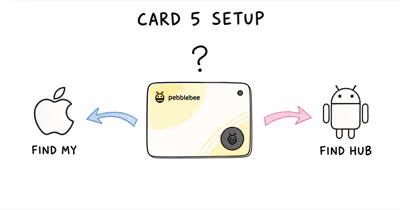
- Pebblebee Clip 5 and Card 5 support Find My OR Find Hub — you choose one at initial pairing, switching requires a factory reset
- No dual-network tracker currently offers UWB Precision Finding — that feature remains exclusive to single-platform devices like AirTag 2 and Moto Tag
- Card-format dual-network trackers (1.8–2.2mm) fit any wallet without a visible bulge and charge wirelessly over Qi
- None of the trackers in this roundup require a subscription — every pick here is a one-time purchase
What Does Dual-Network Mean for a Bluetooth Tracker?
A Bluetooth tracker’s usefulness depends almost entirely on how many devices can relay its signal.
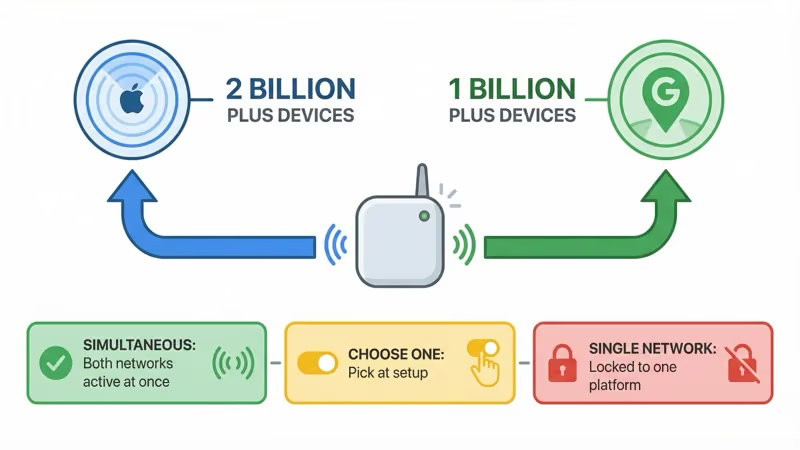
Dual-network trackers tap both the Apple and Google finding networks, which together span billions of devices versus Apple’s billion-plus Find My network alone. AirTag 2 taps into over a billion Apple devices. Samsung SmartTag 2 taps into over 300 million Samsung devices. If you have already picked a side and just want the strongest single-platform tag, our comparison of the three flagship UWB tags ranks Apple, Samsung, and Motorola against each other.
Dual-network trackers solve this by letting you register the same model on either Apple Find My or Google Find Hub, which makes them the safer pick for mixed-platform households. When a Chipolo Pop goes missing, the phones that can relay the signal are the ones on the network you selected during setup.
According to 9to5Google’s analysis of Find Hub dual-network adoption, this was the fastest-growing segment of the tracker market in January 2026, with three new products launching in the prior 90 days alone.
The terminology matters because it covers two different technical approaches.
Every consumer tracker in this category uses one active network per setup. The Chipolo Pop, Pebblebee Clip 5, Pebblebee Card 5, KeySmart SmartCard Gen 3, and the Rolling Square AirCard Pro line all pair to Apple Find My or Google Find Hub; switching later means a factory reset and re-pairing. None broadcast to both networks at once, so treat “dual-network” as compatibility with either ecosystem, not simultaneous broadcasting.
For a full comparison of the two networks themselves, see our Google Find Hub vs Apple Find My breakdown. For the broader category of Bluetooth trackers including single-platform picks, see our best Bluetooth trackers roundup.
The Best Dual-Network Trackers at a Glance
| Tracker | Network Mode | Battery | Water Rating | Price |
|---|---|---|---|---|
| Chipolo Pop | Choose one at setup | about 12 months (CR2032) | IP55 | $29 |
| Pebblebee Clip 5 | Choose one at setup | about 12 months (USB-C) | IP67 | $35 |
| Pebblebee Card 5 | Choose one at setup | about 18 months (Qi) | IP66 | $35 |
| KeySmart SmartCard Gen 3 | Choose one at setup | about 11 months (Qi) | IPX8 | $40 |
| Rolling Square AirCard Pro | Choose one at setup | about 12 months (Qi) | IP67 | about $40 |
Chipolo Pop: Best Overall Dual-Network Tracker
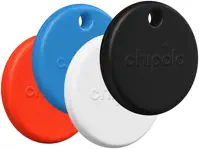
The Chipolo Pop launched in early 2026 with a practical design decision: one tracker SKU can be paired to either Apple Find My or Google Find Hub. You still choose one network during setup, and the device stays on that network until you factory reset and re-pair it. That is enough flexibility for households that may change phone platforms, but it’s not a shared live tracker for iPhone and Android users at the same time.
The speaker is useful. At 120 dB (the equivalent of a chainsaw at 3 feet), it’s the loudest tracker in its class — loud enough to ring clearly across a noisy room. AirTag 2’s redesigned speaker is quieter.
At $29 with a standard CR2032 battery, there is no ongoing cost; our Chipolo Loop vs Pop comparison covers the rechargeable USB-C sibling. The main limitation is IP55 splash resistance: it handles rain and a quick dunk in a puddle, but don’t clip it to a dog collar for a swim. For most key fob, bag, and wallet-adjacent uses, that is fine. For waterproofing, the Pebblebee Clip 5 at IP66 is a better fit.
§ Review summary
Chipolo Pop
≡ Specs
- Price (1-pack)
- $29
- Price (4-pack)
- $89 (~$22 each)
- Network
- Find My or Find Hub (one at a time)
- Speaker
- 120dB
- Battery
- CR2032, ~12 months
- Water resistance
- IP55
- Form factor
- 38.8mm disc
✓ Pros
- +Find My or Find Hub, chosen during setup
- +120dB speaker, loudest in the dual-network category
- +$29 matches AirTag 2 price, no subscription
- +CR2032 battery widely available and easy to replace
- +BLE 6.0 for extended Bluetooth range
✗ Cons
- −IP55, splash-proof but not submersion-rated
- −No UWB Precision Finding
- −38.8mm disc is too large for most wallets
§ Buy if
- ·You need a tracker that works for iPhone and Android household members
- ·You want the loudest alarm in the dual-network category
- ·You don't need waterproofing or UWB precision
Pebblebee Clip 5: Best Rechargeable Dual-Network Tracker
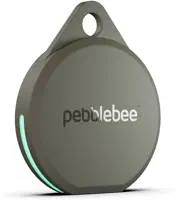
The Pebblebee Clip 5 isn’t a simultaneous dual-network tracker. At initial pairing, you pick either Apple Find My or Google Find Hub.
That network is locked in until you do a factory reset and re-pair the device. For a household where everyone uses the same phone platform, that distinction doesn’t matter much. For a mixed iPhone-and-Android household, it means one person’s phone controls this tracker, not both.
What the Clip 5 does better than anything else in this category is physical design.
The built-in detachable clip attaches directly to a zipper, bag strap, or key ring without any separate accessory.
IP67 waterproofing means it survives submersion to 1 meter for 30 minutes, fine for being left in a jacket pocket on a rainy day or clipped to a dog harness. The 130 dB siren with LED strobe is the loudest in this entire roundup, 10 dB louder than the Chipolo Pop.
USB-C charging means no battery to buy or track. A 20-minute top-up via the included cable gets you weeks of standby, and Pebblebee’s published estimate is up to 12 months on a single charge. The $6 premium over the Chipolo Pop is worth it for the waterproofing alone if that matters to your use case.
§ Review summary
Pebblebee Clip 5
≡ Specs
- Price
- $35
- Network
- Find My or Find Hub (one at a time)
- Speaker
- 130dB siren + LED
- Charging
- USB-C
- Battery
- ~12 months per charge
- Water resistance
- IP67
- Bluetooth range
- ~500 ft
✓ Pros
- +130dB siren + LED strobe, loudest in the roundup
- +IP67 waterproof, survives rain and 1m submersion for 30 min
- +USB-C rechargeable, no disposable batteries
- +Built-in detachable clip, no extra accessory needed
- +500 ft Bluetooth range, furthest on this list
✗ Cons
- −Choose-one network at setup, not simultaneous Find My + Find Hub
- −Switching networks requires factory reset and re-pairing
- −No UWB Precision Finding
- −$6 more expensive than Chipolo Pop
§ Buy if
- ·You need waterproof tracking for bags, harnesses, or outdoor gear
- ·You hate buying disposable CR2032 batteries every year
- ·Your household sticks to one platform (Apple OR Android)
Pebblebee Card 5: Best Dual-Network Wallet Tracker
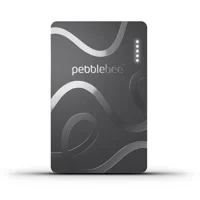
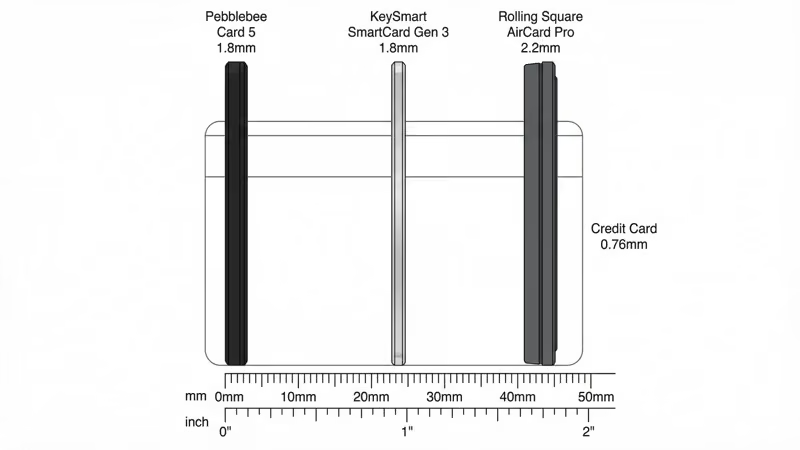
The Pebblebee Card 5 is 1.8mm thick, roughly the same as two credit cards stacked together.
It slides into the card slot of any wallet without adding visible bulk. Like the Clip 5, it’s a choose-one-network-at-setup device: you commit to either Find My or Find Hub at pairing, and switching requires a factory reset. For people who know which platform they use, that isn’t a real problem.
The 18-month battery estimate is the longest in the dual-network card category, nearly 7 months longer than the KeySmart SmartCard Gen 3.
Qi wireless charging means you drop it on any Qi pad with no cable hunting required. IP66 protection keeps dust and strong water jets out. It beats the older Chipolo CARD Spot (Find My only) and the Tile Slim (Tile’s proprietary network) on both network flexibility and battery life.
At $35, the Card 5 is the right call for anyone who wants dual-network compatibility in a wallet and can choose the dominant phone ecosystem up front. If you need a card for a household split across iPhone and Android, buy separate cards or assign the card to the ecosystem most likely to be near the wallet.
§ Review summary
Pebblebee Card 5
≡ Specs
- Price
- $35
- Thickness
- 1.8mm (thinnest)
- Network
- Find My or Find Hub (one at a time)
- Charging
- Qi wireless
- Battery
- ~18 months per charge
- Water resistance
- IP66
- Form factor
- Credit card
✓ Pros
- +1.8mm thick, fits standard wallet card slots without bulge
- +18-month battery life, longest in the dual-network card category
- +Qi wireless charging, no cable required
- +IP66 dust and jet-water resistance
- +$35 at the same price as the Clip 5
✗ Cons
- −Choose-one network at setup, factory reset required to switch
- −No simultaneous dual-network operation
- −No UWB Precision Finding
- −Quieter speaker than the Chipolo Pop or Clip 5
§ Buy if
- ·You want the thinnest possible wallet card with dual-network support
- ·You'd rather wireless-charge once every 18 months than swap batteries
- ·You're committed to one platform (Apple or Android) for the long haul
KeySmart SmartCard Gen 3: Waterproof Dual-Network Card
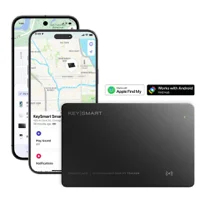
The KeySmart SmartCard Gen 3 launched in January 2026 as a thin card-format tracker that supports both Apple Find My and Google Find Hub.
You still choose one network during pairing, then factory reset and re-pair if you want to move the card to the other ecosystem. 9to5Google’s coverage of the KeySmart SmartCard Gen 3 at launch highlighted the Atlas Gen 3 chipset and Google Find Hub support as the key differentiators.
At 1.8mm, it matches the Pebblebee Card 5 on thickness. IPX8 is the strongest water resistance in this roundup, rated for sustained submersion. The 3-pack at $90 ($30 per unit) makes it one of the more cost-effective dual-network card options if you’re tracking multiple wallets.
The practical catch is battery. KeySmart’s rated runtime is shorter than the Pebblebee Card 5.
Android Police’s hands-on with the SmartCard Gen 3 is useful context for the broader Find Hub and Find My rollout, but the buying decision is still about form factor, water resistance, battery life, and which one network you’ll register at setup.
§ Review summary
KeySmart SmartCard Gen 3
≡ Specs
- Price (1-pack)
- $40
- Price (3-pack)
- $90 ($30 each)
- Thickness
- 1.8mm
- Network
- Find My or Find Hub (one at a time)
- Charging
- Qi wireless
- Battery
- ~11 months per charge
- Water resistance
- IPX8
✓ Pros
- +Find My or Find Hub, chosen during setup
- +1.8mm thickness matches Pebblebee Card 5
- +IPX8 waterproof, strongest water rating on a card tracker
- +$90 3-pack brings per-unit cost to $30
- +Atlas Gen 3 chipset built for dual-network efficiency
✗ Cons
- −~11-month battery, shorter than Pebblebee Card 5's 18 months
- −$40 per unit, $5 more than Pebblebee Card 5
- −No UWB Precision Finding
- −Newer brand with less established service track record
§ Buy if
- ·You need a Find My or Find Hub card in a waterproof form factor
- ·You want the strongest water resistance (IPX8) for outdoor exposure
- ·You're tracking multiple wallets and want the 3-pack discount
Rolling Square AirCard Pro: Best-Built Dual-Network Card
Rolling Square is a Hong Kong-based brand known for building hardware that feels more expensive than its price.
The AirCard Pro holds up to that reputation. At 2.2mm thick, it’s 0.4mm thicker than the KeySmart and Pebblebee cards, but the build quality is noticeably better: the casing has less flex and the Qi charging contact registers more reliably.
Its Pro Dual SKU registers to Apple Find My or Google Find Hub from one gray card, so a single SKU can move between ecosystems with a reset instead of buying the Apple-only or Android-only card. Our Rolling Square AirCard Pro review walks through the 3-SKU lineup and the network choice in detail.
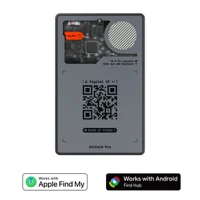
The Sherr.it Digital ID integration is a practical bonus.
A printed QR code on the back lets anyone scan it with any smartphone, even one with no tracking app installed, to report the item found and contact you anonymously. That crowdsourced lost mode adds a recovery layer beyond what either tracking network provides on its own.
Battery life is rated at ~12 months per charge, which sits between the KeySmart (11 months) and Pebblebee Card 5 (18 months). IP67 waterproofing is appropriate for everyday carry and outdoor use. At approximately $40, it competes directly with the KeySmart SmartCard Gen 3 and is worth considering if premium build quality matters to you.
§ Review summary
Rolling Square AirCard Pro
≡ Specs
- Price
- $45
- Thickness
- 2.2mm
- Network
- Find My or Find Hub (one at a time)
- Charging
- Qi wireless
- Battery
- ~12 months per charge
- Water resistance
- IP67
- Lost mode
- Sherr.it QR (no-app)
✓ Pros
- +Find My or Find Hub support from one card SKU
- +Sherr.it QR lost mode works for any smartphone, no app required
- +Premium build quality with a reliable Qi charging contact
- +IP67 waterproof for everyday carry and outdoor use
- +~12-month battery per charge
✗ Cons
- −2.2mm thick, 0.4mm bulkier than Pebblebee Card 5 and KeySmart
- −Battery shorter than Pebblebee Card 5 (12 vs 18 months)
- −No UWB Precision Finding
- −Newer brand with less established service track record
§ Buy if
- ·You value premium build quality over absolute thinness
- ·You want a QR-based crowdsourced lost mode as a recovery backup
- ·You need dual-network compatibility plus IP67 outdoor use
Does It Matter Which Network You Choose?
This question applies to every current dual-network tracker, because each device uses one active network per setup.
For the Clip 5, Card 5, Chipolo Pop, KeySmart SmartCard Gen 3, and Rolling Square AirCard Pro, the decision comes down to where your item spends most of its time and which phones are likely to be nearby.
Apple’s Find My network runs on over a billion active devices globally. Google’s Find Hub network overview states that the service works on Android 9 or later phones with Google Play Services, a base of over a billion devices worldwide. With both networks now at roughly the same global scale, the practical question is no longer which one is bigger but which one is denser wherever your item actually travels day to day.
For most buyers, the choice is clear. If you live in a primarily iPhone household and your tracked items travel through US, European, or East Asian airports and cities, Find My is the obvious pick.
The network density in those regions is difficult to match. If you’re in a household split between iPhone and Android users, or if your items travel through regions where Android market share is higher (Latin America, Southeast Asia), Find Hub’s reach advantages start to matter. For these choose-one devices, we recommend choosing the platform most household members already use. If you lean Google, our Find Hub certified tracker picks rank the top five on that network.
For a deeper comparison of the two networks, including independent coverage tests across six countries, see the network breakdown linked earlier.
Limitations to Know Before You Buy
No UWB in any dual-network tracker. Ultra-wideband Precision Finding (the feature that lets you walk toward your item using a directional arrow on your phone) requires dedicated chipsets that Apple licenses exclusively for Find My-only devices (AirTag 2) and Google for Find Hub-only devices (Moto Tag). No dual-network tracker has been granted this capability as of March 2026. You get Bluetooth-range location pings and a ring alarm, but not centimeter-accurate directional finding.
Factory reset to switch networks. If you buy any current dual-network tracker, choose your network carefully. A factory reset wipes the device and removes it from the app. It’s a full reset-and-re-pair flow, not something you want to do weekly.
No tracker here runs Find My and Find Hub at once. Apple’s Made for Find My certification and Google’s Find Hub setup flow register a tracker to one active network at a time, the AirCard Pro Dual included. For every pick here, “works with both” means compatible with either ecosystem, not visible in both apps after one setup.
Cross-platform anti-stalking alerts protect you and your targets. Both Apple and Google enforce DULT (Detecting Unwanted Location Trackers) alerts.
Any of these trackers traveling with someone who doesn’t own them will trigger an unwanted tracker notification on both iPhone and Android. Apple’s cross-platform tracker detection standard confirms that these alerts fire on both platforms and what information they surface. This is a privacy feature, not a bug. Just know it applies to your own devices if someone borrows your bag without realizing the tracker is inside.
Bottom Line
The Chipolo Pop wins this roundup for most buyers. Find My-or-Find Hub flexibility, a 120 dB speaker, a replaceable CR2032 battery, and a $29 price make it an easy pick for anyone tracking keys, bags, or gear in a phone environment that may change over time. For the absolute floor on cost, the Xiaomi Tag lists at $14.99 with the same one-network-at-a-time switching as the rest of this category; our budget dual-network tracker writeup covers the trade-offs.
Prefer a guided route? Our Tracker Finder narrows it to a match for your phone in four quick questions.
If you’re tracking a wallet specifically, the Pebblebee Card 5 is the right form factor. At 1.8mm and 18-month battery life, it leads the card-tracker category. Just pick your network at setup and leave it.
For mixed iPhone-and-Android households shopping card trackers, the honest answer is to choose the network that most often stays near the wallet or buy separate cards for each ecosystem. KeySmart wins on waterproofing (IPX8 vs IP67); Rolling Square wins on build quality and the Sherr.it QR lost mode. Neither has the battery life of the Pebblebee Card 5.
One thing is true across all five picks: none of them require a subscription. If you have been holding off on a tracker because of recurring fees, this entire category is fee-free. See our best trackers for Android guide if you want to see how single-platform Find Hub devices compare to this dual-network roundup.
FAQ
Can a dual-network tracker use both Find My and Find Hub at the same time?
No. No current consumer tracker broadcasts to both networks at the same time. The Rolling Square AirCard Pro Dual, Chipolo Pop, Pebblebee Clip 5, Pebblebee Card 5, KeySmart SmartCard Gen 3, and the standard AirCard Pro all require you to choose one network at initial pairing; switching to the other network requires a factory reset and re-pairing.
What is the best dual-network Bluetooth tracker in 2026?
The Chipolo Pop is the best dual-network Bluetooth tracker for most people. It costs $29, can be set up on Find My or Find Hub, and produces a 120 dB alarm loud enough to locate items in noisy environments. For wallets specifically, the Pebblebee Card 5 at 1.8mm and 18-month battery life is the better form-factor match.
Do dual-network trackers work with Samsung Android phones?
Yes. Google Find Hub is accessible on all Android phones running Android 9 or later with Google Play Services, including Samsung Galaxy devices. Samsung’s own SmartTag 2 uses the SmartThings Find network, which is separate. But a Chipolo Pop or Pebblebee Clip 5 set to Find Hub will show up in the Find Hub app on any Android 9+ phone, Samsung included.
How do you switch a dual-network tracker between iPhone and Android?
For every current dual-network tracker, switching means a factory reset. Hold the button until the reset pattern completes, remove the device from your current app, and re-pair it to the new network’s app. Treat it as a reset-and-re-pair flow, not an instant network toggle.
Do dual-network trackers have UWB precision finding?
No. As of March 2026, no dual-network tracker supports UWB Precision Finding. Apple licenses UWB for Find My-only devices (AirTag 2) and Google for Find Hub-only devices (Moto Tag). You get Bluetooth-range location pings and a loud alarm, but not directional centimeter-accurate finding.
Are dual-network trackers more expensive than single-platform ones?
Only slightly. The Chipolo Pop is $29, matching the AirTag 2’s price. Pebblebee devices start at $35. The premium over the cheapest single-platform trackers (Chipolo ONE Point at $28, Tile Mate at $25) is $4-10 per unit. None of the dual-network trackers in this roundup require a subscription, so the lifetime cost advantage over subscription-based trackers is significant.
Which dual-network tracker has the loudest alarm?
The Pebblebee Clip 5 has the loudest alarm at 130 dB, 10 dB louder than the Chipolo Pop’s 120 dB. In practical terms, 10 dB represents a roughly 2x perceived loudness increase. The Clip 5 also includes an LED strobe alongside the audio alarm, making it easier to locate in dim conditions like under a couch or inside a dark bag.