Moto Tag 2 and AirTag 2 are similarly sized coin-shaped trackers, but the official weights differ: Moto Tag 2 is 8.5g and AirTag 2 is 11.8g, making Motorola’s tracker 3.3g lighter. Motorola also lists more than 600 days of stated CR2032 life. AirTag 2 pairs Apple’s second-generation U2 silicon with Apple Watch Precision Finding on Series 9 and newer.
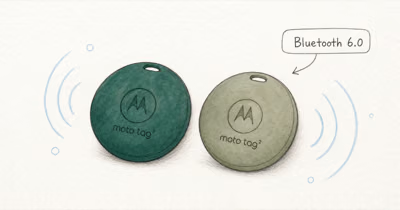
- Moto Tag 2 is the first Bluetooth 6.0 tracker: Channel Sounding centimeter-accurate distance, but needs Android 16 phones to unlock
- AirTag 2 ships with second-gen U2 chip: Precision Finding works up to 50% farther than original AirTag 1
- Moto Tag 2 battery rated more than 600 days: at least 64% longer than the first-gen Moto Tag’s 365-day rating, on a standard CR2032 coin cell
- Networks are not cross-compatible: AirTag 2 stays Apple Find My only, Moto Tag 2 stays Google Find Hub only
- Moto Tag 2 has the higher water-resistance tier and cheaper four-pack: IP68 and a $69.99 launch four-pack versus AirTag 2 at IP67 and $99 for four
Moto Tag 2 vs AirTag 2: Spec Comparison
Both pucks use a CR2032 battery, but the radios and networks pull them in opposite directions. Bluetooth SIG’s Channel Sounding overview describes the Bluetooth Core 6.0 feature as combining phase-based ranging and round-trip timing for secure fine ranging. AirTag 2 instead uses Apple’s second-generation UWB chip and a speaker Apple says is 50% louder than the original AirTag.
≡ Size comparison
True-scale shape, side, and carry setup
Published millimetre dimensions stay visible while the models share one scale. Use Compare 3D for synchronized rotation, or Inspect 3D for one device, finish, and accessory.
Phone network first. Google Find Hub, Apple Find My do not cross-register these trackers.
Exterior envelope only. Dimensions are source-backed. Surfaces are procedural reconstructions, not manufacturer CAD.
Motorola Moto Tag 2
31.9 W ×31.9 H ×8.0 D mm
8.5 g · Accessory required for keys or straps
Apple AirTag 2
31.9 W ×31.9 H ×8.0 D mm
11.8 g · Accessory required for keys or straps
Exact published specs continue in the table below.
Drag to rotate · click a product to select · published dimensions remain below
Selected product
Motorola Moto Tag 2
Its published outer envelope matches AirTag 2, but button, seams, and holder tolerances make cases non-interchangeable.
- Published size
- 31.9 × 31.9 × 8.0 mm
- Weight
- 8.5 g
- Network
- Google Find Hub
- Surface cues
- Stepped matte shell, front button and pinhole, rear rotating battery cover, and rear buzzer opening.
Selected product
Apple AirTag 2
The round body is the same published size as Moto Tag 2; carry size grows when a holder is added.
- Published size
- 31.9 × 31.9 × 8.0 mm
- Weight
- 11.8 g
- Network
- Apple Find My
- Surface cues
- White polymer face, layered steel battery cover, cover seam, and curved edge. Proportional reconstruction, not manufacturer CAD.
One device, one setup
Pick the product first. Finish and carry options only apply to that model.
Choose a verified Apple FineWoven Key Ring color in Inspect 3D, or leave the AirTag unmounted.
Measured view is ready. Compare 3D and Inspect 3D load the interactive reconstruction on demand.
3D unavailable. Continue with the published dimensions below. Verified device links remain in the purchase region.
| Spec | Moto Tag 2 | AirTag 2 |
|---|---|---|
| Price (single) | $29.99 (U.S. launch) | $29 |
| Price (4-pack) | $69.99 (U.S. launch) | $99 |
| Network | Google Find Hub only | Apple Find My only |
| Precision radio | UWB plus Bluetooth 6.0 Channel Sounding | Second-gen U2 UWB (50% longer range) |
| Companion watch precision | No published watch-based precision mode | Apple Watch Series 9 / Ultra 2 and newer |
| Bluetooth version | 6.0 (first tracker) | Not publicly stated |
| Speaker | 77 dB at 10 cm | 50% louder than original AirTag |
| Battery | CR2032, more than 600 days | CR2032, more than 12 months |
| Water resistance | IP68 (1.5m, 30 min) | IP67 (1m, 30 min) |
| Weight | 8.5g | 11.8g |
| Subscription | None | None |
The Channel Sounding line in the table hides one platform constraint: Motorola says the feature requires Android 16 and a Channel Sounding-capable phone. UWB direction is a separate feature and requires a UWB-capable Android device. Motorola doesn’t publish a blanket chipset list, so compatibility should be checked against the phone maker rather than inferred from flagship branding.
Moto Tag 2 vs AirTag 2: Head-to-Head
⇄ Head-to-head
Moto Tag 2 vs AirTag 2
- +Second-generation U2 chip extends Precision Finding up to 50% farther than original AirTag
- +Apple Watch Precision Finding on Series 9 and Ultra 2 or newer
- +Find My network spans over a billion Apple devices worldwide
- +User-replaceable CR2032 means the tag lasts 5+ years across battery swaps
- +Share Item Location works with 50+ airlines for lost-luggage recovery
- +First tracker to ship Bluetooth 6.0 plus Channel Sounding for sub-meter precision
- +More-than-600-day CR2032 rating, at least 64% longer than the original Moto Tag
- +IP68 water resistance survives 1.5 meters submerged for 30 minutes
- +Standard CR2032 coin cell means battery swaps are about $1 from any drugstore
- +Motorola publishes a 77 dB speaker rating measured at 10 cm
- −iPhone-only; no Android registration or tracking
- −No built-in attachment; keychain holders cost $9 to $35 extra
- −Expanded Precision Finding requires iPhone Air or iPhone 15 and later, excluding iPhone 16e and 17e
- −Speaker peak SPL not stated in decibels, only the 50% gain claim
- −IP67 rating is one tier below the Moto Tag 2's IP68
- −Channel Sounding requires Android 16 and a Channel Sounding-capable phone
- −Google Find Hub only; no Apple Find My pairing or registration
- −No built-in keychain hole, so a holder costs extra
- −No published watch-based precision-finding mode
- −Motorola's 77 dB figure is measured at 10 cm, so it isn't directly comparable with Apple's percentage claim
- ·You live in an Apple household and use Precision Finding daily
- ·You value the airline Share Item Location workflow for travel
- ·You want Apple Find My and Share Item Location integration
- ·You want anti-stalking detection built into both iOS and Android by default
- ·You carry a compatible Android 16 phone and want Channel Sounding designed for fine ranging
- ·You prefer the IP68 water resistance tier for outdoor carry
- ·You value Motorola's more-than-600-day CR2032 rating
- ·You're a Pixel or Motorola owner who wants deep Find Hub integration
Moto Tag 2: Find Hub’s Bluetooth 6.0 Flagship
The pitch for Moto Tag 2 is precision-first Android. Motorola pairs UWB with Bluetooth 6.0 Channel Sounding, a Bluetooth Core feature that uses phase-based ranging and round-trip timing. Motorola’s U.S. specifications require Android 16 and a compatible phone for Channel Sounding and list the speaker at 77 dB measured from 10 cm. For the long-term carry data on the first-generation puck, see our Moto Tag hands-on review.
The more-than-600-day CR2032 rating is the second standout. The first Moto Tag was rated 365 days, so the current US figure is at least 64% longer on paper. Bluetooth SIG’s Channel Sounding overview explains the new ranging technology; real battery life still depends on temperature, ringing, and relay activity.
According to 9to5Google’s report on the U.S. launch, the four-pack cost $69.99, matching the B0GV281WNP pack linked above. That is lower per tag than AirTag 2’s $99 four-pack.
The trade-off is network lock-in: the tag pairs only to Google’s Find Hub and never to Apple’s Find My. Apple users who detect a stranger’s Moto Tag 2 via the cross-platform anti-stalking standard can disable it, but never claim or track one of their own. For a wider read on Find Hub’s growth, our Find Hub vs Find My breakdown covers the network density math in detail.
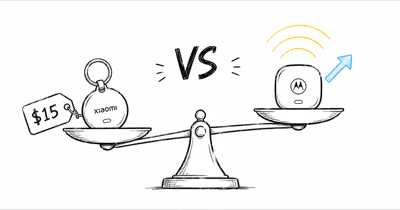
At $29.99 the Moto Tag 2 also faces a far cheaper Android challenger in the $15 Xiaomi Tag, and our Xiaomi Tag compared with the Moto Tag 2 weighs that price gap against the lost UWB precision.
AirTag 2: Apple’s Refreshed UWB Champion
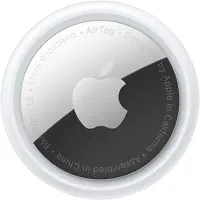
AirTag 2 is Apple’s first AirTag hardware refresh since the 2021 original. According to Apple’s January 2026 newsroom, Apple announced three meaningful upgrades: the second-generation U2 chip (the same silicon Apple ships in iPhone 17 and Apple Watch Ultra 3), a speaker that is 50% louder than the first AirTag, and Apple Watch Precision Finding on Series 9 and Ultra 2 or newer.
The new U2 radio is the most important close-range upgrade. Apple says Precision Finding now guides you from up to 50% farther away than the original AirTag, so a second-gen tag should acquire directional guidance earlier when conditions are favorable. For the full side-by-side carry breakdown, see our AirTag 2 vs AirTag 1 comparison. Apple publishes no absolute distance in meters, only that 50% gain claim, so indoor improvement still depends on walls and interference.
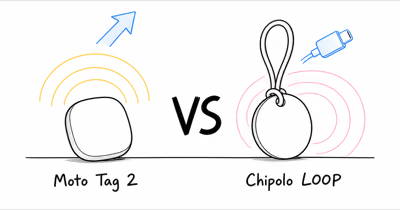
The trade-off is the same one AirTag has always had: it’s iPhone-only. An Android user can detect a stranger’s AirTag 2 through Apple’s cross-platform anti-stalking standard, but can’t register, pair, or track one of their own. For mixed-OS households a dual-network design like the Chipolo LOOP or Pebblebee Clip 5 is a better fit, both covered in our best dual-network trackers roundup. For long-form daily-carry context on the original AirTag, see our AirTag review.
Which Puck Wins on Precision Finding?
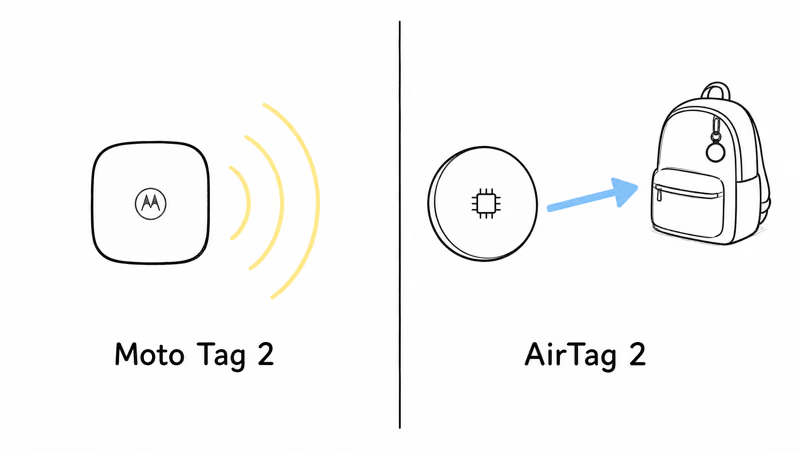
Precision Finding splits into two questions: what the radio is designed to measure and which phones can use it. Bluetooth SIG says Channel Sounding is designed for centimeter-level accuracy, while Apple says AirTag 2’s UWB Precision Finding starts from up to 50% farther away than the original. Those are different manufacturer claims measured under different conditions, so they don’t establish a head-to-head accuracy winner.
Phone eligibility is explicit on Apple’s AirTag 2 specifications: expanded Precision Finding requires iPhone Air or iPhone 15 and later, excluding iPhone 16e and 17e. Motorola requires Android 16 and a Channel Sounding-capable phone for that Bluetooth mode; UWB direction separately requires a UWB-capable Android phone.
For a broader category view on UWB-equipped trackers, our best Bluetooth tracker guide covers AirTag 2, Moto Tag 2, Galaxy SmartTag 2, and Chipolo LOOP side by side, including which phones unlock each tracker’s precision radio. If you want Samsung folded directly into this matchup, our three-way flagship-tag face-off ranks all of them head to head.
How Long Do They Last, and How Wet Can They Get?
The battery story is a clean win for Moto Tag 2 on paper. Motorola publishes more than 600 days, while Apple publishes more than a year, and both run on the same standard CR2032 coin cell. Because Apple does not publish an exact day count, a precise percentage comparison would be misleading.
Apple rates AirTag battery life at more than a year on a standard CR2032. Moto Tag 2’s published more-than-600-day US figure is the longer minimum statement, but both are manufacturer estimates rather than fixed replacement schedules.
Water resistance also favors Moto Tag 2 on the spec sheet: IP68 (1.5 meters submerged for 30 minutes) versus IP67 (1.0 meter submerged for 30 minutes). Both ratings cover brief fresh-water exposure, but neither makes saltwater harmless. Saltwater extends the corrosion risk for either tag and shortens long-term battery life regardless of IP rating, so dry-rinse and air-dry both pucks after any ocean exposure.
For households that want to skip coin cells entirely, the rechargeable Chipolo LOOP and Pebblebee Clip 5 offer USB-C and Qi convenience, but their cells are not user-replaceable. Our rechargeable Bluetooth tracker guide covers the trade-off in detail. If you’re choosing between Android-first and dual-network hardware, our Moto Tag 2 vs Pebblebee Clip 5 comparison covers the tradeoffs.
Who Should Buy Each Tracker
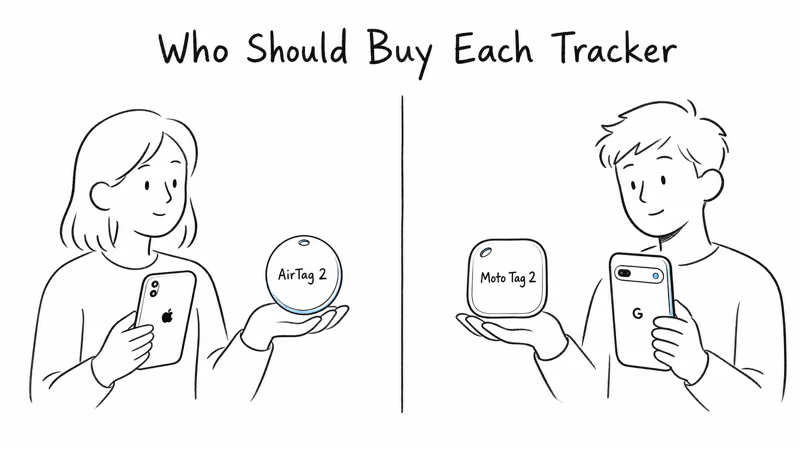
Buy AirTag 2 if you live in an Apple household, use Precision Finding on an eligible iPhone or Apple Watch, value the airline Share Item Location workflow, or prefer Apple’s Find My network. For either tracker, unwanted-tracker alerts depend on current iOS and Android support and should not be treated as an exclusive product advantage.
Buy Moto Tag 2 if you carry an Android 16 flagship and want the first hardware implementation of Channel Sounding, you prefer the IP68 water resistance for outdoor carry, or you value Motorola’s more-than-600-day battery rating. Pixel and recent Motorola owners will also see the deepest integration with Find Hub, including direct ringtone control and item sharing from the Find Hub app.
For mixed-OS households tagging the same suitcase or bike, neither single-network tag is the right answer; pair an AirTag 2 and a Moto Tag 2 on opposite sides of the item, or step up to a Chipolo LOOP that pairs to either network at first setup. The Chipolo LOOP vs AirTag 2 comparison covers the dual-network alternative in depth.
Bottom Line
Moto Tag 2 and AirTag 2 are not really competitors so much as two answers to the same precision-finding question for different platforms. If you own an iPhone, AirTag 2 is the easier and cheaper choice: second-gen U2 UWB, Apple Watch support, $29 entry price, deep ecosystem integration, and the airline Share Item Location workflow.
If you carry a compatible Android 16 phone and want Channel Sounding plus Motorola’s more-than-600-day CR2032 rating, Moto Tag 2 is the answer. At $29.99 it nearly matches AirTag 2’s single-tag price, and that buys Bluetooth 6.0 and IP68 water resistance. The trade-off is Find Hub lock-in and phone compatibility that must be confirmed before purchase.
Frequently Asked Questions
Can Moto Tag 2 work with iPhones?
No. Moto Tag 2 only pairs to Google’s Find Hub network and never to Apple’s Find My. iPhone owners can detect a nearby unknown Moto Tag 2 through Apple’s cross-platform anti-stalking standard and disable it, but they can’t register, claim, or track their own Moto Tag 2. For cross-platform tracking, a dual-network design like Chipolo LOOP or Pebblebee Clip 5 is the right fit.
Does AirTag 2 work with Android phones?
No. AirTag 2 is iPhone-only for registration and tracking. Android users can’t create a Find My account, pair an AirTag, or see its location in any Google or Samsung app. Android phones can detect a nearby unknown AirTag through Apple’s cross-platform anti-stalking standard and through Google’s Unknown Tracker Alerts, but only to identify and disable one carried by someone else.
What is Bluetooth 6.0 Channel Sounding?
Channel Sounding is a Bluetooth Core 6.0 feature that combines phase-based ranging and round-trip timing to measure distance. Bluetooth SIG says it’s designed for centimeter-level accuracy. Moto Tag 2 requires Android 16 and a Channel Sounding-capable phone to use it; Motorola does not publish a blanket chipset list.
Which tracker has better battery life?
Moto Tag 2 wins on the spec sheet with more than 600 days per CR2032 versus AirTag 2’s published more than one year. Both use the same standard CR2032 coin cell, but Motorola’s published minimum is longer. Apple does not publish an exact day count, so a precise percentage comparison would be misleading.
Are both trackers waterproof?
Yes, both pass IP-rated water resistance, but at different tiers. Moto Tag 2 carries IP68 (submersion up to 1.5 meters for 30 minutes) while AirTag 2 carries IP67 (submersion up to 1 meter for 30 minutes). Both ratings cover brief fresh-water exposure, not long saltwater exposure. Saltwater shortens long-term battery life for either tag, so rinse and air-dry after any ocean exposure regardless of IP rating.
Do either of these trackers require a subscription?
No. Neither Moto Tag 2 nor AirTag 2 requires a monthly subscription for its core finding network. At the cited U.S. launch prices, Moto Tag 2 was $29.99 for one or $69.99 for four, while AirTag 2 was $29 for one or $99 for four.
Which tracker should I buy for a mixed iPhone and Android household?
Neither single-network tag is ideal, since AirTag 2 only pairs to Find My and Moto Tag 2 only pairs to Find Hub. A dual-network tracker like the Chipolo LOOP, Chipolo Pop, or Pebblebee Clip 5 pairs to either Apple Find My or Google Find Hub at first setup and is a better fit for mixed households. If you want both networks pinging at once on the same item, pair an AirTag 2 and a Moto Tag 2 on opposite sides of the bag or suitcase.
Is Channel Sounding more accurate than UWB?
The public specifications don’t support a direct winner. Bluetooth SIG describes Channel Sounding as designed for centimeter-level accuracy, while Apple publishes a 50% Precision Finding range improvement over the original AirTag. Those claims use different baselines and aren’t a same-condition comparison.