After two years of letting Tile, Chipolo, Pebblebee, and Motorola carry the crowdsourced network it opened in 2024, Google finally built its own tag. Google’s announcement post confirms the tag leans on a Find Hub network of “over one billion Android devices” and pairs to any phone running Android 9 or newer through Fast Pair. That network scale, not the hardware, is the part worth paying attention to.
- Announced August 12, on sale November 11 — a three-month gap, so this is not a product you can buy or read a real review of today
- $29 single and $99 four-pack — identical to AirTag 2 pricing, and about the same as the $29.99 Moto Tag 2
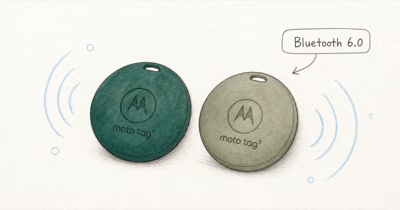
- Two precision radios, not one — UWB needs a UWB-capable phone, while Bluetooth Channel Sounding needs Android 16 and Bluetooth 6.0
- IP67 and a replaceable battery rated up to one year — the same water rating as AirTag 2, one tier below Moto Tag 2’s IP68
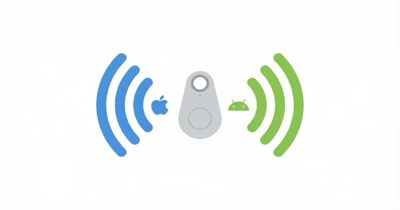
- Find Hub only — it won’t pair to Apple Find My, so iPhone households gain nothing from this launch
Pixel Tag Price, Specs, and Release Date
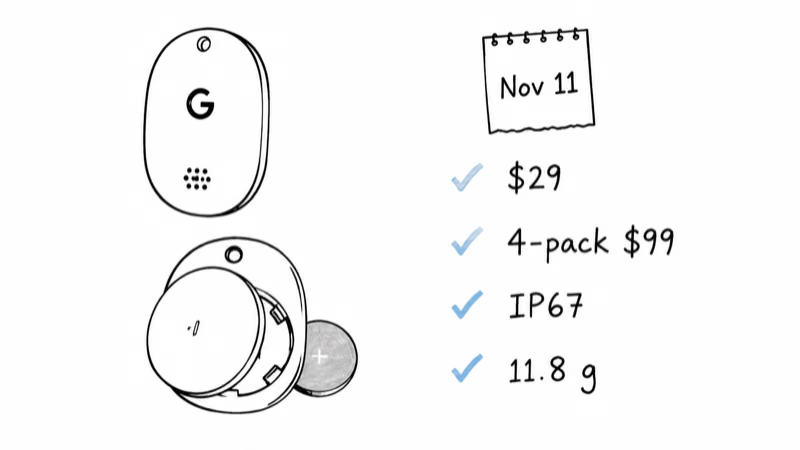
Pixel Tag is a first-party Bluetooth tracker for Google’s Find Hub network, and its headline claim is coverage rather than novelty. Google states the tag draws on a crowdsourced network of over one billion Android devices with end-to-end encrypted location reporting, and prices it at $29 for a single tag or $99 for four. Those are the same two numbers Apple charges for AirTag 2, which makes the comparison unusually clean.
The hardware is conventional on purpose. GSMArena’s spec breakdown lists a single “Fog” colorway, a stainless steel face with a polycarbonate back, dimensions of 28 x 46.1 x 5.4 mm, and a weight of 11.8 grams. The back twists off for a user-replaceable coin cell that Google rates for up to a year of everyday use.
Two details matter more than the spec sheet. First, the battery figure comes from Google’s own testing on preproduction units paired with a Pixel 10 Pro XL, so treat it as a target rather than a measurement. Second, the tag can be shared with up to 10 people, ringed from a Pixel Watch, or triggered by asking Gemini through Pixel Buds.
How Does Pixel Tag Compare to AirTag 2 and Moto Tag 2?
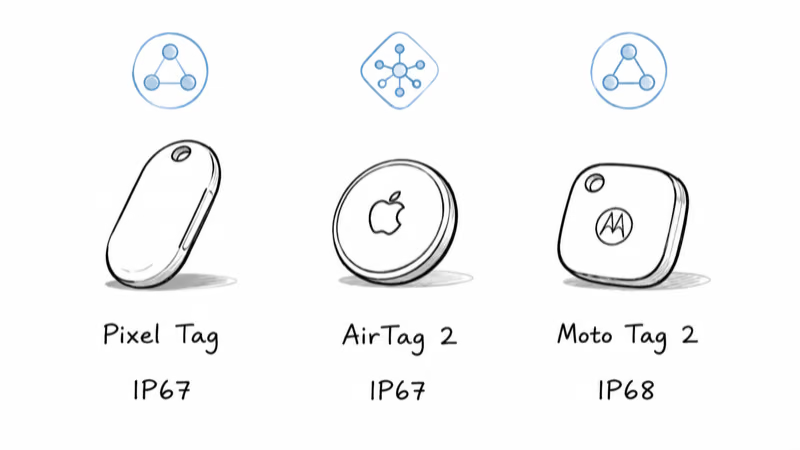
On paper the Pixel Tag lands almost exactly between the two tags it’s chasing. It matches AirTag 2 on price and IP67 water resistance, and it matches Moto Tag 2 on carrying both a UWB radio and Bluetooth Channel Sounding. What it doesn’t do is beat either one outright.
| Spec | Pixel Tag | AirTag 2 | Moto Tag 2 |
|---|---|---|---|
| Price (single) | $29 | $29 | $29.99 |
| Price (4-pack) | $99 | $99 | Available |
| Availability | November 11, 2026 | On sale now | On sale now |
| Network | Google Find Hub | Apple Find My | Google Find Hub |
| Precision radio | UWB + Channel Sounding | Second-gen U2 UWB | UWB + Channel Sounding |
| Water resistance | IP67 | IP67 | IP68 |
| Battery | Replaceable, up to 1 year | CR2032, 12+ months | CR2032, well over a year |
| Weight | 11.8 g | Around 11 g | 7.5 g |
| Subscription | None | None | None |
The precision-radio row is the one that misleads people. Carrying both radios does not mean you get both. UWB guidance needs a phone with a UWB chip, which even Google’s own base Pixel 10 lacks, while Channel Sounding needs Android 16 and Bluetooth 6.0. On an older mid-range Android phone the Pixel Tag degrades to ordinary Bluetooth proximity, exactly like a $15 tag.
One behavioural difference never shows up on a spec sheet. Tom’s Guide’s hands-on reports that Pixel Tag repeats its low-battery warning every two weeks until the cell dies, where AirTag sends one notification that’s easy to miss. Google’s Find Hub documentation exposes three states, OK, Low, and Very Low, and advises swapping at Low.
That sounds minor until it isn’t. A dead tracker fails silently: the item is untracked for months and you only discover it the day you actually need to find something.
If you want the full head-to-head on the two radios themselves, our Moto Tag 2 versus AirTag 2 breakdown covers how Channel Sounding and UWB actually differ. For the three-way flagship view, our Apple, Samsung, and Motorola face-off ranks the current shipping tags.
What Google Left Out of the Announcement
A launch post is as informative for what it omits, and this one omits a lot. Google published no peak decibel figure for the speaker, no stated distance at which Precision Finding acquires a lock, and no dimensions, weight, or material breakdown; those physical numbers reached the press through other outlets. Google’s own post also folds the two radios into one requirement line rather than spelling out the separate Channel Sounding floor.
Nobody has range-tested one yet, either. 9to5Google’s hands-on from the event was a brief supervised session with preproduction hardware, not a review. Every accuracy and battery claim in circulation today traces back to Google’s own testing, so treat the whole spec sheet as vendor-stated until retail units land.
What This Signals for the Find Hub Ecosystem
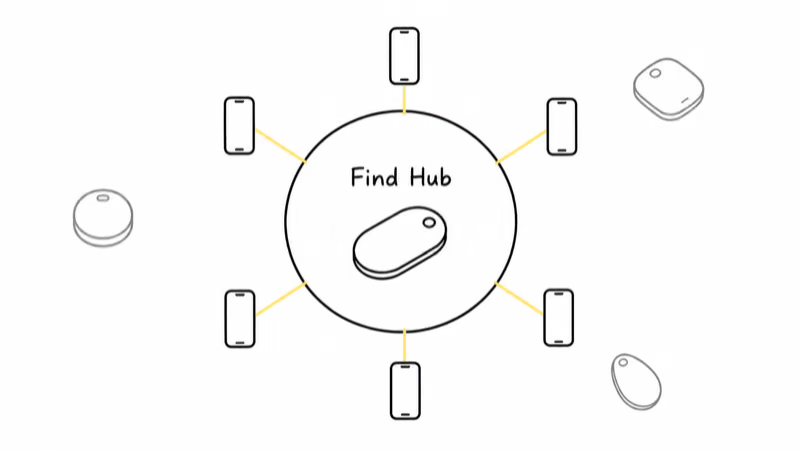
Our read is that the Pixel Tag is a network play dressed up as a hardware launch, and that is why it matters more than its spec sheet suggests. Google has spent two years asking third parties to carry Find Hub while shipping no reference device of its own. A first-party tag gives the network a default answer, and defaults are how Apple won this category.
The bigger consequence is for Motorola, Chipolo, and Pebblebee. Until August 12 the Moto Tag 2 was the premium Find Hub tag by default. It now competes with a same-priced tag from the company that owns the network, the app, and the phone. That is a hard position, and we would expect Find Hub tag prices to soften before the holidays.
The part that should worry buyers is fragmentation, not competition. Apple’s advantage was never radio technology; it was that every iPhone shipped with the same finding hardware. Android’s precision story now depends on which of two radios your specific phone supports, and Google shipping a tag does not fix that. Our Find Hub versus Find My comparison works through what that fragmentation costs in practice.
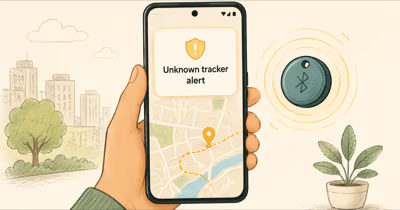
One thing does improve for everyone. Google confirms the tag warns nearby phones when an unknown tracker is traveling with someone, on both Android and iPhone. Cross-platform alerting is now table stakes rather than a differentiator, and our guide to Find Hub unknown tracker alerts explains what those warnings look like.
Should You Wait for It, or Buy Now?
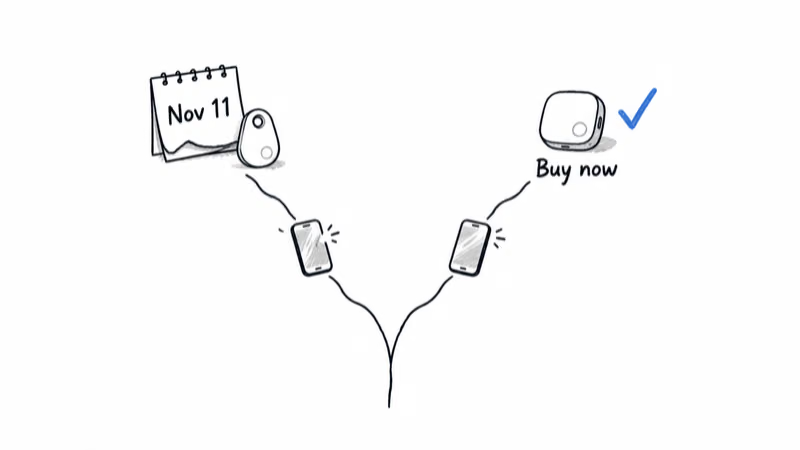
Wait if you are already deep in Google’s ecosystem, you carry a UWB-capable Pixel, and you want four tags for $99 from the company that runs the network. Three months is a short wait for first-party integration, and nothing about the announced specs suggests a bad product.
Don’t wait if you need a tracker before November, or if your Android phone lacks both UWB and Bluetooth 6.0. In that second case the Pixel Tag gives you nothing a cheaper tag wouldn’t, and you would be paying $29 for radios your phone can’t use.
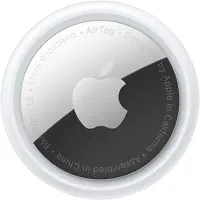
Apple AirTag 2
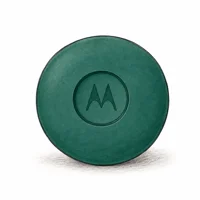
Motorola Moto Tag 2
For iPhone households this announcement is simply not an event, since the tag registers to Find Hub and never to Apple Find My. If you are shopping across both platforms in one household, our dual-network tracker guide covers the tags that pair to either network at setup. For the current Android shortlist, our Find Hub tracker rankings stay accurate until November.
The Android Tracker Shortlist Until November
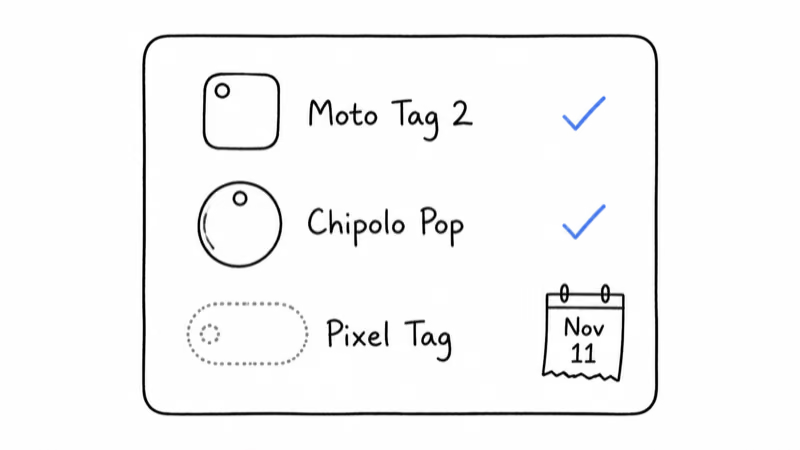
Nothing about this announcement changes what you should buy this week. The Moto Tag 2 keeps both precision radios, a higher IP68 rating, and the lighter 7.5-gram body, and it’s on shelves today. Chipolo and Pebblebee still own the dual-network slot for households running both platforms.
The one group that should pause is four-tag buyers. Google’s $99 four-pack undercuts the per-tag cost of most Find Hub multi-packs, and that bundle is the single strongest reason to wait. If you were about to buy four Android tags, waiting until November 11 is the rational call. Our Android Bluetooth tracker rankings cover the current shortlist.
For iPhone owners the calculus is unchanged, since Find Hub tags never register to Apple’s network. Apple’s AirTag 2 specification page confirms the second-generation tag stays IP67 with a CR2032 rated beyond a year, which keeps it the default for Apple households regardless of what Google ships.
Bottom Line
The Pixel Tag is the most significant thing to happen to Android item tracking in two years, and it’s also a tag you can’t buy for another three months. Its specs are competent rather than class-leading: it matches AirTag 2 on price and water rating, matches Moto Tag 2 on radios, and beats neither.
What Google actually shipped on August 12 was a signal. Find Hub now has a first-party default, which will pull mainstream Android buyers into the network and squeeze the third-party tags that built it. Revisit this decision on November 11, when the tag is real and reviewable. Until then, the Moto Tag 2 remains the Find Hub tag to buy.
Frequently Asked Questions
When can I actually buy the Pixel Tag?
Google says it goes on sale November 11, 2026, through the Google Store. The August 12 event was an announcement with full pricing and specifications, not a release. Anything describing it as available now is wrong. Reviews based on hands-on testing won’t be meaningful until retail units ship in November.
How much does it cost?
It’s $29 for a single tag and $99 for a four-pack in the United States. That is identical to Apple’s AirTag 2 pricing and slightly under the $29.99 Moto Tag 2. Google has not announced promotional bundles, and pricing outside the United States varies by market.
Does the Pixel Tag work with an iPhone?
No. It registers to Google Find Hub only, so you can’t pair, claim, or track one from an iPhone. An iPhone will still warn you if someone else’s Pixel Tag appears to be traveling with you, because cross-platform unknown-tracker alerting works in both directions. For tracking your own items on an iPhone you need an Apple Find My tracker.
Which phones get the precise finding features?
It depends on which of the two radios your phone supports. Ultra Wideband guidance requires a phone with a UWB chip, which many Android phones including the base Pixel 10 don’t have. Bluetooth Channel Sounding requires Android 16 and Bluetooth 6.0. Without either, the tag falls back to standard Bluetooth proximity and a speaker.
How long does the battery last, and can I replace it?
Google rates it for up to one year and the battery is user-replaceable through a twist-off back. That figure came from Google’s own testing on preproduction hardware paired with a Pixel 10 Pro XL, based on everyday use of playing sound and precision finding. Real-world life will depend on how often the tag is rung and located.
Is it waterproof?
It’s IP67 rated, meaning it should survive immersion in up to one meter of water for 30 minutes. Google’s own fine print notes the rating applies when the device leaves the factory and that resistance diminishes with normal wear. That matches AirTag 2 and sits one tier below the Moto Tag 2’s IP68.
Should I buy a Moto Tag 2 now or wait?
Buy now if you need a tracker before November or if your phone can’t use UWB or Bluetooth 6.0. Wait if you own a UWB-capable Pixel and want first-party integration plus the $99 four-pack. The Moto Tag 2 already carries both precision radios and a higher IP68 water rating, so waiting buys ecosystem integration rather than better hardware.
Does it need a subscription?
No. Like AirTag 2 and Moto Tag 2, the Pixel Tag is a one-time purchase with no recurring fee for network access, location reporting, or app features. Find Hub is included with Android at no cost. Subscription pricing in this category is limited to Tile’s premium tiers and GPS trackers that use cellular data.