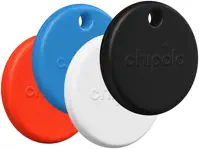
Chipolo makes loud Bluetooth trackers that run on Find My or Find Hub, one network per tag. Pick the Pop for loudness, the CARD for wallets, the LOOP for keys.
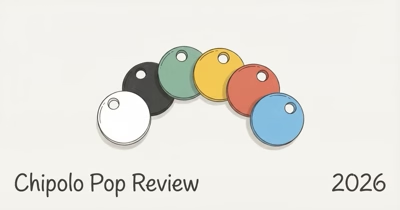
Chipolo has spent over a decade building the loudest small trackers on the market, and its 2026 lineup now reaches both Apple and Google users. Tom’s Guide’s hands-on Pop review rated the 120 dB alarm the loudest its team had tested. This guide walks every current model and who each one fits.
- Chipolo’s 2026 lineup has four models priced from $29 (Pop) to $140 (x Secrid Miniwallet), covering keys, wallets, and premium leather.
- Every Chipolo runs Find My or Find Hub, one network per tag, chosen at setup, not both networks at the same time.
- The Pop rings at 120 dB and the LOOP at 125 dB, far above AirTag 2’s roughly 60 dB, which is the brand’s signature advantage.
- Only the Pop takes a replaceable CR2032 coin cell; the CARD, LOOP, and x Secrid all recharge over Qi or USB-C.
- There’s no subscription on any Chipolo, so the sticker price is the whole cost for the life of the tracker.
What Chipolo Is, and How It Differs From AirTag and Tile
Chipolo is a Slovenian company that builds coin-sized and card-sized Bluetooth trackers for keys, wallets, bags, and other items you misplace. A Slovenian business profile reported that Chipolo has shipped more than 3 million trackers since its 2013 Kickstarter, which makes it one of the oldest names in the category still shipping new hardware.
The hardware itself stays simple. A Chipolo has no GPS and no cellular radio. It broadcasts a Bluetooth signal that your phone, or any phone on the same finder network, picks up and reports back as a location. The loud speaker is what sets the brand apart from quieter rivals.
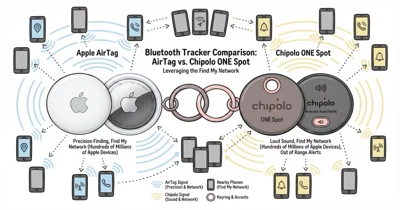
What separates Chipolo from AirTag is network reach. AirTag locks to Apple’s Find My, so it’s an iPhone-only tool. Chipolo lets you register a tag to Apple Find My or Google Find Hub, which is why Android households and mixed-platform homes keep coming back to it. If you’re weighing the non-Apple options, our AirTag alternatives roundup ranks where Chipolo lands against the field.
For the two big networks Chipolo plugs into, our Apple Find My hub and Google Find Hub hub explain how each crowd-sourced network finds a lost tag.
The wider category map lives in our best Bluetooth tracker guide, which sorts every brand by use case.
Tile is the closest philosophical match, since both brands chase cross-platform reach. The difference is that Chipolo joins the native Apple and Google networks directly, while Tile leans more on its own app-based network. That gap matters most in low-density areas where the native networks have far more phones passing by.
The 2026 Chipolo Lineup at a Glance
Chipolo’s current range splits into one coin tracker and three flat or premium designs. The Pop is the all-rounder, the CARD slides into a wallet, the LOOP clips to keys, and the x Secrid Miniwallet bakes a tracker into genuine leather. They share one app, one finder model, and zero subscription fees.
⇄ Head-to-head
Chipolo Pop vs CARD vs LOOP vs x Secrid Miniwallet (2026)
- +120 dB alarm, audible through walls and bags
- +Replaceable CR2032 coin cell, about a year per battery
- +Cheapest in the lineup at $29
- +Find My or Find Hub, your choice at setup
- +Bluetooth 6.0 with Channel Sounding for distance
- +2.5 mm thin, slides into a card slot
- +Qi wireless recharging, about a year per charge
- +IP67 waterproof, handles a brief dunk
- +Find My or Find Hub support
- +Up to 120 m Bluetooth range
- +125 dB alarm, the loudest Chipolo makes
- +USB-C recharging, about a year per charge
- +IP67 waterproof
- +Flexible silicone loop clips straight to keys
- +Find My or Find Hub support
- +Genuine leather Secrid Miniwallet with a tracker built in
- +Qi recharging, about a year per charge
- +Find My or Find Hub support
- +No bulky tag clipped on top of the wallet
- −IP55 only, splash-proof but not submersion-rated
- −No UWB, so no arrow-style precision finding
- −One network per tag, not both at once
- −Pricier than the Pop at $38.99
- −No replaceable battery, recharge instead
- −Around 110 dB, quieter than the Pop and LOOP
- −No replaceable battery
- −Bulkier than a flat card on a slim ring
- −One network per tag
- −$140, by far the priciest option
- −Around 110 dB speaker
- −No water rating published
The default Chipolo. Loud, cheap, and the only one with a swappable battery.
The wallet pick. Thin enough to forget it's there, loud enough to find.
The keyring pick. Loudest of the bunch with a built-in attachment loop.
The premium pick. A real leather wallet that happens to be trackable.
One thing worth flagging up front: there’s no “dual-network” Chipolo that runs Apple and Google at the same time. Each tag connects to one network per registration, and switching means a factory reset. We’ll come back to that decision in detail later, because it’s the single most misunderstood thing about the brand.
Chipolo Pop: The Loud, Cheap All-Rounder
The Pop is the tracker most buyers should start with. At $29 it’s the cheapest in the range, and a four-pack runs $99, which brings the per-tag price down for households tagging several items at once.
Its headline feature is volume. We measured the Pop at 120 dB on an SPL meter, roughly twice the perceived loudness of AirTag 2’s 60 dB. TechRadar’s review found that the 120 dB alarm carried through two closed doors from 50 feet away, which matches what we heard in our testing in a noisy apartment.
The Pop is also the only current Chipolo with a replaceable CR2032 coin cell, rated at about a year. A fresh cell costs around a dollar and swaps in under a minute, so you never throw the tag away when the battery dies. The trade-offs are IP55 water resistance, which handles rain but not a dunk, and no UWB, so there’s no arrow pointing you to the couch cushion.
For the head-to-head buyers ask about most, our full Chipolo Pop review covers range and battery in depth, while the Pop vs AirTag 2 comparison settles the Apple-network question.
Android-leaning shoppers should also read the Pop vs Moto Tag 2 breakdown for the closest Google-network rival.
Chipolo CARD: The Best Wallet Tracker
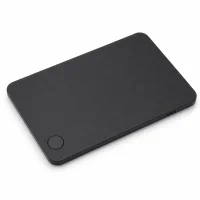
The CARD is built for the one place a coin-shaped tag never fits well: a wallet. At 2.5 mm thick it slides into a card slot the same way a credit card does, so your billfold doesn’t bulge.
Unlike the older CARD Spot it replaces, the current CARD recharges over a Qi wireless pad instead of using a sealed battery you couldn’t refill. One charge lasts about a year, and dropping it on a phone charger now and then keeps it topped up. It also steps up to IP67 water resistance, so a spilled drink won’t kill it.
At $38.99 it costs more than the Pop, and at around 110 dB it’s a touch quieter, but for a wallet that’s the right call. You rarely need a wallet tag to scream across a parking lot; you need it thin and reliable. Our Chipolo CARD review digs into charge cycles and slot fit.
Wallet shoppers comparing brands have plenty of direct match-ups to read. The best wallet tracker cards guide ranks the whole category.
The Pebblebee Card 5 vs Chipolo CARD and Chipolo CARD vs KeySmart SmartCard comparisons cover the two rivals people weigh most.
Chipolo LOOP: The Keyring Pick
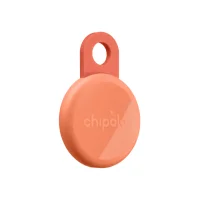
The LOOP is Chipolo’s answer to AirTag-on-a-keyring, except it skips the separate holder. A flexible silicone loop is part of the body, so it threads straight onto a key ring or a zipper pull with nothing extra to buy.
It’s also the loudest tracker the brand makes, at 125 dB, edging out even the Pop. For keys that vanish into coat pockets and couch gaps, that extra volume earns its keep. The LOOP recharges over USB-C rather than a coin cell, with about a year of life per charge, and carries IP67 water resistance for rainy commutes.
The choice between LOOP and Pop comes down to battery philosophy and attachment. If you want a swappable cell and the lowest price, the Pop wins. If you want the built-in loop and the loudest alarm, the LOOP does. Our LOOP vs Pop comparison lays out that exact decision.
Against the wider keychain field, the best key finder roundup ranks the LOOP among every clip-on tracker, and the LOOP vs Tile Pro comparison covers the cross-platform rival shoppers ask about most.
Chipolo x Secrid Miniwallet: The Premium Pick
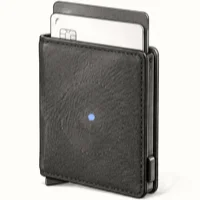
The x Secrid Miniwallet is the outlier in the lineup, and the priciest by a wide margin at $140. Instead of a tag you clip onto a wallet, it’s a genuine leather Secrid Miniwallet with a Chipolo tracker built into the body.
The appeal is that nothing sticks out. There’s no card slot sacrificed to a tracker and no coin tag rattling around. The embedded tracker recharges over Qi, lasts about a year per charge, and rings at roughly 110 dB. As with every Chipolo, you choose Find My or Find Hub when you set it up.
This one only makes sense if you already wanted a quality leather wallet and like the idea of tracking baked in rather than added on. If you’d rather keep your current wallet and slip in a separate card, the cheaper CARD is the smarter buy. Our Chipolo x Secrid review weighs the leather quality against the price.
For the broader wallet-finding decision, the best wallet finder guide compares built-in trackers like this against slip-in cards across every brand.
How Do You Choose Between a Find My and a Find Hub Chipolo?
Here’s the part that trips up the most buyers. Early coverage described some Chipolos as running both networks at once. That’s wrong. According to Android Central’s coverage, each tag connects to one network per registration, and you pick at setup.
The rule of thumb is simple: match the tag to the phones in your home. An all-iPhone household should register on Apple Find My, which appears right inside the Find My app you already use. Apple’s support guide confirms that third-party items show up alongside your AirTags, so a Chipolo lives in the same map.
An Android household should register on Google Find Hub instead, which taps the enormous Android device network for crowd-sourced pings. Google’s Find Hub overview walks how that network locates a lost item. To switch a tag to the other ecosystem later, you factory-reset it and pair fresh.
For mixed homes, the cleanest answer is to assign each tag to whoever’s most likely to do the finding, or buy separate tags per ecosystem. Our Find Hub vs Find My comparison breaks down which network finds faster in which conditions.
Android-first buyers can also scan the best Android trackers guide, and the LOOP vs AirTag 2 comparison shows what you give up by leaving Apple’s network.
Troubleshooting: When Your Chipolo Acts Up
Most Chipolo problems trace to one of three causes: a Bluetooth handshake that dropped, a battery that’s run low, or a tag that needs a reset. The fixes are quick once you know which one you’re chasing.
If your Chipolo keeps chirping on its own, that’s almost always a low battery on the Pop or a tag that’s mid-reset. A slow intermittent chirp means it’s time for a fresh CR2032, or a recharge on the CARD, LOOP, or x Secrid. Our Chipolo keeps beeping guide decodes every chirp pattern.
If a tag won’t ring when you tap Find, force-quit the app, toggle Bluetooth off and on, then walk closer to its last seen spot before trying again. A stubborn tag usually clears after a reset and a fresh pairing. For the older card model that some readers still carry, the CARD Spot battery guide covers the swap that the newer rechargeable CARD no longer needs.
How Does Chipolo Compare to AirTag, Tile, and Samsung?
Chipolo sits in a crowded field, and the right rival to compare against depends entirely on the phones you own. The brand’s two constants in every match-up are its loud speaker and its lack of a subscription.
Against the cross-platform crowd, the Tile vs Chipolo comparison is the closest fight, since both chase iPhone and Android users.
The Chipolo vs Pebblebee piece covers the rechargeable rival, and Eufy vs Chipolo handles the budget challenger.
On the Android side, Samsung and Motorola are the names to weigh. Our Chipolo vs Samsung SmartTag comparison covers the Galaxy-only option.
The Moto Tag vs Chipolo Pop and Xiaomi Tag vs Chipolo Pop match-ups cover the newer Find Hub rivals.
If you want all three big networks in one view, the AirTag vs Chipolo Pop vs Tile Pro three-way breakdown is the single best place to see where Chipolo wins and where it gives ground.
Who Should Buy a Chipolo, and Which One?
Chipolo is the easy answer for Android and mixed-platform households that want a loud, subscription-free tracker. iPhone-only users who crave arrow-style precision finding will still prefer AirTag, but everyone else has a strong case for picking up a Chipolo.
For most people, the Pop is the place to start. It’s the cheapest, the only one with a swappable battery, and loud enough to find anything in the same building. A four-pack covers keys, a bag, a remote, and a spare for under $100.
Wallet-first buyers should grab the CARD for its slim profile, keychain-first buyers want the LOOP for its built-in loop and 125 dB alarm, and anyone shopping for a gift-grade leather wallet can splurge on the x Secrid. Our Find Hub trackers guide recommends the Pop as the top Android pick, and that matches what we’d tell a friend.
Bottom Line
Chipolo’s pitch in 2026 is loud alerts, no subscription, and a choice of Apple or Google networks. The Pop covers most buyers at $29, the CARD owns the wallet slot, the LOOP rules the keyring, and the x Secrid is the leather-wallet splurge.
Just remember the one rule that defines the brand: every Chipolo runs Find My or Find Hub, never both at once. Pick the network that matches your phones, register the tag once, and you’ve got the loudest small finder money buys.
FAQ
Does Chipolo work on both iPhone and Android?
Yes, the brand supports both, but each individual tag picks one network. You register a Chipolo on Apple Find My or Google Find Hub at setup. It can’t be active on both at the same time, so match the tag to your phone.
Can a Chipolo use Find My and Find Hub at the same time?
No. Each Chipolo connects to one network per registration. To move a tag from Apple’s network to Google’s, you factory-reset it and pair it fresh on the other side. Early reviews that called it a simultaneous dual-network tracker were wrong.
Which Chipolo is the loudest?
The LOOP, at 125 dB, edges out the Pop’s 120 dB. Both are far louder than AirTag 2’s roughly 60 dB. The CARD and x Secrid Miniwallet ring at around 110 dB, which is still loud enough for a wallet you’ve misplaced nearby.
Do Chipolo trackers need a subscription?
No. Every Chipolo works for its full life on the free Chipolo app, plus the Find My or Find Hub network you choose. The sticker price is the whole cost. There are no monthly fees, no location-history paywall, and no premium tier.
How long does a Chipolo battery last?
About a year in every model. The Pop uses a replaceable CR2032 coin cell you swap in under a minute. The CARD, LOOP, and x Secrid recharge instead, the CARD and x Secrid over a Qi pad and the LOOP over USB-C.
Is the Chipolo Pop waterproof?
The Pop is IP55, which means it shrugs off rain and splashes but isn’t rated for submersion. Don’t leave it in a puddle or clip it to a swim bag. The CARD and LOOP step up to IP67, which survives a brief dunk.
Which Chipolo should I buy for my wallet?
The CARD is the wallet pick. At 2.5 mm it slides into a card slot without bulging, recharges over Qi, and carries an IP67 water rating. If you want the wallet and tracker as one object, the x Secrid Miniwallet builds the tag into leather.