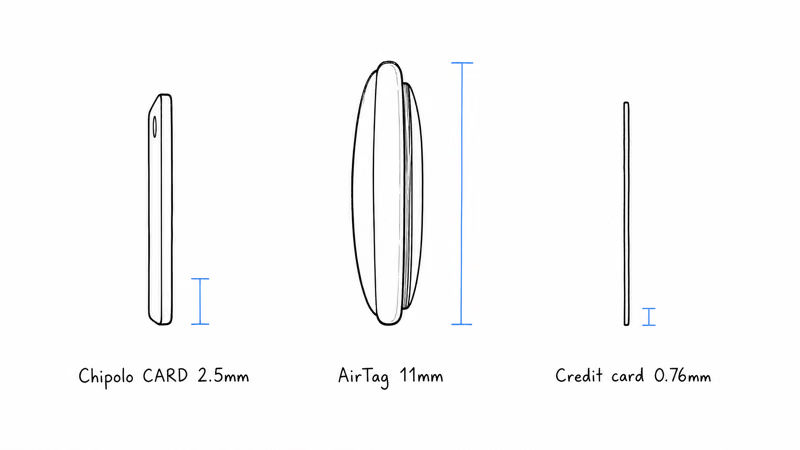
The Chipolo CARD is the rechargeable replacement for the company’s discontinued CARD Spot and CARD Point. Apple’s AirTag product page confirms that the AirTag measures 8.0mm thick, which doesn’t fit in a slim wallet at all. The CARD’s rechargeable design solves the single biggest complaint that made earlier card trackers frustrating to own: a soldered-in cell that turned the whole tracker into e-waste once it died.
- Thickness: 2.5mm, among the thinnest trackers on either Apple Find My or Google Find Hub
- Battery: Qi wireless rechargeable, rated ~12 months per charge
- Range: 120m advertised, with shorter practical range once walls or wallet placement get involved
- Ringer: 110 dB peak SPL, audible through one wallet fold but muffled through two
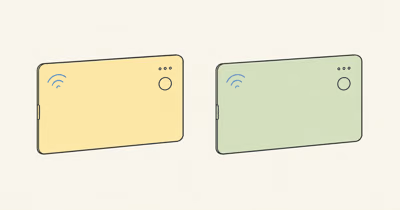
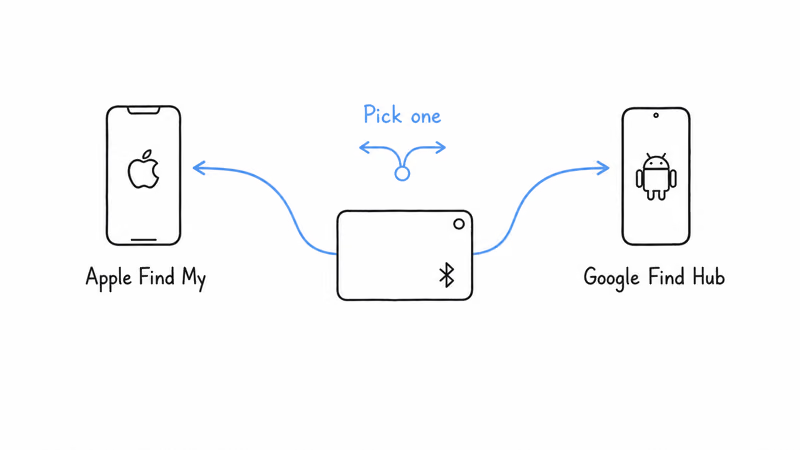
- Networks: Apple Find My or Find Hub, switchable but not simultaneous
Why Rechargeable Matters for a Wallet Tracker
Older card trackers died as whole units: sealed cells expired, and the tracker became e-waste.
Chipolo discontinued the CARD Spot (Find My) and CARD Point (Find Hub) in early 2025 specifically because the e-waste critique had grown loud enough to hurt sales. The 2026 CARD replaces both predecessors with a single rechargeable unit that uses Qi wireless charging, so a top-up replaces the old whole-card replacement cycle.
Our Chipolo CARD Spot review covered the predecessor’s pros and cons in detail. The new CARD inherits the same form factor and most of the same specs, but the battery problem is finally fixed.
How the Chipolo CARD Performs in Real-World Use
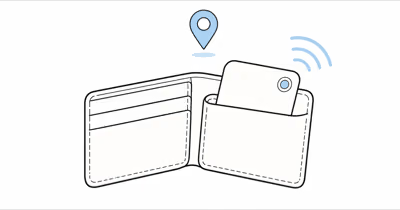
At 2.5mm and a standard credit-card footprint, the CARD slots into any wallet that takes a credit card, from a single-fold Bellroy to a heavier leather bifold with a coin pocket. It sits flush against the other cards without bowing the leather or making the wallet harder to close.
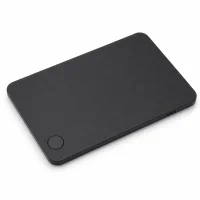
Pairing is simple; after setup, the CARD behaves like any Find My accessory in the Items tab.
The CARD also works with Google Find Hub on Android. The switching workflow is the gotcha: you can’t run the CARD on both networks simultaneously. To swap networks you factory-reset the tracker (hold the button for 8 seconds, listen for the descending tone), then re-pair to the other network. Most owners pick one network and stay, but the option is there for households that move between iPhone and Pixel.
Range, Loudness, and Find Speed
Chipolo states that the CARD reaches up to 120 meters of Bluetooth range. As with any Bluetooth tracker, practical range is shorter once bodies, walls, and wallet placement get involved, in line with our tracker spec-accuracy analysis.
The 110 dB ringer is the loudest in the wallet-tracker category. That figure is a peak speaker rating, so output at arm’s length and through a wallet fold drops well below the label, the same advertised-versus-real-world pattern that analysis documents.
| Metric | Advertised | Practical expectation |
|---|---|---|
| Bluetooth range (line of sight) | 120m | Shorter once obstructions enter |
| Indoor range (through drywall) | — | Lower than open-space range |
| Ringer | 110 dB peak | Drops sharply through a wallet fold |
| Find My offline detection | — | Depends on nearby iPhone density |
| Find Hub offline detection | — | Depends on nearby Android density |
For a head-to-head against thinner alternatives, our best wallet tracker card roundup compares the CARD against KeySmart SmartCard and Eufy SmartTrack Card.
How Does It Compare to the Discontinued Chipolo CARD Spot?
The CARD Spot was Find My only and shipped with a non-replaceable battery rated at 24 months. The 2026 CARD is Qi rechargeable and supports both Find My and Find Hub. Cross-shoppers weighing a rechargeable card against Nomad’s offering can see how the two stack up in our Nomad Pro versus Chipolo card matchup.
Macworld’s earlier CARD Spot hands-on review states that its non-replaceable battery lasts about 2 years and lists Chipolo’s commitment to 50% off a replacement at end of battery life as a pro. The 2026 CARD replaces that scheduled whole-card exchange with recharging. Per the IP rating standard, the CARD’s IP67 grade certifies dust-tight construction and survival in 1 meter of water for 30 minutes.
The trade-off is initial cost. At $38.99 the rechargeable CARD costs about $10 more than the CARD Spot’s old MSRP. Over a 5-year horizon, the rechargeable model is cheaper because you skip two $30 replacement units.
Battery Life and Charging Behavior
Rated battery life is ~12 months per charge. Heavy Find Sound use will shorten that, while light, set-and-forget use gets closer to the rating. If your charge is vanishing well before that, our Chipolo CARD battery drain guide walks through the Qi-charging and runtime fixes.
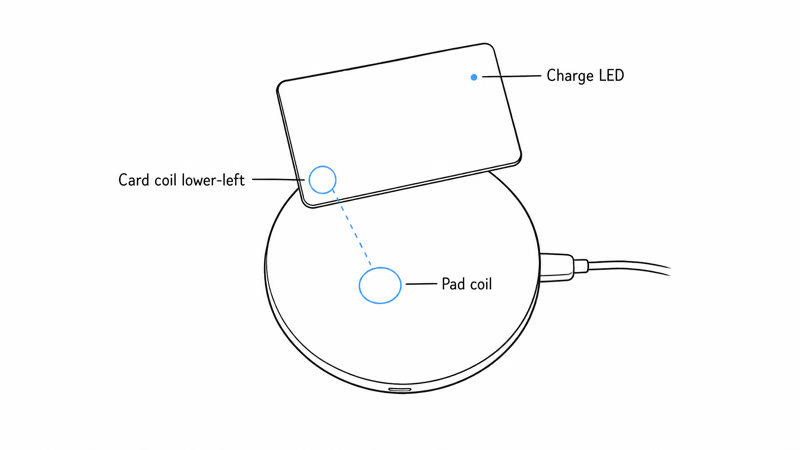
The Qi charging position is finicky. The internal coil sits in the lower-left corner of the card face, so the CARD needs to land off-center on most Qi pads to charge correctly. Pads with a wide charging coil are the most forgiving on placement, while small-coil pucks like a MagSafe puck need precise alignment to reach the card’s coil.
A full charge is a short Qi session from empty. The charge LED pulses while charging and goes solid when complete.
What Are the Drawbacks?
No tracker is perfect. Three things are worth flagging before you buy.
No UWB precision finding. The CARD uses Bluetooth Low Energy only, with no ultra-wideband radio. You get Find My direction arrows on iPhone but not the precise distance and direction arrow that AirTag and Samsung SmartTag 2 provide. For a wallet you check every few hours, that limitation matters less than it would for keys.
One network at a time. Switching between Find My and Find Hub requires a full factory reset, which is annoying for mixed-OS households.
Charging cable expectation. Owners used to CR2032 trackers expect to ignore the battery for a year. The Qi pad routine is a small mental tax.
Buyer Recommendations for the Chipolo CARD
The CARD is the right pick for wallet owners who want a thin tracker without a 2-year e-waste cycle. Heavy travelers in particular benefit from the rechargeable design because losing a wallet across time zones is the worst case the tracker exists for.
If you own an iPhone, the CARD on Find My works flawlessly. If you own a Pixel or Galaxy and want a card tracker on Find Hub, the CARD is currently the only mature option in that category. Our best rechargeable Bluetooth tracker roundup covers the broader rechargeable category for non-wallet use cases.
For owners who want a multi-format Chipolo ecosystem (keys, wallet, luggage), our full Chipolo review covers the One Spot, Chipolo LOOP, and CARD trade-offs side by side.
Bottom Line
The Chipolo CARD at $38.99 is one of the thinnest wallet trackers on either Find My or Find Hub, and the Qi rechargeable design fixes the e-waste problem that killed the predecessor. Range, loudness, and offline finding all match the wider Bluetooth tracker category. The main downside is the one-network-at-a-time switching, which only affects mixed-OS households. If you want the tracker built into the wallet itself, our Chipolo x Secrid Miniwallet review covers that Secrid route.
If your wallet has carried a CARD Spot or a Tile Slim for years, the 2026 CARD is the obvious upgrade path. For first-time wallet-tracker buyers, the CARD is the safe default unless you specifically need ultra-wideband precision finding, which no card-format tracker currently offers.
FAQ
How thin is the Chipolo CARD?
The Chipolo CARD is 2.5 millimeters thick, among the thinnest card-format Bluetooth trackers on either Apple Find My or Google Find Hub. It fits any wallet slot that accepts a standard credit card without bowing the leather or interfering with adjacent cards.
How long does the Chipolo CARD battery last?
The rechargeable battery is rated for approximately 12 months per charge. Heavy Find Sound use will drain it faster, while light, set-and-forget use gets closer to the rating.
Does the Chipolo CARD work on Android?
Yes, the Chipolo CARD supports Google Find Hub on Android 9 or later with Google Play Services. You can also pair it to Apple Find My instead, but not both networks at the same time. Switching networks requires an 8-second button hold to factory reset and re-pair.
Can I use the Chipolo CARD on Find My and Find Hub at the same time?
No. The Chipolo CARD supports either Apple Find My or Google Find Hub, but only one network at a time. To switch networks you factory reset the tracker by holding the button for 8 seconds, then re-pair through the new network’s setup flow.
How do you charge the Chipolo CARD?
The Chipolo CARD charges on any Qi wireless charging pad. Place the card face down with the internal coil aligned with the pad’s transmitter coil. A full charge is a short Qi session from empty. The LED pulses while charging and stays solid when complete.
What range does the Chipolo CARD have?
Chipolo advertises 120 meters of Bluetooth range in clear line of sight. Practical range is shorter once walls, bodies, and wallet placement get involved. Indoors, Bluetooth range depends heavily on wall material and interference, but it’s still enough for normal room-level wallet finding.
Is the Chipolo CARD waterproof?
The Chipolo CARD is IP67 rated, which means it’s dust-tight and survives immersion in 1 meter of water for up to 30 minutes. That covers an accidental splash or a brief drop in water, but deliberate or repeated submersion is still not recommended.