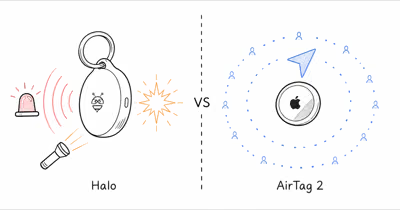
The Pebblebee Halo isn’t a louder AirTag; it’s a panic button with a tracker bolted on. For a spec-by-spec look at how the Halo stacks up against Apple’s tag, we break the two down on siren, finding, and network. Tom’s Guide, in its hands-on review, found that the 130dB siren is loud enough to work as a real emergency deterrent.
- 130dB siren plus a 150-lumen strobe fire the instant you pull the magnetic halves apart, so the alarm needs no app and no unlock
- Live location goes to up to 5 Safety Circle contacts on the paid tier, or 1 contact free, until you cancel the alert in the app
- $59.99 with 12 months of Alert Live included, then $24.99 a year if you keep live sharing past the first year
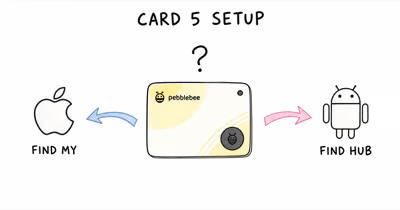
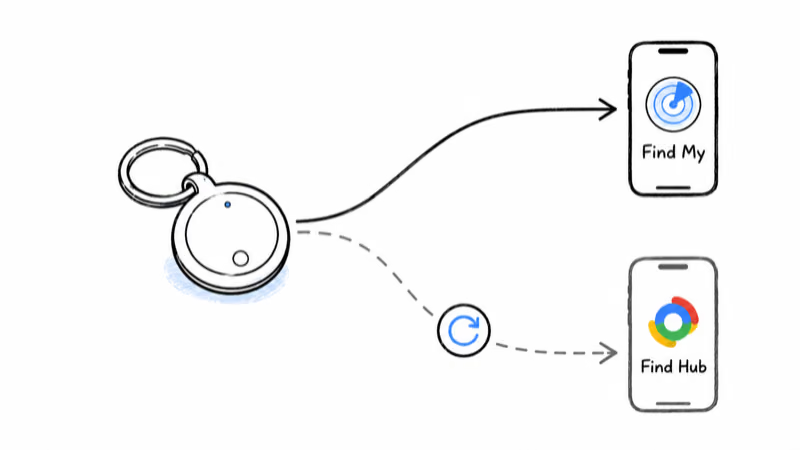
- Find My or Find Hub, one network at a time chosen at setup, so it doubles as a basic keychain finder
- IP66, about 1 oz, and roughly a year per USB-C charge, larger than a Clip 5 because it houses a real siren
The Pebblebee Halo Is a Safety Device First
The Halo is the first device in Pebblebee’s new “Safe Haven” line, and the company is clear that this is a safety product, not a finder with extras. The hardware tells the same story. A magnetic cap clips to a carabiner, and the base pulls away from that cap to arm the device.
According to Pebblebee’s official Halo product page, pulling the two halves apart instantly triggers a 130dB siren, a 150-lumen strobe, and a live location share to your trusted contacts. The trigger is mechanical, so the siren fires almost the moment the cap comes off. There is no menu, no Face ID, no “are you sure.”
That speed is the feature. A panic alarm you have to unlock your phone to fire is a panic alarm you won’t reach in time. 9to5Google’s hands-on report confirms that the magnetic-separation trigger needs no app interaction at all.
Pebblebee Halo Specifications at a Glance
| Spec | Pebblebee Halo |
|---|---|
| Launch | April 7, 2026 (Amazon from April 20) |
| Price | $59.99 MSRP |
| Siren | 130 dB |
| Strobe / flashlight | 150 lumens |
| Trigger | Pull-apart magnetic separation |
| Live sharing | Up to 5 contacts (paid) / 1 contact (free) |
| Silent alert | Yes (rapid button presses) |
| Networks | Apple Find My or Google Find Hub (pick one) |
| Weight | ~1 oz (28 g) |
| Battery | Rechargeable, ~1 year per charge, USB-C |
| Water resistance | IP66 |
| Subscription | 12 months Alert Live free, then $24.99/yr |

Pebblebee Halo
- Pull-apart trigger fires the siren without app interaction
- 130dB siren and 150-lumen strobe are a genuine deterrent, not a token buzzer
- Silent alert mode shares location without making noise
- Doubles as an everyday flashlight and a Find My or Find Hub finder
- USB-C charging and IP66 water resistance
- Live sharing past year one costs $24.99/yr, and the free tier drops to one contact
- Bigger and heavier than a Clip 5, so it’s a worse pure item finder
- One network at a time, no simultaneous Find My and Find Hub
- $59.99 is steep if you only want item tracking
How Do the Siren, Strobe, and Live Location Work?
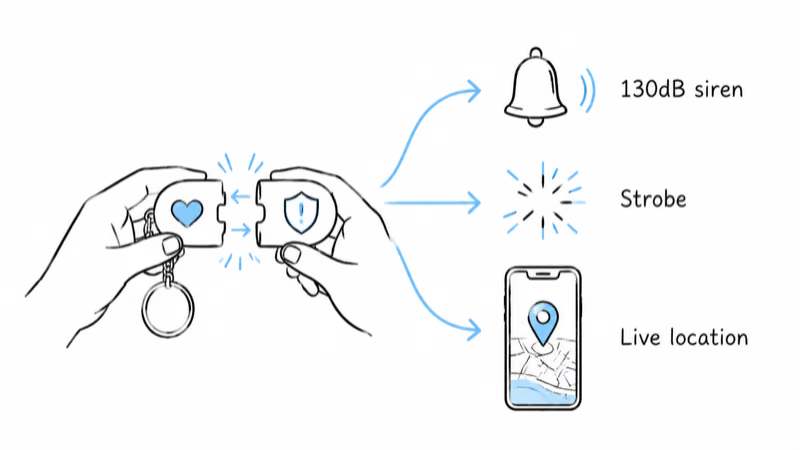
The Halo bundles four things that normally live in separate gadgets: a 130dB siren, a 150-lumen strobe, an SOS that pings your contacts, and a flashlight. Pull the halves apart and the first three fire together. The published siren and strobe ratings are the point: this is an attention-getting safety alert, not a token key-finder beep.
The live-location piece is where the device earns its “safety” label. When the alarm fires, the Halo sends a secure location link to your Safety Circle over SMS. Those contacts keep getting real-time updates until you cancel the alert in the Pebblebee app. Android Authority’s hands-on coverage describes the same continuous-update behavior.
There is also a quieter path. Rapid presses of the side button fire a silent alert that shares your location without the siren or strobe. That matters in a situation where drawing attention could make things worse rather than better, like a tense rideshare or a parking garage.
Set up your Safety Circle before you ever need it. An alarm that shares location with nobody is just a loud noise. Add at least one contact during setup, then test the silent alert once so you know what your contacts receive.
Pebblebee says location data is end-to-end encrypted and only shared during an active alert. Outside of an alarm, the Halo behaves like an ordinary item tracker and Pebblebee states it has no access to that location data.
The Halo as a Plain Item Tracker
Torn between the two Pebblebee tags? Our Pebblebee Halo vs Clip 5 matchup settles it.
Treat tracking as the bonus, not the headline. The Halo rides Apple Find My or Google Find Hub, but only one at a time, chosen at setup. iPhone owners pick Find My; Android owners pick Find Hub. You can switch later, but it takes a reset, not a toggle. Our Find Hub vs Find My breakdown covers which network to choose.
This one-network model is the same setup the rest of Pebblebee’s Gen 5 lineup uses. If you want the trade-offs of the smaller keychain finder, our Pebblebee Clip 5 review walks through that form factor, and if Find Hub location ever stalls, the fixes in our Clip 5 location troubleshooting guide apply to the Halo too.
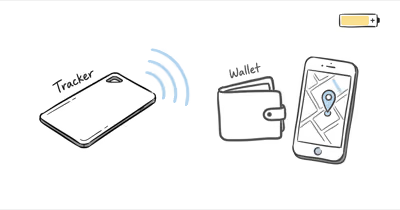
As a pure finder, the Halo is competent, not a standout. It’s Bluetooth, so it leans on the crowd network for anything out of range, and at roughly an ounce with a carabiner it’s bulkier than a tag you’d slip into a wallet.
For pure item finding, the AirTag 2 or a Clip 5 is the better-shaped tool. The Halo’s QR-code Link tag on the back does let a finder scan it to contact you, a nice touch for a device you clip to a bag.
The Alert Live Subscription, Priced Honestly
This is the part that decides whether the Halo fits your budget. Every Halo includes 12 months of Alert Live free. After that, live location sharing with up to five contacts costs $24.99 a year. You enter a card at setup, but TechRadar confirms you aren’t billed until the 12-month renewal.
If you cancel, the Halo still works. The siren and strobe never go behind a paywall, and the free tier still sends your location to one contact. What you lose is multi-contact, live-updating sharing. So the honest math is $59.99 up front for year one, then a yearly choice between $24.99 for full Safety Circle or $0 for siren plus single-contact alerts.
The siren, strobe, flashlight, and item finding never require a subscription. Only multi-contact live location sharing does. If a loud deterrent is your main goal, the free tier covers it indefinitely.
Compared to a standalone tracker, that recurring fee is the Halo’s real cost. A Pebblebee Card 5 or a plain tag has no subscription at all. You are paying for the safety service, not the hardware, and whether that is worth $24.99 a year depends entirely on how much you value the live-sharing feature.
Who Should Buy the Pebblebee Halo?
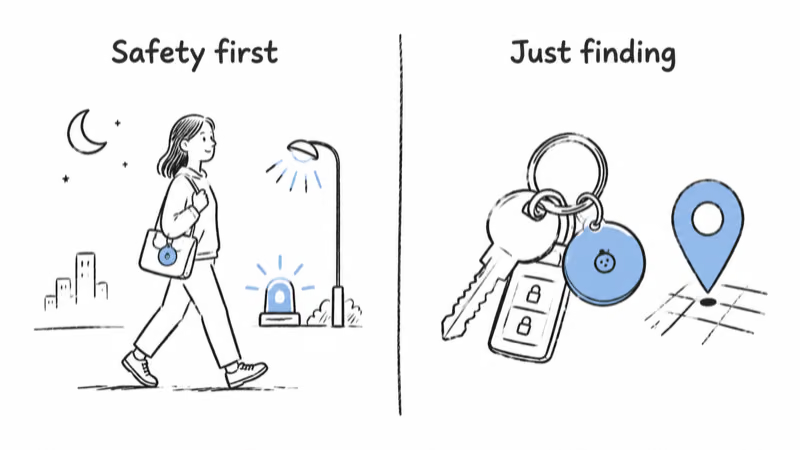
Buy the Halo If…
- You want a fast physical panic button that fires a siren without unlocking a phone
- You walk to a car, transit, or campus alone and want live location going to people who care
- You like that one device covers safety, a flashlight, and basic tracking
- You are shopping safety gear for a teen, a college student, or an older relative who clips it to keys
Skip the Halo If…
- You only want to find lost keys or a bag; a smaller, cheaper, subscription-free tag does that better
- You won’t pay $24.99/yr and the single free contact isn’t enough for your situation
- You need one device to appear in Find My and Find Hub at the same time, which no tracker does
- You want the smallest possible keychain footprint; the siren makes the Halo chunky
For families weighing dedicated safety hardware, the trade-offs in our kids GPS tracker guide are worth reading alongside this one, since a Halo and a live GPS watch solve overlapping but different problems.
Bottom Line
The Pebblebee Halo is the rare tracker that is honest about being something else. As a safety device it’s hard to fault: the pull-apart trigger is fast, the 130dB siren and 150-lumen strobe are real deterrents, and the silent alert covers situations where noise is the wrong move.
As an item finder it’s merely fine, and the $24.99/yr Alert Live fee is a real consideration after the free first year. Buy it for the panic button and treat the tracking as a bonus, and it earns its $59.99. Buy it expecting a cheap AirTag rival and you’ll feel the price.
FAQ
How loud is the Pebblebee Halo siren?
The Halo fires a 130dB siren, which sits around the threshold of pain for human hearing. It’s paired with a 150-lumen strobe light. Both activate the instant you pull the device’s two magnetic halves apart, with no app interaction needed.
Does the Pebblebee Halo require a subscription?
Not for the core features. The siren, strobe, flashlight, and item finding always work without a subscription. The Alert Live plan, which adds live location sharing with up to five contacts, is free for 12 months and then costs $24.99 a year. The free tier still sends location to one contact.
Does the Pebblebee Halo work with iPhone and Android?
Yes, but one network at a time. The Halo connects to Apple Find My or Google Find Hub, and you choose one during setup. iPhone users should pick Find My and Android users should pick Find Hub. The Pebblebee app runs on iOS 16.2 and later and Android 9 and later.
How does the silent alert mode work?
Rapid presses of the side button send a silent alert that shares your location with your Safety Circle without sounding the siren or flashing the strobe. It’s meant for situations where drawing attention could escalate the danger, like a tense rideshare.
How long does the Pebblebee Halo battery last?
Pebblebee rates the Halo at about one year per charge, and it recharges over USB-C. The device is IP66-rated, so it handles rain and splashes but is not built for submersion. It weighs roughly one ounce.
How much does the Pebblebee Halo cost?
The Halo has an MSRP of $59.99. It launched April 7, 2026 at pebblebee.com and became available on Amazon on April 20, 2026. The price includes 12 months of the Alert Live subscription, which renews at $24.99 a year if you keep live location sharing.
Is the Halo a good item tracker on its own?
It works as a tracker but is not the best-shaped one. It’s a Bluetooth device on Find My or Find Hub, and at about an ounce with a carabiner it’s bulkier than a wallet tag. If you only need item finding, a smaller subscription-free tracker is a better fit. Buy the Halo for its safety features.