These two tags are closer than any Android and Apple tracker pair has ever been. Both cost $29, both weigh 11.8 grams, both carry IP67 and a replaceable coin cell rated for about a year. Google’s announcement states that the Find Hub network spans over 1 billion Android devices, which finally matches Apple’s crowd in raw scale.
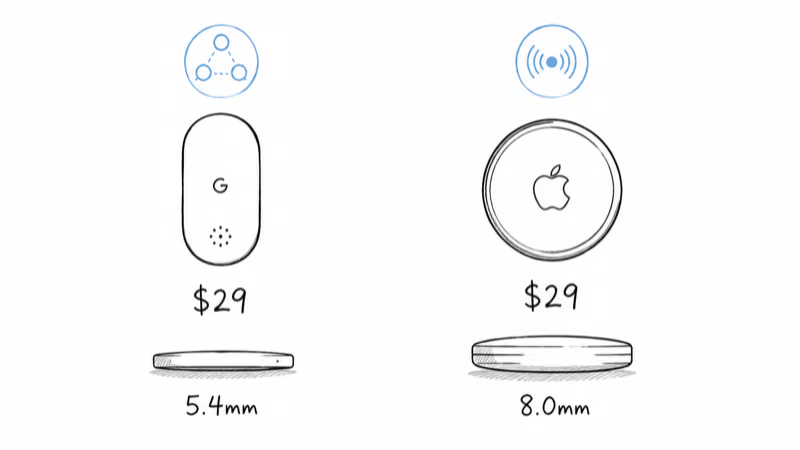
- Same price, same weight, same water rating — $29 single, $99 four-pack, 11.8g, IP67 on both
- Neither tag crosses networks — Pixel Tag is Find Hub only, AirTag 2 is Find My only, so your phone decides
- Pixel Tag is thinner but longer — 5.4mm thick against AirTag 2’s 8.0mm, in a pill shape rather than a disc
- Pixel Tag nags about its battery, AirTag 2 tells you once — a two-week repeating reminder against a single alert
- Pixel Tag is not on sale until November 11 — AirTag 2 is available today, so this is not an even comparison yet
Pixel Tag vs AirTag 2 at a Glance
The honest headline is that you don’t really get to choose. A Pixel Tag never registers to Apple Find My, and an AirTag 2 never pairs from an Android phone. Each will warn you if the other brand’s tag is travelling with you, because cross-platform unknown-tracker alerting runs in both directions, but that’s detection, not tracking.
So the real question isn’t which tag is better. It’s what each ecosystem now gives you for the same $29, and whether either one is worth switching phones over. The answer to that last part is no.
How Do the Specs Compare?
⇄ Head-to-head
Pixel Tag vs AirTag 2
- +On sale today, where Pixel Tag waits until November 11
- +Second-generation U2 chip extends Precision Finding up to 50% farther than the original AirTag
- +Apple Watch Precision Finding on Series 9 and Ultra 2 or newer
- +Share Item Location works with airlines for lost-luggage recovery
- +Every iPhone since the 15 carries UWB, so precision works out of the box
- +Repeats its low-battery warning every two weeks instead of once
- +Carries two precision radios, UWB and Bluetooth Channel Sounding
- +5.4mm thick, noticeably slimmer than AirTag 2's 8.0mm disc
- +A button on the tag rings your phone back
- +Find Hub draws on over a billion Android devices
- −iPhone only; no Android registration or tracking
- −Sends a single low-battery notification that is easy to miss
- −8.0mm thick disc is chunkier in a wallet than a 5.4mm pill
- −No keyring hole, so a holder costs extra
- −Precision Finding needs iPhone 15 or newer
- −Not on sale until November 11, so nobody has tested one
- −Find Hub only; no Apple Find My pairing
- −Precision depends on your phone, and even the base Pixel 10 lacks UWB
- −No keyring hole, the same omission Apple has never fixed
- −One colour at launch, and no multi-pack discount beyond the $99 four-pack
- ·You carry an iPhone, which settles it outright
- ·You want a tracker you can buy this week
- ·You travel and want the airline Share Item Location workflow
- ·You carry an Android phone and can wait until November
- ·You have lost a tracker to a dead battery before
- ·You want the slimmest tag for a wallet or passport sleeve
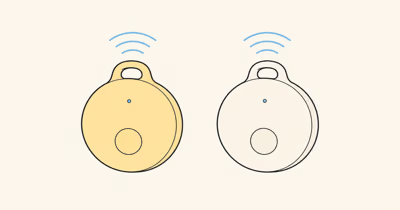
The spec sheet is close enough that the differences hide in behaviour, not hardware. Apple’s AirTag 2 specification page and GSMArena’s Pixel Tag breakdown confirms that both tags weigh 11.8 grams with IP67 and a user-replaceable cell. The shape is the visible difference: a 31.9mm disc against a 28 by 46.1mm pill.
The Low-Battery Difference Nobody Puts on a Spec Sheet
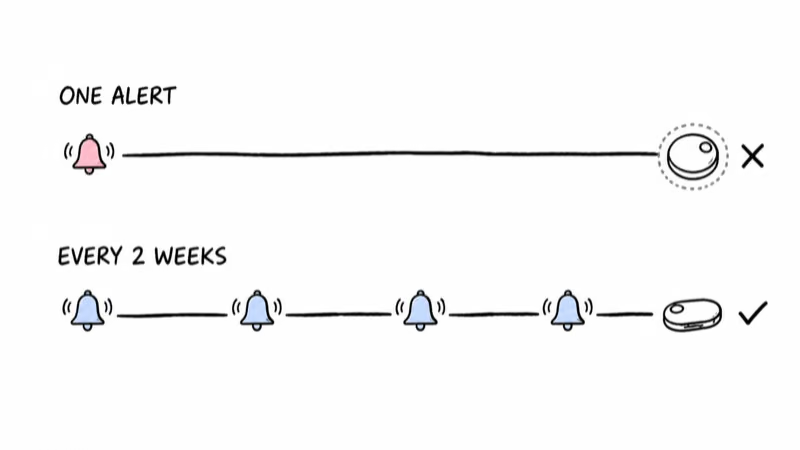
This is the one difference that changes whether a tracker works the day you need it. Tom’s Guide’s hands-on reported that Pixel Tag repeats its low-battery warning every 2 weeks until the cell dies. AirTag sends one notification.
A tracker fails silently. If you miss that single alert, the tag stops reporting and nothing tells you again, so the bag or the bike sits untracked for months. You find out on the day it goes missing, which is the exact day the tag was supposed to earn its $29.
Neither approach is a substitute for checking. Both platforms surface battery state in-app, and Google publishes three levels, OK, Low, and Very Low, with a recommendation to swap at Low. But a reminder you can’t miss beats a status screen you never open.
Precision Finding: Two Radios Against One
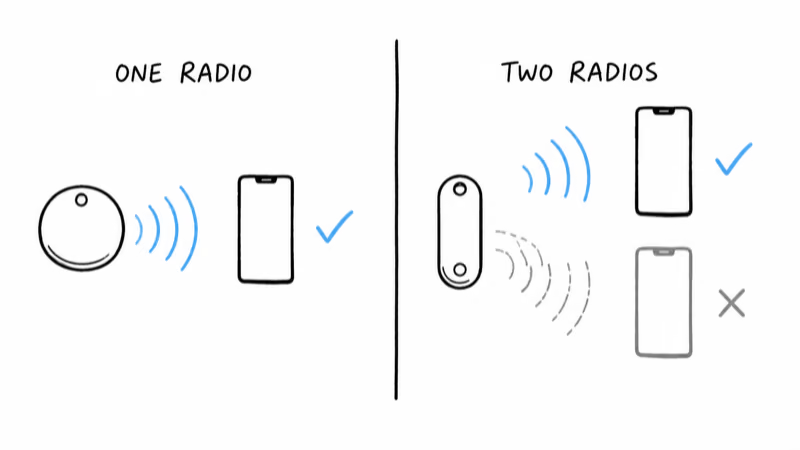
On paper Pixel Tag has the better close-range story: UWB plus Bluetooth Channel Sounding, against AirTag 2’s single second-generation U2 chip. Two radios mean two ways to get a directional arrow instead of one.
In practice Apple wins this today, and it isn’t close. Every iPhone since the 15 ships UWB, so Precision Finding simply works. On Android, UWB is scarce enough that even Google’s own base Pixel 10 omits it, and Channel Sounding needs Android 16 with Bluetooth 6.0. Pair a Pixel Tag with a mid-range Android phone and both radios sit idle while the tag falls back to ordinary Bluetooth proximity.
That fragmentation is the Android tracking story in one sentence, and a first-party tag does not fix it. Our Find Hub versus Find My comparison works through what it costs in practice, and the Moto Tag 2 versus AirTag 2 breakdown covers how the two radio approaches actually differ.
Mixed-Platform Households Get the Worst of It
If your household runs both an iPhone and an Android phone, this matchup has no winner, because a shared suitcase is trackable only by whoever owns the matching phone. Buying one of each and taping both to the same bag works, but you are paying $58 and managing two apps to solve a problem one dual-network tag solves for less.
A dual-network tracker is the actual answer here. Chipolo and Pebblebee tags let you pick Find My or Find Hub at setup, which means the tag follows whoever in the house is most likely to go looking for the item. Our dual-network tracker guide covers the trade-offs, the main one being that you still choose one network per tag rather than getting both at once.
Which One Should You Buy?
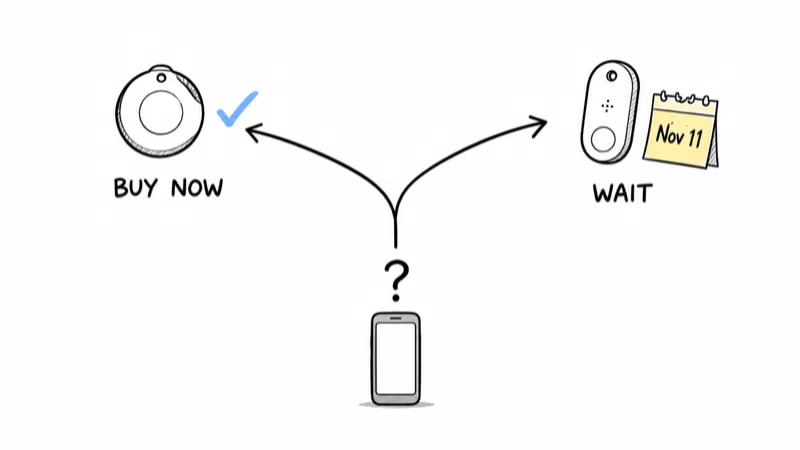
Buy AirTag 2 if you carry an iPhone. That is the whole decision, and no Pixel Tag feature changes it, because a Find Hub tag can’t report to your phone at all. You also get it this week rather than in November.
Wait for Pixel Tag if you carry an Android phone with UWB or Bluetooth 6.0, especially if you have lost a tracker to a dead battery before. The repeating reminder and the slimmer body are real advantages, and $99 for four is the best first-party Android bundle announced so far.
If you need an Android tag before November, the Moto Tag 2 already carries the same two precision radios on the same network, plus a higher IP68 rating. For the current shortlist, our Find Hub tracker rankings stay accurate until launch day, and our Pixel Tag announcement breakdown covers what Google did and did not confirm.
Bottom Line
Pixel Tag versus AirTag 2 is the closest the two ecosystems have ever been on item tracking: identical price, identical weight, identical water rating, and networks of comparable scale. Google even solved a real annoyance Apple has left alone for five years, in the repeating low-battery reminder.
None of it overrides the phone in your pocket. Both tags are locked to their own network, so the comparison settles itself before you reach the spec sheet. The interesting question is not which to buy but whether Apple copies the battery reminder, and whether Android’s UWB fragmentation ever gets fixed well enough for Pixel Tag’s second radio to matter.
Frequently Asked Questions
Can I use a Pixel Tag with an iPhone?
No. Pixel Tag registers to Google Find Hub only, so you can’t pair, claim, or track one from an iPhone. Your iPhone will still alert you if someone else’s Pixel Tag appears to be travelling with you, because cross-platform unknown-tracker warnings work in both directions, but that’s a safety feature rather than tracking.
Can I use an AirTag 2 with an Android phone?
No. AirTag 2 is iPhone-only for setup and tracking, and no Google or Samsung app can pair one. Android phones can detect a nearby unknown AirTag and disable it, but only to protect you from someone else’s tag. For tracking your own items on Android you need a Find Hub or SmartThings Find tracker.
Which one is more accurate?
It depends far more on your phone than on the tag. Pixel Tag carries two precision radios against AirTag 2’s one, which is the better hardware story. But AirTag 2’s UWB works on every iPhone since the 15, while Pixel Tag needs a UWB-capable Android phone or Android 16 with Bluetooth 6.0. On a mid-range Android phone, AirTag 2 on an iPhone will be the more precise setup in practice.
Do they cost the same?
Yes. Both are $29 for a single tag and $99 for a four-pack in the United States, with no subscription on either. That parity is deliberate on Google’s part. Prices outside the United States vary by market and were not verified here.
Which has better battery life?
They’re rated about the same, roughly a year on a user-replaceable coin cell. The meaningful difference is what happens when the battery runs low: Pixel Tag repeats its warning every two weeks until the cell dies, while AirTag sends a single notification. If you have ever found a tracker dead months after the fact, that difference matters more than the rating.
Does either one have a keyring hole?
Neither does. Both are bare tags that need a holder, case, or adhesive mount to attach to keys, a collar, or a bag, and that accessory is an extra cost on top of the $29. Pixel Tag’s pill shape is thinner at 5.4mm, which suits a wallet or passport sleeve better than AirTag 2’s 8.0mm disc.
Should I switch phones to get the better tracker?
No. A $29 accessory is never a reason to change a $1,000 phone and everything tied to it. Buy the tag that matches the phone you already carry. If you truly need one item tracked across both platforms in a mixed household, a dual-network tag from Chipolo or Pebblebee is a far cheaper answer than switching.
What should I buy before Pixel Tag ships?
On Android, the Moto Tag 2 is the closest thing available today: the same Find Hub network, the same pair of precision radios, and a higher IP68 water rating, at about the same price. On iPhone there is nothing to wait for, since AirTag 2 is already the current generation and is on sale now.