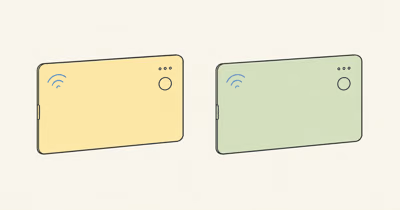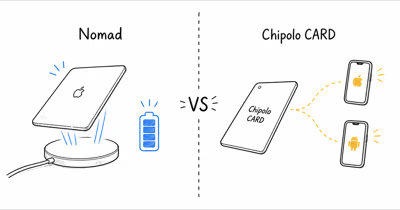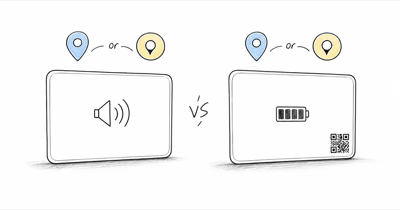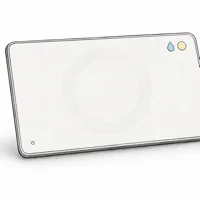
The KeySmart SmartCard wins on form: 1.8mm and IPX8 full submersion. The Chipolo CARD wins on price and a confirmed 110 dB ringer at $38.99 versus $44.99.
The KeySmart SmartCard (Gen 3) and the Chipolo CARD are two of the slimmest rechargeable wallet trackers built for both Apple Find My and Google Find Hub. KeySmart’s official product page states that the card is “Engineered at 1.8mm thick,” a fraction thinner than the Chipolo CARD’s 2.5mm body.
- KeySmart is the thinner card — 1.8mm versus the Chipolo CARD’s 2.5mm, a 0.7mm gap inside a stacked card slot.
- Chipolo is cheaper and louder — $38.99 with a confirmed 110 dB ringer versus the KeySmart’s $44.99 and unpublished decibel rating.
- Water resistance favors KeySmart — IPX8 full submersion beats the Chipolo CARD’s IP67 (dust-tight, 1m for 30 minutes).
- Battery is roughly even — KeySmart rates 11 months per Qi charge; Chipolo rates about 12 months, both wirelessly rechargeable.
- Neither runs both networks at once — you pick Find My or Find Hub at setup, and switching needs a factory reset on both cards.
KeySmart SmartCard vs Chipolo CARD: At a Glance
Both cards solve the same problem: a trackable card that disappears in a wallet and recharges on a Qi pad instead of burning through coin cells. The split is form factor versus price and loudness, and it breaks cleanly.
KeySmart’s spec page states that the card is “IPX8 Waterproof,” its strongest claim. Chipolo’s official CARD page confirms that the siren hits “Loudness: 110 dB” with a Bluetooth range of “120 m (400 ft).” Across both manufacturer listings, the 0.7mm thickness gap (1.8mm versus 2.5mm) holds, while only the Chipolo CARD publishes a decibel figure.
⇄ Head-to-head
KeySmart SmartCard vs Chipolo CARD
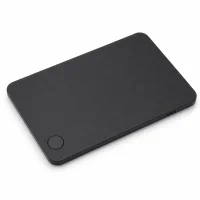
- +1.8mm body, the thinner of the two cards in a stacked slot
- +IPX8 rated for full submersion, the stronger water rating here
- +Atlas Gen 3 chip rated 30% more power-efficient than the prior card
- +Qi wireless rechargeable with a front LED charge indicator
- +Pairs with both Apple Find My and Google Find Hub
- +$38.99, six dollars cheaper than the KeySmart card
- +Confirmed 110 dB ringer, loud enough to find in a couch or bag
- +About 12 months per Qi charge, slightly longer stated life
- +120m (400ft) advertised Bluetooth range
- +Pairs with both Apple Find My and Google Find Hub
- −$44.99, six dollars more than the Chipolo CARD
- −No published decibel rating for its alarm
- −Choose one network at setup, switching needs a factory reset
- −11-month battery is slightly shorter than Chipolo's stated year
- −2.5mm thick, noticeably chunkier than the 1.8mm KeySmart
- −IP67 rather than IPX8, no full-submersion claim
- −Choose one network at setup, switching needs a factory reset
- −No multi-pack listing for outfitting several wallets
- ·You want the thinnest dual-network card for a slim wallet
- ·Full IPX8 submersion protection matters for a soaked wallet
- ·An 11-month Qi recharge cycle is your set-and-forget target
- ·You'd pay a few dollars more for the slimmer, sealed body
- ·You want the cheaper rechargeable card at $38.99
- ·A confirmed-loud 110 dB ringer matters for couch-cushion finds
- ·A 2.5mm body still fits your wallet without trouble
- ·You'd rather save the money than chase the last 0.7mm of slimness
For how both cards sit inside Google’s tracking ecosystem, see our Find Hub tracker hub, which collects every model certified for Google’s network.
Which Is Thinner and Louder?
Thickness is the KeySmart’s headline win. Its product page describes the card as “Engineered at 1.8mm thick (that’s just two credit cards),” while the Chipolo CARD measures 2.5mm. In a packed wallet, that 0.7mm gap is the difference between a card that vanishes into the stack and one you can feel.
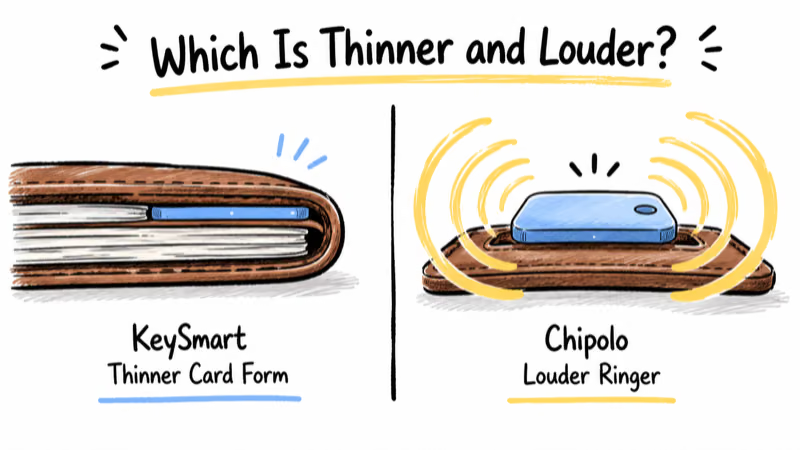
At 1.8mm versus the Chipolo’s 2.5mm, the thinner KeySmart sits more flush in a packed bifold, while the slightly thicker CARD can raise the stack a hair. Either still fits a standard slot, but the KeySmart is the one you forget is there. For buyers chasing the slimmest possible profile, that 1.8mm number is decisive.
Loudness flips the result. Chipolo publishes a 110 dB ringer, confirmed on its spec sheet, while KeySmart lists no decibel figure at all. For a card buried in a couch cushion or a gym bag, a confirmed-loud alarm is worth more than a spec you have to guess at. So the Chipolo CARD is the safer pick when finding-by-sound is the priority.
Both cards add a reverse find-phone trick: press the button and your paired phone rings even on silent. That feature is a wash. The decibel gap is not, since only one brand will commit to a number.
Water and Dust Resistance Compared
Water resistance is the KeySmart’s second win. It carries an IPX8 rating, the strongest tier on the ingress-protection scale, meaning it survives continuous submersion rather than just splashes. The Chipolo CARD is rated IP67, which is dust-tight and holds up to 1 meter of water for 30 minutes.
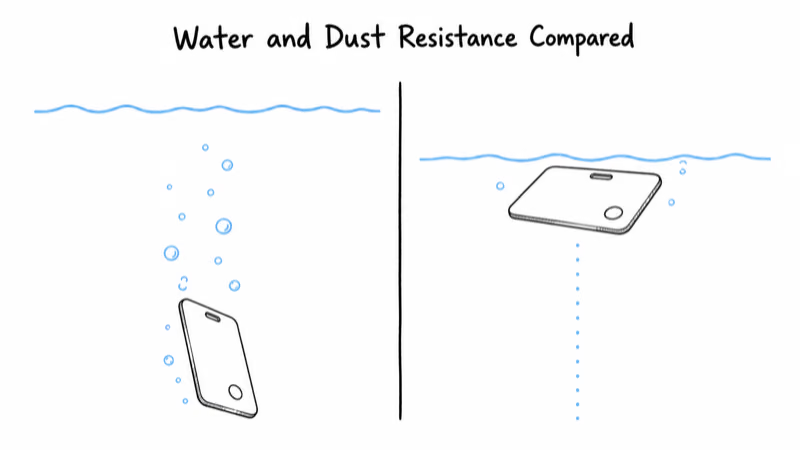
The difference comes from the scale these ratings use. Per Wikipedia’s IP code reference, an IPX8 device is tested against immersion beyond 1 meter under conditions the manufacturer specifies, while IP67’s water digit caps at 1 meter for 30 minutes. For a wallet left in a rained-on jacket or dropped in a sink, IPX8 is the larger safety margin.
Both sealed cards are built to shrug off the daily moisture a wallet sees, from a damp coat pocket to a rainy commute. But if your wallet routinely faces heavy water, the KeySmart’s full-submersion rating is the one that removes the worry entirely.
Which Network Setup Fits Your Phone?
Both cards market “dual-network” support, and both work the same way: you choose Apple Find My or Google Find Hub at setup, not both at once. Switching networks means a factory reset and re-pairing in the other app, which clears your location history. A single Bluetooth radio can only broadcast one beacon format at a time, so this is a hardware limit shared by every card in this class.
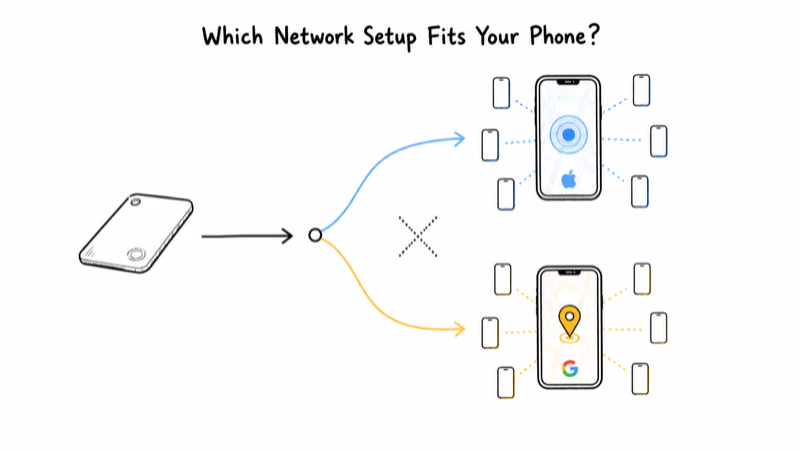
That makes network choice the real decision, and it should follow the phones around you. Pick Find My if you live in an iPhone-heavy area, since the Find My network leans on the density of nearby Apple devices to relay a ping. Pick Find Hub in Android-dominant regions, where Google’s crowd-sourced network has more phones to bounce off.
Neither network charges a subscription. Apple’s Find My network support page confirms that access is free for certified third-party accessories, and Google Find Hub is free too. So the recurring cost on either card is zero, and the only ongoing input is a Qi recharge once or twice a year.
If running both networks simultaneously is a hard requirement, neither card delivers it, and no wallet card on the market does. Our dual-network tracker guide covers which clip-style models actually broadcast to both at once.
Battery Life and Recharge Cycle
Both cards drop the disposable coin cell for a sealed Qi-rechargeable battery, and the rated life is close. KeySmart’s product page states “11-Month Battery” driven by its Atlas Gen 3 chip, while Chipolo rates the CARD at about 12 months per charge. On paper the two land within a month of each other.
That near-tie means battery is not the deciding spec here. Neither card ships with a charger, so you drop it on any Qi pad you already own once or twice a year. The KeySmart adds a front LED so you can see the charge state at a glance, which Chipolo’s card lacks.
Price and Overall Value
On price, the Chipolo CARD undercuts the KeySmart: $38.99 versus $44.99, a six-dollar gap with no subscription on either side. For that saving you get a louder confirmed ringer and a slightly longer stated battery life, at the cost of 0.7mm of thickness and the step down from IPX8 to IP67.
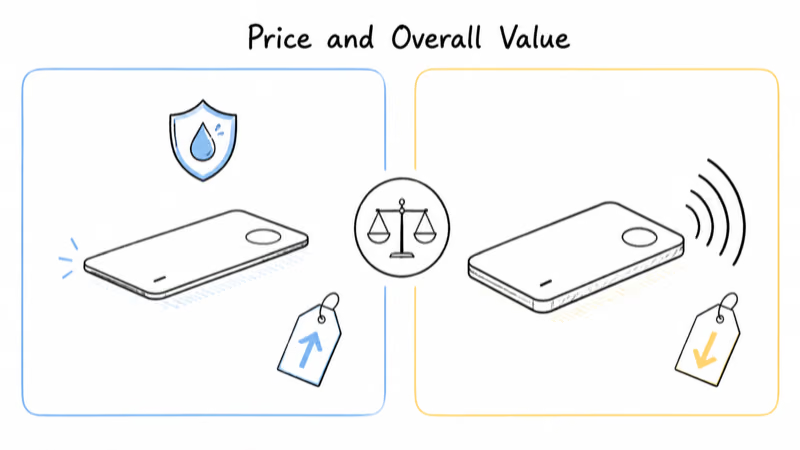
The KeySmart’s extra six dollars buys the thinner, more sealed body. If your wallet is already tight on space or faces real water, that premium is easy to justify. If you mostly want a lower-priced, loud, rechargeable card and a couple of millimeters don’t bother you, the Chipolo CARD is the better deal.
To place both against AirTag and the wider field of slim trackers, our wallet card buying guide ranks the current market and shows where these two land.
Bottom Line
Get the KeySmart SmartCard (Gen 3) if you want the thinnest dual-network wallet card with IPX8 full-submersion protection, and the slimmer, more sealed body is worth $44.99. Get the Chipolo CARD if you want the cheaper option at $38.99 with a confirmed 110 dB ringer and don’t mind a 2.5mm body. Both are honest choose-one rechargeable cards; KeySmart wins on form, Chipolo wins on price and loudness.
FAQ
Can the KeySmart SmartCard and Chipolo CARD use Find My and Find Hub at the same time?
No. Both cards make you choose either Apple Find My or Google Find Hub at setup. Switching networks requires a factory reset and re-pairing in the other app, which clears your location history. This is a hardware limit of a single Bluetooth radio, not a software choice.
Which card is thinner?
The KeySmart SmartCard is thinner at 1.8mm, versus the Chipolo CARD’s 2.5mm. The 0.7mm gap is noticeable in a packed wallet, where the KeySmart sits flush and the Chipolo CARD raises the card stack slightly. Both still fit a standard card slot.
Which card has the louder alarm?
The Chipolo CARD has the louder confirmed alarm at 110 dB, published on its spec sheet. KeySmart does not list a decibel rating for the SmartCard’s alarm, so the Chipolo CARD is the safer pick if you need to find a card by sound in a couch or bag.
Which card is more water resistant?
The KeySmart SmartCard is rated IPX8 for full submersion, the strongest tier on the ingress-protection scale. The Chipolo CARD is rated IP67, which is dust-tight and survives 1 meter of water for 30 minutes. For a wallet that faces heavy water, the KeySmart has the larger margin.
How long does each card’s battery last?
The two are close. The KeySmart SmartCard is rated for about 11 months per Qi charge, and the Chipolo CARD for about 12 months. Both recharge wirelessly on any Qi pad and use a sealed rechargeable battery instead of a replaceable coin cell.
Do either of these trackers need a subscription?
No. Neither the KeySmart SmartCard nor the Chipolo CARD requires a subscription. Apple Find My and Google Find Hub are free for certified third-party trackers, so you pay once for the hardware and nothing after that.
Which card is the better value?
It depends on what you weigh. The Chipolo CARD costs $38.99 and adds a louder confirmed ringer and a slightly longer battery. The KeySmart costs $44.99 and adds a thinner 1.8mm body and IPX8 submersion. Pick the Chipolo CARD for price, the KeySmart for form factor.