The Ridge Tracker Card promises AirTag-style finding in a slot your wallet already has. Apple’s own Find My network overview confirms that any Find My accessory rides the same crowd network as an AirTag. So the real question is the hardware and the $45 price.
- 2.4mm thick and credit-card sized (85 x 53.9mm), so it fits the card-slot format
- Rechargeable 155mAh battery lasts about 5 months, then tops up on any Qi or MagSafe charger
- 95dB ringer is the published sound spec for close-range wallet finding
- Apple Find My only — no Android, no Google support as of mid-2026
- $45 list price, often discounted to about $36 on Amazon, with zero subscription fees
What Is the Ridge Tracker Card?
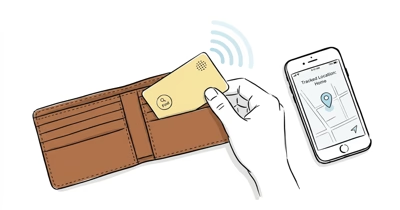
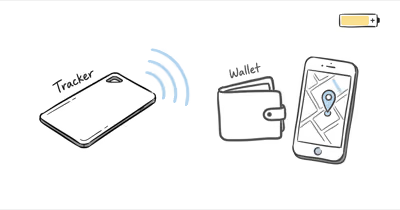
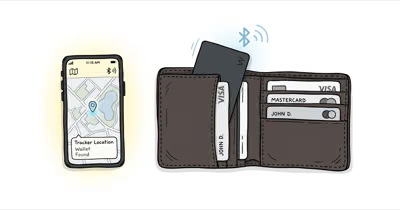
The Ridge Tracker Card is a Bluetooth finder shaped like a credit card. It joins Apple’s Find My network, the same one AirTag uses, so any nearby iPhone can relay its location back to you. Ridge markets it for wallets, but it fits luggage tags, passport holders, and any slot sized for a card.
Ridge ships it MFi-certified, the badge Apple grants accessories that pass its hardware tests. That matters, because a non-certified Find My clone can be cut off from the network without warning. Travel writer Anil Polat of foXnoMad, who carried the card in a real wallet, reported that he only needed to wireless charge it every 5 months or so. That figure matches Ridge’s stated 155mAh battery spec, and it’s the card’s whole pitch in one number.
Its edge over the Chipolo CARD Spot and Ekster Tracker Card is simple: the Ridge battery recharges instead of forcing a replacement card.
Ridge Tracker Card: Complete Buying Summary
§ Review summary
Ridge Tracker Card
≡ Specs
- Dimensions
- 85 × 53.9 × 2.4mm
- Network
- Apple Find My
- Battery
- 155mAh rechargeable; about five months
- Charging
- Qi or MagSafe; charger not included
- Ringer
- 95dB published rating
- Water resistance
- IP67
- Precision Finding
- No
- Subscription
- None
✓ Pros
- +Qi-rechargeable battery avoids replacing the whole card
- +2.4mm credit-card format fits a normal wallet slot
- +95dB published ringer supports nearby wallet searches
- +IP67 rating covers dust and brief shallow-water exposure
- +Apple Find My tracking has no recurring subscription
✗ Cons
- −Works only with Apple Find My, not Android or Find Hub
- −No UWB Precision Finding or directional arrow
- −Five-month battery cadence requires roughly two charges a year
- −No Qi or MagSafe charger is included
- −Costs more up front than sealed Chipolo CARD Spot
§ Buy if
- ·Buy if you carry an iPhone and want a tracker card you can recharge for years
- ·Buy if IP67 protection and a loud nearby ring justify the premium
- ·Choose another card for Android or mixed-platform use
- ·Skip if directional recovery or real-time theft tracking is required
Design and Thickness
The card measures 85mm by 53.9mm, the footprint of a standard credit card, and 2.4mm thick. That is fractionally thicker than a real card but close enough that it disappears in a slot. Owners on Best Buy and Amazon repeatedly describe it as fitting “perfectly” without adding bulk, which is the bar a wallet card has to clear.
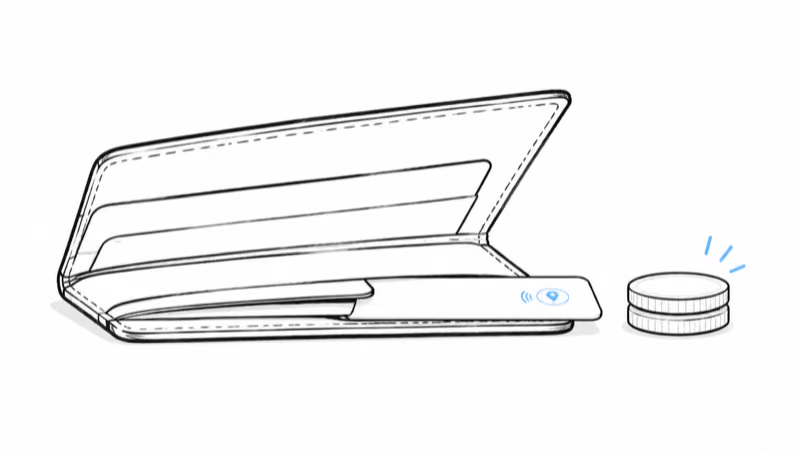
For comparison, the Chipolo CARD Spot is the same 2.4mm, and the Ekster Tracker Card is slightly slimmer at 2.1mm. All three are far thinner than dropping a coin-shaped AirTag into a card-slot adapter, which is the clumsy workaround the card format exists to replace. If you want the AirTag route instead, our best AirTag wallet guide covers the slimmest holders.
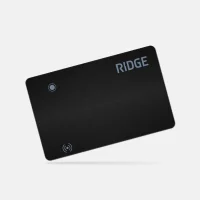
The build is plain matte black with the Ridge logo. There is no screen, no button you press to ring it, and no replaceable parts. Everything happens through the Find My app on your iPhone.
How Long Does the Battery Last?
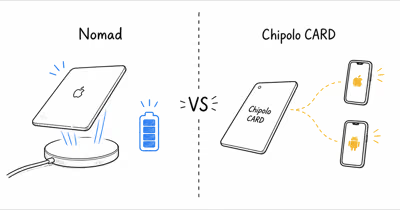
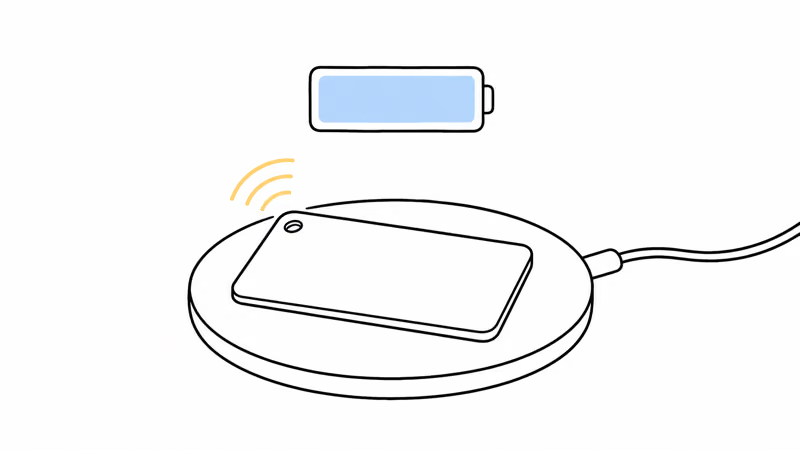
Ridge rates the 155mAh battery at about five months per charge. When it runs low, you set the card on any Qi wireless pad or MagSafe charger and top it back up. No cable plugs into the card itself, and no charger comes in the box — you use one you already own.
This is the card’s defining trait, and it’s the one reason to pay the premium. The Ridge card is the only one of the three major Find My wallet cards you never have to replace.
The Chipolo CARD Spot (sealed two-year battery) and the Ekster Tracker Card (sealed three-year cell) both eventually force a $35-$40 repurchase. Ridge just asks for a recharge twice a year.
The trade-off is attention. A sealed three-year card is truly fire-and-forget. The Ridge card needs a recharge roughly twice a year, and if you forget, it goes dark until you remember. Whether that’s a fair swap depends on how much you trust your own routine.
Sound and Ringing
A 95dB ringer sits inside the card, triggered from the Find My app when you’re close enough on Bluetooth. That lands it above the Ekster card’s quieter 80dB buzzer and just below the loudest cards in the table, though raw decibel numbers don’t tell the whole story once a beep has to travel through folded leather.
Owner reviews describe the sound as easy to hear in a quiet room and through a wallet, which is the realistic test for a finder you keep in a pocket. A handful of buyers on Best Buy report the opposite problem — random alarms going off on their own after months of use — a glitch that seems tied to occasional Bluetooth connection hiccups rather than any hardware defect in the card itself.
On paper, 95dB is a close-range wallet-finding spec, not a long-distance siren. A card-format tracker still depends on Bluetooth range and the Find My network once the wallet leaves the room.
Ridge vs Chipolo CARD Spot vs Ekster
All three cards do the same core job: join Find My and let nearby iPhones report a location. The differences live in battery, sound, price, and platform reach. Here is how they line up.
| Spec | Ridge Tracker Card | Chipolo CARD Spot | Ekster Tracker Card |
|---|---|---|---|
| Thickness | 2.4mm | 2.4mm | 2.1mm |
| Battery | Rechargeable, ~5 months | Sealed, ~2 years | Sealed, ~3 years |
| Ringer | 95dB | 105dB | 80dB |
| Network | Apple Find My | Apple Find My | Apple + Google |
| Water resistance | IP67 | IPX5 | IP-rated splash |
| List price | $45 | $35 | $40 |
The Chipolo is loudest and cheapest up front. The Ekster is the only one that works on Android phones, which matters if your household mixes platforms. The Ridge is the only rechargeable option, and it carries the strongest water rating at IP67. Our best wallet tracker card roundup ranks all three for different buyers.
None of these cards has ultra-wideband. That single missing feature shapes how well any of them actually recovers a lost wallet, so it deserves its own section.
Why No UWB Changes the Math
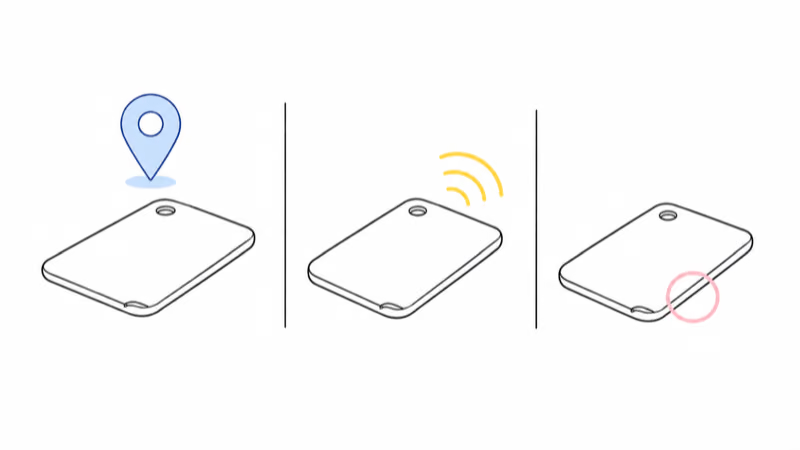
The Ridge Tracker Card has no ultra-wideband (UWB) chip. That’s the technology behind the on-screen arrow that walks you to a lost AirTag. Without it, the card rings and drops a map pin, but it can’t point you to the inch.
Anil Polat hit this limit directly. In his follow-up test against an AirTag, he had friends walk off with both trackers and timed the alerts. He reported that it took over 10 minutes to get a single notification.
His conclusion is the one to carry away. Cards like this are built for lost items, not stolen ones. They’ll tell you the wallet is at the cafe, that you left it at home, or that a kind stranger has it. What they won’t do is lead you to a thief in real time.
That’s a Find My network limit, not a Ridge flaw, and it applies equally to Chipolo and Ekster. If real-time recovery is your goal, a GPS tracker for your wallet is the category you actually want.
Who the Ridge Tracker Card Is Built For
This card fits a specific buyer. You carry an iPhone, you want a wallet finder that never needs replacing, and you don’t mind a recharge twice a year. Ridge wallet owners are the obvious fit — the card is designed around that ecosystem — but it works in any wallet with a card slot.
Buy it if you value the rechargeable battery and the IP67 water rating, and you’re committed to the Apple ecosystem. The long-term cost is essentially the $45 sticker and nothing more, since you never repurchase.
Skip it if you use Android, in which case the Ekster card is your only cross-platform option here. Skip it too if you want the cheapest upfront price, where the $35 Chipolo wins, or if you need precision recovery, where no card competes with a true GPS unit.
The short version: the Ridge card trades a little ongoing attention for a battery that outlives its rivals. For the right owner, that’s a smart trade.
Bottom Line
The Ridge Tracker Card is the wallet finder to buy if you are an iPhone owner who hates replacing dead trackers. Its rechargeable battery, IP67 rating, and 95dB ringer make it a solid daily carry at $45, and discounted Amazon pricing improves the value when available.
Just go in clear-eyed about the two limits: it’s iPhone-only, and like every card tracker it finds lost wallets, not stolen ones. If those fit your situation, it earns its slot.
FAQ
Does the Ridge Tracker Card work with Android?
No. The Ridge Tracker Card uses Apple’s Find My network and works only with iPhones and iPads. As of mid-2026 there is no Android or Google Find Hub support. If you carry an Android phone, the Ekster Tracker Card is the cross-platform alternative, since it works on both Apple Find My and Google Find My Device.
How do you charge the Ridge Tracker Card?
You charge it wirelessly. Set the card on any Qi wireless charging pad or a MagSafe charger and it tops up the built-in 155mAh battery. No cable plugs into the card, and Ridge doesn’t include a charger in the box, so you use one you already own. A full charge lasts about five months.
How loud is the Ridge Tracker Card?
The ringer outputs 95dB, triggered from the Find My app when your phone is within Bluetooth range. That’s louder than the Ekster card’s 80dB buzzer, though a touch below the loudest Chipolo card, and all of them are short-range aids rather than long-distance sirens.
Is the Ridge Tracker Card waterproof?
It carries an IP67 rating, which means it withstands dust and brief submersion in shallow water. That covers everyday risks like rain, spills, or a dropped wallet near a sink. It’s the strongest water rating of the major Find My wallet cards, since the splash-only competitors are not rated for submersion at all.
Can the Ridge Tracker Card track a stolen wallet?
Not reliably. Reviewer Anil Polat found that Find My cards update too slowly to follow a wallet someone is actively carrying away, and the card has no UWB arrow for precise close-range tracking. It works well for wallets you misplace or leave behind, but it isn’t an anti-theft device. For real-time recovery you need a GPS tracker instead.
How much does the Ridge Tracker Card cost?
The list price is $45 on Ridge’s website and most retailers. It may drop during Amazon sales. There are no subscription fees, and because the battery recharges, you never buy a replacement card, so the sticker price is essentially the lifetime cost.
Is the Ridge Tracker Card better than an AirTag for a wallet?
For a wallet, yes, on form factor. The card slides into a slot, while an AirTag needs a bulky holder. Both use the same Find My network, so coverage is identical. The AirTag wins on precision finding thanks to its UWB chip, but if slimness is your priority, the card is the better wallet fit.