A snowmobile sits in unsecured storage half the year, then disappears into trail systems where cellular service drops out for hours at a time. The National Insurance Crime Bureau reported that snowmobile recovery sits near 42%, far below the 80% figure for stolen passenger cars. Most sleds are gone before owners notice. A tracker that costs less than one fuel jug closes that gap.
- Best overall: Tracki Pro at $36 hardware + $20/mo, with a 10,000 mAh battery and a 12V hardwire kit for sled installs
- Best annual-billing: Vyncs at $99.99/yr (device included), three-year total around $340
- Best stealth anti-theft: LandAirSea 54 at $30, magnetic mount that hides under the tunnel or in the airbox
- Best for backcountry: Optimus 3.0 at ~$27 + $19.95/mo, with an SOS panic button for rider emergencies
- Cellular dead zones cover most trails: 42% snowmobile recovery rate vs 80%+ for cars shows the gap a tracker has to close
How Cold Weather and No Cell Service Change the Trade-offs
The first thing snowmobile buyers learn is that none of the major consumer GPS trackers publish a manufacturer-stated cold-temperature operating rating. We checked the spec sheets for all five trackers in this guide; only purpose-built fleet hardware advertises down to -40°F. LandAirSea’s own product page notes the 54 is rated IP65 for dust and splash but provides no minimum operating temperature, and Tracki, Spytec, Vyncs and Optimus follow the same pattern.
Battery University states that lithium-ion runtime falls roughly 30% in winter conditions, which means a tracker rated for two weeks at room temperature is realistically a 10-day device on a stored sled in a Minnesota driveway.
Two install paths solve the cold-runtime problem. A 12V hardwire to the sled battery eliminates it entirely. A portable tracker mounted inside the airbox or under the seat uses engine heat to keep the unit above freezing during rides.
The second trade-off is cellular coverage. Polaris confirms that its RIDE COMMAND system stores over 380,000 trail miles offline because most trail systems are outside reliable LTE coverage. A cellular tracker is useful for theft (sleds get moved to populated areas) but unreliable for live-tracking a rider in the backcountry.
For genuine wilderness riding, you layer in a satellite communicator like a Garmin inReach. A cellular tracker is the recovery tool; the satellite radio is the rescue tool.
The Best Snowmobile GPS Trackers in 2026
We compared each tracker against four criteria: 12V hardwire support, IP-rated enclosure, hidden-mount feasibility, and three-year subscription cost. Picks are ranked by how those four factors trade off against price.
Tracki Pro: Best Overall
Tracki Pro wins because it’s the only tracker in this guide that pairs a large 10,000 mAh battery with both a built-in SIM and a 12V hardwire kit. The hardwire kit handles cold-weather runtime; the 10,000 mAh battery covers the storage scenario for sleds without a working battery; the global SIM gives you signal in cross-border riding regions (US, Canada, Europe).
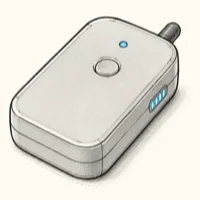
Hardwired to a 12V keyswitch tap, Tracki Pro draws power from the sled and stays online indefinitely, which is the setup that makes the most sense for a machine parked outdoors through a cold snap. In battery-only mode, plan for runtime below the 7-month power-save figure on the spec sheet, since that number assumes warmer conditions and 30-minute reporting intervals; sub-freezing temperatures and frequent reporting both shorten it considerably.
The downside: Tracki Pro requires a $20/month subscription on the standard plan, and the multi-year prepay options reduce the monthly cost but lock you in.
Vyncs GPS: Best No-Monthly-Fee Option
Vyncs is the annual-billing winner because the $99.99 annual plan (device included) brings the three-year total to roughly $340 against $720 for Tracki Pro on the standard plan. There is a one-time $39.99 activation fee, and the location update interval is slower at 3 minutes on the base plan, but the math wins over any horizon longer than about two years.
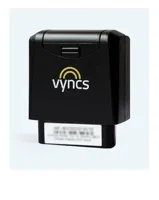
The catch is the OBD-II form factor. Vyncs plugs into a standard 16-pin OBD-II port, which most snowmobiles don’t have. For sled use, you order the Vyncs 12V hardwire adapter and tap the keyswitch-fed power line.
The install is a basic crimping job rather than a plug-in setup.
If your sled is a pull-start model with no battery, you can still run Vyncs by adding a small auxiliary lithium battery in the stock battery-tray location, but at that point the install is non-trivial and a portable tracker is the easier path.
LandAirSea 54: Best for Stealth Anti-Theft
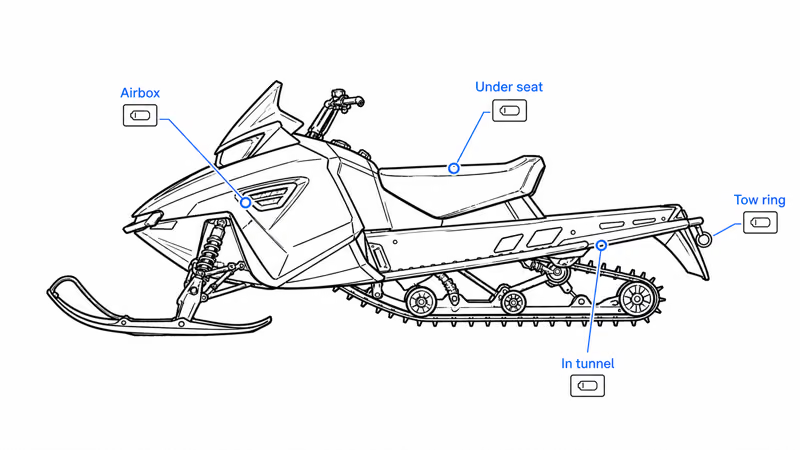
LandAirSea 54 is the right pick when theft recovery matters more than rider tracking. At $30 hardware it’s the cheapest entry point in this guide, and the magnetic mount lets you stick it under the tunnel, inside the airbox, or behind the headlight cowl where a thief looking for an OBD or hardwired tracker won’t find it.
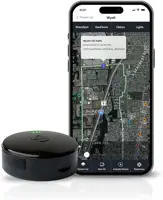
The 4G LTE radio reports on a $20/month Silver plan, which can be paused during off-season storage in covered buildings. The LandAirSea 54 magnetic mount is rated for roughly two weeks of runtime in default mode, but plan on noticeably less in deep cold: lithium-ion cells lose a meaningful share of their capacity below freezing, so a tracker reporting hourly through a -10°F stretch will reach a recharge sooner than the spec sheet suggests.
LandAirSea 54 pairs well with a Tracki Pro or Vyncs install. The hardwired primary reports live; the magnetic backup keeps reporting from its hidden spot even after a thief unplugs the obvious one. On a high-value sled, that redundancy is worth the extra $50.
Spytec GL300: Best for Renters and Multi-Sled Riders
Spytec GL300 is the right pick when you want a tracker that moves between sleds, not one bonded to a specific machine. It runs on Verizon LTE in the US, has a 2.5-week battery in default mode that stretches to 4 weeks with reduced reporting, and accepts a magnetic case for hidden mounting.

The trade-off is cost. The Spytec subscription is the highest in this guide at $34.95/month, which puts the three-year total around $1,258. For owners of a single sled, Vyncs or Tracki Pro is a better economic choice. For someone who tracks a rotating fleet of two or three sleds owned by family members, paying for one Spytec unit and rotating it between vehicles per riding season can be cheaper than buying multiple OBD-II or hardwired trackers.
Spytec and Tracki both run on cellular SIMs with similar signal reliability; the Spytec advantage is the magnetic case ecosystem and the larger spare-battery aftermarket.
Optimus 3.0: Best for SOS-Capable Solo Riding
Optimus 3.0 is the right pick when you ride alone and want a tracker that doubles as an emergency button. The unit has a physical SOS panic button on the case that, when pressed, sends a high-priority location alert to up to five contacts you configure in the app.
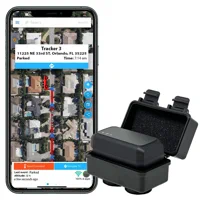
The Optimus subscription runs $19.95/month, with discounts on longer prepaid terms. Battery life is rated up to a month at the default reporting setting, which outlasts Spytec at a lower hardware cost. The drawback for snowmobile use is the lack of a 12V hardwire option; Optimus is portable-only, which means the cold-weather runtime derate hits the device directly.
An SOS button only fires with cellular service, so layer a Garmin inReach Mini 2 on the rider for true backcountry routes outside LTE.
How Do You Install a GPS Tracker on a Snowmobile?
The install choice depends on whether your sled has an electric start and a working 12V battery. About 70% of modern 4-stroke sleds do; most 2-stroke pull-start models don’t.
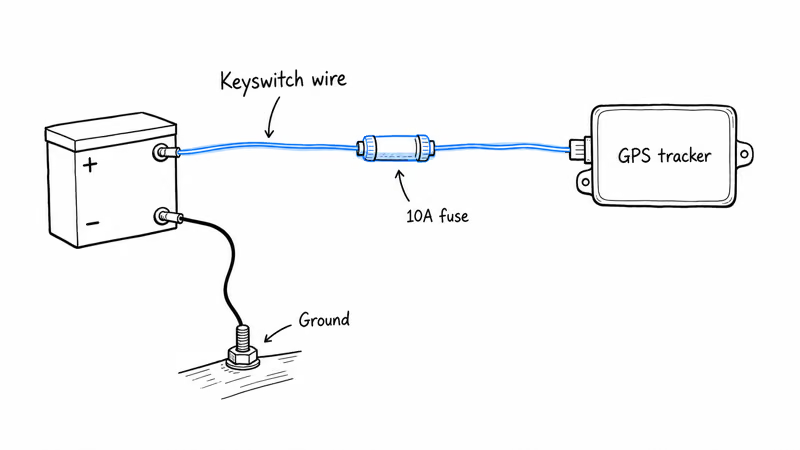
For sleds with a battery and electric start. Use a fuse tap on the keyswitch-fed circuit (typically the large red wire on Ski-Doo and Polaris ignition switches). Install an inline 10A fuse on the positive lead within 6 inches of the power source.
Wire ground to a clean chassis bolt on bare metal, not painted or plastic surfaces. This is the standard install for Tracki Pro with the 12V kit, and the same approach works for Vyncs with its hardwire adapter.
For pull-start sleds with no battery. Three options exist: add a small lithium battery in the stock battery-tray location and wire as above; use a portable tracker (Tracki Pro on battery, Spytec, Optimus, or LandAirSea 54) and accept the cold-weather runtime hit; or hardwire to the keyswitch circuit on running-only power (no theft tracking when the sled is off, but no parasitic battery drain either).
Hidden-Mount Spots Thieves Won’t Find
A thief who has ridden snowmobiles knows the obvious mounting spots: under the seat, on the dash, on the tow ring. The places they don’t check first are inside the airbox, behind the headlight cowl, under the tunnel between the running boards, and inside the storage compartment in the chassis. Magnetic trackers like LandAirSea 54 are designed for those locations specifically.
Plastic-bodied trail sleds have fewer magnetic-mount options, which is why their owners default to airbox installs.
How Do You Cover Areas Without Cellular Service?
Cellular GPS trackers fail in true wilderness because they need a tower to phone home. Most trails in Minnesota’s Boundary Waters, Wisconsin’s Northwoods, Alaska’s Iditarod Trail system, and the backcountry behind Yellowstone have no LTE coverage at all.
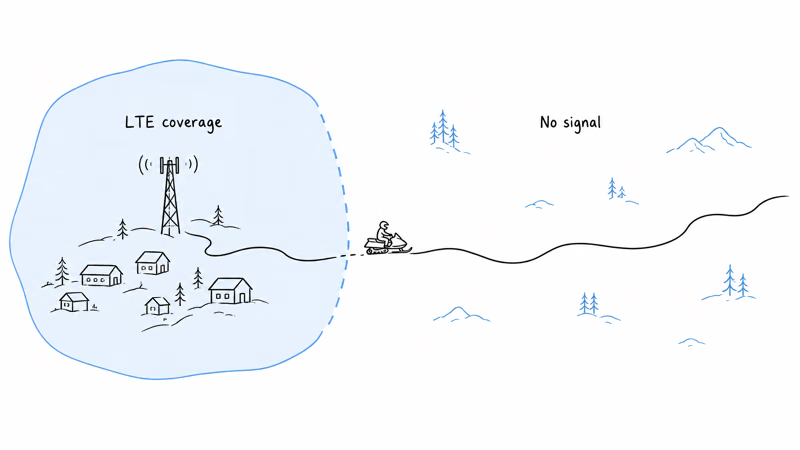
The standard pattern for backcountry-bound riders is to use two devices:
- Cellular tracker for theft recovery. A Tracki Pro or LandAirSea 54 mounted on the sled reports location only when the sled is moved to a populated area, which is exactly the recovery scenario after a theft. The dead-zone gap doesn’t matter because nobody is stealing snowmobiles from deep wilderness.
- Satellite communicator for the rider. A Garmin inReach Mini 2 or Zoleo carried on the rider’s person provides two-way text messaging and an SOS function via Iridium, with no dependency on cellular service. Gaia GPS’s cell coverage overlay is the easiest pre-trip check to see whether your planned route exits LTE.
The cellular tracker on the sled and the satellite communicator on the rider are not redundant; they cover different failure modes. The tracker covers stolen sleds; the satellite radio covers stranded riders.
If your riding stays within state-park trail systems with reasonable LTE coverage along the main roads (most of upstate New York, southern Wisconsin, the Upper Peninsula of Michigan near towns), a cellular tracker alone is enough. The two-device pattern is specifically for riders who exit cell range for more than 2-3 hours at a time.
Subscription Costs Compared Over 3 Years
The sticker price of a snowmobile tracker is misleading because subscription cost dominates the three-year total. Across the five trackers in this guide, the gap between cheapest and most expensive ownership is about $918.
| Tracker | Hardware | Subscription | 3-year total |
|---|---|---|---|
| Tracki Pro | $36 | $20/mo | About $756 |
| Vyncs | $0 (in plan) | $99.99/yr annual | About $340 |
| LandAirSea 54 | $30 | $20/mo (pausable) | About $510 (pause 6 mo/yr) |
| Spytec GL300 | Free w/ plan | $34.95/mo | About $1,258 |
| Optimus 3.0 | ~$27 | $19.95/mo | About $745 |
Two factors shift the math.
The first is pause behavior. LandAirSea 54 lets you pause the Silver plan during off-season storage (April through October in most of the US snow-belt), which knocks the three-year subscription cost roughly in half for riders who only need active tracking during the November-March riding window. Tracki Pro and Spytec don’t offer pause; you pay year-round.
Many of those same owners switch to summer water toys in that window. Our PWC tracker guide covers the warm-season counterpart with the same pausable-plan logic.
The second factor is multi-year prepay. Tracki sells 1-year, 3-year, and 5-year prepay plans at progressively deeper discounts. The 5-year Tracki plan drops the effective monthly cost to about $10/month, which lands the 3-year horizon at roughly $396 instead of $756. Most riders who buy a sled to keep for 5+ years should look at the prepay option seriously.
Vyncs is the cheapest no-monthly path, but its 3-minute refresh feels slow for live group rides. For pure theft recovery the interval is irrelevant.
Riders looking at other off-road vehicles will find overlapping picks at different price points in our best GPS tracker for ATV roundup and the best GPS tracker for truck guide. Tracki Pro and Vyncs both appear in those guides, but the mounting and weather trade-offs are different on enclosed cargo vehicles than open trail sleds.
For pure stealth-only anti-theft, see our best anti-theft GPS tracker for car coverage. Cellular-SIM-specific picks live in the best GPS trackers with SIM card roundup.
Bottom Line
The Tracki Pro is the default snowmobile GPS pick: 10,000 mAh battery, IP67 enclosure, 12V hardwire kit, and global SIM in a single $36 unit. Add LandAirSea 54 as a hidden secondary for sleds parked in unsecured storage. Vyncs is the right answer if you refuse monthly subscriptions and can wait 3 minutes between location pings.
None of these trackers replace a Garmin inReach for backcountry rider safety. The cellular tracker recovers the sled after a theft; the satellite communicator gets the rider home after a breakdown. Riders who exit LTE coverage for more than a couple of hours should carry both.
FAQ
What is the best GPS tracker for a snowmobile?
Tracki Pro is the best overall pick because it pairs a 10,000 mAh battery with a 12V hardwire kit, IP67 weatherproofing, and a global SIM. That combination handles both stored-sled scenarios and active-riding scenarios without forcing you to choose between battery life and install permanence. For annual-billing buyers, Vyncs at $99.99/year (device included) is the runner-up.
Will a GPS tracker work in cold weather?
All the trackers in this guide use lithium-ion batteries, which lose a significant share of their rated runtime in sub-freezing conditions. None of the consumer-grade trackers publish a manufacturer-stated minimum operating temperature, and owners do report them continuing to function through multi-day cold snaps at single-digit temperatures, though with shortened battery life. Hardwiring to a 12V sled battery eliminates the runtime concern entirely.
How do I hide a GPS tracker on a snowmobile?
The four hidden-mount locations that thieves rarely check are inside the airbox, behind the headlight cowl, under the tunnel between the running boards, and inside the chassis storage compartment. Magnetic trackers like the LandAirSea 54 are designed for those spots. Avoid mounting on the dash, under the seat, or on the tow ring because experienced thieves check those first.
Do snowmobile GPS trackers work without cell service?
Cellular trackers like Tracki, Vyncs, Spytec, Optimus, and LandAirSea 54 require LTE coverage to report location. Most snowmobile trail systems in northern Minnesota, the Boundary Waters, the Iditarod corridor, and similar backcountry areas have no LTE service. For wilderness riding, layer a satellite communicator like Garmin inReach Mini 2 on the rider while the cellular tracker stays on the sled for theft recovery.
Can I install a GPS tracker on a pull-start snowmobile with no battery?
Yes, through one of three paths. Use a fully portable tracker like Tracki Pro, Spytec GL300, or LandAirSea 54 that runs on its own battery; install a small auxiliary lithium battery in the stock battery-tray location and hardwire as you would on an electric-start sled; or wire the tracker only to the running-only power circuit (no theft tracking when the sled is off, but no parasitic drain either).
How much does it cost to track a snowmobile per year?
Subscription costs range from $99.99 per year for Vyncs (annual plan) to about $419 per year for Spytec GL300 at $34.95/month. Tracki Pro and Optimus run about $240/year on standard plans. LandAirSea 54 effectively costs about $120/year if you pause the subscription during the April-October off-season. Multi-year prepay options at Tracki and Vyncs reduce the per-year cost further.
Will theft insurance discounts cover the tracker cost?
Most snowmobile insurance carriers offer 5 to 15% premium discounts for active GPS tracking, similar to RV and motorcycle policies. On a $250-per-year sled premium, a 10% discount saves $25 annually, which doesn’t fully cover the subscription but reduces effective tracker cost to roughly $150-220/year on the better plans. Riders with multiple insured sleds see larger absolute savings.