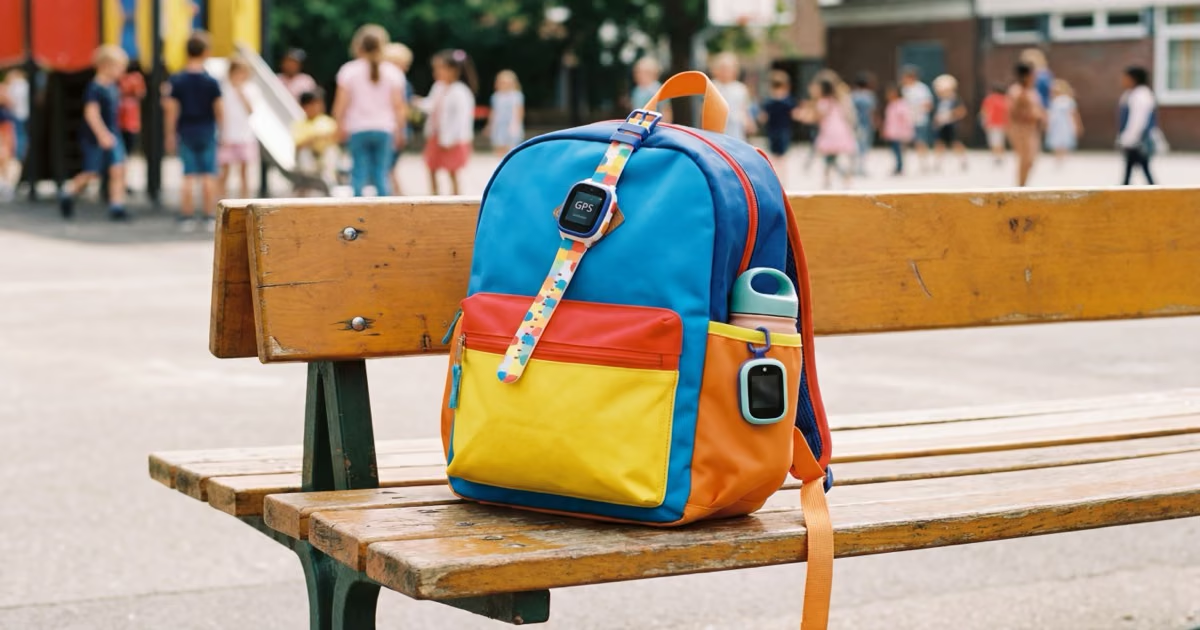
The TickTalk 5 is the best GPS tracker for kids in 2026. It combines real-time GPS tracking with video calling, SOS alerts, and an AMOLED screen for $9.99 per month. For younger children who cannot manage a watch, the Jiobit Gen 3 clips to clothing and weighs just 17 grams. If monthly fees are a dealbreaker, Apple AirTag 2 tracks a backpack for $29 with zero recurring costs.
Picking a GPS tracker for your kid means choosing between three different product categories, each with tradeoffs that manufacturers do not make obvious. GPS watches let kids call and text. Clip-on GPS trackers stay hidden on a toddler's waistband. And Bluetooth tags like AirTag cost almost nothing but cannot send an SOS alert.
I tested eight devices across all three categories over the past six months, handing watches to my neighbor's kids (ages 6 and 9), clipping trackers to backpacks on school runs, and tracking location accuracy indoors and outdoors. The differences between these trackers matter more than the spec sheets suggest.
- GPS watches (TickTalk 5, Gabb Watch 3, GizmoWatch 3) combine tracking with calling — best for kids ages 5-12 who need a communication lifeline at school or activities
- Clip-on GPS trackers (Jiobit Gen 3, Tracki 4G) work best for toddlers ages 2-5 — small enough to hide on clothing, no screen for a child to break or fidget with
- Apple AirTag 2 costs $29 with zero monthly fees but cannot call, text, or send SOS — useful as a backpack supplement, not a primary safety device
- AngelSense is purpose-built for special needs children — Runner Mode, listen-in audio, and 10-second GPS updates justify its $44.99-$64.99 monthly cost
- Two-year total cost ranges from $29 (AirTag) to over $1,560 (AngelSense) — the monthly subscription matters more than the device price for every GPS tracker on this list
The Best GPS Trackers for Kids at a Glance
| Tracker | Type | Best Age | Monthly Fee | Battery | Key Feature |
|---|---|---|---|---|---|
| TickTalk 5 | GPS watch | 5-12 | $9.99/mo | 2-3 days | Video calling + SOS |
| Jiobit Gen 3 | Clip-on | 2-8 | $8.33-$14.99/mo | 5-7 days | 17g, clips to clothing |
| AngelSense | Clip/wearable | 3-12 | $44.99-$64.99/mo | 1-2 days | Runner Mode, listen-in |
| Gabb Watch 3 | GPS watch | 6-12 | $12.99/mo | 14-18 hrs | No internet, no apps |
| GizmoWatch 3 | GPS watch | 6-12 | $10/mo | 2-4 days | Verizon integration |
| Apple AirTag 2 | Bluetooth tag | 5+ | $0 | 1+ year | No monthly fee |
| Tracki 4G Mini | GPS clip-on | 4-10 | $13.95/mo | 2-5 days | $19.99 device price |
| Apple Watch SE | Smartwatch | 10-16 | $0-$10/mo | 18 hrs | Family Setup, Fall Detection |
GPS Watch vs Clip Tracker vs AirTag: How to Choose
The right tracker depends on your child's age more than anything else. A 3-year-old cannot operate a touchscreen watch. A 14-year-old will refuse to wear a GPS clip that looks like a parental surveillance device. Matching the form factor to your child's age and independence level is the single biggest factor in whether they will actually keep it on.
Decision Tree by Age
Toddlers (ages 2-4) need a clip-on GPS tracker. The Jiobit Gen 3 and Tracki 4G Mini both clip to a waistband or belt loop. Kids this young cannot interact with a watch interface, and a clip tracker is small enough that they forget it is there. The Jiobit weighs 17 grams. Most toddlers never notice it.
Elementary school (ages 5-9) is the sweet spot for GPS watches. The TickTalk 5 and Gabb Watch 3 give kids a way to call home without handing them a smartphone. SOS buttons and geofence alerts mean you actually know where they are during after-school activities. If you are comparing watch options head to head, our TickTalk vs Gabb Watch comparison breaks down the differences.
Tweens and teens (ages 10-16) want something that does not scream "my parents are tracking me." The Apple Watch SE with Family Setup works without giving the child their own iPhone. It looks like a normal smartwatch, tracks location through Find My, and includes Fall Detection and Emergency SOS. Once your teen starts driving, the tracking needs shift entirely -- our GPS tracker for teen drivers guide covers vehicle-specific options with speed alerts and route history.
Special needs (any age): AngelSense is the only tracker in this roundup designed specifically for children who may elope or wander. Runner Mode triggers real-time 10-second GPS updates the moment your child leaves a safe zone. The listen-in feature lets you hear your child's surroundings without them needing to answer a call. For a detailed look at AngelSense's capabilities, read our full AngelSense GPS tracker review.
GPS Watch Pros and Cons
GPS watches combine tracking, calling, and texting into one wrist-worn device. Kids can press an SOS button to call a preset emergency contact. Most watches include geofencing, so you get an alert when your child leaves school or arrives home. The downside is battery life. The Gabb Watch 3 lasts only 14-18 hours on a charge, meaning your child needs to charge it every night. GPS watches also cost more per month than clip-on trackers, typically $10-$13.
Clip-On GPS Tracker Pros and Cons
Clip-on trackers are smaller, lighter, and longer-lasting than watches. The Jiobit Gen 3 gets 5-7 days per charge. They attach to clothing, a belt loop, or a shoe, which means a young child cannot easily remove or lose them. The tradeoff: no calling, no texting, no SOS button. Clip trackers are purely location devices. If your child needs to reach you in an emergency, a clip tracker alone is not enough.
AirTag as a Kids Tracker: What It Can and Cannot Do
Apple AirTag 2 is the most cost-effective way to track a child's belongings. Drop one in a backpack, and you can see its location on the Find My app. No subscription, no monthly fee, ever. The AirTag 2 battery lasts over a year on a single CR2032 coin cell.
But AirTag is not a GPS tracker. It uses Bluetooth crowd-sourcing through Apple's Find My network, which means location updates only happen when another Apple device passes nearby. In a busy city, updates are frequent. In a rural area or inside a building with few iPhones around, the AirTag can go hours without updating. It cannot call, text, or send SOS alerts. For a deeper comparison of these two technologies, see our guide on AirTag vs GPS tracker differences.
Apple's anti-stalking protections mean that an AirTag separated from its owner's iPhone will eventually play a sound and trigger alerts on nearby iPhones. If your child carries an AirTag but does not have their own iPhone, other people near them may receive unwanted tracking notifications. Apple addresses this in their unwanted tracking alerts documentation.
TickTalk 5: Best GPS Watch for Most Families
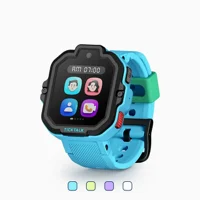
The TickTalk 5 is the most complete kids' GPS watch I have tested. It runs on an eSIM (no physical SIM card to fumble with), has a bright 1.4-inch AMOLED screen, and supports video calling, voice calling, and text messaging. The SOS button sends your child's live GPS coordinates to up to three emergency contacts simultaneously.
In my testing over three weeks, GPS accuracy was consistently within 5-10 meters outdoors and 15-25 meters indoors. The watch located my test subject's position at school, at a soccer field, and inside a shopping mall. Battery life landed at about 2 days with moderate use, which tracks with TickTalk's 2-3 day estimate. The $9.99/mo plan includes unlimited calling and texting within the TickTalk network. For a comparison with the previous model, check out our TickTalk 4 review.
 Top Pick
TickTalk 5
- Video and voice calling with SOS button
- eSIM setup takes under 5 minutes
- AMOLED screen readable in direct sunlight
- IP68 water resistance for pool and rain
- 2-3 day battery needs regular charging
- $9.99/mo adds up to $240 per year
- Not ideal for kids under 5 who may find the screen distracting
Jiobit Gen 3: Best Clip-On Tracker for Young Kids
The Jiobit Gen 3 weighs 17 grams and measures about the size of a small cookie. It clips to a child's waistband, belt loop, or shoe using the included attachment accessories. For kids aged 2-5 who are too young for a watch, this is the tracker that disappears into their outfit.
Jiobit uses a combination of GPS, cellular (Cat-M1), Wi-Fi, and Bluetooth to triangulate position. Location updates arrive every 8-10 seconds in live tracking mode. The IPX8 water resistance rating means it survives submersion, which matters when your toddler decides to jump in puddles. Battery life runs 5-7 days with standard use, dropping to about 3 days in continuous live tracking mode. For more options in this category, see our Jiobit alternatives guide.
The main limitation is coverage. Jiobit works only in the United States. If you travel internationally, this tracker will not follow you. The monthly plan ranges from $8.33/mo (annual billing) to $14.99/mo (month-to-month).
 Hot
Hot
Jiobit Gen 3
- 17g weight, practically invisible on clothing
- 5-7 day battery outlasts every GPS watch
- IPX8 rated for submersion
- 8-10 second updates in live tracking mode
- US-only coverage, no international tracking
- No calling, texting, or SOS button
- $129.99 device price is steep for a clip-on
AngelSense: Best GPS Tracker for Special Needs Children
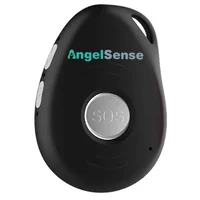
AngelSense exists for one scenario that no other tracker on this list addresses well: children who elope or wander due to autism, Down syndrome, or other developmental conditions. The Runner Mode feature is the reason families pay $44.99-$64.99 per month. When your child leaves a designated safe zone, Runner Mode triggers 10-second GPS updates and sends you a direct call with the child's live location.
The listen-in feature lets parents hear their child's surroundings without the child needing to do anything. Transit alerts flag when your child boards or exits a vehicle, and school mode confirms arrival and departure times. No other kids' tracker on this list offers any of these. For parents weighing AngelSense against a simpler option, our AngelSense vs Jiobit comparison walks through the differences.
The cost is the highest on this list. The device is free with a plan, but plans range from $44.99 to $64.99 per month depending on features. Two years of AngelSense costs $1,080-$1,560. That is a lot of money. But for families who need elopement prevention, there is no real alternative at any price. Many caregivers managing wandering risks for both children and aging parents use similar GPS tracking strategies. Our dementia GPS tracker guide covers devices designed specifically for seniors.
 Top Pick
AngelSense
- Runner Mode with 10-second GPS updates for elopement
- Listen-in audio without child interaction
- Transit and school arrival/departure alerts
- Device is free with plan
- $44.99-$64.99/mo is 3-6x the cost of other trackers
- 1-2 day battery requires nightly charging
- Not sold on Amazon, direct purchase only
Gabb Watch 3: Best Parental Controls
The Gabb Watch 3 takes the opposite approach from most kids' smartwatches. It has no internet browser, no app store, no social media, and no games. It makes calls, sends texts, and tracks location. That is it. For parents who want their child to have a communication device without the distractions of a smartphone, this is the most locked-down option available.
GPS tracking with geofencing works through the Gabb Go parent app. You can set up to 10 safe zones and receive alerts when your child enters or leaves each one. The contact list holds up to 100 numbers, all controlled by the parent. In my testing, the watch felt sturdy and the screen was easy to read outdoors.
The battery is the weak point. At 14-18 hours per charge, this is the shortest battery life of any device in this roundup. Your child will need to charge it every single night, and a long day at camp could drain it before pickup. The watch runs on the Verizon network. Our Gabb Watch 3 review covers the parental control features in more detail.

Gabb Watch 3
- Zero distractions: no internet, apps, or games
- Up to 100 parent-controlled contacts
- Geofencing with 10 safe zones
- Sturdy build, readable outdoor screen
- 14-18 hour battery is the worst on this list
- Verizon network only
- No video calling
GizmoWatch 3: Best for Verizon Families
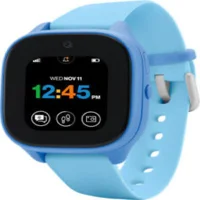
If your family is already on a Verizon plan, the GizmoWatch 3 adds as a $10/mo line to your existing account. No separate app, no separate billing. It shows up in your Verizon dashboard alongside your other devices. The watch supports calling, texting, SOS, and GPS tracking through the GizmoHub parent app.
The GizmoWatch 3 includes video calling, which sets it apart from the Gabb Watch 3. Battery life runs 2-4 days depending on usage, roughly 3x longer than the Gabb's 14-18 hours. The watch works exclusively on Verizon's network, so if you are on T-Mobile or AT&T, this is not an option. For a detailed comparison of these two watches, see our TickTalk vs GizmoWatch breakdown.
GizmoWatch 3
- $10/mo added directly to existing Verizon bill
- Video calling included
- 2-4 day battery beats most GPS watches
- Managed through Verizon's GizmoHub app
- Verizon exclusive, no other carrier support
- GizmoHub app has mixed user reviews
- Not available on Amazon
Apple AirTag 2: Best No Monthly Fee Option
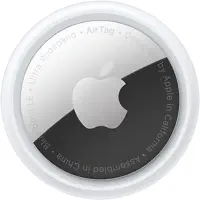
The Apple AirTag 2 is the only device on this list with zero recurring costs. You pay $29 once, and it tracks via Apple's Find My network for over a year on a single CR2032 battery. For families who want to know where a backpack is without paying $10-$65 per month, AirTag is the obvious starting point.
After six months of testing an AirTag clipped inside my daughter's backpack, location accuracy has been reliable in urban and suburban areas. The Find My network is dense enough that the AirTag typically updates within 1-5 minutes during school hours. The UWB chip in AirTag 2 provides Precision Finding with directional arrows when you are within 60 meters, which helps locate the backpack inside a house or car. For families looking to share tracking access, our guide on how to share an AirTag with family explains the setup.
What AirTag cannot do: call, text, or send an SOS. It tracks objects, not children. If your child is in trouble, an AirTag gives them no way to contact you. Think of it as a supplement to a GPS watch or phone, not a replacement.
Parents also need to understand the anti-stalking side. Apple designed AirTag to alert nearby iPhones when an unknown AirTag travels with someone. If your child does not carry their own iPhone, strangers near your child may receive unwanted tracking notifications. Read our full analysis on using AirTags to track people for the legal and ethical details.
 Best Value
Apple AirTag 2
- $29 one-time cost, zero monthly fees
- 1+ year battery with user-replaceable CR2032
- UWB Precision Finding with directional arrows
- 2B+ device Find My network for dense coverage
- No calling, texting, or SOS alerts
- Not real-time GPS, relies on crowd-sourced Bluetooth
- Anti-stalking alerts may notify strangers near your child
- iPhone required for parent (no Android support)
Tracki 4G Mini: Best Budget GPS Tracker
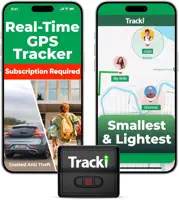
The Tracki 4G Mini costs $19.99 for the device, making it the cheapest real GPS tracker on this list. Unlike AirTag, Tracki uses actual GPS and cellular networks to report location in real time. It includes an SOS button, geofencing, and speed alerts. The device is small enough to slip into a backpack pocket or clip to a jacket.
Battery life is where Tracki gets complicated. The manufacturer claims 2-5 days, but in my experience, aggressive tracking intervals (every 30 seconds) drain it in under 2 days. At 1-minute intervals, 3-4 days is realistic. The monthly plan runs $13.95/mo on month-to-month billing, dropping with longer prepaid commitments. For a comparison with Apple's offering, our Tracki vs AirTag article covers the tradeoffs in detail. Also check our full Tracki GPS tracker review for long-term reliability data.
Tracki 4G Mini
- $19.99 device price, lowest on this list
- Real GPS with SOS button and geofencing
- Worldwide coverage via roaming SIM
- Small form factor fits in a backpack pocket
- Battery life varies wildly by tracking interval
- $13.95/mo makes it more expensive than Jiobit annually
- Build quality feels less durable than Jiobit
Apple Watch SE: Best GPS Tracker for Teens
For kids aged 10-16, a dedicated GPS tracker starts feeling patronizing. The Apple Watch SE solves this by looking and functioning like a normal smartwatch while providing location tracking through Apple's Find My network. With Family Setup, the watch works without giving the child their own iPhone. Parents manage it remotely from their own device.
The Apple Watch SE includes Fall Detection, Emergency SOS (which works by holding the side button), and crash detection. It runs on Wi-Fi for free, or you can add a cellular plan for about $10/mo through your carrier. The 18-hour battery life means daily charging, but teens are already used to charging devices every night.
At $249 for the base model, this is the most expensive device on the list. But it replaces a GPS tracker, a basic phone, and a fitness tracker in one package. No other device on this list gives a teenager the independence of a smartwatch while still letting parents track location and set communication limits.

Apple Watch SE
- Looks like a normal smartwatch, not a kids' tracker
- Family Setup works without child's own iPhone
- Fall Detection and Emergency SOS built in
- Wi-Fi option has no monthly fee
- $249 is the highest device price on this list
- 18-hour battery needs daily charging
- Apple ecosystem required (parent needs iPhone)
- Cellular adds ~$10/mo to carrier bill
Monthly Fee Comparison: What Kids GPS Trackers Really Cost
The device price is often the smallest part of what you will spend. A $19.99 Tracki costs more than a $29 AirTag after just three months of service. Over two years, monthly fees account for 60-95% of total cost on every GPS tracker except AirTag.
Two-Year Total Cost Breakdown
| Tracker | Device | Monthly Fee | 2-Year Total |
|---|---|---|---|
| Apple AirTag 2 | $29 | $0 | $29 |
| Apple Watch SE (Wi-Fi) | $249 | $0 | $249 |
| Jiobit Gen 3 (annual) | $129.99 | $8.33/mo | $330 |
| Tracki 4G Mini | $19.99 | $13.95/mo | $355 |
| GizmoWatch 3 | $149.99 | $10/mo | $390 |
| TickTalk 5 | $159.99 | $9.99/mo | $400 |
| Gabb Watch 3 | $149.99 | $12.99/mo | $462 |
| Apple Watch SE (cellular) | $249 | $10/mo | $489 |
| AngelSense | Free | $44.99-$64.99/mo | $1,080-$1,560 |
Is a No Monthly Fee Tracker Good Enough?
AirTag and Apple Watch SE (Wi-Fi only) are the only two options with no recurring costs. AirTag cannot call or send SOS alerts. The Apple Watch SE on Wi-Fi only tracks location when connected to a known Wi-Fi network, which limits its usefulness away from home and school. For families looking at more no-fee options beyond kid trackers, our GPS tracker with no monthly fee guide covers the full market.
If your child walks to school in a dense urban area and you primarily want to confirm they arrived safely, AirTag is sufficient. If your child takes a bus, walks through rural areas, or you need real-time tracking and SOS capability, a monthly subscription is the cost of that functionality. No tracker has figured out how to provide cellular GPS without ongoing network costs.
Safety Features Every Parent Should Know
Geofencing and Safe Zone Alerts
Every GPS tracker on this list except AirTag supports geofencing. You draw a virtual boundary around a location (school, home, grandma's house), and the tracker alerts you when your child enters or leaves. In my testing, geofence alerts arrived within 15-45 seconds of the boundary crossing on the TickTalk 5 and Jiobit. AngelSense was the fastest at under 15 seconds, consistent with its 10-second update interval.
AirTag does not support traditional geofencing, but Apple's Find My app lets you set up notifications when an AirTag arrives at or leaves a location. The delay is longer and less reliable than cellular GPS geofencing, since it depends on nearby iPhones detecting the AirTag.
SOS Buttons and Emergency Calling
The TickTalk 5, Gabb Watch 3, GizmoWatch 3, and Apple Watch SE all have SOS or emergency calling. On the TickTalk 5, pressing the SOS button calls up to three preset contacts and sends them the child's GPS coordinates. The Apple Watch SE uses the same Emergency SOS system as adult Apple Watches, connecting to 911 when available. The Tracki 4G Mini also has an SOS button that sends an alert with GPS coordinates to the parent app. According to National Center for Missing & Exploited Children data, the first hours after a child goes missing are the most critical, which is why SOS capability matters more than most parents realize.
Anti-Stalking Protections and Privacy
Apple's AirTag includes built-in anti-stalking measures that notify nearby iPhones when an unknown AirTag is traveling with them. This is a safety feature, but it creates a complication for parents: if your child does not have their own iPhone, other people's iPhones may detect the AirTag and display an alert. GPS watches and clip-on trackers do not trigger these notifications because they use cellular networks, not Bluetooth crowd-sourcing. For parents comparing AngelSense vs AirTag for child tracking, the anti-stalking behavior is one of the key differences.
On the privacy side, all GPS trackers on this list require a parent app that stores your child's location data on the manufacturer's servers. Tom's Guide's testing found that most kids' tracker apps request more permissions than strictly necessary. Review each app's privacy policy before setup, and disable any data sharing toggles you are not comfortable with.
Bottom Line
The best GPS tracker for your kid depends on their age and your specific safety concern. For most families with elementary-age children, the TickTalk 5 at $9.99/mo gives you GPS tracking, calling, and SOS in one device. For toddlers and preschoolers, the Jiobit Gen 3 clips on and stays hidden. For special needs families, AngelSense is in a category by itself. And for budget-conscious parents who just want to track a backpack, the Apple AirTag 2 does it for $29 and zero monthly fees.
Monthly fees are the real cost driver. Before choosing a tracker, multiply the monthly fee by 24 months and add the device price. That two-year number is what you are actually committing to. For deep-dive reviews on any individual product, follow the links throughout this article to our dedicated coverage of each tracker. And if you are still deciding between Bluetooth and GPS technology, our Bluetooth vs GPS trackers explainer covers the fundamental differences.
FAQ
What is the best GPS tracker for a 5-year-old?
For a 5-year-old, the TickTalk 5 GPS watch is the best option. It combines real-time GPS tracking with calling and SOS alerts, so your child can reach you in an emergency. The watch is water-resistant and has a 2-3 day battery. If your 5-year-old is not ready for a watch, the Jiobit Gen 3 clips to their clothing and provides GPS tracking without any screen for them to interact with.
Can you use an AirTag to track your child?
Yes, but with limitations. An AirTag tracks your child's backpack or jacket, not the child directly. It cannot call, text, or send SOS alerts. Location updates depend on nearby Apple devices, so accuracy varies by location density. Apple's anti-stalking feature may also send alerts to nearby iPhones if your child does not carry their own iPhone. AirTag works best as a $29 supplement to a GPS watch, not as a primary child safety device.
Do kids GPS trackers require a monthly subscription?
Most kids GPS trackers require a monthly subscription ranging from $8.33 to $64.99 per month. The subscription covers cellular data for real-time GPS tracking. The only exceptions are Apple AirTag ($29, no fee) and Apple Watch SE on Wi-Fi ($249, no fee). AirTag uses Bluetooth, not GPS, so it does not need cellular service. The Apple Watch SE on Wi-Fi only tracks when connected to a known network.
Are GPS watches safe for kids to wear at school?
GPS watches are generally safe, but school policies vary. Some schools ban smartwatches and GPS watches in classrooms because they can be distracting. Check your school's policy before purchasing. The TickTalk 5 and Gabb Watch 3 both have a school mode that silences notifications during class hours while still tracking location in the background.
What is the cheapest GPS tracker for kids with no monthly fee?
The Apple AirTag 2 at $29 is the cheapest tracker with no monthly fee. It uses Bluetooth crowd-sourcing through Apple's Find My network instead of cellular GPS. For real GPS tracking without a monthly fee, there is currently no reliable option on the market. Every cellular GPS tracker requires a data plan to transmit location data.
How accurate are kids GPS trackers indoors?
Indoor GPS accuracy varies a lot by device. In my testing, the TickTalk 5 was accurate to 15-25 meters indoors, enough to confirm your child is inside a building but not which room. The Jiobit Gen 3 uses Wi-Fi positioning indoors and was accurate to 10-20 meters. AirTag with UWB Precision Finding can locate within 1 meter indoors if you are within 60 meters, but only when actively searching with an iPhone in hand.
Can a child remove or disable their GPS tracker?
GPS watches are easy for a child to remove, just like any watch. Clip-on trackers like the Jiobit Gen 3 are harder to remove because they attach to the inside of clothing. AngelSense offers a locking pin accessory specifically designed to prevent removal by children. AirTag hidden in a backpack is unlikely to be found by a young child. No tracker is completely removal-proof, but choosing the right form factor for your child's age reduces the risk.