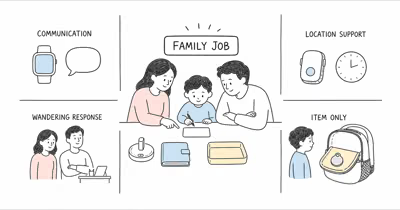
Life360 currently says the Jiobit line is out of stock while it continues to service existing subscriptions. That changes the question: a family shopping now should compare current systems by communication, location, response, participation, privacy, service and charging—not treat a stale marketplace listing as proof of new-device support.
Kid-tracker lineups change quickly. Relay’s consumer kids phone is discontinued, and an item tag, smartwatch, wandering-response wearable and vehicle tracker are not interchangeable. This guide keeps those system roles separate while the product-level claims remain pending a dated audit.
- Availability comes first. Verify current hardware, activation, service and support before paying for a Jiobit listing.
- Communication watches are a different system. TickTalk and Gabb combine caregiver-approved contacts with location tools, but still depend on service, charge, settings and human response.
- AngelSense serves a specialized workflow. Attachment, voice, alerts and response controls require participation, sensory fit, privacy, school permission and a tested recipient chain.
- AirTag is an item finder. Use it only for an agreed belonging; it’s not real-time child GPS, a help control or proof of the child’s safety.
- A missing-child response never waits for the app. Use the applicable official process immediately.
Why Do People Look for Jiobit Alternatives?
Jiobit does a lot right. The IPX8 water resistance, quad-technology tracking (GPS + cellular + Wi-Fi + Bluetooth), and 18-gram weight make it hard to beat for clip-on kid tracking.
But three things push parents toward alternatives.
Cost. Jiobit’s annual plan works out to $229.98 for the first year ($129.99 device + $99.99/yr prepaid).
Device and service pricing can change, and Jiobit’s new-device availability now needs a current check before a family treats any listing as a supported path. The useful comparison isn’t just price; it’s whether the system provides communication, supported service, transparent placement and a real response plan.
No communication features. Jiobit tracks location only.
No calling, no messaging, no SOS button.
For parents who want their child to reach them in an emergency, that’s a dealbreaker.
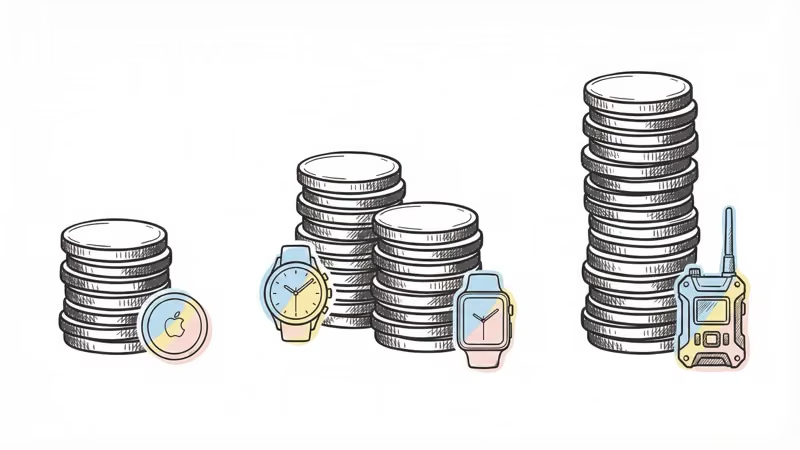
Battery life. Jiobit Gen 3 advertises a best-case battery rating, but frequent location checks and Live View pings can shorten runtime quickly.
Battery life is the top complaint among parents using cellular trackers, and the safe planning rule is to choose a charging cadence that survives a full school week. The practical takeaway: treat any “up to” battery claim as best-case, and budget extra charging when Live View or weak coverage is part of your routine. Mid-week dead trackers leave you blind exactly when school dismissal goes sideways.
GPS Tracker vs Bluetooth Tag: A Critical Distinction
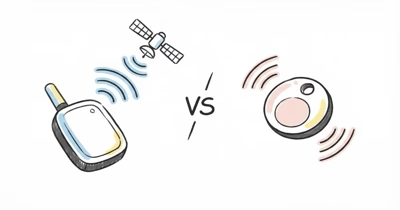
Before comparing alternatives, understand the two categories. GPS trackers like Jiobit use cellular networks to report location anywhere with coverage, updating every few seconds to minutes. GPS.gov states that 95% of the time, civilian GPS is accurate to about 4.9 m (16 ft) outdoors. Bluetooth tags like AirTag have no cellular radio and rely on Apple’s Find My network of nearby smartphones to relay their position.
GPS trackers charge monthly fees ($5-25) for the cellular connection. The AirTag costs $29 once with no subscription, but location updates in low-traffic areas can lag by hours.
The 5 Jiobit Alternative Roles Compared
| Option | System role | Ongoing service | Primary fit | Main limitation | Current check |
|---|---|---|---|---|---|
| Jiobit Gen 3 | Existing GPS clip-on service | Active supported account | Already-owned Jiobit setup | New-device availability and long-term support are not proven here | Confirm account, hardware, plan, support and replacement path |
| Apple AirTag | Item finder | No cellular tracker plan | Agreed backpack or belonging | No child GPS, calling, SOS or response service | Confirm the item-only boundary and Find My expectations |
| TickTalk 5 | Managed kids smartwatch | Compatible service required | Approved contacts plus location tools | Charging, school rules and help routing need testing | Confirm model, service, contacts, school mode and recipient chain |
| Gabb Watch 3e | Managed kids smartwatch | Compatible service required | Simple approved calling and location support | Still depends on service, charge, settings and response | Confirm current model, plan, settings and school behavior |
| AngelSense | Specialized location wearable | Service required | Wandering-response workflow | Attachment, voice, privacy and care-setting rules are central | Confirm exact hardware, permissions, fit and responders |
| LandAirSea 54 | Vehicle/equipment tracker | Cellular subscription required | Authorized vehicle or equipment use | Not a child communication or wearable safety system | Keep it outside child-tracking recommendations |
1. Apple AirTag — Item-Only No-Subscription Path
§ Review summary
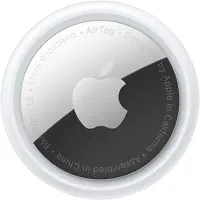
Apple AirTag 2
≡ Specs
- System role
- Item finder
- Location path
- Apple Find My network
- Dedicated GPS/cellular
- No
- Child help control
- None
- Battery
- Replaceable CR2032; duration claim pending
- Plan
- No cellular subscription
✓ Pros
- +No cellular subscription for the item-finding service
- +Replaceable CR2032 battery
- +Find My network can report an item's location through nearby Apple devices
- +Precision Finding support on compatible Apple hardware
- +Compact hardware for an agreed removable belonging
✗ Cons
- −Not a dedicated child GPS tracker
- −No child calling, messaging, SOS or monitoring desk
- −The item can separate from the child and updates depend on nearby devices
§ Buy if
- ·The agreed job is finding a backpack or belonging
- ·The child and setting know about the item tag
- ·You retain independent communication, supervision and official response
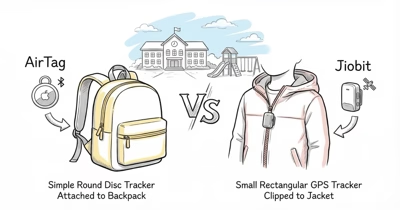
AirTag isn’t a GPS tracker. It uses Apple’s Find My network — a billion-plus iPhones relaying its Bluetooth signal to Apple’s servers. That distinction matters.
In dense urban areas, AirTag updates frequently because iPhones are everywhere.
On a busy commute route surrounded by other riders, an AirTag in a backpack can refresh quickly as iPhones pass by. SafeWise’s kids GPS tracker guide recommends pairing AirTag tracking with a dedicated GPS device for kids who travel beyond dense iPhone coverage.
But in a quiet suburban park, updates can lag for a long stretch. The difference depends entirely on how many iPhones happen to walk past your kid.
Where AirTag can fit: no cellular tracker plan, replaceable battery, and strong item-finding utility when the job is an agreed belonging.
Where AirTag falls short: No real-time GPS. No geofence alerts. No SOS button. Apple’s safety guidance confirms that its unwanted tracking alerts will notify nearby Android users that an AirTag is moving with them, which can complicate use on teens who carry Android phones.
For a deeper look at how these two stack up, see our AirTag vs Jiobit comparison.
2. TickTalk 5 — Communication-First Smartwatch
§ Review summary
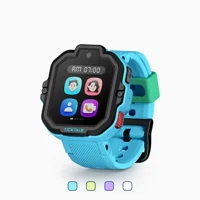
TickTalk 5
≡ Specs
- System role
- Managed kids smartwatch
- Connection
- GPS + cellular claim
- Communication
- Voice, video and messaging claim
- Help control
- SOS feature claim
- Battery
- Daily/every-other-day planning; audit pending
- Plan
- Service required
✓ Pros
- +Approved voice and video calling features
- +Messaging and caregiver contact controls
- +Location tools over a cellular connection
- +Wearer-accessible help control claim
- +A communication-first alternative to a clip-on tracker
✗ Cons
- −Requires compatible service and an ongoing plan
- −Shorter charging cadence than a simple clip-on tracker
- −Camera and messaging features may conflict with school policy
§ Buy if
- ·Approved child-to-caregiver communication is part of the job
- ·The exact service, contacts, school settings and charging routine pass a trial
- ·The family understands location and help controls are conditional
The TickTalk 5 does everything Jiobit does for tracking, then adds video calling, voice calling, messaging, and an SOS button. That’s the core trade-off: you’re getting a smartwatch instead of a clip-on tracker.
Outdoor GPS accuracy lands in the same 10-15 foot range you get from Jiobit, in line with the roughly 16-foot civilian GPS accuracy noted above. The 4G LTE connection means location updates don’t depend on crowd-sourced networks.
Battery life is the weak point. Expect a smartwatch charging routine rather than a clip-on tracker cadence. Jiobit’s rated full-week battery wins here.
The point is not just whether the watch costs more or less than an old Jiobit plan. You are choosing a communication device your child can use to contact approved caregivers directly, with location as one part of the system.
The TickTalk 4 is still available at a lower price if you don’t need the TickTalk 5’s improved durability and updated processor.
3. Gabb Watch 3e — Restricted-App Communication Watch
§ Review summary
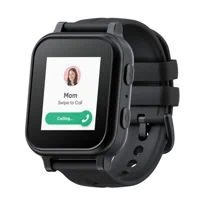
Gabb Watch 3
≡ Specs
- System role
- Managed kids smartwatch
- Connection
- GPS + cellular claim
- Communication
- Approved calls and texts claim
- Open apps/browser
- Restricted by design claim
- Battery
- Up to 48 hours claim
- Plan
- Service required
✓ Pros
- +Approved calling and texting without an ordinary app store
- +GPS and cellular location tools
- +Parent-managed contacts and settings
- +No open social-media or browser experience claim
- +Communication-first option for younger children
✗ Cons
- −Requires compatible service and an ongoing plan
- −Needs a frequent charging routine
- −Exact contacts, location, help controls and school behavior need testing
§ Buy if
- ·Simple approved calling matters more than broad watch apps
- ·The current model, service and school settings are confirmed
- ·The family can maintain charging and a separate response fallback
Gabb’s philosophy is intentional absence.
No apps, no browser, no social media. Just calls, texts, GPS tracking, and a digital pet to keep kids engaged.
For parents of 5-8 year olds, this approach solves a real problem: you want your child reachable and trackable without handing them a screen they’ll disappear into.
The IP68 rating adds dust protection alongside water resistance, while Jiobit’s IPX8 rating focuses on water exposure.
Gabb rates the watch for up to 48 hours, so every-other-day charging is the planning assumption.
Current plan and hardware details need a fresh check, but the system role is clear: Gabb is a restricted communication watch with location tools, not a simple clip-on tracker.
Our Gabb Watch review covers the setup process and parental controls in detail.
4. AngelSense — Specialized Wandering-Response System
§ Review summary
AngelSense GPS4 or Watch
≡ Specs
- System role
- Wandering-response location system
- Current hardware
- GPS4 or Watch claim
- Communication
- Voice options; configuration dependent
- Help controls
- Model and setup dependent
- Battery
- Device and mode dependent
- Plan
- Service required
✓ Pros
- +Current GPS4 and Watch options serve caregiver-managed location jobs
- +Provider documents location, boundary, voice and configurable help tools
- +Multiple guardian and wearing options
- +Specialized wandering-response workflow
- +Location-sharing and first-responder support features claim
✗ Cons
- −Service, coverage, settings, charge and human response remain prerequisites
- −Voice and secure attachment raise privacy, consent and school-policy questions
- −Exact hardware, plan and battery differ and need current confirmation
§ Buy if
- ·The family needs a specialized wandering-response system
- ·The child, attachment, voice permissions, school rules and responders pass a trial
- ·The family keeps a no-device and official-response fallback
AngelSense is designed around a more specialized wandering-response workflow than a general kids smartwatch. Diagnosis or age alone doesn’t make it the right choice; the actual plan has to fit the child, setting and responders.
Provider materials describe guardian-managed location, boundary and transit tools, voice options, multiple wearing accessories and device-specific help controls. Those features are conditional. One-way audio can capture classmates, staff or bystanders; secure attachment can create comfort, consent and emergency-removal concerns; and no app event guarantees that a responder receives or acts on it.
Confirm the current GPS4-versus-Watch hardware, plan and service area.
Our AngelSense vs Jiobit comparison separates those support paths.
5. LandAirSea 54 — Vehicle Tracker, Not a Default Child Alternative
§ Review summary
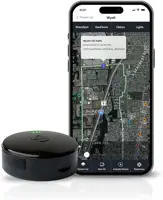
LandAirSea 54 GPS Tracker
≡ Specs
- System role
- Vehicle/equipment GPS tracker
- Connection
- 4G LTE claim
- Child communication
- None
- Mount
- Built-in magnet claim
- Battery
- Mode and update-rate dependent
- Plan
- Cellular subscription required
✓ Pros
- +Cellular GPS location for supported use cases
- +Configurable update and geofence features claim
- +Rechargeable hardware
- +Magnetic mounting for owned vehicles or equipment
- +Established app and subscription model claim
✗ Cons
- −Designed around vehicle/equipment tracking, not child communication
- −No child-facing calling, messaging or help control
- −Hidden placement on a child or their clothing is outside this guide
§ Buy if
- ·Use it only for an authorized vehicle or equipment-tracking job
- ·Don't treat small size or magnetic mounting as a child-tracking advantage
- ·Choose a child-appropriate system when communication or wearable safety matters
The LandAirSea 54 is a compact cellular tracker whose built-in magnet is aimed at authorized vehicle and equipment use. Compact hardware doesn’t make it a child-appropriate wearable and must not be used to conceal tracking from a child, school, caregiver or other responsible setting.
Provider update intervals, battery and service depend on the selected plan, settings, signal and movement. Verify the current service rather than assuming a fixed refresh rate.
It has no child-facing calling, messaging or help control. Check our LandAirSea 54 review for its intended vehicle and equipment use.
The No-Subscription Boundary: Item Finding Is Not Child GPS
Removing a cellular plan also removes the dedicated data path used by GPS wearables to send location and help events. An AirTag can help recover an agreed backpack or belonging through Find My, but the item can separate from the child and the network observation can be delayed or absent.
A bring-your-own-SIM tracker or shared carrier line still has service cost, account, coverage, compatibility, charging and privacy requirements. It should not be treated as a zero-cost or plug-and-play substitute for a supported child communication system.
| Path | Ongoing service | What it can support | What it does not prove |
|---|---|---|---|
| Agreed AirTag belonging | No cellular plan | Item finding through nearby Find My devices | The child’s location, safety or ability to call |
| Managed kids smartwatch | Required service | Approved contacts, model-specific location and help tools | Delivery, pickup or human response |
| Specialized location wearable | Required service | Model-specific location, alerts, voice and response workflows | Continuous coverage or safety |
| Existing Jiobit service | Active supported account | Account-specific Care Team, places and location tools | New-device availability or indefinite support |
Our AirTag for school backpack guide covers the item-only boundary. Confirm the exact current service before relying on any cellular alternative.
What Existing Jiobit Owners Should Recheck
An already-owned Jiobit can remain useful only while its exact hardware, account, membership, app, Care Team, Trusted Places, location modes, alerts, charging, coverage and support path still work. Indoor and outdoor location remain conditional observations; they don’t prove a room, route or safety.
Record the account owner, approved viewers, device generation, renewal, replacement position, cancellation and data-deletion path. If activation, hardware replacement, service or charging becomes unreliable, return to the family job instead of stretching an unsupported unit into a critical role.
How Do You Choose the Right Jiobit Alternative?
- The job is finding a backpack or belonging, not monitoring a person
- The child and setting know the tag is present
- You retain independent communication and response
- You want your child to call or text you directly
- You can test the exact help control and recipient
- You can maintain service, charging and a no-device fallback
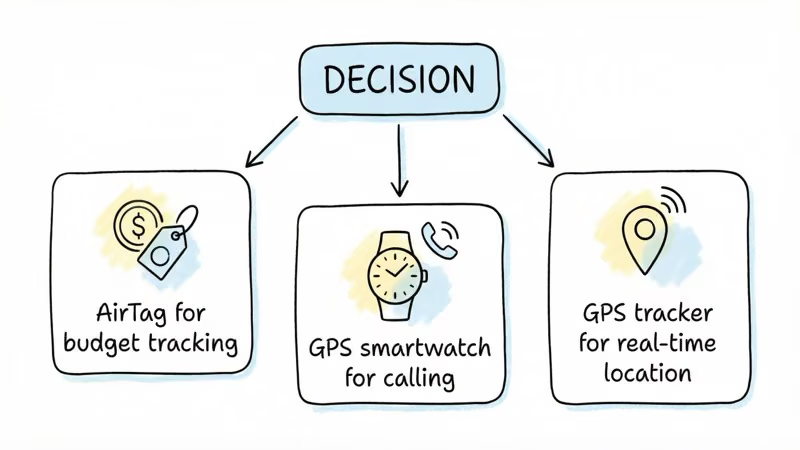
Start with the system role: communication, specialized response, or item finding. The people and fallback matter more than feature count.
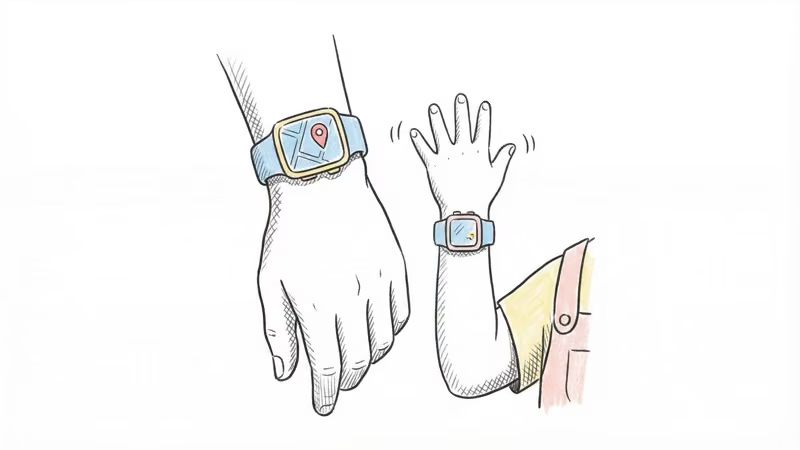
If communication matters, compare the current TickTalk and Gabb systems by contacts, school behavior, service, charging and exact help controls. If the family already owns Jiobit, verify the current account and support path rather than assuming that a marketplace listing can replace it. The Jiobit reviews article covers the owner experience and support questions.
Fit, Participation and School Rules Matter More Than Age Labels
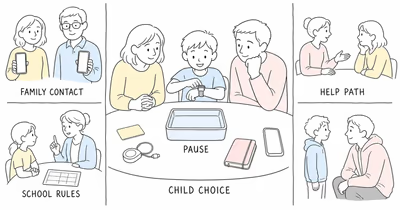
Age doesn’t settle sensory fit, communication ability, consent, authority, school policy, attachment safety or charging reliability. Let the child see and participate in the plan, test a removable fit, obtain required setting permission, limit viewers and stop when the device causes distress or the purpose changes. Never answer resistance with secret placement.
Bottom Line
There’s no single “best” Jiobit alternative because these devices serve different jobs.
AirTag is for an agreed item. TickTalk and Gabb are managed communication watches. AngelSense is a specialized location and response system. LandAirSea belongs in the vehicle/equipment category, not as a default child-tracking recommendation.
Start with the family job, confirm the current service and permissions, and keep a human response plan outside the device. For a broader buyer’s guide, see our best GPS tracker for kids roundup.
FAQ
Can AirTag replace a kids GPS tracker?
No. AirTag can help find an agreed backpack or belonging, but it isn’t a child GPS tracker. It has no cellular radio, calling, SOS, monitoring service, or proof that the child is with the item. For safety-critical situations, use the applicable human and official response instead of waiting for an item-location update.
Are there GPS trackers for kids with no monthly fee?
AirTag has no cellular tracker plan, but it’s an item finder rather than a true GPS child tracker. Dedicated GPS systems generally need a cellular service path to transmit location data. Confirm current hardware, activation, plan, cancellation, and support before treating any option as available.
What is the cheapest Jiobit alternative with real-time GPS?
Don’t choose a child-location system on sticker price alone. Real-time GPS depends on current hardware, service, coverage, settings, charging, and the person who responds to alerts. LandAirSea is a vehicle/equipment tracker, not a default child alternative; compare current kids smartwatch or specialized wearable plans instead.
Is TickTalk or Gabb Watch better for kids?
Neither is universally better by age. Compare the current model’s approved contacts, calls and messages, school restrictions, location limits, help control, service, charging, privacy and human fallback. Run an announced trial with the child and the responsible setting before relying on either system.
Does Jiobit work without a subscription?
Jiobit location service depends on an active supported account and service path. Existing owners should confirm the exact hardware, membership, app access, replacement position, cancellation path, and support status before relying on it.
What happened to Relay Kids Phone?
Relay discontinued its consumer kids phone service and shifted its focus. A former Relay family should compare current managed watches and location systems by approved contacts, service, school behavior, charging, help controls, privacy and fallback rather than assume a one-for-one replacement.
Which Jiobit alternative has the longest battery life?
Battery claims depend on the device, settings, signal, movement, update rate, and charging routine. AirTag’s battery belongs to item finding, not child GPS. For watches and specialized wearables, test the exact mode your family will use and keep a no-device response fallback.