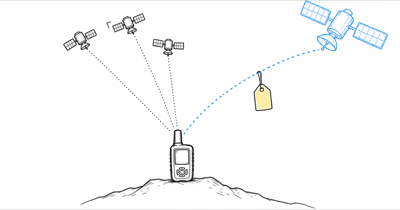
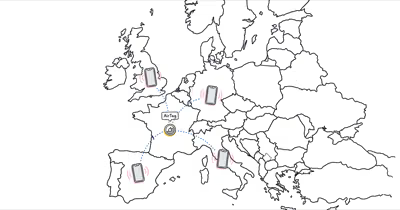
Comparing Garmin inReach against SPOT for areas with no cell service comes down to one structural difference before any spec matters: Garmin’s inReach technology overview confirms that inReach messaging runs two-way over the Iridium satellite network, while SPOT’s flagship Gen4 transmits outbound only over Globalstar. Everything else — price, plans, battery, SOS routing — flows from that split.
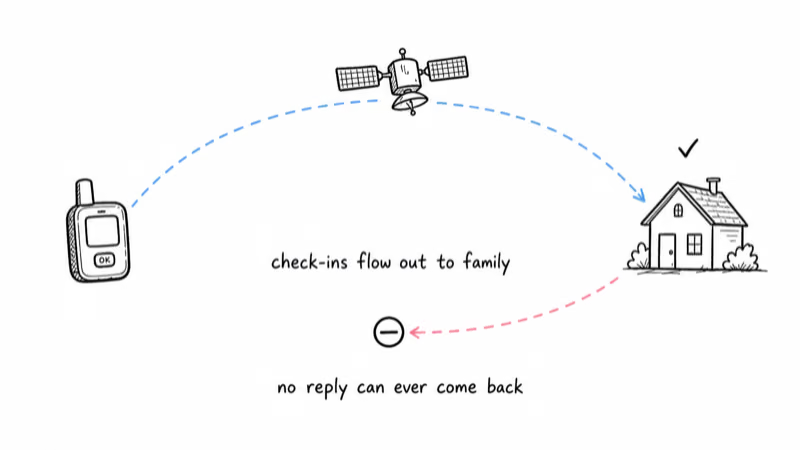
- inReach is two-way, SPOT Gen4 is one-way. A Gen4 can tell family you’re OK or call for help; it can’t receive an answer. The two-way SPOT X closes that gap at $199.99.
- Both need a clear view of the sky: Garmin’s own manual requires open sky for reliable operation, and forum riders report failures mainly in deep canyons and heavy canopy.
- SPOT wins on entry cost at $99.99 on sale plus $11.95 a month on contract; Garmin plans start at $7.99 a month but the Mini 3 hardware costs considerably more.
- inReach tracking runs up to 350 hours per charge at 10-minute intervals on the Mini 3, against 240 hours on the SPOT X; the Gen4 is rated in messages, about 1,250 per battery set.
- SOS goes to different desks: Garmin Response coordinates inReach emergencies, while SPOT routes SOS through FocusPoint International.
How Do inReach and SPOT Work Where Phones Don’t?
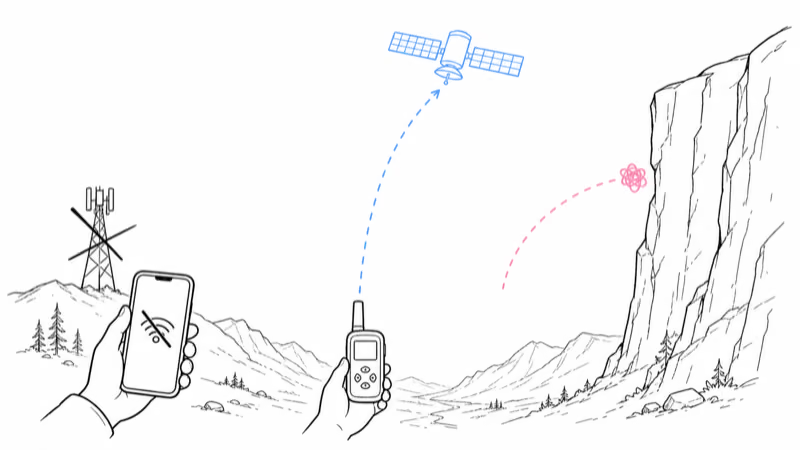
Both replace the cell tower with a commercial satellite constellation, and that swap sets their limits. A phone dies in a dead zone because it has no tower to talk to. An inReach transmits to Iridium satellites and a SPOT to Globalstar satellites, so coverage depends on sky, not on infrastructure below. GPS positioning works identically on both — the network only matters for getting your position out.
The physics carries one non-negotiable requirement. Garmin’s Mini 3 manual states that the device needs a clear view of the sky for messaging and tracking. Riders on a snowmobile forum comparing inReach, SPOT, and ZOLEO report the same pattern from the field: messages go out fine in the open and struggle mainly in deep canyon country. Neither device transmits from inside a vehicle trunk, a slot canyon, or dense old-growth canopy on the first try.
The networks are not twins, either. Iridium’s constellation covers the globe pole to pole, which is why expedition users default to it. Globalstar’s footprint covers the populated continents well but thins at extreme latitudes and over open ocean. For trips inside North America, both networks do the job; the difference shows up on remote expeditions and blue-water crossings.
One scope note before the head-to-head: everything in this comparison assumes you’re tracking your own trips, your own vehicle, or a group that knows the device is running and has agreed to share locations. These are safety tools for people who want to be found, not tools for monitoring someone without their consent.
Garmin inReach Mini 3: What You Get
The Mini 3 anchors Garmin’s current compact inReach line, with a step-up Mini 3 Plus listed at $499 adding features on the same platform. The base model’s defining trait is independence. It messages, tracks, and triggers SOS entirely from the device — a paired phone makes typing nicer but nothing about the safety loop requires one. That matters on the exact day this class of device exists for: the day your phone is dead, soaked, or shattered.
Battery is rated at up to 350 hours of tracking at 10-minute intervals, the case carries an IP67 rating, and SOS messages route to Garmin Response, Garmin’s own 24/7 coordination center. Plans run $7.99 to $49.99 a month after a $39.99 activation fee, and service suspends for $0 between seasons — the full cost anatomy is in our satellite tracker subscription breakdown.
SPOT Gen4 and SPOT X: What You Get
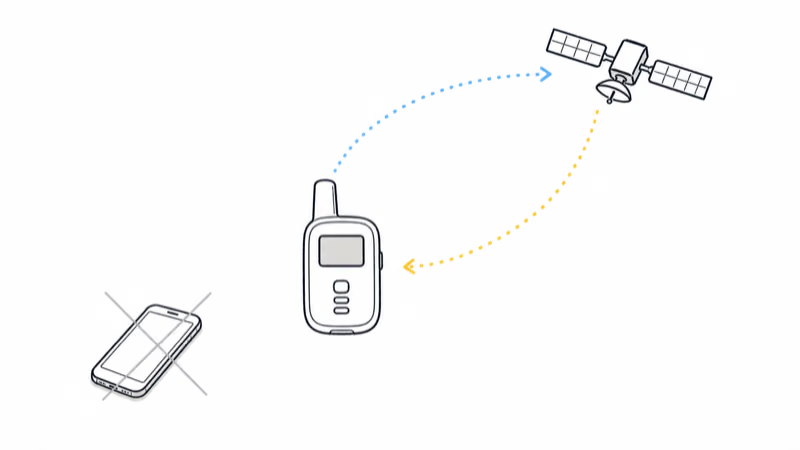
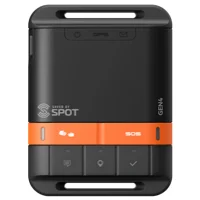
SPOT splits the same job across two devices. The Gen4 is the minimalist: a one-way beacon that sends preset check-ins, a HELP message, custom messages, and SOS over Globalstar, with emergencies coordinated by FocusPoint International. SPOT’s official page confirms that the Gen4 carries an IP68 rating, weighs 5 oz with batteries, and rates endurance in messages — about 1,250 check-ins per set of AAA lithiums — rather than hours.
The SPOT X is the answer to the Gen4’s one-way limit: a $199.99 two-way messenger with its own keyboard, Bluetooth pairing, and up to 240 hours of tracking at 10-minute intervals. It competes head-on with the inReach on capability while staying on Globalstar and SPOT’s cheaper contract plans. The catch across the whole SPOT line is the reply problem on Gen4: a one-way device can say “I’m OK” but never hear “rescue is 40 minutes out.”
inReach Mini 3 vs SPOT Gen4: Head-to-Head
⇄ Head-to-head
Garmin inReach Mini 3 vs SPOT Gen4
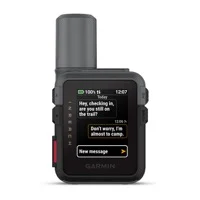
- +Two-way messaging: contacts and rescuers can answer you
- +Works standalone; no phone needed for any safety feature
- +Up to 350 hours of tracking battery at 10-minute intervals
- +$0 plan suspension fits seasonal use
- +Iridium coverage reaches polar and open-ocean routes
- +Cheapest entry into satellite safety at $99.99 on sale
- +Lower contract rate than any Garmin tier above Enabled
- +Replaceable AAA batteries -- swap in the field, no charging
- +IP68 rating, the toughest water rating in this comparison
- −Hardware costs roughly twice a sale-priced SPOT Gen4
- −Small screen makes on-device typing slow without a phone
- −$39.99 activation fee before the first month starts
- −One-way only; no incoming replies, ever
- −Cheapest rate requires a 12-month contract commitment
- −Globalstar coverage thins at extreme latitudes and mid-ocean
- −Two-way SPOT X costs $199.99, closing most of the price gap to Garmin
- ·You want rescuers and family able to reply to you
- ·Your phone dying must not take the safety loop with it
- ·You use it seasonally -- $0 suspension slashes annual cost
- ·Routes reach polar latitudes or open ocean where Iridium matters
- ·Budget caps the purchase: $99.99 is the cheapest satellite SOS
- ·You run it 12 months a year and the $11.95 contract rate wins
- ·Field-swappable AAA batteries beat recharging on your trips
- ·You want two-way on a budget: SPOT X at $199.99, same cheap plans
Which Costs Less to Actually Own?
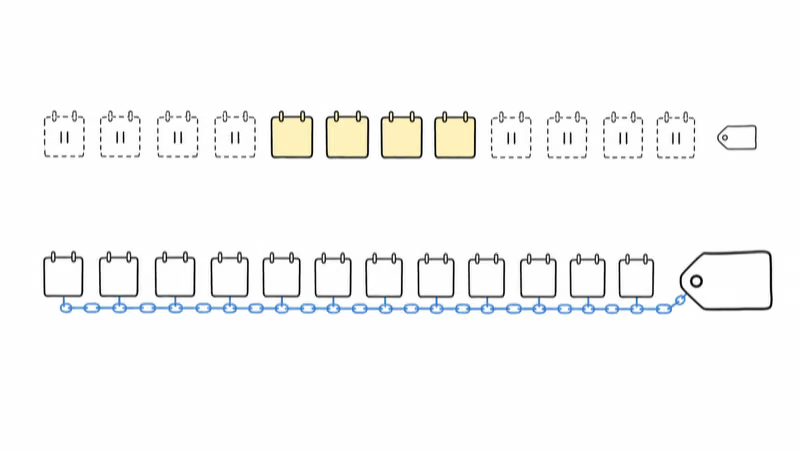
SPOT wins year one for committed year-round users; Garmin wins for seasonal users, and it isn’t close. The sticker comparison misleads because the two companies structure plans differently: SPOT’s cheapest rate demands a 12-month contract, while every Garmin plan runs month to month with free suspension.
| Cost item | inReach Mini 3 | SPOT Gen4 | SPOT X |
|---|---|---|---|
| Device | At Garmin (Plus model listed at $499) | $99.99 sale / $149.99 reg | $199.99 sale / $249.99 reg |
| Activation | $39.99 | $29.95 | $29.95 |
| Cheapest plan | Enabled, $7.99/mo, no contract | Contract Basic, $11.95/mo, 12-month term | Contract Basic, $11.95/mo, 12-month term |
| No-contract option | Every plan | Flex, $14.95/mo + $34.95/yr flex charge | Flex, $14.95/mo + $34.95/yr flex charge |
| Off-season pause | Suspend for $0 | Flex months off (flex charge still applies) | Flex months off (flex charge still applies) |
| 12 months of cheapest service | $95.88 | $143.40 | $143.40 |
| 4 months of use, 8 suspended | $31.96 | $143.40 (contract) or $94.75 (flex) | same as Gen4 |
Two numbers in that table decide most purchases. According to the two carriers’ plan pages, a four-month summer user pays $31.96 a year on Garmin Enabled against $94.75 on SPOT Flex — the suspend feature pays for the hardware gap within a few seasons. A year-round vehicle or cabin monitor flips it: SPOT’s $11.95 contract undercuts every Garmin tier that includes meaningful tracking.
Rates and terms live on SPOT’s plan page and Garmin’s plan page; both change, so re-check before committing.
Messaging, SOS, and the iPhone Question
The head-to-head specs above settle the device-versus-device rows. Two capability questions sit outside that table, and both change what you should buy.
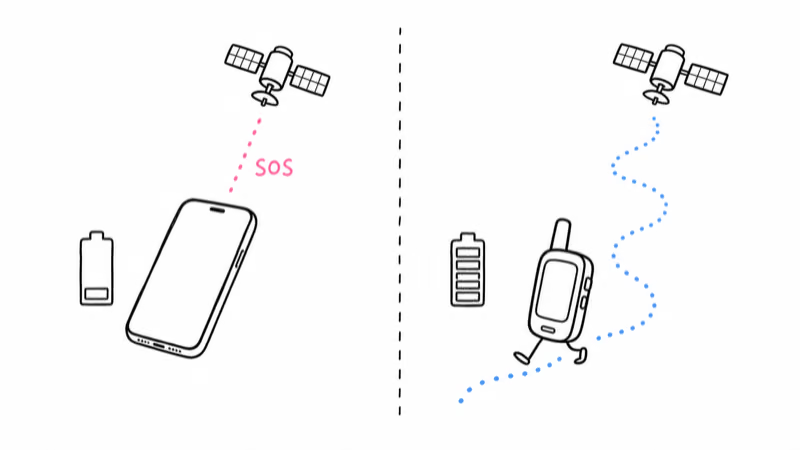
First: is a modern iPhone enough on its own? Apple’s satellite location guide covers sending your location and emergency texts via satellite on recent iPhones — a real safety net for a day hike. It isn’t a tracker, though: no continuous breadcrumb for people at home, a battery shared with everything else, and a feature set that narrows outside supported regions. Dedicated devices exist for multi-day exposure, not for redundancy theater.
Second, a boundary note on the Garmin name: Garmin also sells dog-collar GPS systems (Alpha, Astro) that work over radio, not Iridium — a different product line for a different job, covered in our Tractive vs Garmin comparison. And if your dead zones are urban parking garages rather than wilderness, a cellular GPS tracker is the cheaper tool.
One more budget boundary: if any monthly fee at all is the dealbreaker, a no-monthly-fee tracker is a different product class — shorter range or delayed data, but zero recurring cost.
Bottom Line
With no cell service, the Garmin inReach Mini 3 is the more capable safety device: two-way Iridium messaging, standalone operation, 350-hour tracking, and a plan you can pause for free. That combination is why it carries the winner mark here despite the higher hardware cost.
SPOT earns its place on price. A Gen4 on contract delivers real satellite check-ins and professionally coordinated SOS for less than half the money, and the SPOT X gives budget buyers a two-way path. Decide on two questions: do you need replies, and how many months a year will the device actually work? The first answer picks the brand; the second picks the plan.
FAQ
Does Garmin inReach work with no cell service at all?
Yes. An inReach communicates entirely over the Iridium satellite network and never uses cell towers. Messaging, tracking, and SOS all work in a dead zone, provided the device has a clear view of the sky, which Garmin’s manual lists as a requirement for reliable operation.
Is SPOT one-way or two-way messaging?
The SPOT Gen4 is one-way: it sends check-ins, custom messages, HELP, and SOS, but can’t receive anything back. The SPOT X is the two-way model in the lineup, with its own keyboard for composing and receiving messages. Garmin’s inReach devices are all two-way.
Which network has better coverage, Iridium or Globalstar?
Iridium covers the entire globe including the poles, which is why inReach is the default for expeditions. Globalstar covers the populated continents well but thins at extreme latitudes and over open ocean. Inside North America the practical difference is small; the gap shows on remote routes.
Do trees and canyons block satellite messengers?
They can delay or block transmissions on both networks. Garmin’s manual calls for a clear view of the sky, and field reports describe failures mostly in deep canyons and heavy canopy. Moving to open ground and letting the device retry usually gets the message out.
Is iPhone satellite SOS a replacement for an inReach or SPOT?
Not for tracking or multi-day trips. Apple’s satellite features let recent iPhones send location and emergency texts without coverage, which is real protection on short outings. A dedicated device adds continuous tracking for people at home, its own multi-day battery, and function when the phone itself is dead.
Which is cheaper over a year, inReach or SPOT?
It depends on months of use. Year-round, SPOT’s $11.95 contract rate beats Garmin tiers with comparable tracking. Seasonally, Garmin wins: four months of the $7.99 Enabled plan with free suspension costs about $32 a year, far under SPOT’s contract or flex minimums.