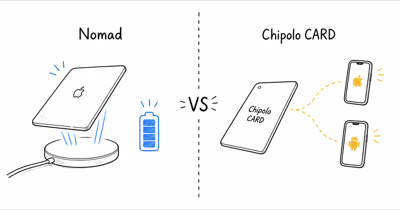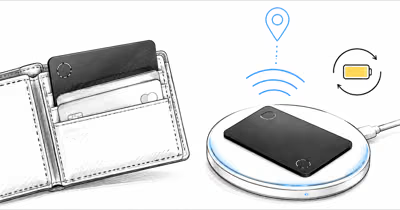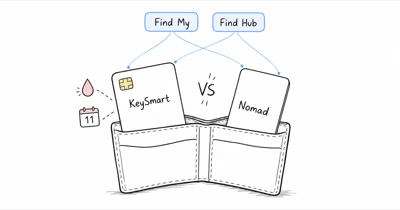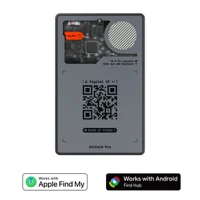
The Rolling Square AirCard Pro and Nomad Tracking Card Air are two rechargeable wallet trackers that both work with Apple Find My and Google Find Hub, but they trade off in opposite directions. 9to5Mac’s hands-on with the AirCard Pro confirms that it measures 2.2mm and charges wirelessly, putting it half a millimeter behind the slimmer 1.7mm Nomad card while adding more than double the battery life.
- Battery is the biggest gap — the AirCard Pro rates 12 months per Qi charge versus 5 months (iOS) or 7 months (Android) for the Nomad card.
- Nomad is thinner and cheaper — 1.7mm at $29 versus the AirCard Pro’s 2.2mm body at $45.
- Water resistance favors Nomad — the Tracking Card Air carries IPX7 (submersion to 1m), while Rolling Square does not publish an IP rating.
- Neither runs both networks at once — each card registers to Apple Find My OR Google Find Hub at setup, and switching needs a factory reset that clears location history.
- The AirCard Pro is the better all-rounder — a 20mm speaker, aluminum frame, and a 2-pack option give it more for the wallet you carry every day.
AirCard Pro vs Nomad Card Air: At-a-Glance Comparison
These two cards solve the same problem — a trackable credit card for a wallet — but split on endurance versus form factor. The AirCard Pro buys you a year of battery and a metal build; the Nomad card buys you the thinnest, cheapest slot-filler. If you want Nomad’s brand with even more runtime, our Nomad Pro review covers the thicker 16-month variant that out-endures the AirCard Pro.
Rolling Square rates the AirCard Pro’s 220mAh cell at 12 months versus the Nomad card’s 5 to 7 — documented numbers, not estimates. Our own wallet card buying guide ranks both against the wider field; here is the direct head-to-head.
⇄ Head-to-head
Rolling Square AirCard Pro vs Nomad Tracking Card Air
- +12-month battery per Qi charge, more than double the Nomad card
- +20mm speaker, the louder find-my-wallet alert here
- +CNC aluminum frame feels closer to a metal credit card
- +Works with both Apple Find My and Google Find Hub (you pick one)
- +Sold as a single or a 2-pack for multi-wallet households
- +1.7mm credit-card-thin body, the slimmer card here
- +IPX7 waterproof, rated for submersion to 1m
- +$29 single price, the cheaper of the two
- +Qi wireless rechargeable, no proprietary cable
- +12g and flexible polycarbonate for tight wallet slots
- −2.2mm body, thicker than the Nomad card's 1.7mm
- −No published IP water-resistance rating
- −Choose one network at setup, switching needs a factory reset
- −$45 single price, the more expensive of the two
- −5-month battery on iOS, 7 months on Android, far shorter than the AirCard Pro
- −Polycarbonate body flexes more than an aluminum frame
- −Choose one network at setup, like the AirCard Pro
- −No multi-pack option from Nomad
- ·You want a year of battery, not a recharge every few months
- ·A 20mm alert is the stronger speaker spec here
- ·An aluminum build matters more than the last half-millimeter
- ·You may want a matching 2-pack for two wallets or a partner
- ·You want the thinnest possible card for a slim wallet
- ·The card may face rain or a dropped-in-a-puddle moment (IPX7)
- ·You'd rather spend $29 than $45 for the same dual-network reach
- ·You don't mind a Qi top-up two or three times a year
For how these cards fit into the wider world of Android-compatible trackers, see our Find Hub tracker hub, which collects every model certified for Google’s network.
Form Factor and Build Quality Compared
Both cards are built to disappear inside a wallet. AndroidGuys’ hands-on with the dual trackers reported that the AirCard Pro runs up to 12 months per charge at a $40 launch price, while Nomad lists the Tracking Card Air at 1.7mm and 12g. The AirCard Pro measures 2.2mm, thin enough to slip into a standard card slot, though the 0.5mm gap over the Nomad adds thickness behind a full deck.
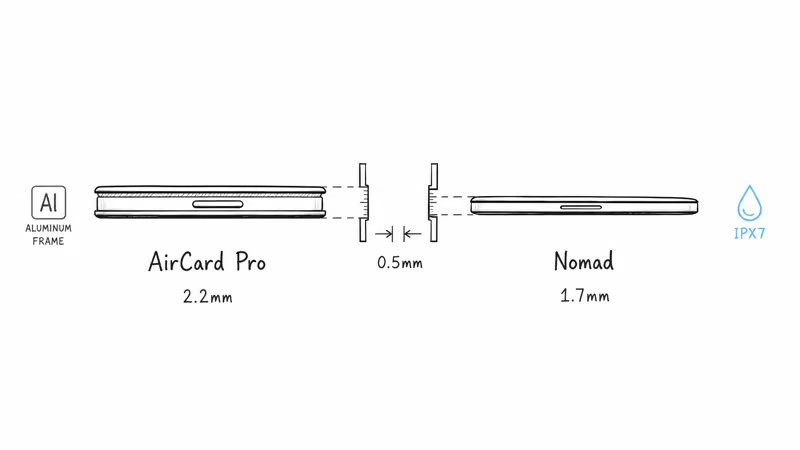
Build material is where the two diverge most. The AirCard Pro uses a CNC-machined aluminum frame intended to resist flex. The Nomad card uses a flexible polycarbonate body at 12g, which is the better fit for people prioritizing the slimmest possible profile. If you want rigidity, Rolling Square wins; if you want thinness, Nomad does.
Water resistance is the one durability spec where Nomad pulls clearly ahead. The Tracking Card Air carries an IPX7 rating, meaning it survives submersion in up to a meter of water for 30 minutes. Rolling Square does not publish an IP rating for the AirCard Pro, so for a card that might meet rain or a spilled drink, the Nomad is the safer bet on paper.
How Long Does Each Card’s Battery Last?
This is the headline difference. Rolling Square rates the AirCard Pro at 12 months per Qi charge from a 220mAh cell. Nomad’s own Tracking Card Air product page states that the card lasts roughly 5 months on iOS and 7 months on Android — more than a 2x gap that changes how a wallet-buried tracker behaves day to day.
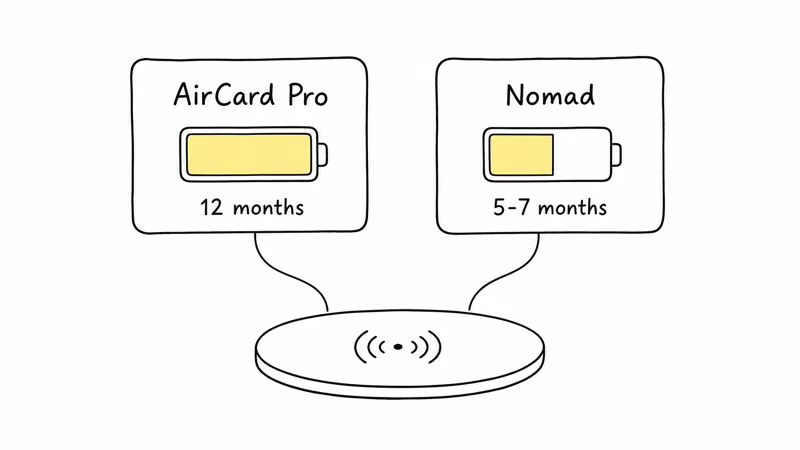
A 5-to-7-month cycle means setting a reminder to recharge twice a year. If the Nomad card dies the week your wallet goes missing, the tracker is dead weight exactly when you need it. Both recharge on any standard Qi pad, so the recharge chore itself is the same — the AirCard Pro just asks for it a third as often.
Both ditch disposable coin cells for built-in Qi-rechargeable batteries, so neither generates the CR2032 e-waste older cards did. Neither ships with a charger either — you drop the card on any Qi pad you already own. On the spec sheet, the AirCard Pro is the clear endurance pick, and that gap is the single strongest reason to pay its higher price.
Do These Cards Run Both Networks at the Same Time?
This is the most misunderstood spec on both products. Despite “dual-network” marketing, neither card broadcasts to Apple Find My and Google Find Hub at the same time. Each one registers to one network you choose at setup. To switch, you factory reset the card and re-pair it in the other app — and your location history resets in the process. “Dual-network” here means “compatible with either, your choice,” not “active on both at once.”
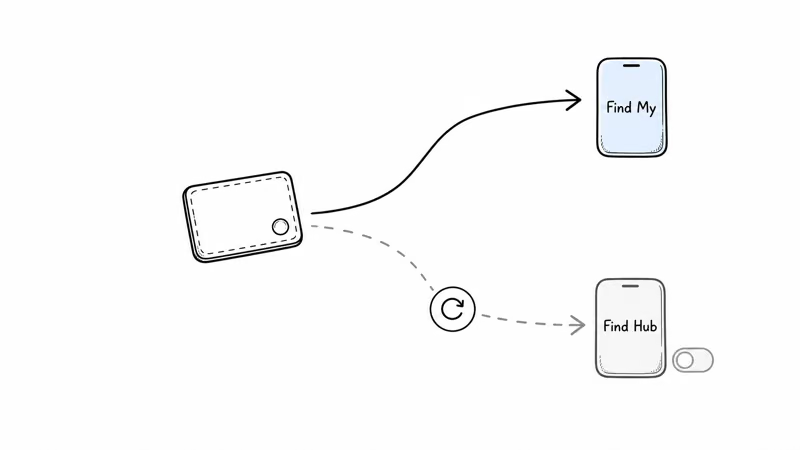
The AirCard Pro makes the choice concrete: Rolling Square ships an Apple-only black card, an Android-only white card, and a gray Dual SKU that can register to either network — but still only one at a time. AndroidGuys’ hands-on framed it plainly, noting you can add the trackers to “either Android’s Find Hub, or Apple Find My.” The Nomad card works the same way: you pick Find My or Find Hub when you set it up.
Network choice has real consequences. 9to5Google’s roundup of the best Find Hub wallet cards placed the $29 Nomad card above the $45 AirCard Pro on price and thickness, but the underlying point applies to both: pings depend on how many phones of the right ecosystem walk past your lost card. Pick the network that matches the dominant phone ecosystem around you — Find My in iPhone-heavy regions, Find Hub where Android dominates.
If running both networks simultaneously is a hard requirement, neither of these cards delivers it. Google’s Find Hub overview explains that the network locates a lost item by relaying its Bluetooth signal through nearby Android devices, so coverage on the Find Hub side scales with the Android phones around you — and the Find My side scales with iPhones. Choosing one network is choosing which of those two crowds is doing the finding.
Alarm Volume and Find Features Compared
For locating a card buried in a couch or bag, alarm volume counts. The AirCard Pro has a 20mm speaker, which Rolling Square sizes specifically to be heard inside a wallet or a narrow pocket. Nomad uses a built-in buzzer on the Tracking Card Air rated around 94dB but does not market the driver size, so on the hardware spec the AirCard Pro is the safer pick for a loud find.
Both cards also lean on their networks for finding, not just the onboard speaker. Once a card is out of Bluetooth range, the 20mm speaker is useless — you rely on the last-seen map in Find My or Find Hub. That is why the network choice in the section above matters as much as the buzzer: the speaker is for nearby recovery, while the network handles distance.
For how these slim cards compare to other thin trackers on alarm and battery, our eufy vs Pebblebee thin-card comparison breaks down loudness and endurance across two more wallet cards in the same class.
Price and Overall Value
On price, the Nomad card wins outright. The Tracking Card Air lists at $29 and the AirCard Pro at $45 — a $16 gap for the same dual-network reach. Neither requires a subscription; both Apple Find My and Google Find Hub are free services for certified third-party trackers, so you pay once for the hardware.
Value, then, comes down to what the extra $16 buys. The AirCard Pro returns more than double the battery life, a louder 20mm speaker, an aluminum frame, and a 2-pack option at $80 for two wallets or a partner’s. The Nomad card returns the thinnest body, IPX7 waterproofing, and the lower entry price. If you carry the card daily and hate recharging, the AirCard Pro earns its premium; if you want the cheapest slim slot-filler, Nomad is the buy.
To see how both stack up against AirTag and the rest of the slim-card field, our wallet finder guide places these trackers in the broader market before you commit.
Bottom Line
Get the Rolling Square AirCard Pro if you want a wallet tracker you charge once a year, with a louder 20mm speaker, an aluminum build, and a 2-pack option for $45. Get the Nomad Tracking Card Air if a 1.7mm body, IPX7 waterproofing, and a $29 price outweigh battery life.
We give the AirCard Pro the edge as the better all-rounder: the endurance, sound, and build gap is wider than the half-millimeter and $16 it costs you. Both are honest choose-one dual-network cards — the AirCard Pro simply does more for the wallet you actually carry.
FAQ
Can the AirCard Pro and Nomad Card Air use Find My and Find Hub at the same time?
No. Despite dual-network marketing, both cards make you choose either Apple Find My or Google Find Hub when you set them up. Switching networks requires a factory reset and re-pairing in the other app, which clears your location history. Treat “dual-network” as compatible with either, not active on both at once.
Which card has the longer battery life?
The Rolling Square AirCard Pro wins by a wide margin. It’s rated for 12 months per Qi charge, while the Nomad Tracking Card Air lasts about 5 months on iOS or 7 months on Android. Both recharge wirelessly on any Qi pad, and neither uses a replaceable coin cell.
How thin are these two wallet cards?
The Nomad Tracking Card Air measures 1.7mm and the Rolling Square AirCard Pro measures 2.2mm. Both fit a standard wallet card slot, but the 0.5mm difference can matter in a packed wallet. The Nomad card is the slimmer of the two.
Which card is more water resistant?
The Nomad Tracking Card Air carries an IPX7 rating, meaning it survives submersion in up to a meter of water for 30 minutes. Rolling Square does not publish an IP rating for the AirCard Pro, so for a card that may face rain or spills, the Nomad is the safer pick on paper.
Do either of these trackers need a subscription?
No. Neither the Rolling Square AirCard Pro nor the Nomad Tracking Card Air requires a subscription or monthly fee. Apple Find My and Google Find Hub are both free services for certified third-party trackers, so you pay once for the hardware and nothing after.
Which card is louder when you ring it?
The AirCard Pro uses a 20mm speaker that Rolling Square sizes to be heard inside a wallet, while the Nomad card uses a built-in buzzer rated around 94dB. On the hardware spec the AirCard Pro is the safer pick for a loud find, though both rely on the Find My or Find Hub map once the card is out of Bluetooth range.
Can you buy these wallet trackers in a multi-pack?
The Rolling Square AirCard Pro is sold as a single card for $45 or a 2-pack for $80, which suits two wallets or a partner. Nomad sells the Tracking Card Air as a single card only, so if you need two trackers the AirCard Pro pack is the more economical route.