Yes. AirTag works in every European country without any configuration change because it uses the local Find My network of iPhones, not cellular data. Coverage is strongest in cities and along tourist corridors; expect slower relays in rural Alpine villages, Scottish Highlands, and Greek islands.
Does AirTag work in Europe? Yes, and it works the same way it does in the United States because Apple’s Find My network is a global device relay, not a region-locked service. This guide maps country-by-country coverage, explains the GDPR angle travellers actually ask about, and lays out what to expect when your trip cuts through rural parts of the continent.
- No SIM, no roaming, no setup change — AirTag uses Bluetooth relay through any nearby iPhone, in any country
- Find My network size: over a billion Apple devices; iPhone share averages 30-35% across the EU
- Best coverage: UK and Nordics (~50% iPhone share); weakest in Eastern Europe (~15-25%)
- GDPR: tracking your own property is legal; tracking a person without consent is not
- Cross-platform: Android users in Europe receive unknown-AirTag alerts since the 2024 Apple/Google joint standard
How Does AirTag Work Outside the U.S.?
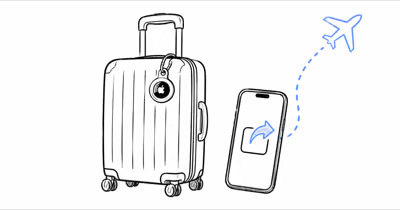
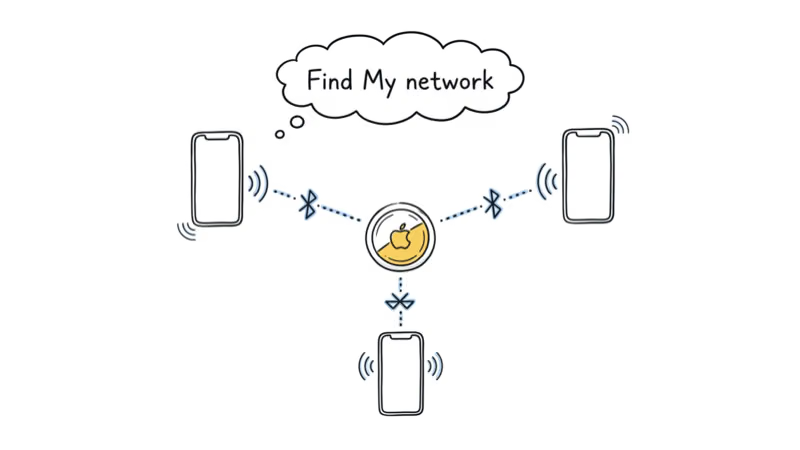
AirTag has no SIM card, no cellular radio, and no Wi-Fi chip. It sends a short Bluetooth LE ping every few seconds, which any nearby iPhone picks up and anonymously relays to Apple’s servers. That owner’s iPhone shows the location in the Find My app.
That’s the whole trick.
The chain is country-agnostic because iPhones do the heavy lifting, not the AirTag itself. This is why AirTag doesn’t need Wi-Fi or cellular to function abroad. It also explains why AirTag doesn’t have GPS: the chip is a Bluetooth LE beacon plus a U2 UWB radio for Precision Finding, nothing more.
Apple describes the Find My network as “a crowdsourced network of over one billion Apple devices” that detect nearby items over Bluetooth and report their location back to the owner. That relay pool is what your AirTag draws from the moment your plane lands in Frankfurt, London, or Athens.
No carrier setup. No menu toggles.
In a high-iPhone hub like Heathrow, an AirTag has many chances to relay through a passing stranger’s iPhone because the Find My network is dense in major European airports.
No carrier setup changes when you cross the Channel.
Density changes. Function doesn’t.
Does AirTag Work in the UK, France, Germany, and Italy?
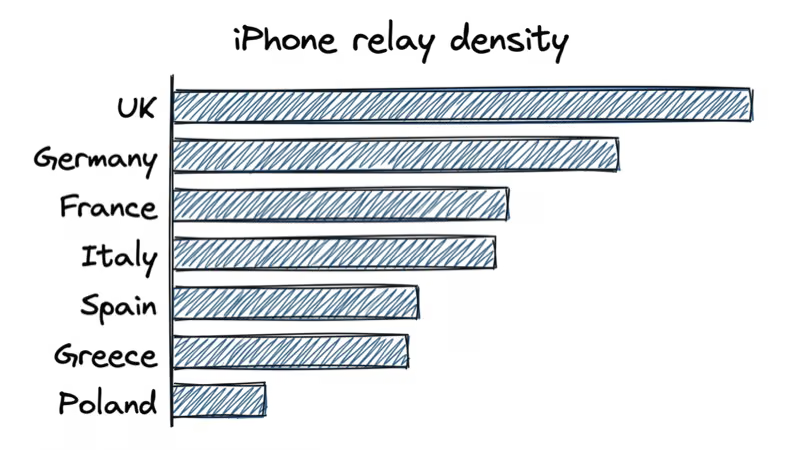
Yes, and coverage in these four markets is effectively indistinguishable from a major U.S. city when you are anywhere urban or along a tourist corridor. The variable is iPhone market share by country, because relay speed depends on how many iPhones walk past your bag.
| Country | iPhone share (approx) | Urban relay expectation | Rural relay expectation |
|---|---|---|---|
| United Kingdom | ~50% | Strong in cities and airports | Slower outside towns |
| Germany | ~30-35% | Strong in major hubs | Slower in rural regions |
| France | ~25-30% | Strong in tourist corridors | Slower in rural areas |
| Italy | ~25-30% | Strong in city centers | Slower in rural south |
| Spain | ~20-25% | Strong in major cities | Slower away from hubs |
| Nordics (NO/SE/DK/FI) | ~50% | Strong in cities | Slower in remote coastline |
| Eastern Europe (PL/CZ/HU) | ~15-25% | More variable | Most variable outside capitals |
Statcounter’s mobile vendor market share tracker shows iPhone running in the mid-30s to low-40s percent of the European market, with the UK and Nordics leading (near 50%) and Eastern Europe trailing (15-25%). The country-by-country gap is what matters for relay speed.
More iPhones, faster relays.
In central Paris, relays have many chances at a busy hub like Gare du Nord during morning rush, while the same AirTag at a remote Provence farmhouse may wait much longer for an iPhone to pass. Relay speed depends entirely on how many iPhones pass nearby.
That gap scales with population density.
Cities, trains, and airports are the strongest AirTag environments. If your trip centres on London, Paris, Berlin, Milan, Amsterdam, Stockholm, or any major EU hub, AirTag behaves much closer to its U.S. city experience than it does in remote rural areas.
Rural Europe and the Nordics
Rural density is where the Find My network thins. The network still works, but relay cadence slows because fewer iPhones cross paths with your AirTag.
In a remote spot like a rental cottage near Fort William in the Scottish Highlands, a relay may wait for the next nearby iPhone, while driving back into a city like Glasgow improves update opportunities. The device is never “offline”; it’s waiting for an iPhone to pass. The AirTag accuracy guide breaks down how relay cadence affects apparent precision on the map.
Expect slower relays in these scenarios:
- Alpine villages off the main ski corridors (think side valleys in Tyrol or Haute-Savoie)
- Norwegian fjord coastline outside Bergen, Ålesund, and the major cruise stops
- Greek island interiors during shoulder season (Oct-Apr), when tourist density collapses
- Scottish Highland glens and Irish west coast off the Wild Atlantic Way
- Polish, Czech, and Hungarian countryside outside the capital metro areas
If your trip is primarily rural and you need live updates on demand, a cellular GPS device is the better choice. Our guide to international GPS trackers covers pay-as-you-go SIM-based options that report independently of nearby iPhones. For mixed city-plus-rural itineraries, AirTag is usually sufficient because the urban legs refill the location history on the way in and out.
Rural Europe is where AirTag becomes a reliable breadcrumb trail rather than a live map.
GDPR and EU Anti-Stalking Rules
Tracking your own property with an AirTag is legal in every EU country. GDPR governs personal data about people, not property; a suitcase, rental car, or bicycle does not have personal-data rights. The law is specifically about protecting individuals from being tracked without their consent.
The EU’s official GDPR portal states that the regulation applies when “personal data” of a natural person is processed. Personal-property tracking falls outside that scope as long as no other individual is identifiable from the location data. Tracking a family member is also fine when they consent. Covertly tracking another adult is not legal, GDPR aside, under basic EU privacy and stalking laws.
Property isn’t people.
Apple enforces this boundary automatically through the anti-stalking system. Apple’s AirTag and Find My anti-stalking overview confirms that an iPhone alerts any user carrying an unknown AirTag that isn’t paired to them. The system has operated across Europe since AirTag launched in 2021, and it runs regardless of country.
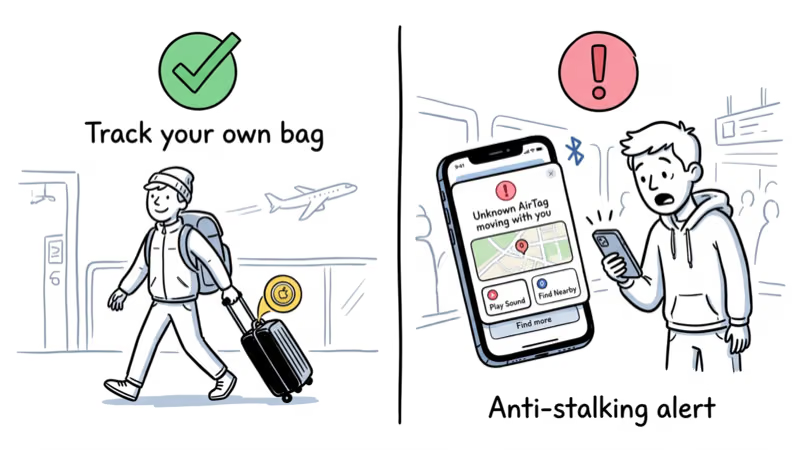
Apple and Google announced in May 2024 a joint industry specification for unwanted tracker detection. Android users in the EU now receive the same unknown-AirTag alerts that iPhone users do. Samsung, Google Pixel, and Xiaomi phones running Android 6.0 or later all support the detection standard.
For travellers, the practical rule is simple: track your own bag, car, or bike with a clear conscience. If you want to track another adult (spouse, teen, elderly parent), ask them first and share the Find My item with their Apple ID, which is the intended legal path. Our explainer on the AirTag anti-stalking system details the alert timing and how to check for unknown trackers on the road.
Best Travel Use Cases for AirTag in Europe
The AirTag 2 covers four travel scenarios well in Europe, and one it doesn’t. Specs matter here: the device is IP67 rated, weighs 11 grams, runs on a CR2032 coin cell for about 12 months, and supports Precision Finding at close range via the U2 UWB chip.
Checked Luggage
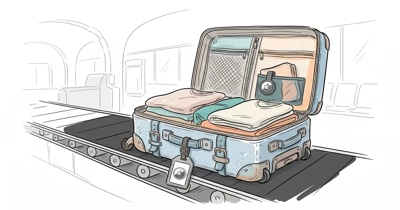
Drop one AirTag in each checked bag before you hand it over at the counter. In a major European airport, the bag has many chances to relay through airport staff and passenger iPhones before it reaches the carousel.
That’s the gap airlines can’t close for you.
Lost and delayed bags are the top traveller anxiety, and Find My gives you a location that the airline’s own system can’t show you. Our full guide to AirTag in checked luggage covers airline rules and battery certification.
That alone justifies the $29.
Rental Car
AirTag in the glovebox of a rental car is a low-stakes insurance policy against a stolen vehicle or a wrong address on a late-night arrival. It won’t help you find it in a parking garage where UWB Precision Finding is out of range, but it will tell you which district of Rome or Barcelona the car currently sits in.
 Top Pick
City-Break Bag and Kid’s Backpack
A clip-on AirTag in a daypack, camera bag, or a child’s backpack during a city break is useful in crowded places where handoffs and misplacements happen. In a busy European market or transit hub, the dense Find My network gives the tag more chances to resolve a fresh location. The more Apple devices nearby, the tighter the updates.
Crowds help, not hurt.
What AirTag Doesn’t Cover Well
Long-distance rural travel where you need a live feed, not a breadcrumb trail. If you’re driving a rental camper through Norway’s fjord country for two weeks, a cellular GPS with its own SIM reports independently of iPhone density. AirTag will still work; it just reports more slowly. The AirTag 2 review covers the device’s broader trade-offs across use cases.
Match the tool to the terrain.
Buying AirTag Before Your Europe Trip
Hardware is identical worldwide, so you can buy at home or abroad with no regional lockout concern. U.S. Amazon lists $29 for a single and $99 for a 4-pack as of April 2026. European retail runs roughly 35 to 39 euros per unit depending on country and VAT.
For most U.S. travellers, the 4-pack is the better call because it covers two checked bags, a carry-on, and a rental car glovebox with one purchase. European residents heading across the EU by train should buy locally because Apple’s EU pricing already bakes in VAT and warranty support across the bloc.
Check your trip length first.
Order at least 5 business days before departure to allow for activation and Find My pairing with your iPhone. Both need to be completed before the trip so you’re not fumbling with setup at an airport gate.
Bottom Line
Buy an AirTag or a 4-pack before your Europe trip if you travel with checked luggage, rent cars, or carry expensive bags through crowded cities. The $29 single or $99 4-pack is a one-time purchase with no subscription, and it works in every EU country the moment you land. There is no activation step, no country setting, and no cellular plan to buy.
Skip AirTag and choose a cellular GPS tracker for international use if your entire trip is rural (remote Norwegian coast, Scottish Highland weeks, Greek island interior) and you need scheduled location pings rather than opportunistic Find My sightings. For trips that include major European cities, AirTag remains the simpler no-subscription choice.
FAQ
Does my AirTag need a SIM card or roaming plan in Europe?
No. AirTag has no cellular radio and no SIM slot. It sends a Bluetooth LE ping that any nearby iPhone relays to Apple's servers via that iPhone's own data connection. You pay nothing for this relay, and no setting changes when you cross a border.
Is AirTag legal to use in France, Germany, or Italy?
Yes, for tracking your own property (luggage, car, bike, bag). GDPR regulates personal data about people, not property, so personal-use tracking is unrestricted across the EU. Tracking another adult without consent is illegal everywhere in Europe under stalking and privacy laws, and Apple's anti-stalking alerts enforce this behaviorally.
Will my AirTag work on a Greek island or in the Alps?
Yes, but relays will be slower. In a remote area like the Scottish Highlands, an AirTag may wait for the next nearby iPhone before updating. Expect a similar slowdown in Alpine side valleys, Greek island interiors during shoulder season, and Norwegian fjord coastline outside the cruise-ship stops. Driving back into a town improves update opportunities.
Do Android users in Europe get the unknown-AirTag alert?
Yes. Apple and Google rolled out a joint unwanted-tracker detection specification in May 2024, and every Android 6.0-or-later phone in Europe now flags unknown AirTags and other compatible trackers that appear to be travelling with the user. Samsung, Google Pixel, Xiaomi, and other Android brands all support it.
Can I track my rental car in Europe with AirTag?
Yes. Toss one in the glovebox before you leave the rental lot. In any major European city, nearby iPhones give Find My plenty of chances to update the car's district or street. Precision Finding via UWB only works at close range, which means it's useful once you're near the vehicle but not for locating it inside a parking garage.
Should I buy AirTag in Europe or bring one from the U.S.?
Buy whichever is cheaper at the time of purchase. Hardware is identical worldwide; there's no regional lockout and no firmware difference between U.S. and EU units. U.S. retail is typically $29 (single) or $99 (4-pack) on Amazon, while European pricing runs roughly €35 to €39 per unit. If you're an Amazon Prime member in the U.S. and the trip is imminent, buying at home is usually faster and often cheaper.
Does Precision Finding work in Europe the same way?
Yes. Precision Finding uses Apple's U2 ultra-wideband chip, which is the same worldwide hardware. The directional arrow guidance works identically in Paris, Berlin, Athens, or New York. All iPhone 11 and later models have the U1 or U2 chip needed to use Precision Finding.