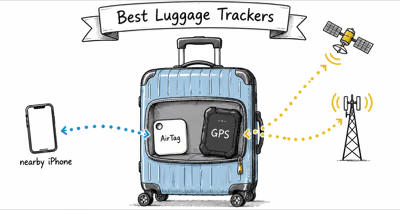
Domestic luggage trackers and international luggage trackers aren’t the same problem. At a US airport, AirTag has dense iPhone coverage. Put that same bag on a connection through Nairobi, Jakarta, or São Paulo, and the Find My network can go silent for hours. This guide focuses specifically on the best GPS tracker for luggage international travel: the products, trade-offs, and rules that matter when your bag crosses borders, not just terminals.
- Bluetooth trackers depend on crowd-sourced phone density — AirTag works well in Western Europe and East Asia, but updates become sparse across Sub-Saharan Africa, Central America, and interior South America.
- GPS cellular trackers (Tracki, GEGO PRO, SpaceHawk) work in 150—190+ countries independently, with no nearby phones required, but cost $9.95—$13.95/month.
- Bluetooth trackers are unrestricted in checked luggage worldwide — CR2032 coin cells contain just 0.1g of lithium metal, far below IATA’s 0.3g limit for checked devices.
- AirTag 2’s Share Item Location now works with 50+ airline partners — SITA data cited by Apple shows this helped carriers cut truly unrecoverable bags by up to 90%.
- For trips routing through Africa, Central Asia, or interior South America, a GPS cellular tracker is the only dependable option — Bluetooth crowd-finding can’t substitute for independent cellular coverage.
Does the Tracker Type Actually Matter for International Flights?
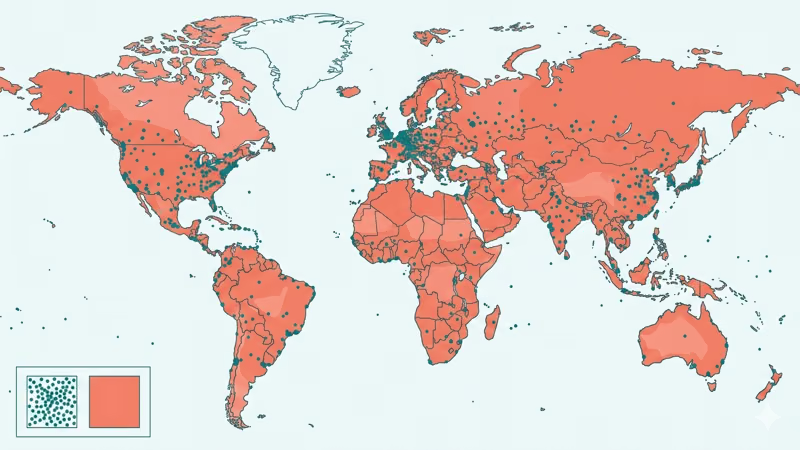
It matters more than most people realize. The technology gap that barely shows up on a domestic flight becomes a real problem on a multi-leg international itinerary.
When the crowd-sourced network thins out
Apple Find My works by piggybacking on nearby iPhones. Every iPhone running iOS 14+ with Bluetooth enabled anonymously relays AirTag location data back to you — without the phone owner knowing. In cities where iPhones are common (New York, London, Tokyo, Sydney), the network is dense enough for useful crowd-finding updates.
International coverage tells a different story. iPhone market share drops under 10% across much of Sub-Saharan Africa and sits around 15—20% in parts of Southeast Asia and Latin America. Through a low-iPhone-density hub like Addis Ababa, an AirTag can go many hours with no update — not because the bag is lost, but because too few nearby iPhones exist to relay its signal. For a full country-by-country breakdown, our guide on AirTags working internationally documents where coverage is unreliable.
Tile’s Life360 network (~70 million devices globally) faces the same density ceiling. Its cross-platform nature draws from both iOS and Android, giving it slightly wider reach in Android-dominant markets — but it’s still crowd-sourced and still depends on foot traffic passing your bag.
How GPS cellular tracking works abroad
GPS trackers like the Tracki 4G, GEGO PRO, and SpaceHawk operate on an entirely different model. They connect directly to local cellular towers using a multi-network SIM card — the same way your phone roams internationally. No nearby iPhones required. The device pings its coordinates to the cloud, and you see real-time location in the app from anywhere.
The trade-off is ongoing cost. Cellular data for global roaming isn’t free, so every GPS tracker in this category carries a monthly plan between $9.95 and $13.95. Battery life is also shorter: GPS continuously polling satellites consumes significantly more power than a Bluetooth chip waiting passively.
Most GPS luggage trackers last 2—14 days per charge depending on update frequency. For a week-long trip with a pre-departure charge, it works. For a 14-day itinerary, factor in a mid-trip charge.
For a deeper technical comparison between the two approaches, our AirTag vs GPS tracker guide covers the architecture differences in detail.
What Are the IATA Battery Rules for International Luggage Trackers?
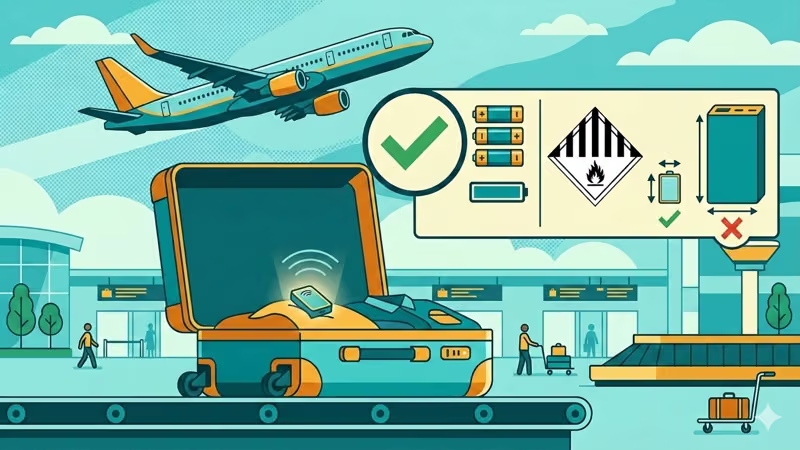
Battery regulations vary by tracker type and can determine whether your device is legally allowed in checked luggage. Getting this wrong at an international security checkpoint creates delays and potential confiscation.
Bluetooth trackers: no restrictions
AirTag, Tile, Chipolo, and Samsung SmartTag all run on CR2032 coin cells. Each CR2032 contains approximately 0.1g of lithium metal — well below the IATA lithium battery rules threshold of 0.3g for devices in checked luggage. You can pack any Bluetooth tracker in a checked bag anywhere in the world, on any airline, without restriction or declaration.
These devices are also unrestricted in carry-on. No approvals needed, no quantity limits.
GPS trackers: verify the battery size before you fly
GPS trackers with built-in lithium-ion batteries require more attention. According to IATA, their 2026 passenger guidance states that devices with non-removable batteries exceeding 0.3g lithium metal (equivalent to about 2.7 Wh) can’t travel in checked baggage. Batteries between 2.7 Wh and 100 Wh are permitted in carry-on only.
In practice, most GPS luggage trackers have batteries in the 300—1000 mAh range (roughly 1.1—3.7 Wh). The Tracki standard model uses a 600 mAh battery (~2.2 Wh), placing it below the 2.7 Wh checked-bag threshold. The GEGO PRO doesn’t publish a specific Wh rating for its battery — when the spec is ambiguous, the conservative and correct approach is carry-on placement.
The 2026 state of charge rule
A new IATA requirement effective January 1, 2026 specifies that lithium batteries packed with equipment in cargo must be at 30% state of charge or below. For passenger carry-on items, this restriction doesn’t apply. If you’re shipping GPS trackers as cargo (not in your personal luggage), charge them down before packing. The GEGO PRO’s smart flight mode automatically reduces power output during detected flight phases, which helps manage battery state without manual intervention.
The 7 Best Luggage Trackers for International Travel Compared
| Tracker | Type | Countries | Subscription | Battery | Checked Bag? |
|---|---|---|---|---|---|
| Tracki 4G | GPS + Cellular | 185+ | $9.95—$13.95/mo | 2—14 days | Yes (2.2 Wh) |
| Apple AirTag 2 | Bluetooth (Find My) | 140+ (varies) | None | about 12 months | Yes (CR2032) |
| GEGO PRO | GPS + Cellular | 190+ | $9.99/mo (annual) | Up to 14 days | Carry-on recommended |
| Tile Pro 2024 | Bluetooth (Life360) | 195+ (varies) | Free / $2.99/mo Premium | about 1 year (CR2032) | Yes (CR2032) |
| SpaceHawk GPS | GPS + Cellular | 150+ | about $9.95/mo | 2—7 days | Carry-on recommended |
| Samsung SmartTag 2 | Bluetooth (SmartThings) | 200+ (varies) | None | about 700 days | Yes (CR2032) |
| Chipolo Pop | Bluetooth (dual-network) | 140—195+ (varies) | None | about 12 months | Yes (CR2032) |
For physical security alongside GPS tracking, the AirBolt smart travel lock combines both in one device.
Tracki 4G GPS Tracker: Best Overall for International Travel
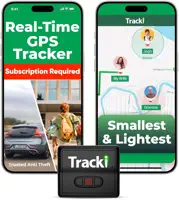
The Tracki 4G is the most practical GPS tracker for international luggage use. It ships with a global multi-network SIM already activated, covering 185+ countries. There’s no SIM swap, no country-specific data plan to purchase in advance, and no manual network configuration. Drop it in your bag, open the app, and it reports position.
§ Review summary
Tracki 4G GPS Tracker
≡ Specs
- Network
- 4G LTE multi-network SIM
- Coverage
- 185+ countries
- Update interval
- 1-60 seconds configurable
- Battery
- 600 mAh, 2-3 days at 1-min updates
- Subscription
- $9.95-$13.95/mo
- Features
- Geofence + location history
✓ Pros
- +Global SIM works in 185+ countries with zero manual configuration
- +Real-time updates every 1-60 seconds, no nearby phones needed
- +Configurable update interval extends battery on long-haul routes
- +About $30 device cost is the lowest entry price among GPS trackers here
- +Geofence alerts and location history in the app
✗ Cons
- −Monthly subscription required ($119-$167 per year if used continuously)
- −Standard 600 mAh battery lasts only 2-3 days at 1-minute update intervals
- −No bag-opening sensor; GPS-location only
- −App interface is functional but dated compared to Find My or SmartThings
§ Buy if
- ·Your itinerary spans 4+ countries or low-iPhone-density regions
- ·Real-time GPS (not crowd-sourced Bluetooth) is required for your scenario
- ·You'll switch to 5-minute updates to stretch battery to 10+ days
- ·Monthly subscription is acceptable trade vs cellular global coverage
Because Tracki reports over cellular networks rather than relying on nearby phones, it keeps updating position through regional airports where an AirTag can go silent for hours. Switching to 5-minute update intervals extends battery life to 10+ days — enough for most international trips without a mid-trip charge. Our full Tracki GPS tracker review covers the extended battery model and app deep-dive.
Apple AirTag 2: Best No-Fee Option for High-iPhone-Density Routes
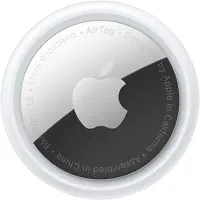
The AirTag 2 (January 2026) is the strongest argument for a Bluetooth-only tracker on international trips — if your routes stay within iPhone-dense regions. Apple’s AirTag 2 launch announcement confirmed 50+ airline partnerships for Share Item Location.
That feature lets airline staff access your bag’s real-time position when you file a delayed baggage claim. SITA data cited in the announcement shows carriers using this system have cut truly unrecoverable luggage incidents by up to 90% — a significant improvement on the old process of waiting for airline scanners to detect bags manually. For country-by-country iPhone density notes specific to European travel, see our AirTag in European countries rundown.
§ Review summary
Apple AirTag 2
≡ Specs
- Network
- Apple Find My (1B+ devices)
- Airline integration
- 50+ airline partners
- Precision Finding
- UWB, longer range
- Battery
- CR2032, about 12 months
- Water rating
- IP67 waterproof
- Subscription
- None
✓ Pros
- +No monthly fee, $29 one-time purchase
- +50+ airline partners for Share Item Location, speeds up delayed bag recovery
- +1B+ Find My devices; excellent update frequency at major airports worldwide
- +CR2032 battery lasts about 12 months, no mid-trip charging required
- +IP67 water resistance; safe inside luggage without a case
✗ Cons
- −Requires iPhone, zero tracking capability on Android
- −Coverage drops sharply in low-iPhone-density countries
- −No real-time GPS, location depends entirely on nearby iPhones reporting in
- −Apple anti-stalking alerts can trigger if a bag is away from its owner for extended periods
§ Buy if
- ·Your routes stay within iPhone-dense regions (US, Western Europe, Japan, etc.)
- ·Zero monthly fee matters more than rural-area coverage
- ·Airline lost-bag claims with Share Item Location matter (50+ airlines support it)
- ·Annual battery (no mid-trip charge) fits long-haul trip pattern
GEGO PRO: Best for Frequent International Flyers
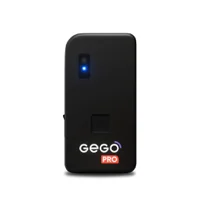
The GEGO PRO takes a different approach to airline integration. Rather than relying on your airline’s app, it includes a built-in light sensor that detects when your bag is opened and sends an immediate push notification to your phone. If someone rummages through your bag at any point during transit — at a transfer point, in a baggage facility, or at your destination — you’ll know the moment it happens.
Coverage spans 190+ countries through a multi-network SIM that auto-selects the strongest carrier in each region. That global reach matters because checked bags still go astray — SITA’s baggage report found that airlines mishandle fewer than 7 bags per 1,000 passengers, so a tracker means you are not relying on the airline to locate yours.
§ Review summary
GEGO PRO GPS Tracker
≡ Specs
- Network
- GPS + cellular multi-network SIM
- Coverage
- 190+ countries
- Subscription
- $9.99/mo (annual plan)
- Special feature
- Bag-opening light sensor
- Flight mode
- Auto-pause during detected flights
- Battery
- Li-ion (carry-on only)
✓ Pros
- +Bag-opening light sensor is unique, no other tracker here detects tampering
- +Smart flight mode conserves battery during transit; aids battery-state compliance
- +190+ country coverage is the widest GPS reach in this roundup
- +Landing alerts notify you when the device detects touchdown
- +Annual plan brings effective monthly cost to $9.99
✗ Cons
- −Higher device cost (about $70) than Tracki (about $30)
- −Li-ion battery, carry-on placement is the correct IATA approach
- −Newer product; long-term reliability data is still accumulating
- −Smart flight mode may occasionally misfire during high-speed ground transport
§ Buy if
- ·You're a frequent international flyer who values bag-opening alerts (tampering detection)
- ·190+ country coverage matters because you visit edge regions Tracki misses
- ·Smart flight mode saves you battery management on long-haul trips
- ·$70 device + $9.99/mo annual is acceptable given the tamper sensor
Tile Pro 2024: Best Cross-Platform International Option
Tile’s main international advantage is platform independence. It works on both iOS and Android without any ecosystem lock-in, which matters for mixed households or travelers who share itinerary tracking with someone on a different phone.
The Tile Pro’s 500-foot Bluetooth range is the longest in Tile’s lineup, giving it a slightly better chance of picking up network relays in less-dense areas — like a crowded bus terminal or a market in a city where iPhones are rare. For a full comparison of Android-compatible options, our guide to luggage trackers for Android goes deeper on the network differences.
Tile Pro 2024 at a glance: works on both iOS and Android with no ecosystem restriction, 500 ft range improves relay coverage in sparse networks, user-replaceable CR2032 makes it safe in checked bags with no mid-trip charging, no subscription is required for basic tracking, and the 90 dB speaker cuts through noisy baggage claims.
Limits: the 70M-device network is a fraction of AirTag’s 1B+, Tile is deliberately excluded from Google Find Hub, Premium ($2.99/mo) is required for location history and smart alerts, and it’s still crowd-dependent on low-traffic international transit routes.
SpaceHawk GPS Tracker: Best Real-Time Location Accuracy
The SpaceHawk uses a 3-second update interval — the fastest position refresh of any tracker in this roundup. Like most consumer GPS units it can resolve location to within a few meters in open-sky conditions, which helps when trying to pinpoint a bag inside a large international baggage facility. Coverage spans 150+ countries on 4G LTE multi-network roaming.
The SilverCloud subscription runs approximately $9.95 per month. Battery drains quickly at maximum update frequency; switching to 30-second intervals extends runtime to 5—7 days. Before packing a tracker, check the FAA rules on lithium batteries and devices in checked luggage.
SpaceHawk GPS Tracker at a glance: 3-second updates deliver the most granular position data of any tracker here, accuracy held around 6 feet in open-sky conditions, 4G LTE multi-network roaming auto-selects the strongest carrier in each country, and the magnetic housing drops easily into bag pockets.
Limits: the 3-second polling drains battery in 2-3 days at the top rate, coverage spans 150+ countries (narrower than Tracki’s 185+ and GEGO PRO’s 190+), the SilverCloud app is less polished than Find My, and the $9.95/month plan adds $119/year to the bill.
Samsung SmartTag 2: Best for Galaxy Users Traveling Abroad
Samsung’s SmartThings Find network reaches over 300 million Galaxy find nodes worldwide — an enormous pool that provides solid coverage in South Korea, Southeast Asia, and large urban centers where Samsung phones dominate. The Turkish Airlines integration (launched December 2025) lets SmartTag 2 users share bag location with Turkish Airlines staff during delayed baggage claims, mirroring AirTag’s Share Item Location feature. SmartTag 2 is a consistent top pick in our roundups of best luggage trackers for Samsung Galaxy owners specifically.
Samsung SmartTag 2 at a glance: the 300M+-node Galaxy network delivers excellent coverage in South Korea, Southeast Asia, and the Middle East; Turkish Airlines integration mirrors AirTag’s lost-bag recovery workflow; the 700-day CR2032 battery means no charging for years; IP67 water resistance lets it ride unrestricted in checked luggage; and there is no subscription fee.
Limits: Galaxy-only means no iPhone or non-Samsung Android support, SmartThings Find is weaker in North America and Western Europe, there is only one airline partner vs AirTag’s 50+, and UWB Precision Finding is limited to select Galaxy Ultra models.
Chipolo Pop: Best Dual-Network Budget Pick
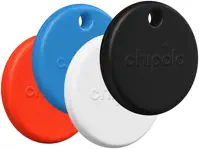
The Chipolo Pop is the only tracker in this roundup that can be registered to either Apple Find My or Google Find Hub. It does not operate on two Bluetooth networks simultaneously; choose the network that matches your primary travel phone, then factory reset and re-pair if you switch ecosystems later.
For travelers who don’t know their exact routing or who move through regions with mixed iOS/Android demographics, the dual-network hedge is useful. It’s one of the standout options in our best Bluetooth tracker roundup for exactly this reason.
§ Review summary
Chipolo Pop
≡ Specs
- Network
- Apple Find My + Google Find Hub
- Coverage
- Wherever iPhones or Androids are dense
- Speaker
- 120dB (loudest)
- Battery
- CR2032, about 12 months
- Subscription
- None
- Airline integration
- None
✓ Pros
- +Dual-network (Find My + Find Hub) gives widest Bluetooth reach of any tracker here
- +Works with both iPhone and Android, true cross-platform flexibility
- +120dB speaker is the loudest in this roundup, easy to locate in baggage claim
- +No subscription; CR2032 unrestricted in checked luggage globally
✗ Cons
- −Still Bluetooth-only, won't help in regions sparse on both iPhones and Androids
- −No airline integration for lost bag claims
- −No UWB Precision Finding, standard Bluetooth range guidance only
- −Smaller physical size means it can shift around inside larger bags
§ Buy if
- ·Your itinerary mixes iPhone-dense and Android-dense regions (dual-network hedges both)
- ·Zero subscription is the priority over cellular real-time tracking
- ·120dB speaker matters for finding bag in noisy baggage claim
- ·No airline lost-bag integration is acceptable trade-off
International Luggage Tracking: Practical Tips for Every Trip

Carry-on vs checked bag placement
Bluetooth trackers with CR2032 batteries go anywhere in checked luggage — no declaration, no limits. Place them in an interior zipper pocket or secured to a bag handle inside the main compartment. Avoid exterior attachment where they can be seen and removed.
For GPS trackers with Li-ion batteries, carry-on is the correct placement under IATA’s 2026 guidance. Keep them in your personal item or backpack on the plane. Some travelers place GPS trackers inside a clothing item in the checked bag (“packed with equipment” language), which technically addresses the checked-bag concern for trackers under 2.7 Wh — but carry-on is the risk-free approach that no airline will question.
The dual-tracker strategy for long international trips
The most reliable international setup isn’t a single expensive GPS tracker. It’s a two-device combination: an AirTag 2 or Chipolo Pop in your carry-on (free, no battery concerns, airline-integrated) plus a Tracki or GEGO PRO in or near your checked bag for real-time GPS coverage when the bag disappears into an international baggage system.
Total hardware cost: ~$30 (AirTag 2) + ~$30 (Tracki) = $60. Monthly cost during travel: ~$10. For two international trips per year, the GPS subscription costs $20—$30 per trip. Compare that to the average airline mishandled bag claim reimbursement timeline (days to weeks) and the math is simple.
Airline baggage integration: what’s working in 2026
AirTag’s Share Item Location feature has the widest airline support by far — 50+ carriers including major global hubs. When you file a delayed bag claim, you share a time-limited location link from Find My directly to the airline’s customer service agent. That agent can see your bag’s real-time coordinates without you needing to be present. The 9to5Mac analysis of AirTag’s airline loss reduction data puts the headline number at 90% fewer truly lost bags on participating carriers.
Samsung SmartTag 2’s Turkish Airlines integration works identically, but covers only Turkish Airlines routes. Google has announced Find Hub airline tracker sharing for 2026, which would extend similar functionality to Chipolo Pop and Pebblebee users — as of March 2026, that rollout isn’t yet complete.
Bottom Line
The right international luggage tracker depends on your route more than your budget. If your itinerary stays within high-iPhone-density regions — Western Europe, Japan, South Korea, Australia, North America — the AirTag 2 at $29 with no subscription and 50+ airline partners is the practical default. The airline integration alone recovers the cost of the device if it ever speeds up a delayed bag claim.
If your routing includes transit through Africa, Central Asia, interior South America, or any region where iPhone density is low, a GPS cellular tracker isn’t optional. The Tracki 4G covers the most countries at the lowest device cost and includes a global SIM out of the box.
The GEGO PRO earns its higher price through bag-opening alerts and smart flight mode — worth it if you check bags on every trip. For a no-fee hedge that works on both iPhone and Android, Chipolo Pop’s dual-network coverage is the pragmatic choice.
Whatever you choose: check the IATA battery rules before your first international flight. Bluetooth trackers are unrestricted. GPS trackers belong in your carry-on.
FAQ
Can you put a GPS tracker in checked luggage on international flights?
It depends on the battery. Bluetooth trackers (AirTag, Tile, Chipolo, SmartTag) use CR2032 coin cells containing 0.1g of lithium metal — well below IATA’s 0.3g checked-bag threshold — and are unrestricted worldwide. GPS trackers with built-in lithium-ion batteries fall under stricter rules: IATA’s 2026 passenger guidance restricts devices with non-removable batteries above 0.3g lithium (2.7 Wh) to carry-on luggage only. Most GPS luggage trackers sit in a borderline range of 1—4 Wh, so the safest approach is to carry GPS trackers in your personal item rather than in the checked bag.
Do AirTags work in every country?
AirTag works reliably in countries where iPhone market share is high. The US, UK, Japan, Australia, Canada, and most of Western Europe see frequent location updates because iPhones are common. In Sub-Saharan Africa, parts of Southeast Asia, Central America, and interior South America, the Find My network thins out — updates can arrive hours apart or not at all during transit. AirTag performs best at international airports, which are densely packed with travelers carrying iPhones regardless of the country. For a full regional breakdown, our guide to AirTags working internationally documents the specific gaps.
What happens to a GPS tracker when the plane is in the air?
GPS trackers lose cellular connectivity above approximately 10,000 feet because ground-based cell towers are out of range at altitude. The GPS module continues logging coordinates internally on most devices. Trackers like the GEGO PRO enter a dedicated flight mode that pauses cellular transmissions entirely to conserve battery. Once the plane lands and the device reacquires signal, it can sync its most recent position. You won’t see mid-flight updates, but you’ll get an on-ground location after landing — which is exactly when it matters for baggage tracking.
Is Tracki worth the monthly fee for international travel?
For travelers who check bags on international routes regularly, yes. The $9.95—$13.95 monthly cost covers independent GPS coverage in 185+ countries — something no Bluetooth tracker can replicate in low-iPhone-density regions. The device costs ~$30. Many frequent travelers activate the subscription during travel months only and cancel when home, bringing annual cost to $30—$60 depending on trip frequency. Set against the cost of replacing lost luggage contents — or the time lost filing airline claims without location data — the subscription is clear value for regular international travelers.
Which luggage tracker works best in Asia and Southeast Asia?
It depends on which part of Asia. Japan, South Korea, and Australia have high iPhone density, so AirTag delivers frequent updates. Singapore and major Chinese cities have strong Samsung Galaxy penetration, making SmartTag 2 a good Bluetooth option. For transit through Vietnam, Indonesia, the Philippines, Bangladesh, or Myanmar — where both iPhone and Galaxy share is more mixed and rural routing is common — a GPS cellular tracker like Tracki or GEGO PRO provides reliable position data regardless of local phone demographics. Because it reports over cellular networks instead of nearby phones, a GPS tracker is the most dependable choice for routes through low-iPhone-density regions.
Do you need a special SIM card for a GPS luggage tracker abroad?
Not with current GPS luggage trackers. Tracki, GEGO PRO, and SpaceHawk all ship with a global multi-network SIM card already installed and activated. The SIM automatically connects to the strongest available carrier in each country you visit. There is no SIM swap, no international roaming plan to purchase separately, and no manual configuration required. Your monthly subscription fee covers the cellular data costs for global roaming. Older GPS trackers that require a bring-your-own SIM (BYOD) are a different case — those need a local or international roaming SIM per country, which is an additional hassle none of the trackers in this guide require.
Are luggage trackers allowed by TSA and international airport security?
Yes. TSA explicitly permits AirTags and similar Bluetooth trackers in both checked and carry-on bags. GPS cellular trackers are also allowed; their electronics and battery may occasionally prompt additional screening, but they aren’t prohibited items. Internationally, the relevant authority is IATA rather than any single security body — and IATA’s 2026 passenger guidance focuses on battery size rather than the tracking function itself. Bluetooth trackers never trigger battery restrictions. GPS trackers with batteries under 100 Wh (which covers all consumer-grade luggage trackers) are permitted in carry-on worldwide.