Before you put an AirTag in a package, know the one rule that matters: USPS Publication 52 states that up to 4 lithium button cells installed in the equipment they operate mail domestically with no hazmat marking. An AirTag clears that easily. Placement, recipient sharing, and tag return are the real work, and this guide walks through each.
- USPS Publication 52 permits up to 4 lithium button cells installed in equipment per domestic mailpiece with no hazmat marking, and an AirTag carries just 1 CR2032.
- Transit tracking is real: in one published mail test, the AirTag reached the first sorting facility within 28 minutes of pickup and kept updating overnight.
- Share Item Location gives your recipient a live browser map with no Find My app needed, and the link expires on its own after 7 days.
- Find My keeps no route history. The map shows the last relayed pin with a timestamp, never a breadcrumb trail of the whole journey.
- A $99 4-pack works out to $24.75 per tag, so even a tag that never comes home costs less than stacking insurance add-ons on every high-value parcel.
Is It Allowed to Ship an AirTag in a Package?
Yes -- an AirTag is mailable in a domestic US package with all three major carriers. The concern people bring to this question is the lithium battery. The actual rule is friendlier than the hazmat reputation suggests, because an AirTag runs on a single CR2032 coin cell sealed inside the device, which is exactly the configuration postal regulations treat most gently.
The USPS spells it out in Publication 52, section 349: small lithium cells installed in the equipment they operate ship domestically, and a mailpiece with no more than 4 cells installed needs no lithium-battery marking at all. Button cells are capped at 0.3 grams of lithium metal each, and a CR2032 falls well under that cap. One AirTag in a taped box clears every threshold with room to spare.
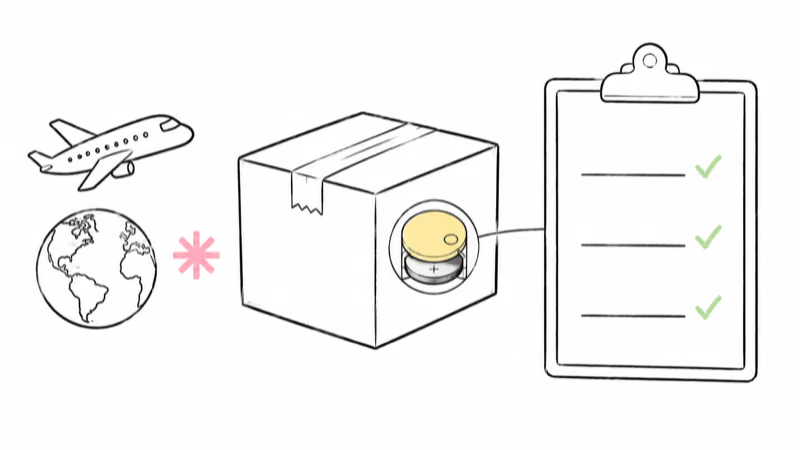
UPS and FedEx build their small-battery rules on the same DOT framework, and both move consumer electronics with installed coin cells every day. A single AirTag packed inside a domestic shipment needs no markings or paperwork with either carrier. International mail is the exception: lithium rules tighten in air transport, and some destination countries restrict batteries in inbound post entirely, so check the specific lane before tagging an overseas box.
| Carrier | Allowed? | What the rule says |
|---|---|---|
| USPS | Yes | Pub 52 excepts up to 4 button cells installed in equipment; no marking required |
| UPS | Yes | DOT-based small-battery rules; an installed coin cell rides as ordinary goods |
| FedEx | Yes | Same DOT framework; no declaration for a single installed CR2032 |
| International post | Varies | Air-transport lithium rules tighten; check the destination country first |
One boundary worth naming: these are parcel rules, not aviation rules. If your scenario is a suitcase in a cargo hold rather than a box at the post office counter, the TSA and FAA framing in our AirTag in checked luggage guide is the one to read instead.
How Well Does an AirTag Track a Package in Transit?
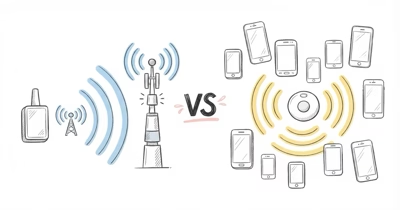
Better than most senders expect, with updates clustering wherever iPhones cluster. An AirTag carries no GPS chip and no SIM card. It pings nearby Apple hardware over Bluetooth, and Apple's Find My overview confirms that the same app locating a lost iPhone locates AirTags too. The relay network behind it spans over a billion Apple devices, and sorting facilities are full of workers carrying them.
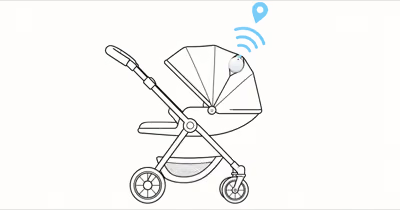
The best published cadence data comes from Intego, whose writer mailed an AirTag through Royal Mail and found that it reached the first sorting station 28 minutes after pickup, kept reporting through an overnight truck run, and surfaced at the destination sorting office by 6:45 the next morning. Updates thinned out at highway speed and got dense again at every facility, which is exactly what the iPhone-relay model predicts.
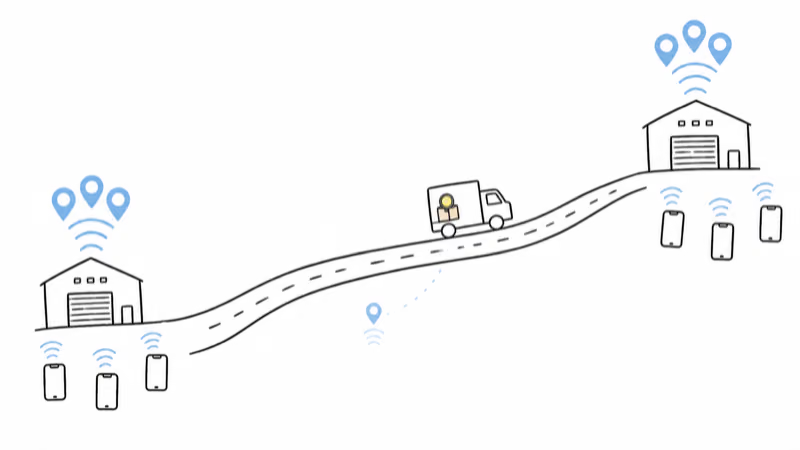
Stateside, a Texas TV newsroom reported that 11 Priority Mail packages it tagged with AirTags exposed routing the official scan history never showed, including a box that detoured through a facility in Coppell, Texas before circling back toward Houston. When a delivery dispute comes down to where the box actually went, that independent pin is your evidence.
Two limits keep expectations honest. Find My stores no breadcrumb trail -- the map shows the last relayed position only, a design our AirTag location history explainer covers in depth. Coverage also follows iPhone density: a box on a rural line-haul can sit silent for hours, and cross-border parcels depend on how well AirTags work internationally along that specific route.
Setting Up the AirTag Before You Ship
Five minutes of prep prevents the two classic mistakes: an AirTag that spams you with alerts as the truck pulls away, and one buried where no Bluetooth signal escapes. Run through this list while the box is still open.
- Rename the tag in Find My to something like "Camera lens to Denver" so the map pin identifies the shipment at a glance.
- Turn off Notify When Left Behind for that tag. Skip this and your iPhone fires separation alerts the moment the parcel leaves your street.
- Check the battery. A fresh CR2032 runs about 12 months, but a cell already near empty has no business starting a 2-week journey.
- Pad the tag near the middle of the box, away from metalized bubble wrap or foil-lined pouches, which choke the Bluetooth signal.
- Leave Lost Mode off. The tag relays its position either way; save Lost Mode for the day the box actually disappears.
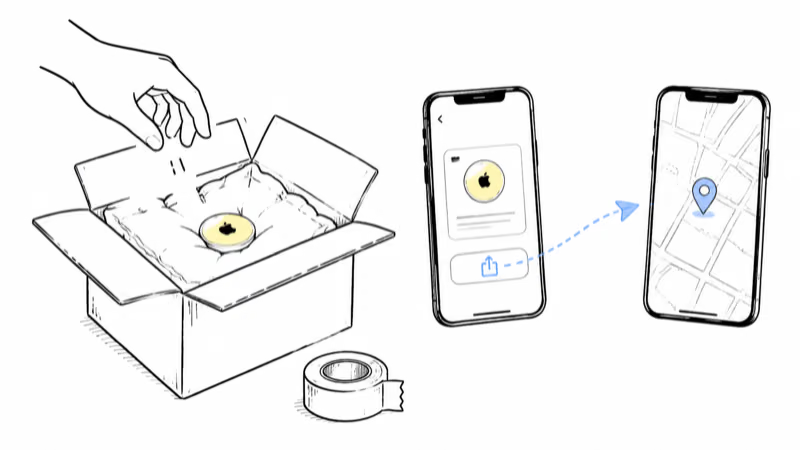
The scope here is your own AirTag riding in your own outgoing parcel. Tell the recipient the tag is in the box -- the shared map is the point of the exercise, it keeps everything on the right side of tracking-consent norms, and it sets up the return trip covered below.
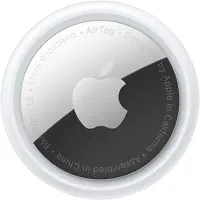 Top Pick
Sharing the Map With Your Recipient
Share Item Location turns the AirTag from your private tracker into a link anyone can open. Apple announced the feature in late 2024 with iOS 18.2: you generate a URL in Find My, the recipient opens a live web map in a browser, and the link expires on its own after 7 days or the moment you tap Stop Sharing. No Find My app on their end, no Apple device required.
The flow takes seconds. Open Find My, tap the AirTag under Items, tap Share Item Location, and send the link by text or email. For a shipment that might outlast the first week, generate a fresh link when the old one lapses -- the expiry is a privacy feature, not a defect.
Recipients on iPhone have a longer-term option: add them as a borrower so the tag appears in their own Find My app. Our walkthrough on how to share an AirTag's location covers the borrower flow, its 5-person cap, and what borrowers can and can't do with the tag.
Getting the AirTag Back After Delivery
The return question decides whether tagging parcels becomes a habit or stays a one-off experiment. Three patterns work, and the right one depends on who sits at the other end of the shipment.
The return-envelope loop suits repeat lanes: a seller shipping to the same buyer, or family members swapping boxes across the country. Drop a padded envelope with prepaid postage inside the parcel, and the recipient peels the tag out and mails it back the same day. One tag can shuttle between the same two addresses for its entire battery life.
Gift-it-forward is cleaner for one-time shipments. At $24.75 per tag in the $99 4-pack, the tracker becomes part of the gift, and the recipient walks away with a starter AirTag for their own keys.
Writing it off as insurance makes sense on truly high-value parcels. Weigh a sub-$25 tag against declared-value fees, signature services, and the cost of losing a delivery dispute with no evidence of your own. Recover the tag when you can; shrug when you can't.
When a GPS Tracker Beats an AirTag for Shipments
The Find My relay assumes iPhones pass near the parcel. Freight moves through places where that assumption breaks: sealed trailers on interstate line-hauls, rail yards, container terminals, customs holding lots. In those environments the pin goes quiet exactly when you want it most, and no amount of AirTag placement fixes a physics problem.
A cellular GPS unit reports on a fixed schedule from its own radio, keeps a full route log, and can geofence the arrival zone. An AirTag does none of that. For pallet freight, container moves, or any lane through low-iPhone territory, our roundup of GPS trackers for shipping containers covers units with 80-day idle batteries and magnetic steel mounts. For a cardboard box moving through USPS, UPS, or FedEx parcel networks, the AirTag stays the cheaper, subscription-free answer.
Bottom Line
Shipping your own AirTag inside your own parcel is allowed, useful, and cheap. Domestic carrier battery rules accept an installed CR2032 without paperwork, the Find My network reports movement that carrier scans skip, and Share Item Location hands your recipient a live browser map. Switch off Left Behind alerts, plan the tag's return trip before you tape the box, and reach for a cellular GPS tracker only when the route leaves iPhone territory.
FAQ
Is it against USPS rules to put an AirTag in a package?
No. USPS Publication 52 treats the AirTag's CR2032 as a button cell installed in the equipment it operates, mailable domestically with no hazmat marking for up to 4 installed cells. One AirTag in a box sits far below every limit in the rule.
Can the person receiving the package track it too?
Yes. Send a Share Item Location link from Find My on iOS 18.2 or later, and the live map opens in a web browser with no Find My app needed. The link expires after 7 days, or you can add an iPhone-owning recipient as a borrower for ongoing access.
How accurate is AirTag tracking while a package is in transit?
Update frequency depends on nearby iPhones, so pins cluster at sorting facilities and on delivery routes. In Intego's Royal Mail test the tag reported within 28 minutes of pickup and surfaced at each facility through the night. Expect quiet stretches on highways and dense updates in cities.
Do UPS and FedEx allow AirTags in packages?
Yes, for domestic shipments. Both carriers base their small-battery rules on the same DOT framework as USPS, which excepts coin cells installed in the device they power. International air shipments face tighter lithium rules, so confirm the destination lane before you ship abroad.
How do I get my AirTag back after the package is delivered?
Include a prepaid padded return envelope in the box, or let the recipient keep the tag as part of the shipment. In a 4-pack each tag costs $24.75, so many senders simply write it off on one-way, high-value parcels.
Does an AirTag in a package work for international shipping?
It works where iPhones are common, and update gaps grow in regions with low Apple device density. Battery rules also tighten for international airmail, and some destination countries restrict lithium cells in inbound post. Check both the coverage and the postal rules before tagging an overseas parcel.
Is an AirTag better than the carrier's own tracking?
The two answer different questions. Carrier scans confirm custody milestones, while the AirTag shows where the box physically sits between scans, which is the data that matters when a shipment stalls or a delivery is disputed. Running both costs $29 or less with no subscription.