Motorcycle theft remains a serious problem in the U.S., and NICB data shows only about 42% of stolen bikes are ever recovered. A GPS tracker won’t stop someone from loading your bike into a van at 3 AM, but it gives you and the police a live breadcrumb trail to follow before the bike gets parted out. This guide compares seven trackers on alert speed, battery endurance, hiding options, and total ownership cost over three years.
- Monimoto 9 auto-arms via key fob and calls your phone — no app checking needed when the bike moves
- 3-year cost ranges from $35 (AirTag alone) to $822 — the cheapest dedicated GPS tracker over 3 years is Monimoto at $272
- TKSTAR TK905 at ~$50 is the cheapest real GPS option — but you need to supply your own SIM card and deal with a Chinese tracking app
- AirTag 2 isn’t a GPS tracker — it relies on nearby iPhones, so use it as a hidden backup layer, not your primary defense
- A GPS tracker can qualify you for a 10-20% motorcycle insurance discount — ask your agent, the savings can offset the subscription cost
The Best Motorcycle GPS Trackers at a Glance
| Tracker | Type | Battery | Subscription | 3-Year Cost |
|---|---|---|---|---|
| Monimoto 9 | Dedicated moto GPS | 12+ months | $2.85/mo | about $272 |
| Invoxia Cellular GPS | No-sub GPS (yr 1) | 4-6 months | Free yr 1, then $120/yr | about $370 |
| TKSTAR TK905 | BYOD SIM GPS | Up to 30 days standby | SIM about $5-10/mo | about $230-410 |
| Family1st Portable | 4G LTE GPS | about 2 weeks | $22/mo ($17 annual) | about $642-822 |
| Apple AirTag 2 | Bluetooth backup | about 12 months | None | about $35 |
| Bouncie | OBD-II GPS | Vehicle-powered | $9.65/mo | about $437 |
| LandAirSea 54 | Magnetic GPS | about 2 weeks | $15/mo (annual) | about $570 |
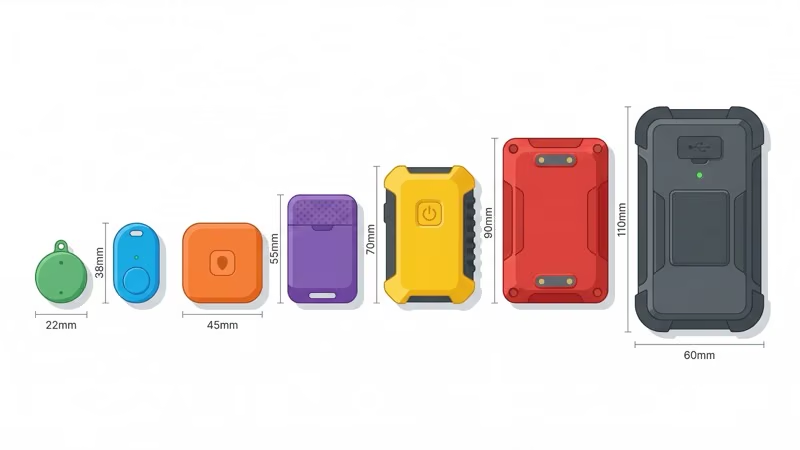
Real GPS vs Bluetooth: Why Motorcycles Need Both Layers
How GPS Trackers Work on a Motorcycle
A dedicated GPS tracker contains a cellular modem with a SIM or eSIM. The NICB has found that stolen motorcycles are far more likely to be recovered when a GPS tracker is installed.
When your bike moves, the tracker locks onto GPS satellites, calculates its position, and sends coordinates to a server over 4G/LTE. You get a push notification, a phone call, or both depending on the device. Alert timing depends on the tracker, network signal, and reporting mode. For more SIM-based options across price tiers, see our best GPS trackers with SIM card roundup.
Alert speed varies dramatically between trackers. Monimoto 9 is built around a phone-call alert workflow instead of app-only notifications.
Battery life is the other Monimoto strength. Monimoto’s official spec sheet states that the Monimoto 9 runs up to 12 months on a single charge.
Family1st is built around app-based live tracking, while the TKSTAR TK905 relies more on SMS commands than a persistent server connection. Alert speed is one of the biggest factors in theft-recovery success, so a slower SMS workflow matters when a thief is loading your bike into a van.
Why AirTag Is Layer 2, Not Layer 1
AirTag has no GPS chip and no cellular modem. It broadcasts a Bluetooth signal that nearby iPhones relay anonymously through Apple’s Find My network. In a dense city, that produces useful location pings. In a suburban garage or rural storage unit, there are no iPhones nearby, and the AirTag goes silent for hours.
There’s also the anti-stalking problem. Apple’s unwanted tracking alerts notify the thief’s iPhone over time that an unknown AirTag is traveling with them.
That feature protects people from stalking, but it works against theft recovery.
For a full breakdown of where Bluetooth tracking stops and GPS begins, see our Bluetooth vs GPS trackers comparison.
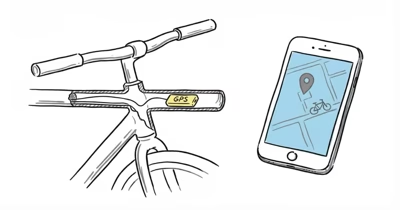
The smart play is to run both. Hide a GPS tracker under the seat for instant alerts and live tracking, then stash an AirTag 2 deep inside the handlebar tube as a $29 insurance policy.
If the thief finds one, the other keeps working.
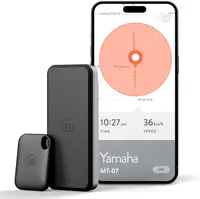
Monimoto 9: Best Overall Motorcycle GPS Tracker
Monimoto is a Lithuania-based company that has been making motorcycle theft trackers since 2016. The Monimoto 9 does one thing: detect unauthorized movement and alert you immediately. No ride logging, no speed tracking, no social features.
The key fob system separates it from every other tracker on this list. You carry a small fob on your keychain.
When you walk away from your bike, the fob goes out of Bluetooth range and the tracker arms itself automatically. No buttons, no app toggles, nothing to forget. When someone moves the bike without the fob nearby, Monimoto is designed to send a push notification and then call your phone.
The eSIM means no hunting for compatible SIM cards. IP68 weatherproofing handles rain and road spray without a case. At 2 ounces, it hides under a seat or inside a fairing with zero trouble. Read our full Monimoto 9 review for install details and battery specs.
§ Review summary
Monimoto 9
≡ Specs
- Network
- LTE-M + eSIM global coverage
- Subscription
- $2.85/mo ($34.20/yr)
- Battery
- 12+ months rechargeable
- Water rating
- IP68 waterproof
- Alert speed
- Phone call alert
- Install
- No wiring, key fob auto-arm
✓ Pros
- +Phone call movement alert, not just app notification
- +Key fob auto-arms, zero daily effort
- +IP68 waterproof, 2 oz weight, hides anywhere
- +Lowest 3-year cost of any dedicated GPS tracker (about $272)
- +eSIM works globally, no SIM card setup
✗ Cons
- −$169 upfront is the highest device cost on this list
- −No ride tracking or route logging
- −Key fob battery needs replacing every 6-12 months
- −Limited Amazon availability, check stock
§ Buy if
- ·You want phone-call theft alerts, not just a push notification
- ·You ride year-round and need the longest battery: 12 months between charges
- ·You're OK with $169 upfront because the 3-year total stays under $275 with no surprise costs
- ·Key fob auto-arming matters: you've forgotten to enable a manual alarm at least once
Invoxia Cellular GPS Tracker: Best for Seasonal Riders
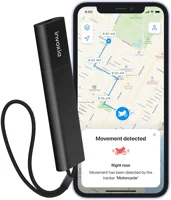
The Invoxia Cellular GPS Tracker ships with one full year of cellular service included in the purchase price. No credit card on file, no trial to cancel.
After year one, it’s $120/year to continue. For riders who store their bike over winter and only ride six months, that free first year covers the entire riding season. Weighing this against a $29 AirTag? Our Invoxia vs AirTag comparison shows when cellular GPS justifies the subscription.
Invoxia uses GPS, Wi-Fi, and Bluetooth together to fix its position, which helps indoors where pure GPS struggles. The tilt detection feature sends an alert if someone tips or lifts your bike — even a bump from a passing delivery driver can trigger it. Geofencing lets you draw a virtual perimeter and get notified if the tracker leaves it.
Battery life is 4-6 months with standard settings, dropping closer to 4 months with geofencing active and frequent check-ins.
For a head-to-head with Monimoto, see our Invoxia vs Monimoto comparison.
The full Invoxia GPS Tracker review covers the app experience. The Invoxia also works well on e-bikes, where it tucks under the seat or inside the battery compartment — our best GPS trackers for e-bikes guide compares it against motor-hidden options like PowUnity BikeTrax.
§ Review summary
Invoxia Cellular GPS Tracker
≡ Specs
- Network
- GPS + Wi-Fi + Bluetooth multi-mode
- Subscription
- Free year 1, then $120/yr
- Battery
- 4-6 months rechargeable
- Water rating
- IPX7 water resistant
- Alert speed
- Push notification
- Special feature
- Tilt and motion detection
✓ Pros
- +Free cellular for year 1, no subscription to start
- +Multi-mode positioning (GPS + Wi-Fi + Bluetooth)
- +Tilt detection catches bike being lifted into a van
- +Small enough to hide under most seats
✗ Cons
- −$120/yr after year 1 adds up fast
- −About 4 months battery with geofencing active
- −Push-only alerts are slower than Monimoto's call workflow
- −No phone call alerts, push notifications only
§ Buy if
- ·You're a seasonal rider whose riding season fits inside the free year-1 cellular window
- ·You want multi-mode positioning (GPS + Wi-Fi + Bluetooth) that works in mixed indoor/garage scenarios
- ·Tilt detection matters because thieves at your storage location lift bikes into vans, not ride them
- ·Push-only alerts are acceptable instead of a phone call
TKSTAR TK905: Best Budget Motorcycle Tracker
The TK905 is the entry point for real GPS tracking on a motorcycle.
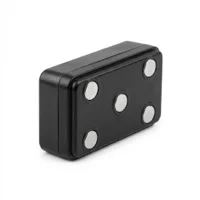
At around $50, it costs a fraction of the Monimoto, and the 5,000mAh battery is manufacturer-listed for up to 30 days on standby. The magnetic mount sticks to any steel surface on your frame, though you should add a zip tie as insurance against road vibration.
The catch: you supply your own SIM card. That means buying a prepaid data SIM (a $5/month Hologram IoT SIM is one option), inserting it, and configuring the tracker via SMS commands. Setup is more manual than an eSIM tracker. The TKSTAR app is functional but bare-bones, and the tracking platform runs on Chinese servers.
For riders who want more battery, the TK905B variant doubles capacity to 10,000mAh for about $20 more. Our TKSTAR TK905 review walks through the full SIM setup process.
§ Review summary
TKSTAR TK905
≡ Specs
- Network
- BYOD SIM (about $5-10/mo data plan)
- Subscription
- None (you supply SIM)
- Battery
- 5,000mAh, up to 30-day standby
- Water rating
- IP65 (rain only)
- Alert speed
- SMS-command workflow
- Install
- Strong magnetic mount, no wiring
✓ Pros
- +Lowest upfront cost of any real GPS tracker (about $50)
- +5,000mAh battery listed up to 30 days on standby
- +Strong magnetic mount, no wiring needed
- +10,000mAh TK905B variant available for extended runtime
✗ Cons
- −BYOD SIM setup is more manual than eSIM trackers
- −SMS-command workflow is slower than app-first trackers
- −App is basic, tracking server hosted in China
- −IP65 only, less weather protection than competitors
§ Buy if
- ·Upfront cost is your hard constraint and $50 is the entry budget for real GPS tracking
- ·You're comfortable installing a third-party SIM and reading SMS-based docs
- ·Up-to-30-day standby battery matches a bike that sits parked between rides
- ·An SMS-based alert workflow is acceptable instead of a faster app-first alert
Family1st Portable GPS Tracker: Best Real-Time Alerts
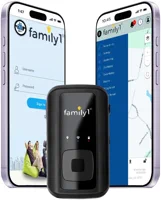
If alert speed is your top priority, the Family1st Portable GPS is the app-first live-tracking pick on this list. The 4G LTE connection supports quick alerts, and the tracking map can refresh frequently during active movement. That faster refresh cadence is the reason to choose it over SMS-command trackers.
The tradeoff is battery life and cost. Two weeks between charges means you’re plugging this thing in regularly.
For daily commuters who charge overnight, that’s manageable. For bikes that sit parked for weeks, it’s a headache. The subscription at $22/month (or $17/month annually) makes it the most expensive option over three years at $642-822. Our Family1st GPS Tracker review has the full app walkthrough.
§ Review summary
Family1st Portable GPS Tracker
≡ Specs
- Network
- 4G LTE, 5-second update
- Subscription
- $22/mo ($17/mo annual)
- Battery
- About 2 weeks rechargeable
- Alert speed
- Fast 4G LTE push notifications
- Features
- Geofencing, speed alerts, SOS button
- 3-year cost
- $642-822
✓ Pros
- +Fast push alerts over a 4G LTE connection
- +5-second update interval during active tracking
- +Feature-rich app with geofencing and speed alerts
- +$30 device cost is very low upfront
✗ Cons
- −2-week battery life requires frequent charging
- −$22/mo subscription is the highest on this list
- −3-year cost reaches $642-822 depending on plan
- −No auto-arm feature, must set alerts manually
§ Buy if
- ·You watch your bike in real time during a theft attempt, not just get a one-shot alert
- ·5-second map updates matter (you're tracking a moving bike on the map, calling police live)
- ·You ride daily and can plug in the charger overnight, every 2 weeks at minimum
- ·Highest subscription is acceptable because alert-speed is non-negotiable
Apple AirTag 2: Best $29 Backup Layer
An AirTag isn’t a GPS tracker and should never be your only defense against motorcycle theft.
It has no cellular modem, no GPS chip, and no way to send you an instant theft alert. What it does is broadcast a Bluetooth signal that nearby iPhones detect and relay silently. In dense urban areas, that produces a useful breadcrumb trail. In a garage or rural storage facility, it goes dark.
What makes it worth the $29 is redundancy. Hide it in a different location from your GPS tracker.
If the thief finds the GPS unit under the seat, the AirTag tucked inside the handlebar tube keeps transmitting. For a waterproof mount, the Elevation Lab TagVault Surface sticks to flat surfaces inside fairings.
Our guide on AirTag for motorcycle theft covers hiding spots and real recovery stories in detail.
One concern specific to motorcycles: heat. Engine-adjacent spots can exceed 150F during summer rides, and AirTag’s operating range tops out at 140F. Keep it away from exhaust headers and engine cases. Our AirTag heat resistance guide has the full thermal details.
Where AirTag 2 wins as a backup layer: $29 with no subscription, a tiny form factor that hides where a cellular tracker can’t (handlebar tube, seat liner, fairing panel), and the billion-plus-device Find My network that excels in urban areas. In Lost Mode, the tamper alert fires when the battery cover is opened, and any passing iPhone relays location silently.
Where it falls short as a primary tracker: no GPS, no instant alerts, silent in garages and rural areas, and the anti-stalking beep warns the thief within a day.
Bouncie: Best for Trike and Can-Am Riders
Most motorcycles don’t have an OBD-II diagnostic port. That limits Bouncie to three-wheeled vehicles like the Can-Am Spyder, Polaris Slingshot, and various trike conversions that retain the donor car’s OBD-II system. If your ride has one, Bouncie is the simplest tracker to install: plug it in and go.
Vehicle power means no battery to charge. The 15-second update interval is fast enough for live theft tracking, and the app includes trip history, geofencing, and driver behavior scoring.
At $9.65/month, the subscription is reasonable for what you get. The Bouncie GPS Tracker review covers the full feature set and accuracy.
Bouncie at a glance: vehicle-powered, $9.65/month, 15-second updates, full trip logging.
LandAirSea 54: Best Magnetic Mount Option
The LandAirSea 54 is a flat magnetic puck about the size of a jar lid.
The built-in magnet sticks to any steel surface on a motorcycle frame, which makes installation a 10-second job. For riders who want quick deployment without zip ties or adhesive, that magnetic mount is convenient.
Battery life is the limiting factor: about two weeks of active tracking before you need to recharge via USB-C. The subscription at $15/month on an annual plan pushes the 3-year cost to around $570, which puts it on the expensive side.
The real appeal is portability. It can move between two bikes and a car without tools.
If you ride different motorcycles or want to move a tracker between vehicles, the magnetic puck makes that painless. See the full LandAirSea 54 review for accuracy benchmarks.
LandAirSea 54 at a glance: no-tool magnetic mount, compact puck form factor that’s easy to conceal, $30 device cost keeps the entry point low, and Google Maps integration in the tracking app. The limits: 2-week battery life requires frequent recharging, the $15/mo subscription drives 3-year cost to $570, the magnet may lose grip under heavy vibration, and the update interval is slower than Family1st or Bouncie.
Where Should You Hide a GPS Tracker on Your Motorcycle?
The best tracker is useless if a thief finds it quickly. Concealment is half the battle. We wrote a dedicated guide on motorcycle GPS tracker hiding spots with six locations ranked by signal, concealment, and battery access. Here is the quick summary.
For cold-weather riding and storage, our GPS trackers for snowmobiles guide covers snow, vibration, and cellular coverage tradeoffs.
Off-road riders should see the dirt bike GPS tracker picks instead.
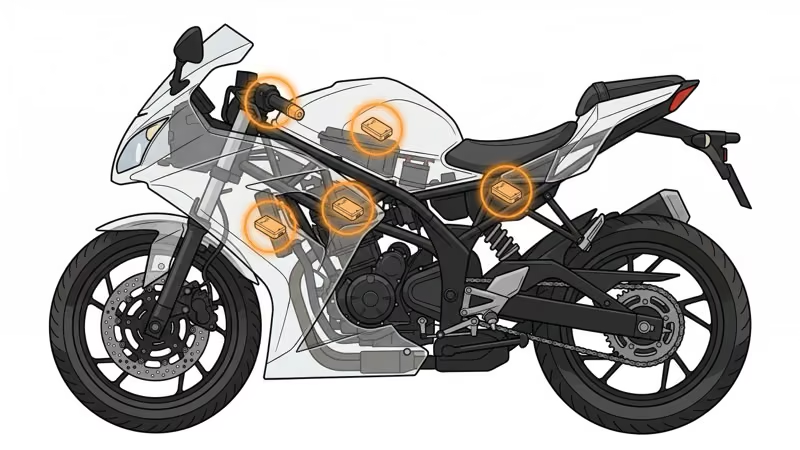
Under the Seat
The most common hiding spot and the easiest to access for battery swaps.
Lift the seat, zip-tie the tracker to the subframe. The downside: it’s the first place any experienced thief checks. Use this for your primary GPS tracker only if you also have a backup hidden deeper.
Inside the Fairing or Side Panel
Sport bikes and touring bikes have hollow fairing panels that provide solid concealment. The plastic shell protects from direct rain, and removing fairings takes tools and time that a grab-and-go thief won’t invest.
Frame Cavity or Headstock
Steel-frame bikes often have hollow backbone tubes accessible through wiring grommet holes.
Dropping a small tracker (especially an AirTag) inside the frame gives the deepest concealment available. The downside is reduced GPS signal strength through steel. Test signal quality before committing.
Handlebar Tube
Most handlebars are hollow aluminum tubes. Pop off the bar-end weight, slide a tracker wrapped in foam inside, and replace the end cap.
This works well for AirTag given its small size. Wrap it in foam to cut rattling, and check signal before sealing the end cap. For additional concealment strategies that transfer between vehicles, our guide on hiding an AirTag in a vehicle has more ideas.
What Is the 3-Year Total Cost of Each Tracker?
Device price tells you almost nothing about what you’ll actually spend. Subscriptions dominate the total cost over three years. Here’s the math.
| Tracker | Device Cost | 3-Year Subscription | Other Costs | 3-Year Total |
|---|---|---|---|---|
| AirTag 2 | $29 | $0 | about $6 (batteries) | $35 |
| TKSTAR TK905 | $50 | $180-360 (SIM) | $0 | $230-410 |
| Monimoto 9 | $169 | $102.60 | $0 | $272 |
| Invoxia | $130 | $240 (yr 2-3) | $0 | $370 |
| Bouncie | $90 | $347 | $0 | $437 |
| LandAirSea 54 | $30 | $540 | $0 | $570 |
| Family1st | $30 | $612-792 | $0 | $642-822 |
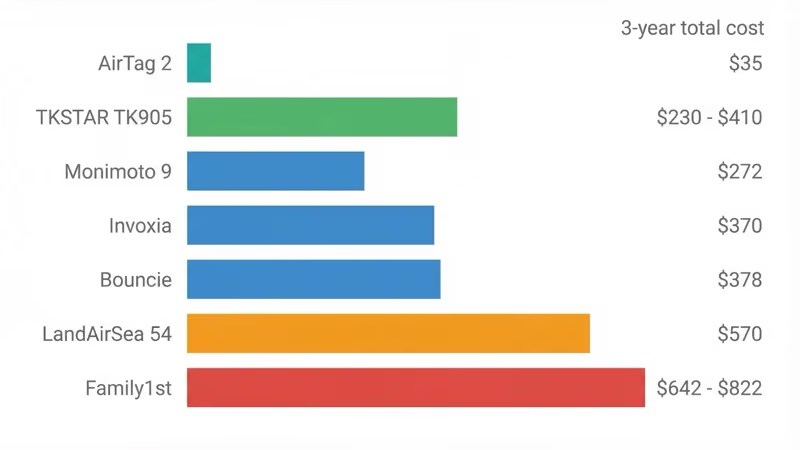
The numbers tell a clear story. If you want dedicated GPS tracking, Monimoto 9 at $272 over three years is the least expensive option that doesn’t require you to source your own SIM card. The TKSTAR can undercut it if you find a cheap data SIM, but the convenience gap is wide.
Family1st’s $30 tracker looks attractive until you realize you’re paying $17-22/month for three years. That low device cost is a hook, not a bargain. For more no-subscription options across vehicle types, see our GPS tracker no monthly fee guide.
Can a GPS Tracker Lower Your Motorcycle Insurance?
Insurance Discounts for Tracked Motorcycles
Many insurers offer a 10-20% premium discount if you can prove your motorcycle has an approved GPS tracker installed. According to ValuePenguin’s analysis of motorcycle insurance anti-theft discounts, the savings on a typical policy can offset most or all of a tracker’s annual subscription cost. Progressive, State Farm, and Allstate have all offered anti-theft device discounts in recent years.
Not every tracker qualifies. Call your insurance agent and ask which devices they accept. Monimoto and Family1st are most commonly recognized because they provide documented theft-alert logs. AirTag is unlikely to qualify since it’s not classified as a GPS tracking device.
Motorcycle Theft Statistics That Put the Risk in Perspective
The NICB motorcycle theft report shows only about 42% of stolen bikes are recovered, with Honda the most-stolen brand. California, Texas, and Florida lead in volume, with New York City as the top metropolitan hotspot.
RevZilla’s theft data analysis notes that while overall U.S. motorcycle thefts have stabilized nationally, urban hotspots keep seeing year-over-year increases. A GPS tracker won’t prevent someone from stealing your bike, but it directly raises your odds of getting it back. Police respond differently when you hand them live coordinates instead of a description and a prayer.
Bottom Line
For serious motorcycle theft protection, the Monimoto 9 is the tracker to get.
The auto-arming key fob means you never forget to activate it, the phone call alert is impossible to ignore, and $272 over three years is less than most riders spend on a set of tires.
If $169 upfront is too steep, the TKSTAR TK905 at $50 gets you real GPS tracking with manufacturer-listed up-to-30-day standby. You’ll spend time setting up a SIM card and dealing with a basic app, but the tracking works.
Still weighing options? Our Tracker Finder walks you to a vehicle pick after four quick questions.
Regardless of which GPS tracker you pick, add an AirTag 2 for $29 as a hidden backup in a separate location.
Two trackers in different spots is the most reliable anti-theft setup. For more on how these two technologies complement each other, our AirTag vs GPS tracker comparison breaks it all down.
FAQ
Do motorcycle GPS trackers work without a subscription?
Most dedicated GPS trackers require a cellular subscription to transmit location data. The Invoxia Cellular GPS Tracker includes one free year, then charges $120/year. The TKSTAR TK905 has no built-in subscription but requires you to buy a separate SIM card with a data plan. AirTag has no subscription at all, but it’s Bluetooth-only, not GPS. True subscription-free GPS tracking on motorcycles doesn’t currently exist.
Can an AirTag replace a GPS tracker on a motorcycle?
No. AirTag uses Bluetooth and the Find My network, not GPS or cellular. It can’t send instant theft alerts, provide live tracking, or work in areas without nearby iPhones. In dense cities it produces a useful breadcrumb trail, but it goes dark in garages and rural areas. Use AirTag as a backup layer alongside a real GPS tracker, not as a replacement.
Where is the best place to hide a GPS tracker on a motorcycle?
The handlebar tube and frame cavity are the hardest spots for a thief to find quickly. Under the seat is easiest for battery access but also the first place thieves check. For maximum security, hide your GPS tracker under the seat and stash a second tracker like an AirTag inside the handlebar tube or frame as a backup.
How long do motorcycle GPS tracker batteries last?
Battery life varies widely by device. Long-standby motorcycle trackers like Monimoto and Invoxia stretch runtime by reporting less often, while frequent-update portable trackers need more regular charging. Bouncie avoids batteries entirely by drawing power from an OBD-II port.
Will a GPS tracker lower my motorcycle insurance premium?
Many insurers offer 10-20% discounts on motorcycle policies when an approved GPS tracker is installed. The discount depends on your carrier, state, and the specific device. Dedicated GPS trackers like Monimoto and Family1st are most commonly accepted. Contact your insurance agent to confirm which devices qualify before purchasing.
Do GPS trackers work if a motorcycle is in a metal shipping container?
Metal containers block both GPS satellite signals and cellular transmissions, so a tracker inside a sealed container will lose its connection. Some trackers store the last known position before signal loss, which can still help police narrow the search. This is one reason to use two trackers in different locations, as one may have transmitted a final ping before being shielded.
Can thieves detect or jam a motorcycle GPS tracker?
GPS jammers exist but are illegal in the United States under federal law. Most opportunistic motorcycle thieves don’t carry jamming equipment. A well-hidden tracker inside a fairing or frame cavity is difficult to find without disassembling the bike. Using two trackers in separate locations reduces the risk of both being discovered or disabled.