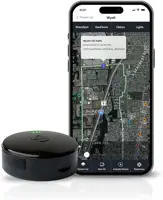
The LandAirSea 54 wins on update speed and price: it refreshes as fast as every 3 seconds and the device costs about $30. The SpyTec GL300 wins on battery, with a larger cell and a longer published runtime path, and it offers a 5-second live tier. Both are 4G LTE, magnetic, and require a paid plan. Pick the LandAirSea 54 for near-live vehicle tracking on a tighter budget. Pick the GL300 if you want longer runtime and worldwide coverage.
The LandAirSea 54 and the SpyTec GL300 are two of the best-selling portable GPS trackers for cars and assets. Both clip a magnetic puck to a vehicle, both run on 4G LTE, and both bill a monthly plan. The gap shows up in the details: refresh rate, battery, and how much that subscription costs over a year.
Both rely on the same satellites: the U.S. government’s GPS accuracy data puts typical smartphone-grade accuracy at about a 4.9 m (16 ft.) radius under open sky, with real-world tracker accuracy varying by receiver and conditions. So this comparison is about everything other than raw positioning.
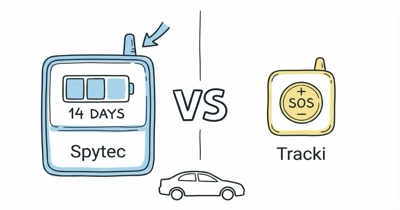
- LandAirSea 54 refreshes every 3 seconds on its top plan versus the GL300’s fastest 5-second tier, both fast enough for turn-by-turn live tracking
- SpyTec GL300 holds battery longer thanks to its larger 2,600 mAh cell and longer published runtime path
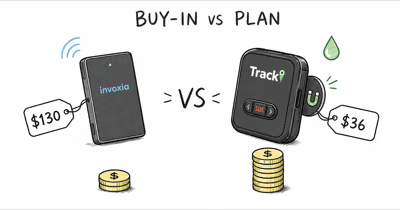
- The GL300 now bundles hardware free with a plan versus about $30 for the 54, but its subscription runs higher, with monthly rates from about $20 (54) to $35 (GL300)
- Fastest update costs more on the 54: its 3-second tier runs $49.95/mo, while the base $19.95 plan only pings every 3 minutes
- Both are 4G LTE and magnetic, but the GL300 covers 185+ countries while the 54 focuses on the US, Canada, and Mexico
LandAirSea 54 vs SpyTec GL300 at a Glance
Here is the full spec comparison between these two portable GPS trackers. The refresh and battery figures below come from each maker’s own listing, cross-checked against an independent review.
Tom’s Guide’s GL300 field test found that the tracker delivered about 12 days of battery on regular use against the rated two weeks. The review reported that accuracy landed within a few yards even indoors, and that monthly data ran $25 to $45.
That independent 12-day result is the clearest signal that the GL300’s strength is endurance rather than price, where the LandAirSea 54’s edge is refresh speed.
Still deciding between live GPS and a Bluetooth tag? Our Bluetooth vs GPS trackers breakdown covers the practical tradeoffs before you commit to a subscription.
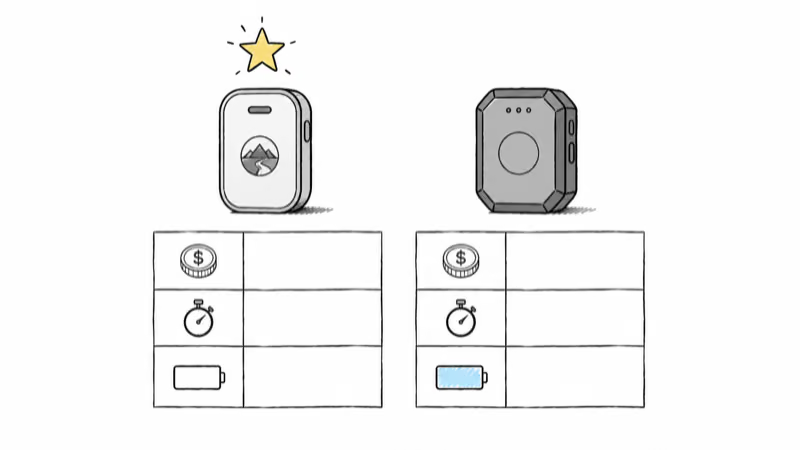
⇄ Head-to-head
LandAirSea 54 vs SpyTec GL300

- +3-second update tier is the fastest refresh in this price class
- +Strong built-in magnet for attaching to a vehicle frame
- +About $30 device with flexible plans, no forced annual term
- +IP67 waterproof and dustproof, rated for a 1 m dunk
- +Free SilverCloud app on iOS, Android, and web
- +~14-day battery at 60-second updates on a 2,600 mAh cell
- +5-second update tier for live vehicle monitoring
- +Magnetic weatherproof case included in the box
- +Worldwide 4G LTE coverage across 185+ countries
- +M4 and M6 extended cases push runtime past 140 days
- −3-second refresh requires the $49.95/mo top plan
- −1500 mAh battery is smaller than the GL300's cell
- −Base $19.95 plan only updates every 3 minutes
- −Coverage focused on US, Canada, and Mexico
- −Always requires an active subscription to report
- −Subscription runs higher than the 54 entry plan
- −Plans run $22.95/mo (annual) to $34.95/mo, steeper than the 54 base tier
- −No 3-second refresh option to match the 54's top plan
- −Hapn app transition confused some long-time users
- −Always requires an active subscription to report
You want the fastest live tracking for a moving vehicle, a stronger magnet mount, and a lower device price.
You want the longest battery runtime, worldwide coverage, and an extended-battery accessory path for low-power assets.
LandAirSea 54: The Speed Pick
The LandAirSea 54 does one thing better than almost any portable tracker in its bracket: it refreshes fast. On the top-tier plan, location pings arrive every 3 seconds, fast enough to follow a vehicle turn-by-turn on a live map instead of waiting minutes between updates. Most rivals in this price range cap out at 60 seconds. That speed is the 54’s whole identity.
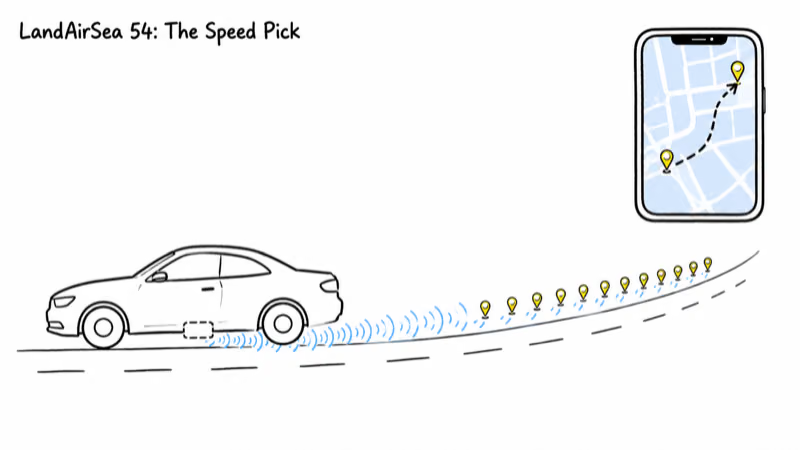
The catch is that the 3-second refresh sits on the $49.95/month plan. The base $19.95 tier only pings every 3 minutes, which is fine for general asset checks but not for watching a car in motion. LandAirSea’s own listing rates the 54 at a 4G LTE refresh as fast as 3 seconds across six plan tiers, and the official 54 product page confirms the IP67 waterproof rating and the built-in magnet billed as the industry’s strongest.
Battery is the 54’s weak spot against the GL300. The 1500 mAh cell is smaller and depends heavily on update frequency and energy-saving mode. LandAirSea bills the built-in magnet as the industry’s strongest, designed to hold against a vehicle frame at highway speed. For a daily-driven vehicle the runtime is workable, but you’ll recharge more often than a GL300 owner does.
SpyTec GL300: The Endurance Pick
The SpyTec GL300 trades the 54’s headline speed for longer legs. Its 2,600 mAh battery delivers roughly 14 days at 60-second updates and about 9 days on the faster 5-second tier, and SpyTec’s M4 and M6 extended cases push standby past 140 days for assets that barely move. The magnetic weatherproof case ships in the box, so vehicle mounting needs no extra accessories.
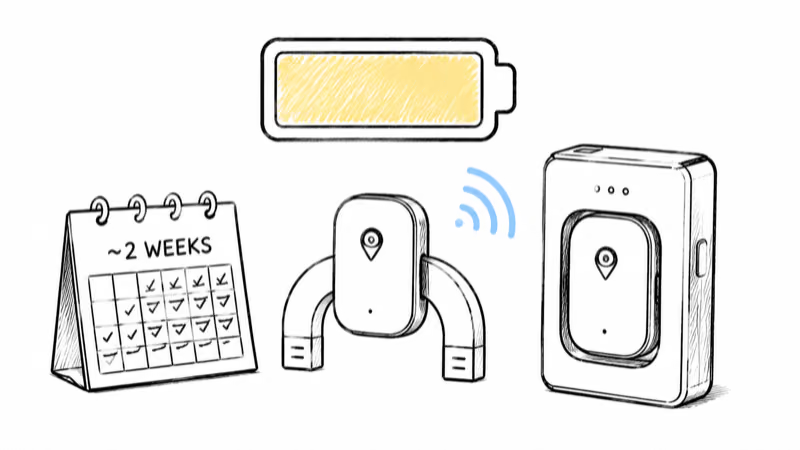
Independent testing backs the runtime claim more than the marketing one. Tom’s Guide reported that the GL300 ran about 12 days on regular use and noted that the biggest knock is data cost, with plans running $25 to $45 a month. According to GPS.gov, typical smartphone-grade GPS accuracy is about a 4.9 m (16 ft.) radius under open sky, a useful baseline for what either tracker realistically delivers.
SpyTec’s own GPS tracker lineup lists the GL300’s 5-second to 60-second update tiers and worldwide 4G LTE coverage across 185+ countries. That global reach is where it pulls clearly ahead of the 54.
The GL300’s tradeoff has flipped: the hardware now comes free with a plan, undercutting the 54’s roughly $30 device, but its subscription runs higher at $34.95/month monthly (or $22.95/month on the annual plan) versus the 54’s $19.95/month entry tier. There is still no 3-second refresh option to match the 54’s top plan. If you rarely need sub-5-second updates and you value not recharging, that tradeoff favors the GL300.
Which One Is Cheaper Over a Year?
The subscription dominates the math. The 54’s entry plan is $19.95/month against the GL300’s $34.95/month monthly rate, so on month-to-month billing the plan gap is about $15/month, or roughly $180 over a year in the 54’s favor. The GL300’s now-free hardware claws back about $30 of that, and its annual plan ($22.95/month) narrows the gap further, but the 54 stays cheaper over 12 months on entry tiers. The 54’s $49.95/month top tier only matters if you need its 3-second refresh.

For most buyers tracking one vehicle, the cheapest sensible setup is the LandAirSea 54 on a mid-tier plan. If your priority is endurance and global coverage rather than the fastest refresh, the GL300’s higher entry cost buys longer runtime. For more ways to keep recurring cost down, our car trackers with no monthly fees guide covers the subscription-free alternatives, and the GPS tracker hub rounds up every model in the category.
Which Tracker Is Better for a Vehicle?
For active vehicle tracking, the deciding factor is how often the car moves and how live you need the feed. If you are monitoring a vehicle in real time, watching a teen driver, or recovering a stolen car, the LandAirSea 54’s 3-second refresh gives you the most current position. If the vehicle sits for days between trips, such as a fleet truck or a seasonal RV, the GL300’s longer battery means fewer charge cycles and less maintenance.
Both mount magnetically to a vehicle, both survive weather, and both are easy to hide. The 54 is the smaller-budget, faster-refresh choice; the GL300 is the longer-running, wider-coverage choice. Neither is wrong for a car, but the trip pattern points clearly to one or the other. For heavier-duty use cases, our best GPS tracker for a truck guide ranks both against fleet-grade options.
How These Trackers Were Compared
This comparison weighs the two on what matters for a moving vehicle: GPS accuracy under open sky, battery drain by update tier, geofence behavior, and subscription cost over a year. The GL300’s runtime figure reflects the independent review cited above rather than the marketing claim, while subscription pricing and coverage come directly from each manufacturer’s current listing.
Bottom Line
The LandAirSea 54 and SpyTec GL300 solve the same problem from opposite ends. The 54 wins on refresh speed and price, making it the better pick for live, near-real-time vehicle tracking on a tighter budget. The GL300 wins on battery and coverage, making it the better pick for long-running assets and worldwide use.
Choose the LandAirSea 54 if you want the fastest live updates and the lower device cost. Choose the SpyTec GL300 if you want longer published runtime, an extended-battery path, and coverage in 185+ countries.
FAQ
Does the LandAirSea 54 update faster than the SpyTec GL300?
Yes. The LandAirSea 54 refreshes as fast as every 3 seconds on its top-tier plan, while the SpyTec GL300’s fastest interval is 5 seconds. Both are fast enough for turn-by-turn live tracking of a moving vehicle. The difference matters most when you need the most current position possible. Note that the 54’s 3-second tier requires its $49.95 monthly plan.
Which tracker has longer battery life?
The SpyTec GL300 lasts longer on the published battery specs. Its larger 2,600 mAh battery is built for longer intervals between charges, while the LandAirSea 54’s smaller 1500 mAh cell depends more heavily on update frequency and energy-saving mode. For assets that sit idle, the GL300’s extended battery cases push standby much farther.
Do both trackers require a subscription?
Yes. Both the LandAirSea 54 and the SpyTec GL300 need an active paid plan to transmit location, since they use cellular 4G LTE rather than a free Bluetooth network. The 54’s plans start at $19.95 per month and the GL300’s run $34.95 per month monthly or $22.95 per month on the annual plan. Without a plan, neither device reports its position. If you want to avoid recurring fees, you need a different category of tracker.
Which is cheaper overall, the 54 or the GL300?
On entry plans the LandAirSea 54 is cheaper over a year. The GL300’s hardware is now free with a plan (versus about $30 for the 54), but its $34.95/month monthly rate is $15 more than the 54’s $19.95 entry plan, so over 12 months the 54 saves roughly $150 on month-to-month billing. On the GL300’s annual plan ($22.95/month) the two land close. The 54’s $49.95 top tier costs more per month but adds a 3-second refresh the GL300 doesn’t offer.
Are both trackers waterproof?
Both handle weather, but differently. The LandAirSea 54 carries an IP67 rating, meaning it survives dust and a 1-meter dunk for up to 30 minutes. The SpyTec GL300 relies on the magnetic weatherproof case it ships with rather than a bare-device IP rating. For a tracker mounted under a vehicle exposed to rain and road spray, both hold up in normal outdoor conditions.
Which tracker works in more countries?
The SpyTec GL300 has broader coverage, working across 185+ countries on worldwide 4G LTE. The LandAirSea 54 focuses on North America, covering the US, Canada, and Mexico on AT&T’s network. If you travel internationally or need to track assets that cross borders, the GL300 is the safer choice. For domestic vehicle tracking, the 54’s coverage is sufficient.
Which one should I buy for tracking a car?
It depends on the trip pattern. For a frequently driven car where you want live, near-real-time position, the LandAirSea 54’s 3-second refresh is the better fit. For a vehicle that sits for days at a time, such as a fleet truck or seasonal RV, the GL300’s longer battery means fewer recharges. Both mount magnetically and are easy to conceal.