Yes. AirTag and AirTag 2 are rated to -4°F (-20°C), and they keep working in freezing cold, though the CR2032 battery loses power temporarily until it warms back up.
Winter raises a fair question for anyone hiding a tracker in a car or a ski bag: will it still report a location below freezing? Cold is far kinder to an AirTag than heat, and here's what actually changes.
- Apple rates AirTag and AirTag 2 to a -4°F (-20°C) operating floor, the same limit on both generations.
- Cold capacity loss is temporary: a CR2032 delivers noticeably less current in hard cold, then recovers its output once it warms back up.
- An independent freezer test dropped an AirTag to -7.6°F (-22°C) and it kept reporting its location.
- Heat causes permanent battery loss while cold usually does not, so winter is the safer season for a car-mounted tag.
- Below freezing, expect slower Find My updates and a possible low-battery warning that clears when the tag warms up.
Apple's Official Cold Temperature Rating
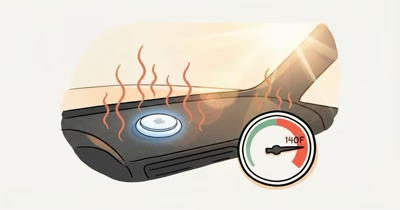
Apple rates both AirTag and AirTag 2 for an operating range of -4°F to 140°F (-20°C to 60°C), and the cold floor is the same on both models. Apple's AirTag 2 spec page confirms that the operating range bottoms out at -4°F (-20°C), and the original AirTag tech specs quote the identical floor.
That -20°C floor is Apple's rated limit, not a hard failure line. Below it, behavior isn't guaranteed, but in practice the tag doesn't brick itself; cold mostly saps battery current until things warm up.
| Scenario | Typical temp | Works? |
|---|---|---|
| Winter car, parked outside overnight | 10-32°F (-12-0°C) | Yes, within rated range |
| Ski jacket or backpack on the slopes | 0-20°F (-18--7°C) | Yes, near the floor |
| Checked luggage in an aircraft hold | Around 40°F (5°C) | Yes, comfortably inside range |
| Home freezer or deep-cold storage | -10 to 0°F (-23--18°C) | Usually, below rated but often still reports |
Does an AirTag Keep Working Below Freezing?
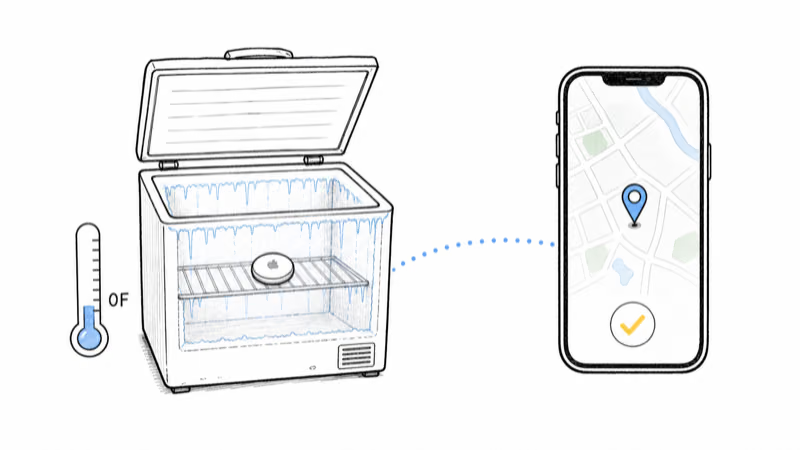
In practice AirTag tolerates cold better than its printed floor suggests. A hands-on freezer test by Intego's durability review found that an AirTag chilled to -7.6°F (-22°C), colder than Apple's rated limit, kept reporting without a stumble. That matches how most owners describe winter use: the location keeps coming in.
The reason is simple. AirTag has no moving parts and no screen to freeze. The Bluetooth radio and U1 or U2 chip draw very little current, so even a sluggish cold battery can usually still push out a location ping. What you lose in the cold is margin, not the whole device.
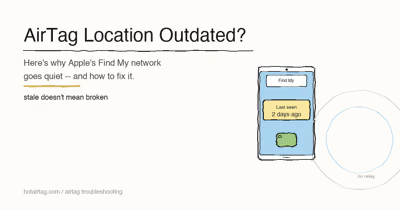
If a tag does go quiet on a brutal morning, it often shows up as a location that won't update in Find My rather than a device that's gone for good. Give it time in a warm pocket and check again before assuming it failed.
What Cold Does to the CR2032 Battery
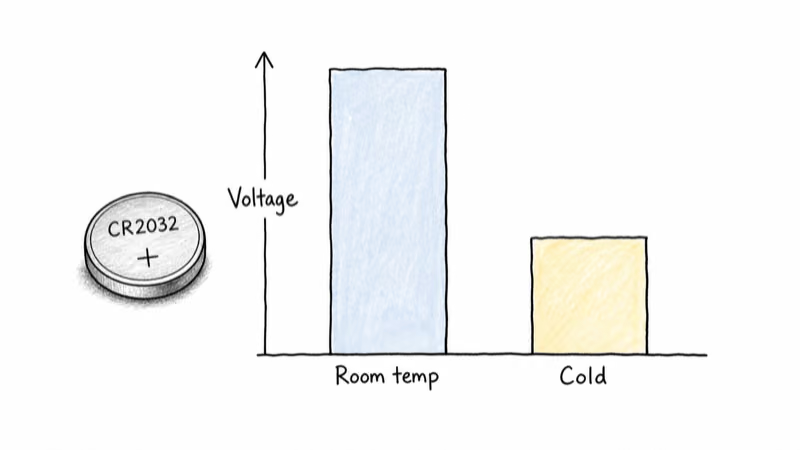
The battery, not the electronics, is the real cold-weather variable. Energizer's lithium coin handbook states that a CR2032 delivers less of its rated output as the cell gets colder, because the chemistry slows down. Lithium ions simply move more slowly at low temperature.
Here's the good news that owners miss: that loss is mostly temporary. Warm the cell back to room temperature and the voltage recovers, so a battery that flagged low on a freezing morning can read fine by afternoon. Cold borrows capacity; it doesn't burn it.
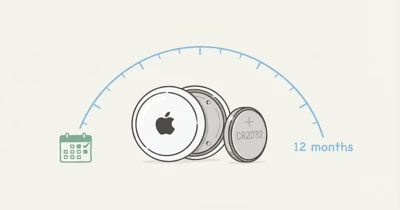
There's a catch worth knowing. A battery that's already old and near the end of its life has less headroom to spare, so hard cold is what finally tips a weak CR2032 into a real low-battery warning. If yours is more than a year old, a fresh CR2032 replacement restores that winter margin. The full picture on cell life sits in our AirTag battery life guide.
Why Cold Is Less Risky Than Heat
This is where AirTag owners get the trade-off backwards. Everyone worries about winter, but summer is the season that actually shortens a tracker's life. The difference comes down to reversible versus permanent damage.
Battery University's lithium research reported that sustained heat drives permanent capacity loss in lithium cells, while cold's effect is temporary and lifts the moment the battery warms. So a tag that bakes on a Phoenix summer dashboard takes real cumulative damage, while one that spent a Minnesota winter under the seat does not.
If your bigger worry is the hot side of the range, our AirTag heat resistance guide covers the dashboard temperatures that push a tag past its ceiling. For year-round car tracking, winter is the easy season and summer is the one to plan around.
How Cold Affects Find My Updates
Cold rarely kills a location; it just slows the refresh. A chilled CR2032 has less punch for the Bluetooth broadcast, so update intervals can stretch out when the tag is sitting in sub-zero air with no nearby iPhone to relay through. In a parked car, that can mean a location that's a bit staler than usual.
Snow and slush add little risk beyond the cold itself. The IP67 rating that our AirTag waterproofing breakdown explains is a controlled-lab rating for short, shallow freshwater exposure, so a snowy trailhead or a damp ski bag is fine for brief contact. The temperature, not the moisture, is the variable to plan around.
AirTag vs Other Trackers in Winter
AirTag sits at the tolerant end of the Bluetooth-tracker range for cold, tied with Tile at a -4°F (-20°C) floor. Samsung's tag is the outlier that struggles first. Every CR2032-based tracker shares the same basic cold chemistry, but the rated floors still differ.
| Tracker | Rated cold floor | Battery |
|---|---|---|
| Apple AirTag / AirTag 2 | -4°F (-20°C) | CR2032 (replaceable) |
| Tile Pro / Tile Mate | -4°F (-20°C) | CR2032 (replaceable) |
| Chipolo ONE Point | 5°F (-15°C) | CR2032 (replaceable) |
| Samsung SmartTag 2 | 32°F (0°C) | CR2032 (replaceable) |
Samsung's 32°F floor is the one to flag. It means a SmartTag 2 is rated to stop behaving normally the instant water would freeze, which rules out most winter car use. Chipolo's 5°F floor is better but still marginal for a cold-climate garage. AirTag and Tile give you the most winter headroom of the four.
Cellular GPS trackers with lithium-ion packs handle deep cold and give real-time location without leaning on nearby phones, but they cost $5-15 a month and need recharging. For a passive winter theft-recovery tag, a $29 AirTag in a warm-ish spot is still the better trade.
How Do You Protect an AirTag in Winter?
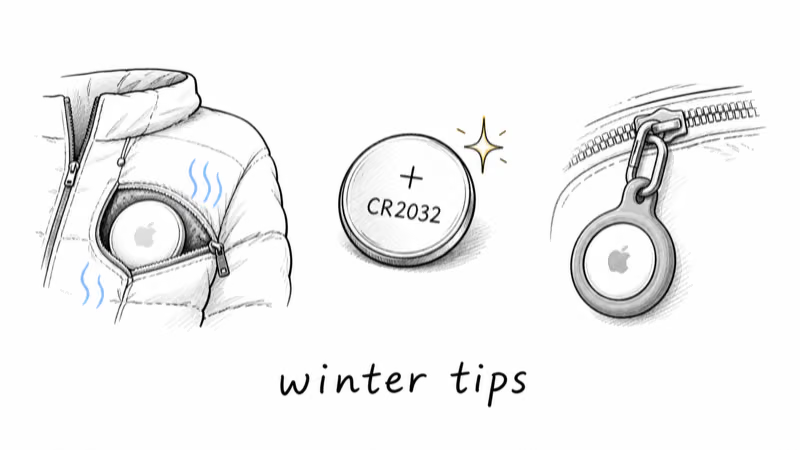
You don't need much to keep a tag reliable through winter, because cold does no lasting harm. The goal is simply to preserve battery margin on the coldest days.
- Start winter with a fresh battery. A new CR2032 has full headroom, so cold voltage sag won't drop it into a false low-battery warning.
- Favor insulated spots over exposed ones. A tag inside a bag, under a seat, or in a jacket pocket stays warmer than one clipped to the outside of a pack.
- Don't panic over a cold low-battery alert. Warm the tag and recheck before replacing the cell; the warning often clears on its own.
- Expect staler updates in a parked car. With no nearby iPhone and a cold battery, refreshes slow down. That's normal, not a fault.
- Skip bare-metal mounts outdoors. Metal pulls heat away fast, so a silicone holder keeps the cell marginally warmer than an aluminum one bolted to a cold frame.
The Bottom Line
AirTag works in cold weather, full stop. It's rated to -4°F (-20°C), independent testing kept it running well past that, and the only real effect is a temporary battery dip that recovers with warmth. Winter is the season you can relax about. Start the cold months with a fresh CR2032, keep the tag somewhat insulated, and save your worry for the summer dashboard instead.
Frequently Asked Questions
What is the coldest temperature an AirTag can handle?
Apple rates AirTag and AirTag 2 down to -4°F (-20°C) for normal operation. Below that, the tracker doesn't fail outright, but the battery delivers less current and Find My updates can slow. Independent freezer testing has kept an AirTag reporting at -7.6°F (-22°C), colder than the rated floor.
Will cold weather permanently damage my AirTag?
No, in almost all cases. Cold reduces the CR2032 battery's output temporarily, and that capacity comes back once the cell warms to room temperature. This is the opposite of heat, which causes permanent battery loss. A winter of cold is far gentler on a tag than a summer of dashboard sun.
Why does my AirTag show low battery in the cold?
Cold slows the lithium chemistry, so voltage sags and Find My may read the cell as low even when it has life left. If the battery is fairly new, warm the tag and the warning usually clears. If it's more than a year old, cold is the nudge that finally reveals a truly weak cell, so replace it.
Can I leave an AirTag in a car during winter?
Yes. A car parked outside overnight typically sits between 10°F and 32°F, well inside AirTag's rated range. Winter is actually the safe season for a car-mounted tag, unlike summer heat. Expect slightly slower updates when the car is parked and cold, which is normal behavior, not a malfunction.
Does an AirTag work in the snow?
Mostly. AirTag carries an IP67 rating for short, shallow freshwater exposure, so snow and slush add little risk beyond the cold itself. A tag in a ski bag or on a snowy trail keeps working. Just keep it somewhat insulated to protect battery margin on the coldest days.
Which tracker handles cold best?
AirTag and Tile share the widest cold tolerance among Bluetooth trackers at -4°F (-20°C). Chipolo ONE Point stops at 5°F, and Samsung SmartTag 2 is the weakest at 32°F, meaning it's rated to falter the moment water would freeze. For truly harsh cold with real-time updates, a cellular GPS tracker on a lithium-ion pack does better but adds a monthly fee.
Does AirTag 2 handle cold better than the original?
No. Apple kept the same -4°F (-20°C) operating floor on AirTag 2. The upgrades were a second-generation ultra-wideband chip, a louder speaker, and refreshed anti-stalking features, not thermal changes. Apple lists the same rated floor for both, so both generations behave the same way in winter.