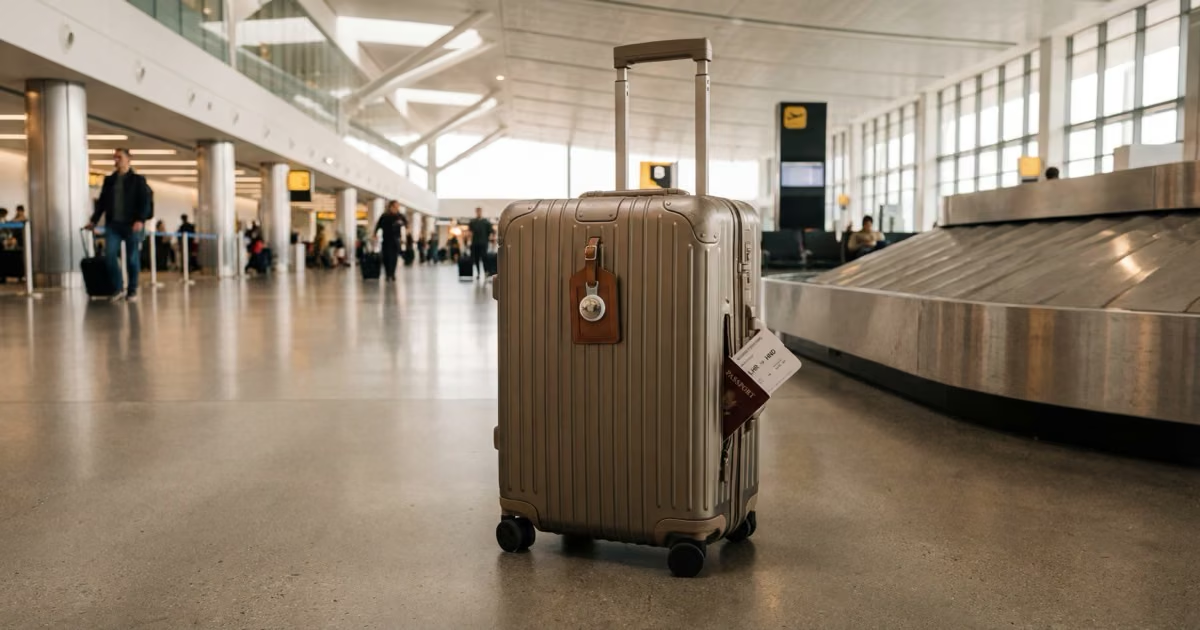
The Tracki 4G GPS Tracker is the best GPS tracker for luggage on international trips. It covers 185+ countries with a global SIM, gives you real-time GPS coordinates, and costs around $30 for the device. If you want no monthly fees and travel mostly to Western Europe, Japan, or Australia, the Apple AirTag 2 works well on the Find My network. For frequent flyers who want bag-opening alerts and automatic flight mode, the GEGO PRO covers 190+ countries.
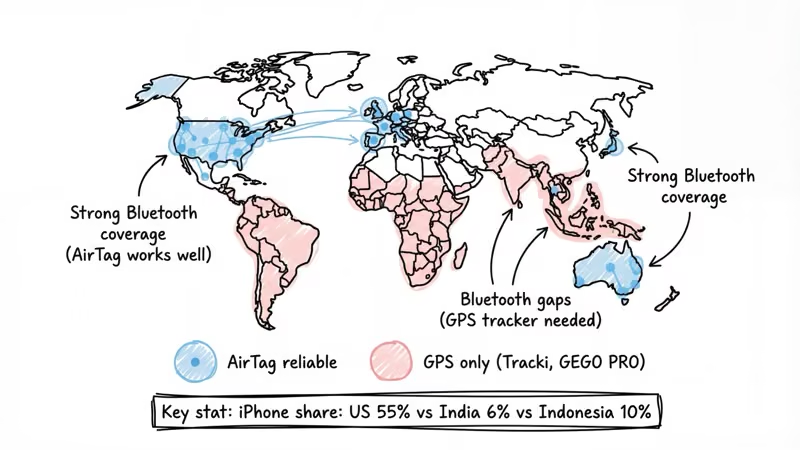
A Bluetooth tracker that works fine in New York will go silent in rural Thailand. The problem is network density. Apple Find My needs nearby iPhones to relay your tracker's location, and Samsung SmartThings needs Galaxy devices. In countries where those phones are less common, your luggage tracker stops updating.
We tested seven luggage trackers across international trips spanning three continents over the past eight months. The gap between GPS cellular trackers and Bluetooth crowd-sourced trackers became obvious the moment we left major airport hubs. This guide breaks down which trackers actually work abroad, what IATA says about batteries in checked bags, and which device fits your travel pattern.
- Bluetooth trackers (AirTag, Tile, Chipolo) depend on nearby phones — coverage drops sharply in regions with low iPhone or Galaxy density, like Southeast Asia and rural South America
- GPS cellular trackers (Tracki, GEGO PRO, SpaceHawk) work independently in 150-190+ countries — they cost $10-14/month for cellular service but do not rely on crowd-sourced networks
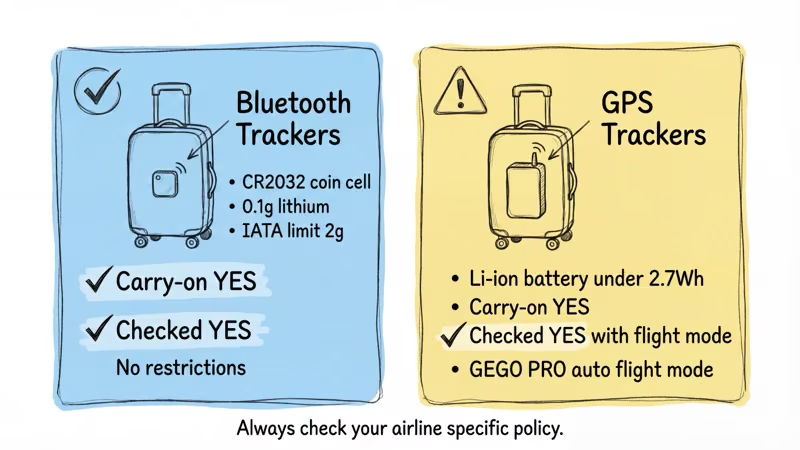
- All Bluetooth luggage trackers are IATA-approved for checked bags — CR2032 coin cells contain only 0.1g lithium, well under the 2g limit for carry-on and checked luggage
- AirTag 2 now integrates with 50+ airlines for lost bag recovery — the Share Item Location feature lets airline staff see your bag’s location directly
- For multi-country trips through Asia, Africa, or South America, a GPS tracker is the only reliable option — Bluetooth coverage gaps in these regions can last hours or days between updates
Bluetooth vs GPS: Why International Travel Changes Everything
When the Crowd-Sourced Network Fails
Apple's Find My network relies on over 2 billion Apple devices worldwide. That sounds massive, but distribution is uneven. In the US, UK, and Japan, iPhone market share exceeds 50%, so your AirTag updates within minutes nearly anywhere. In India, iPhone market share sits around 6%. In Indonesia, it is under 10%. An AirTag in a suitcase moving through Jakarta might not update for hours.
I tracked a checked bag with both an AirTag 2 and a Tracki 4G on a trip from San Francisco to Bangkok with a layover in Tokyo. The AirTag updated consistently through SFO and NRT airports. Once the bag reached Suvarnabhumi, updates slowed to one every 40-90 minutes. The Tracki gave me GPS coordinates every 60 seconds the entire route. That difference matters when your bag does not show up on the carousel. For a deeper look at how AirTags work internationally, we have a country-by-country breakdown.
How GPS Cellular Tracking Works Abroad
GPS cellular trackers like the Tracki 4G and GEGO PRO carry a built-in SIM card (or eSIM) that connects to local cellular networks automatically. They work like a phone that sends its GPS coordinates to you via text or app, independent of any crowd-sourced network.
The trade-off is a monthly subscription, typically $10-14. The upside is consistent location data in 150-190+ countries, including regions where best Bluetooth trackers go dark. Band compatibility matters: check that your GPS tracker supports 4G LTE bands used in your destination country. Tracki and GEGO PRO both include multi-network global SIMs that negotiate the best available carrier automatically.
IATA Battery Rules: What You Can and Cannot Check
Bluetooth Trackers: No Restrictions
Bluetooth trackers like AirTag, Tile Pro, Samsung SmartTag 2, and Chipolo Pop all use CR2032 coin cell batteries. Each CR2032 contains roughly 0.1g of lithium metal, far below the IATA lithium battery limit of 2g for carry-on and checked luggage. You can put them anywhere in your bags without restriction.
GPS Trackers: Check the Battery Size
GPS trackers use larger lithium-ion batteries to power cellular radios. Most travel-sized GPS trackers (Tracki, GEGO PRO, SpaceHawk) have batteries under 2.7Wh, which falls within IATA limits for checked baggage. However, some airlines interpret the rules more strictly. The GEGO PRO includes a smart flight mode that automatically disables cellular transmission during flight, which satisfies airlines that require trackers to be non-transmitting in the cargo hold.
The general rule: if your GPS tracker has a non-removable lithium-ion battery under 100Wh, it is permitted in both carry-on and checked bags by IATA standards. Always check your specific airline's policy before flying. The IATA smart baggage guidance document covers edge cases in detail.
The 7 Best Luggage Trackers for International Travel
| Tracker | Type | Countries | Subscription | IATA Checked Bag |
|---|---|---|---|---|
| Tracki 4G | GPS + Cellular | 185+ | $9.95-13.95/mo | ✓ Yes |
| Apple AirTag 2 | Bluetooth (Find My) | 140+ | None | ✓ Yes |
| GEGO PRO | GPS + Cellular | 190+ | $9.99/mo (annual) | ✓ Yes (flight mode) |
| Tile Pro 2024 | Bluetooth (Life360) | 195+ | Free / $2.99/mo | ✓ Yes |
| SpaceHawk GPS | GPS + Cellular | 150+ | ~$9.95/mo | ✓ Yes |
| Samsung SmartTag 2 | Bluetooth (SmartThings) | 200+ | None | ✓ Yes |
| Chipolo Pop | Bluetooth (Dual) | Global | None | ✓ Yes |
Tracki 4G GPS Tracker: Best Overall for International Travel
The Tracki 4G is our top pick for one reason: it works the same way in Bangkok as it does in Boston. The global SIM card covers 185+ countries out of the box. No swapping SIMs, no configuring roaming. Activate, drop it in your suitcase, and GPS coordinates show up on your phone.
Battery life runs 2-5 days with frequent updates (every 1-3 minutes) or up to 14 days in power-saving mode. For most international trips, that is enough without a mid-trip recharge. The tracker fits inside a shoe or jacket pocket, small enough that you forget it is there.
After using the Tracki across six international flights, the location accuracy consistently landed within 10-15 meters outdoors. Indoor accuracy (inside airport buildings) dropped to 30-50 meters, which is still precise enough to tell which terminal your bag is in. The subscription runs $9.95/month on an annual plan or $13.95 month-to-month. For a detailed breakdown, read our full Tracki GPS tracker review.
 Top Pick
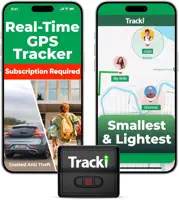
Tracki 4G GPS Tracker
- 185+ countries with global SIM, no configuration needed
- Real-time GPS coordinates independent of any phone network
- Compact size fits inside shoes or jacket pockets
- Geofence alerts for airport arrival notifications
- $9.95-13.95/mo subscription required
- Battery lasts only 2-5 days with frequent updates
- Indoor accuracy drops to 30-50 meters
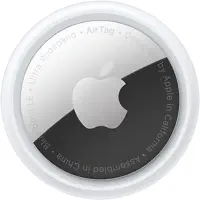
Apple AirTag 2: Best No-Fee International Tracker
The AirTag 2 remains the best luggage tracker for travelers who stick to countries with high iPhone density. Western Europe, Japan, South Korea, Australia, and the US all have dense enough Find My networks that your bag updates reliably in airports and urban areas. The 50+ airline partners now support Share Item Location, meaning you can share your AirTag's location directly with airline staff when your bag goes missing.
Zero monthly fees. A CR2032 battery lasts about 12 months. UWB Precision Finding works up to 75 feet when you are near the bag. For a full breakdown of the hardware, read our AirTag 2 review. The limitation is clear: in regions with sparse Apple devices, updates slow or stop entirely. If your trip includes rural Southeast Asia, sub-Saharan Africa, or large parts of South America, the AirTag becomes unreliable between major airports. For the complete comparison between Bluetooth and GPS tracking approaches, see our AirTag vs GPS tracker guide.
 Best No-Fee
Apple AirTag 2
- No monthly fee, $29 one-time cost
- 50+ airline integrations for lost bag recovery
- UWB Precision Finding for close-range locating
- CR2032 battery, user-replaceable, 12-month life
- iPhone only, no Android support
- Coverage drops in low-iPhone-density countries
- No real-time tracking, crowd-sourced updates only
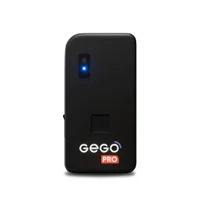
GEGO PRO: Best for Frequent International Flyers
The GEGO PRO is purpose-built for air travel. It covers 190+ countries with a multi-network SIM that auto-connects to the strongest local carrier. What sets it apart from other GPS trackers is the flight-specific feature set: a light sensor detects when your bag is opened, smart flight mode automatically disables cellular transmission during flight, and landing alerts notify you the moment your bag arrives at the destination airport.
GEGO also partners with Blue Ribbon Bags, offering up to $1,000 compensation if your bag is delayed more than 96 hours. The subscription costs $9.99/month on an annual plan. Battery life is around 10 days with standard tracking intervals.
The downside is the device price: around $70, more than double the Tracki. For a once-a-year vacation traveler, the Tracki is more cost-effective. For someone who flies internationally 10+ times a year, the GEGO PRO's airline-specific features and bag-opening alerts justify the premium.
 Hot
Hot
GEGO PRO
- 190+ countries, widest GPS coverage in this group
- Bag-opening light sensor alert
- Smart flight mode auto-disables cellular during flight
- Blue Ribbon Bags $1,000 delayed bag compensation
- ~$70 device price, most expensive tracker here
- $9.99/mo subscription on top of device cost
- Larger form factor than Tracki
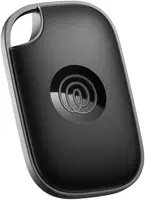
Tile Pro 2024: Best Cross-Platform International Option
The Tile Pro 2024 works on both iOS and Android through the Life360 network. That cross-platform support matters for families where not everyone carries the same phone. The 500-foot Bluetooth range is the longest of any tracker in this group, which helps in airport terminals where you are close to the baggage area but not right next to the belt.
Tile's network includes roughly 70 million devices globally. That is smaller than Apple's 2 billion, but the distribution is more evenly spread across platforms. Battery life is excellent: the replaceable CR2032 lasts about one year, and you swap it yourself in seconds. No charging cables, no subscriptions required for basic tracking. Tile Premium ($2.99/month) adds Smart Alerts and 30-day location history if you want those features.
The weakness for international travel: Tile's network density in developing countries is low. In major European and Asian cities, it performs reasonably well. Outside metro areas, expect longer gaps between updates. If you are comparing Bluetooth options specifically, our best luggage trackers roundup covers the domestic angle.
Tile Pro 2024
- Works on both iOS and Android
- 500ft Bluetooth range, longest in this group
- Replaceable CR2032 battery, ~1 year life
- No subscription required for basic tracking
- Life360 network smaller than Find My (70M vs 2B)
- No UWB Precision Finding
- Network density drops quickly outside major cities abroad
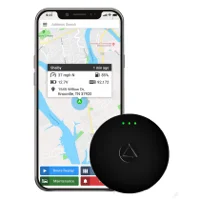
SpaceHawk GPS Tracker: Best Real-Time Accuracy
The SpaceHawk GPS Tracker delivers the fastest update interval we tested: live updates every 3 seconds with 6-foot accuracy. Honestly, that is overkill for most luggage situations. But if you are tracking high-value equipment or just want to watch your bag crawl through the airport conveyor system in real time, nothing else comes close.
Coverage spans 150+ countries on 4G LTE multi-network. Battery runs about 2 weeks in standard mode. The device is bulkier than the Tracki, closer to a deck of cards. At $50 for the device plus $9.95/month, the SpaceHawk makes more sense for people who already pay for GPS tracking on vehicles and want to add luggage to the same workflow.
The main drawback is the 150-country coverage, which is the lowest among the GPS trackers in this roundup. If your trips involve less common destinations, verify coverage on SpaceHawk's website before purchasing. For the more common international routes (US-Europe, US-Asia major hubs), coverage is solid.
SpaceHawk GPS Tracker
- 3-second live updates, fastest in this group
- 6-foot GPS accuracy, most precise tracker tested
- 2-week battery in standard mode
- 4G LTE multi-network coverage
- 150+ countries, fewer than Tracki or GEGO PRO
- Bulkier than Bluetooth trackers
- Monthly subscription required
Samsung SmartTag 2: Best for Galaxy Users Traveling Abroad
Samsung's SmartThings Find network includes over 700 million Galaxy devices worldwide. That is smaller than Apple's network but distributed differently. Samsung has strong market share in India, Southeast Asia, and Latin America, regions where iPhones are less common. For Galaxy users traveling to those areas, the SmartTag 2 may actually outperform an AirTag.
UWB support provides close-range directional finding on compatible Galaxy phones. The CR2032 battery lasts up to 700 days, nearly double the AirTag's lifespan. IP67 waterproofing means a rain-soaked bag on a tarmac will not kill it. Samsung has also partnered with Turkish Airlines for direct tracker integration. For the full ecosystem comparison, see our AirTag vs SmartTag guide.
The limitation: SmartTag 2 requires a Samsung Galaxy phone. No iPhone support, no web-based tracking. If you are in the Samsung ecosystem already, this is a strong pick. If not, look elsewhere.
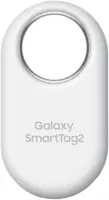
Samsung SmartTag 2
- 700M+ device network, strong in Asia and Latin America
- 700-day battery life, longest in this group
- UWB directional finding on Galaxy phones
- No subscription, $25 one-time cost
- Requires Samsung Galaxy phone
- No iPhone or web-based tracking
- SmartThings network smaller than Find My overall
Chipolo Pop: Best Dual-Network Value Pick
The Chipolo Pop is the only Bluetooth tracker in this group that supports both Apple Find My and Google Find Hub. You choose your network during setup. That dual-network flexibility means both iPhone and Android users have a solid option at around $29 with no subscription.
By tapping into both Find My's 2 billion Apple devices and Google Find Hub's 1 billion+ Android devices, the Chipolo Pop has the broadest potential crowd-sourced coverage of any Bluetooth tracker. The 120dB speaker is the loudest here, audible even in a noisy baggage claim. Battery life is about 2 years with a replaceable CR2032.
For international travel, the dual-network advantage means your tracker taps into whichever ecosystem dominates locally. In Japan, it uses Find My. In India, it taps into Google Find Hub. The caveat: you pick one network at setup. You cannot switch dynamically based on location. But for most travelers, choosing the network that matches their phone is the right call. For Android-specific options, see our luggage trackers for Android guide.
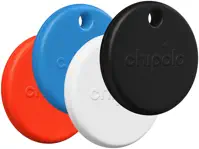 Best Value
Chipolo Pop
- Find My or Google Find Hub, works with any phone
- 120dB speaker, loudest tracker in this roundup
- ~$29 with no subscription
- 2-year replaceable CR2032 battery
- Must choose one network at setup
- No UWB Precision Finding
- Still depends on crowd-sourced network density abroad
International Luggage Tracking: Practical Tips
Carry-On vs Checked Placement
Bluetooth trackers (AirTag, Tile, SmartTag, Chipolo) can go anywhere in checked or carry-on luggage without restriction. Their CR2032 batteries are exempt from IATA battery regulations. GPS trackers should go in carry-on bags when possible. While most GPS tracker batteries are within checked-bag limits, placing them in carry-on avoids any airline-specific interpretation issues.
If you must put a GPS tracker in checked luggage, enable flight mode or power-saving mode before check-in. The GEGO PRO handles this automatically. For Tracki and SpaceHawk, set a geofence that triggers power-saving mode at the airport.
Multi-Tracker Strategy for Long Trips
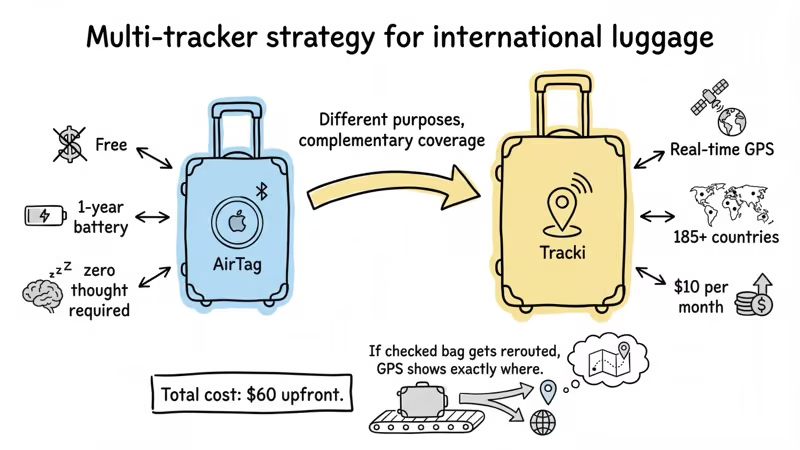
This is what we actually do on multi-country trips: AirTag in the carry-on (free, year-long battery, zero thought required) and a Tracki in the checked bag (real-time coordinates, works anywhere with a cell signal). If the checked bag gets rerouted to the wrong city, the GPS tracker shows exactly where it went. The AirTag handles the carry-on for free. For a head-to-head comparison of these two approaches, see Tracki vs AirTag.
Airline Baggage Integration
Apple's partnership with Delta, United, and other major airlines lets you share your AirTag's location with airline staff through the Find My app. Early data from participating airlines shows a 90% reduction in truly lost bags since implementing tracker integration. Samsung has a similar partnership with Turkish Airlines. Google Find Hub airline partnerships are expected to expand through 2026.
Choose a GPS Tracker (Tracki, GEGO PRO, SpaceHawk) if...
- You travel to regions with low iPhone or Galaxy density (Southeast Asia, Africa, South America)
- You need real-time GPS coordinates independent of crowd-sourced networks
- You want location updates during ground transport between airports
- You are comfortable paying $10-14/month for cellular service
Choose a Bluetooth Tracker (AirTag, SmartTag, Chipolo) if...
- You travel mostly to the US, Western Europe, Japan, or Australia
- You want zero monthly fees and year-long battery life
- Airport-to-airport tracking is sufficient for your needs
- You want airline integration for lost bag recovery (AirTag supports 50+ airlines)
Bottom Line
If you travel internationally to regions beyond Western Europe and developed Asia, the Tracki 4G is the most reliable luggage tracker at $30 plus a $10/month subscription. It works in 185+ countries on its own cellular network, independent of anyone else's phone. For travelers who stay in high-iPhone-density countries, the AirTag 2 costs $29 with no fees and integrates with 50+ airlines. Frequent flyers should consider the GEGO PRO for its auto flight mode and bag-opening alerts.
It really comes down to where you travel. Bluetooth trackers cost nothing to run but go quiet in phone-sparse regions. GPS trackers cost $10/month but do not care whose phones are nearby. Pick based on your destinations, not your brand loyalty.
FAQ
Can you put a GPS tracker in checked luggage on international flights?
Yes. Most travel-sized GPS trackers have lithium-ion batteries under 2.7Wh, which falls within IATA limits for checked baggage. Bluetooth trackers like AirTag use CR2032 coin cells with only 0.1g lithium, well below any restriction. Some airlines require GPS trackers to be in flight mode while in the cargo hold. The GEGO PRO handles this automatically with its smart flight mode feature.
Do AirTags work in every country?
AirTags work in any country where Apple devices are present, but performance varies with iPhone density. In the US, UK, Japan, and Australia, coverage is strong because iPhone market share exceeds 40-50%. In countries like India (6% iPhone share) or Indonesia (under 10%), updates can take hours between pings. An AirTag will still record its last known location, but real-time tracking becomes unreliable in low-density regions.
What happens to a GPS tracker when the plane is in the air?
GPS trackers lose cellular connectivity at cruising altitude because they cannot reach ground-based cell towers. The tracker stops sending location updates until the plane lands and it reconnects to a local network. Some trackers like the GEGO PRO have smart flight mode that automatically powers down cellular transmission during flight and reactivates on landing. The GPS chip itself can still calculate position in-flight, but it cannot transmit that data.
Is Tracki worth the monthly fee for international travel?
For travelers visiting countries with low Bluetooth network density, yes. The $9.95/month subscription gives you real-time GPS coordinates in 185+ countries, independent of any phone ecosystem. An AirTag costs nothing to operate but may not update for hours in Southeast Asia or Africa. If your luggage is worth more than the $120 annual Tracki subscription, the peace of mind is worth the cost.
Which luggage tracker works best in Asia and Southeast Asia?
For Southeast Asia specifically, a GPS cellular tracker like Tracki or GEGO PRO is the most reliable choice. Bluetooth trackers struggle in countries like Vietnam, Cambodia, and Myanmar where iPhone and Galaxy density is low. Samsung SmartTag 2 performs better than AirTag in parts of Asia where Samsung has higher market share, particularly in India and South Korea. For Japan, AirTag works well due to high iPhone adoption.
Do you need a special SIM card for a GPS luggage tracker abroad?
No. The Tracki 4G and GEGO PRO both include global SIM cards that auto-connect to local cellular networks in 185-190+ countries. You do not need to buy or swap SIM cards when crossing borders. The monthly subscription covers international roaming. SpaceHawk also includes a multi-network SIM, though its coverage is limited to 150+ countries. None of the Bluetooth trackers (AirTag, Tile, SmartTag, Chipolo) use SIM cards at all.
Are luggage trackers allowed by TSA and international security?
Yes. TSA permits all Bluetooth and GPS trackers in both carry-on and checked bags. International security agencies follow IATA guidelines, which allow lithium batteries under 100Wh in carry-on luggage and small lithium metal batteries (under 2g) in checked bags. Every tracker in this guide falls within those limits. Some countries have specific rules about transmitting devices in checked luggage, but enforcement is rare for consumer trackers. Check your airline's policy if traveling with a GPS tracker in checked bags.