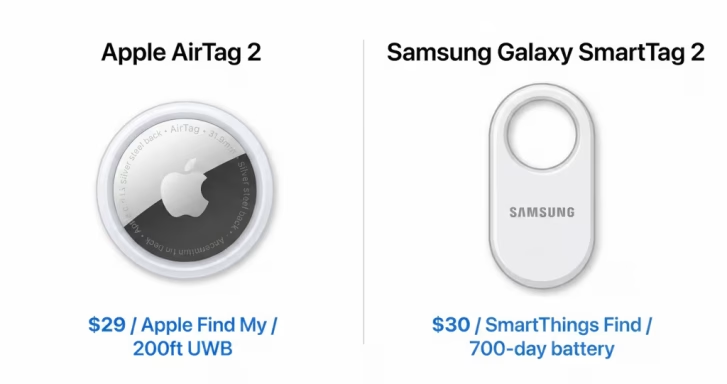
Apple updated its AirTag in January 2026 with a faster U2 UWB chip, a significantly louder speaker, and Apple Watch support for Precision Finding. Samsung’s Galaxy SmartTag 2, released in late 2023, still holds its own with AR-guided tracking, a class-leading battery life of up to 700 days, and smart home integration — all for a nearly identical price. This head-to-head breaks down the differences that actually matter so you can pick the right tracker for your setup.
AirTag 2 vs SmartTag 2: Specs at a Glance
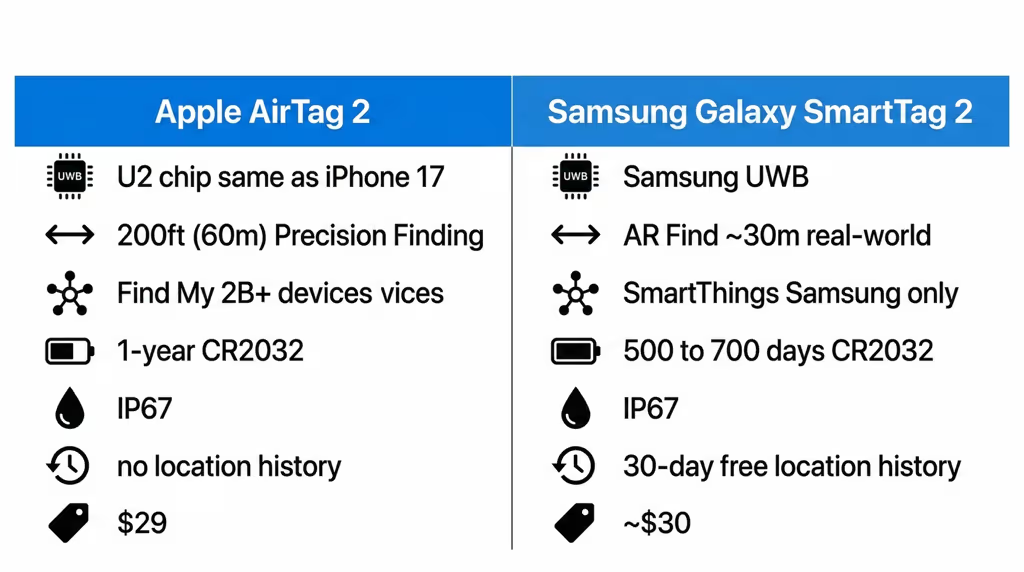
| Feature | Apple AirTag 2 | Samsung SmartTag 2 |
|---|---|---|
| Release | January 2026 | October 2023 |
| UWB Chip | U2 (same as iPhone 17) | Samsung UWB |
| Precision Finding | Up to 200ft (60m) | AR Find (~30m real-world) |
| Apple Watch Support | ✅ Series 9 / Ultra 2+ | ❌ |
| Bluetooth Range | ~30m (upgraded chip) | Up to 120m (claimed) |
| Battery Life | ~1 year (CR2032) | 500 days / 700 days (eco) |
| Water Resistance | IP67 | IP67 |
| Tracking Network | Apple Find My (2B+ devices) | SmartThings Find (Samsung only) |
| Location History | ❌ | ✅ 30 days (free) |
| NFC Info Tag | Lost mode only | ✅ Embed contact info |
| Smart Home Control | ❌ | ✅ SmartThings |
| Subscription | None | None |
| Price (1-pack) | $29 | ~$30 |
| Compatible Devices | iPhone 11+ (iOS 14.5+) | Samsung Galaxy (Android 11+) |
Compatibility: Which Phones Work?
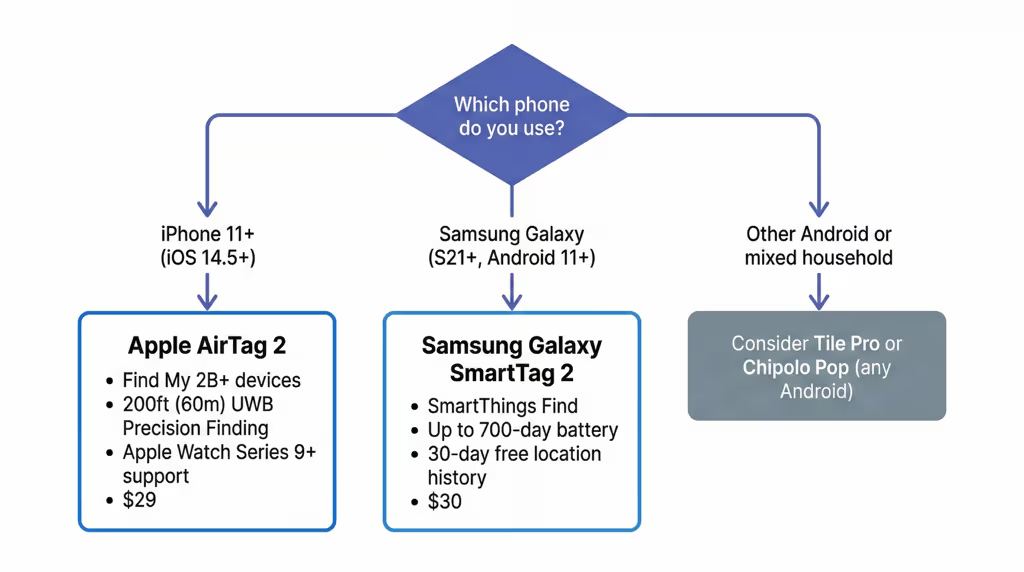
For most buyers, this is the only question that matters. AirTag 2 requires an iPhone — specifically iPhone 11 or later running iOS 14.5 or higher. Precision Finding (the UWB arrow-guided feature) requires iPhone 11 or later with a U1 or U2 chip. It does not work on Android at all, except for an NFC tap in Lost Mode that lets non-iPhone users see the owner’s contact info.
Samsung SmartTag 2 requires a Samsung Galaxy phone running Android 11 or higher, with the SmartThings app installed. Full UWB Precision Finding (including AR Find) requires a Galaxy device with a UWB chip — Galaxy S21+, S22 series, S23 series, S24 series, and their Ultra variants. Non-Samsung Android phones cannot set up or use the SmartTag 2 at all.
If your household includes a mix of iPhones and non-Samsung Android phones, neither tracker will work for everyone. See our AirTag alternatives guide for cross-platform options like Tile Pro and Chipolo Pop.
Precision Finding & UWB Performance
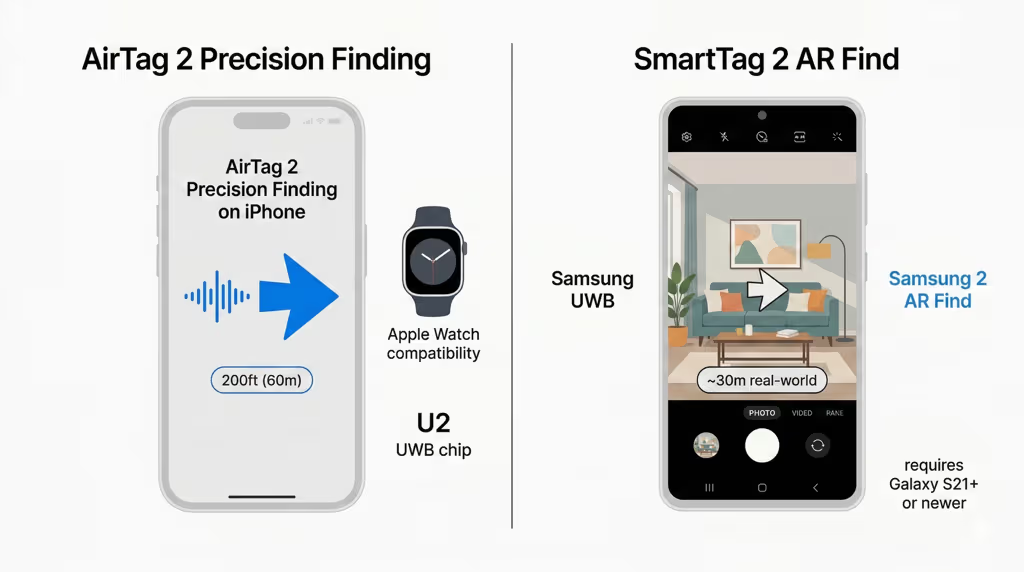
Both trackers have UWB for close-range precision, but the AirTag 2’s U2 chip delivers a significantly longer useful range.
AirTag 2 uses Apple’s U2 chip — the same chip found in the iPhone 17, iPhone Air, Apple Watch Ultra 3, and Apple Watch Series 11. Its Precision Finding guides you to your item using a combination of haptic vibration, directional arrows, and audio, working from up to 60 meters (200 feet) away. That’s 1.5× further than the original AirTag’s ~40m range. For the first time, this now also works on Apple Watch Series 9 or Ultra 2 and later — meaning you can find your AirTag while your phone is in your bag.
SmartTag 2’s UWB powers an AR Find mode that uses your Samsung phone’s camera to overlay a directional arrow on a live view of your surroundings — visually intuitive, especially in open rooms. In practice, reliable AR-guided tracking works at roughly 30 meters in real-world conditions with obstacles. The mode also requires that your specific Galaxy model has a UWB chip (S21+ and above).
For everyday close-range use (finding keys in a room), both work. For larger spaces — a parking lot, a hotel lobby, a large home — AirTag 2’s 60m range pulls ahead of SmartTag 2’s real-world ~30m. For a deeper look at how AirTag accuracy actually works, see our how accurate are AirTags explainer.
Speaker Volume
AirTag 2’s speaker is 50% louder than the original and audible from twice the distance. SmartTag 2’s speaker is also noticeably loud — in independent testing, it measured louder than the original AirTag. Both are functional for sound-based finding in everyday situations; AirTag 2 has the edge in open or noisy environments after the January 2026 update.
AirTag vs SmartTag Network: Find My vs SmartThings Find
AirTag’s Find My network is bigger — and that matters when your item has traveled far from you.
Apple’s Find My network relies on over 2 billion Apple devices (iPhones, iPads, Macs, Apple Watches) passively and anonymously relaying the location of any AirTag they detect via Bluetooth. In virtually every city, airport, shopping mall, or suburb in the world where iPhones exist, an AirTag’s location can be reported quickly. Coverage is effectively global.
Samsung’s SmartThings Find network works the same way — but only with Samsung Galaxy devices. Samsung has hundreds of millions of active devices, which gives it solid coverage in South Korea, Germany, and major US cities. But in rural areas, less Android-dense markets, or internationally outside Samsung’s strongholds, the network thins out. If your lost bag is in an airport or a mall with few Samsung users, update frequency drops significantly.
AirTag 2 also has no location history — it shows you where the item is right now (based on the last ping), not where it’s been. SmartTag 2 offers free 30-day location history in the SmartThings app, so you can trace an item’s route over time. That matters for tracking a vehicle, a pet that roams, or figuring out how a bag went missing. See AirTag location history for why Apple made this design choice.
Battery Life
SmartTag 2 wins by a wide margin.
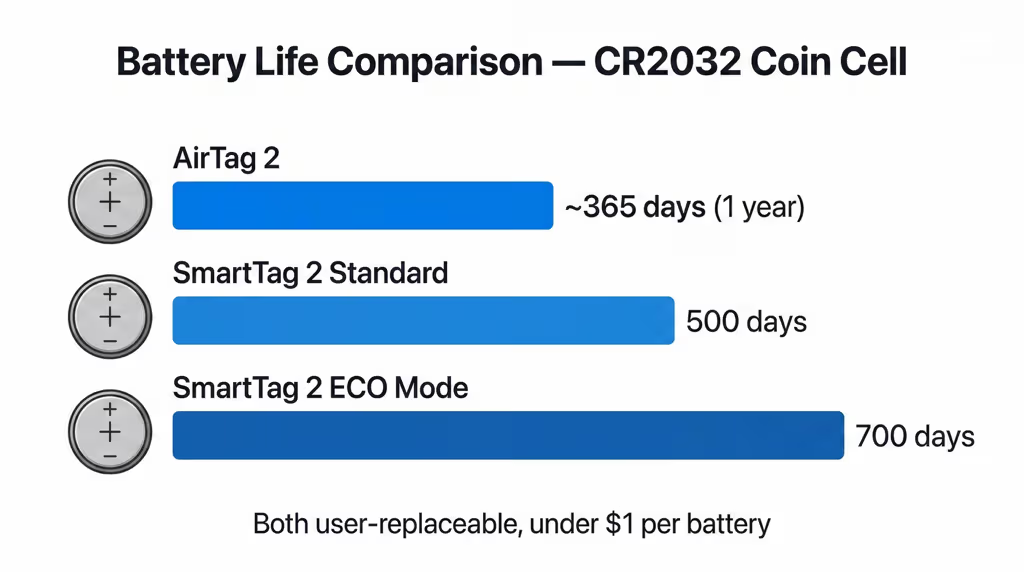
AirTag 2 runs on a CR2032 coin cell that lasts approximately one year in typical use — same as the original. Battery replacement is user-serviceable and costs under a dollar. IP67 means the battery compartment is well-sealed against moisture.
SmartTag 2 also uses a CR2032, but Samsung’s more efficient UWB implementation and the SmartThings app’s power-saving mode stretch battery life to 500 days in standard mode and up to 700 days in power-saving mode. In practice, that means roughly 1.5–2 years between battery changes — versus one year for AirTag 2. If you’re attaching these to items you rarely think about (luggage, tool bags, seasonal items), the SmartTag 2’s battery interval matters.
Neither tracker has a rechargeable battery; both require occasional coin cell replacement. See our guide to replacing the AirTag battery for step-by-step instructions — the SmartTag 2’s process is similar.
Design, Durability & Extra Features
Both are IP67-rated and nearly identical in price. Where they differ is in physical design and extra functionality.
Physical Design
AirTag 2 is a flat disc: 31.9mm in diameter, 8mm thick, with a polished steel back and a white front. It has no built-in attachment point — you’ll need a separate holder, keyring case, or luggage tag accessory (sold from ~$10). SmartTag 2 is an oblong fob with a large integrated keyring hole, so it attaches directly to keys or a bag strap without any accessories.
NFC Embedding
SmartTag 2 has a useful NFC feature: you can embed your contact information (phone number, email, message) into the tag. Anyone with any NFC-capable phone — iPhone or Android — can tap it to retrieve your contact info and return the item. AirTag 2’s NFC is limited to Lost Mode, where a tap shows the owner’s contact info only if they’ve enabled it in Find My.
Smart Home Integration
SmartTag 2 doubles as a SmartThings button: a long press can trigger smart home actions like turning off your lights or locking a door as you leave. AirTag 2 has no smart home functionality whatsoever — it’s purely a tracker.
Anti-Stalking
Both devices have built-in anti-stalking protections. AirTag 2 alerts iPhone users if an unknown AirTag has been traveling with them for a period of time, and Android users can install Apple’s Tracker Detect app. SmartTag 2 similarly alerts Samsung users to unknown nearby tags. Both are compliant with Google’s cross-industry DIDT (Detecting Unwanted Location Trackers) standard.
Pricing
Pricing is virtually identical — both at $29–$30 for a single unit and ~$99–$100 for a 4-pack. Neither requires a subscription. AirTag 2 accessories (holders, keyring cases) add $10–$35 per tracker if you need a specific form factor.
AirTag 2 or SmartTag 2: Which Should You Buy?
🍎 Choose Apple AirTag 2 if…
- You use an iPhone (any model 11 or later)
- You want the largest possible tracking network globally
- You prioritize UWB Precision Finding range (200ft)
- You own an Apple Watch Series 9+ and want wrist-based finding
- You travel internationally frequently
🤖 Choose Samsung SmartTag 2 if…
- You use a Samsung Galaxy phone (S21+ or newer for UWB)
- You want battery life that lasts 700 days between changes
- You want free 30-day location history
- You use SmartThings smart home and want the button feature
- You prefer a form factor with a built-in keyring hole
If you’re on a non-Samsung Android phone, neither of these is the right pick. Our best Bluetooth tracker roundup covers options like Tile Pro and Chipolo Pop that work with any Android device — and our best luggage trackers guide has travel-specific picks.
Frequently Asked Questions
Is Samsung SmartTag 2 compatible with iPhone?
No. The Samsung Galaxy SmartTag 2 requires a Samsung Galaxy phone running Android 11 or higher with the SmartThings app. It is not compatible with iPhones, and there is no iOS app that supports it. The only cross-device interaction is the NFC tap feature, which lets any NFC-capable phone (including iPhones) read embedded contact information if the owner has set it up.
Does the Samsung SmartTag 2 work with non-Samsung Android phones?
No. SmartTag 2 is Samsung-exclusive and requires a Samsung Galaxy device. Non-Samsung Android phones such as Google Pixel, OnePlus, or Motorola devices cannot set up or use the SmartTag 2. For Android users who don’t own a Samsung, consider Tile Pro, Chipolo Pop, or Pebblebee Clip 5, which work with all Android devices.
What’s the main difference between AirTag 2 and the original AirTag?
The AirTag 2 (January 2026) introduces three key improvements over the original: a U2 UWB chip that extends Precision Finding range to up to 200 feet (from ~130ft on the original), a speaker that is 50% louder, and support for Apple Watch Series 9 and Ultra 2 to run Precision Finding without needing your iPhone. Price ($29), design, IP67 rating, and CR2032 battery remain unchanged.
Does Samsung SmartTag 2 have location history?
Yes — the SmartTag 2 offers free 30-day location history in the SmartThings app. You can see a timeline of where the tracker has been, not just its current location. AirTag does not offer location history; it only shows the last known location.
Which has better Precision Finding — AirTag 2 or SmartTag 2?
Both use UWB, but AirTag 2’s U2 chip extends reliable Precision Finding to up to 200 feet (60 meters), while SmartTag 2’s AR Find mode works reliably at roughly 30 meters in real-world conditions with obstacles. For close-range finding in a room, the difference is minimal. For larger spaces, AirTag 2’s range is longer — 60m vs roughly 30m in real-world conditions. SmartTag 2’s AR camera overlay is arguably more visually intuitive, though.
Which tracker has a longer battery life?
Samsung SmartTag 2 wins clearly. In standard mode it lasts up to 500 days; in power-saving mode (enabled in the SmartThings app), up to 700 days — roughly 1.5 to 2× longer than AirTag 2’s approximately one-year battery life. Both use the same CR2032 coin cell, which is user-replaceable.
Do AirTag 2 and SmartTag 2 have subscription fees?
Neither requires a subscription. AirTag 2 is fully functional with the free Find My app. SmartTag 2 is fully functional with the free SmartThings app, including the 30-day location history. This is a key advantage both have over Tile, which charges $2.99/month for similar location history features. For more on AirTag’s fee structure, see our AirTag monthly fee page.
Can I use AirTag 2 or SmartTag 2 to track a car?
Yes, both can be hidden in a vehicle — though neither is a real-time GPS tracker. They update location only when a Find My or SmartThings Find device passes nearby. In busy areas this happens frequently; in remote locations, updates may be hours apart. For details on AirTag’s effectiveness in vehicles, see AirTag for car. For real-time vehicle tracking, a dedicated GPS tracker is more appropriate.
Which tracker is better for international travel?
AirTag 2 is significantly better for international travel due to the scale of the Find My network. With over 2 billion Apple devices worldwide in 180+ countries, an AirTag in a lost bag has a very high chance of being detected in any major airport, city, or tourist area globally. SmartTag 2 is strong in South Korea, Germany, and US urban areas but coverage drops outside Samsung’s key markets. For luggage tracking recommendations, see best luggage trackers.