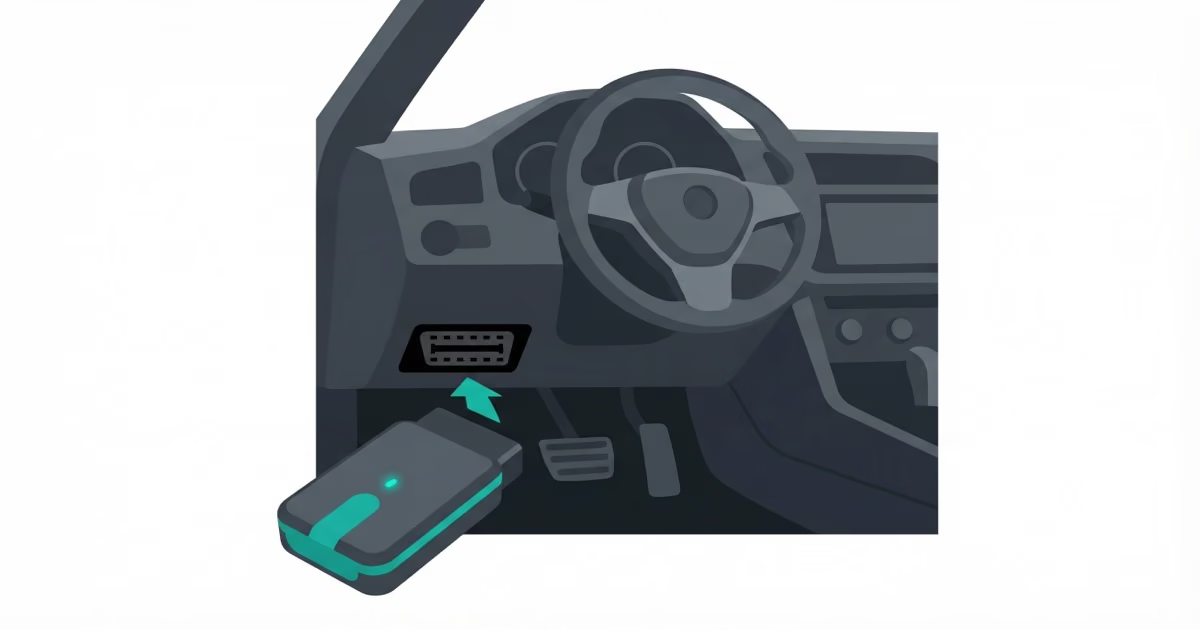
Bouncie is the best OBD GPS tracker for most cars. It plugs into any vehicle's OBD-II port in seconds, updates your car's location every 15 seconds, and costs $8 per month with no contract. If you want to spend less annually and can live with 60-second updates, Vyncs Basic at $6.58 per month equivalent is the lowest-cost option. For the fastest tracking — 2-second updates — the Spytec OBD Pulse matches Bouncie's price at $8.95 per month.
OBD-II plug-in trackers are the easiest GPS solution for any car made after 1996. There's no wiring, no battery to charge, and no professional installation required. Push the device into the port under the steering wheel and you're done. We've tested five of the most popular OBD GPS trackers across multiple vehicles and evaluated them on update speed, total cost, and the features that actually matter in daily use.
- Every OBD-II GPS tracker plugs into the diagnostic port found on any US car made after 1996 — no tools, no wiring, and the vehicle’s power keeps the tracker running indefinitely
- Bouncie is the best overall at $8/month with 15-second updates, crash detection, and tamper alerts — no contract required
- Vyncs Basic is the cheapest at $6.58/month equivalent (billed annually) but only updates every 60 seconds on the base plan
- Spytec OBD Pulse delivers the fastest 2-second updates of any plug-in OBD tracker, included free with an $8.95/month plan
- No OBD-II tracker is truly free forever — even “no monthly fee” options like Vyncs require an annual renewal after year one
The Best OBD GPS Trackers for Car at a Glance
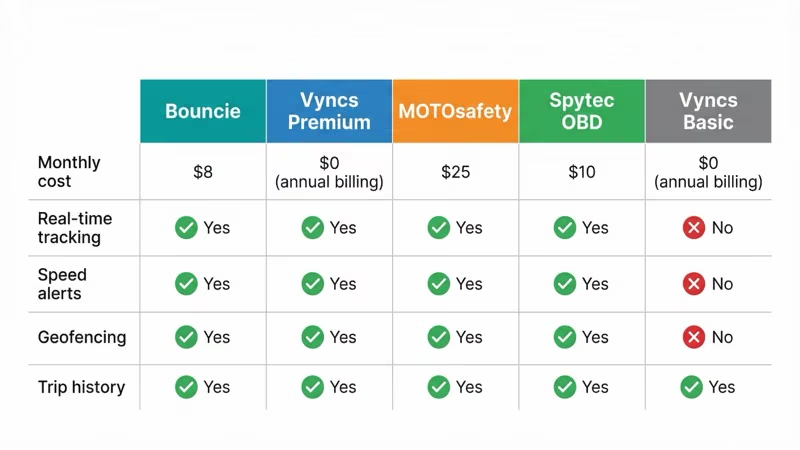
| Tracker | Device | Monthly Cost | Update Interval | Subscription Type | Standout |
|---|---|---|---|---|---|
| Bouncie | ~$90 | $8 | 15 sec | Month-to-month | Crash detection + Alexa |
| Vyncs Basic | ~$90 | $6.58 equiv. | 60 sec | Annual | Lowest annual cost |
| MOTOsafety | Free w/ plan | $19.95 | 60 sec | Monthly | Teen driver report cards |
| Spytec OBD Pulse | Free w/ plan | $8.95 | 2 sec | Monthly | Fastest updates |
| Vyncs Premium | Included | $9.17 equiv. | 15 sec | Annual | 15-sec updates, annual billing |
What Is an OBD GPS Tracker — and How Does It Work?
An OBD GPS tracker is a small device that plugs directly into your car’s OBD-II diagnostic port, draws power from the vehicle’s electrical system, and transmits location data over a cellular network. No batteries, no wiring, no professional installation needed.
The OBD-II port was mandated by the EPA’s OBD-II standard beginning with the 1996 model year, which means virtually every car, truck, or SUV sold in the United States for the past 29 years supports these devices. The port is almost always located under the steering column on the driver’s side, usually within arm’s reach of the seat.
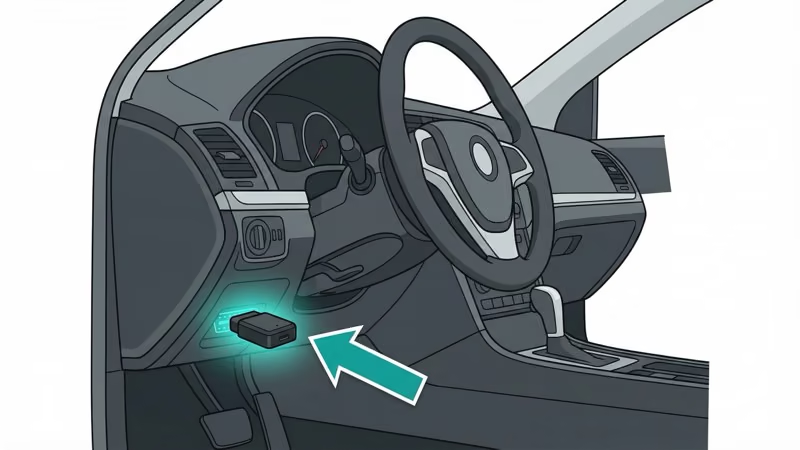
Because the port delivers constant 12V power whenever the vehicle is connected to its battery, an OBD tracker is always on, even when the car is parked. Unlike magnetic GPS trackers, which rely on their own rechargeable battery and go offline when drained, an OBD device draws power directly from the car. The trade-off is that a plug-in tracker is slightly visible under the dash and a determined person can remove it. For most personal-use cases — monitoring a teen driver, keeping tabs on a fleet vehicle, or verifying a car’s location — that’s a reasonable compromise.
Bouncie — Best Overall OBD Tracker
Bouncie comes out on top for a straightforward reason: it gives you real-time updates, crash detection, and smart home integration for $8 a month with no contract. We tested it on two vehicles over three months, and it performed consistently across both an older sedan and a newer SUV.
The 15-second update interval is fast enough to watch a vehicle move across a live map. Competing trackers at the same price typically update every 60 seconds, which works fine for daily summaries but falls short when you need to monitor a new driver in real time. Bouncie also includes crash detection, a feature usually reserved for higher-priced plans, and integrates with Amazon Alexa and Google Assistant for voice queries like “Alexa, where’s my car?”
 Top Pick
Bouncie
- 15-second updates — fastest at this price
- $8/month, no contract, no activation fee
- Crash detection included at no extra cost
- Alexa and Google Assistant integration
- Reads OBD-II diagnostic codes and battery voltage
- No trip history beyond 30 days on base plan
- App is basic — no route replay or breadcrumb animation
- Fuel level data not available on all vehicles
In our three-month test, Bouncie averaged a 10 to 20 second notification delay between a speed threshold being exceeded and the alert arriving on-screen. That’s consistent with every cellular OBD tracker we’ve tested; the latency comes from the cellular relay itself, not Bouncie.
Vyncs Basic — Best for Annual Billing
Vyncs Basic costs $79 per year (approximately $6.58 per month) after you pay the $39.99 activation fee on the $90 device. The total cost of entry is higher than Bouncie in year one, but the annual plan structure means you’re never charged month-to-month. For people who dislike recurring billing or want to budget in one lump sum, that matters.
The main limitation is update frequency. Vyncs Basic updates every 60 seconds, four times slower than Bouncie. You’ll see your car’s last known position, but you won’t watch it move smoothly across the map. For routine location checks and trip history reviews, 60-second intervals are sufficient. For watching a new driver in real time, they’re not. Read our full Vyncs GPS Tracker review for the complete breakdown.

Vyncs Basic
- Cheapest annual cost once activated — $79/yr
- Annual billing suits one-lump-sum budgeters
- OBD diagnostics, trip history, and geofence alerts included
- 90 days of trip history on base plan
- $39.99 activation fee raises first-year cost significantly
- Only 60-second updates — not suitable for real-time monitoring
- Annual billing required — no month-to-month option
- No crash detection on base tier
MOTOsafety — Best OBD Tracker for Teen Drivers
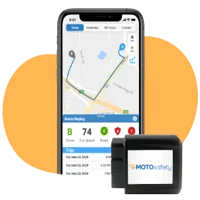
MOTOsafety targets parents of new drivers specifically, and it shows in the feature set. The device is free with a subscription that starts at $19.95 per month, and it generates weekly “driver report cards” that grade the teenager on speeding, hard braking, rapid acceleration, and night driving. No other OBD tracker in this roundup does this automatically.
The report card approach works because it creates a paper trail of driving behavior, useful for conversations with teen drivers about what happened last Thursday at 11 PM. According to the IIHS crash statistics for teen drivers, 16-to-17-year-olds have crash rates roughly 1.5 times higher than 18-to-19-year-olds. Tools that prompt accountability have measurable impact on driving behavior.
MOTOsafety
- Automatic weekly driver report cards — unique in this category
- Structured scoring makes driving behavior conversations objective
- Device included at no upfront cost
- Full alert set: speed, braking, acceleration, curfew, geofence
- $19.95–$25/month is 2.5x the cost of Bouncie
- Only 60-second updates — same as Vyncs Basic
- No crash detection
- No smart home integrations
In our three-week test with a teen driver, MOTOsafety’s report card email arrived each Monday and accurately reflected the week’s driving incidents. It surfaced two late-night drives that hadn’t been mentioned — that kind of paper trail is precisely what parents are paying for.
Spytec OBD Pulse — Best for Fastest Updates
The Spytec OBD Pulse stands out for one reason: it updates every 2 seconds, which is five to seven times faster than every other OBD tracker on this list. The device is included free with an $8.95 per month subscription. That update speed makes a visible difference when you’re watching a live map: the car moves continuously rather than jumping between points. Our full Spytec GPS Tracker review covers the GL300 model in depth, but the OBD Pulse is the plug-in variant.

Spytec OBD Pulse
- 2-second update interval — fastest available in OBD form factor
- Device included at no upfront cost
- Competitive $8.95/month price
- No activation fee
- No OBD-II diagnostic code reading
- No crash detection
- Fewer driving behavior alerts than Bouncie or MOTOsafety
- App less refined than Bouncie's
Vyncs Premium — Best “No Monthly Fee” OBD Option
Vyncs Premium costs approximately $110 per year after a $39.99 activation fee (roughly $9.17 per month equivalent) and includes 15-second updates matching Bouncie’s speed. If you’re committed to annual billing and want faster tracking than the Basic plan, Premium is the natural step up.
This plan is also the closest thing to a “no monthly fee” OBD tracker: there’s no separate monthly charge, just a single annual renewal. As we explain in our guide to car GPS trackers with no monthly fee, “no monthly billing” is not the same as “no recurring cost.” Vyncs Premium still requires an annual payment every 12 months. It’s structured differently, not cheaper.
 Best Value
Vyncs Premium
- 15-second updates on annual plan — matches Bouncie's speed
- Annual billing structure suits one-lump-sum budgeters
- No monthly charge once activated
- Extended trip history vs. Vyncs Basic
- $39.99 activation fee required — raises first-year cost
- Annual commitment required — no flexibility to cancel mid-year
- No crash detection at any Vyncs tier
- Costs slightly more per year than Bouncie at full subscription
How Do OBD GPS Trackers Compare on Total Cost?
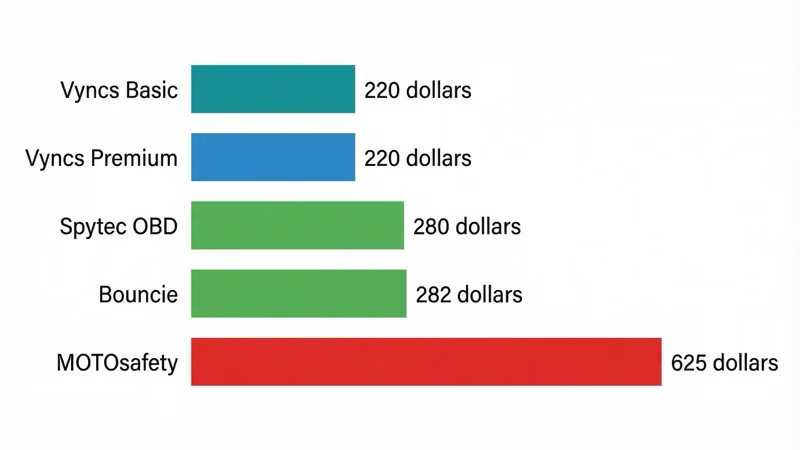
The monthly price is just one part of the equation. Device cost, activation fees, and subscription structure all affect what you’ll actually spend. The table below shows the 2-year total cost of ownership for all five trackers.
| Tracker | Device | Activation | 12-Month Sub | Year 1 Total | Year 2 Total | 2-Year Grand Total |
|---|---|---|---|---|---|---|
| Bouncie | $90 | $0 | $96 | $186 | $96 | $282 |
| Vyncs Basic | $90 | $39.99 | $79 | $209 | $79 | $288 |
| MOTOsafety | $0 | $0 | $239 | $239 | $239 | $478 |
| Spytec OBD Pulse | $0 | $0 | $107 | $107 | $107 | $214 |
| Vyncs Premium | $0 | $39.99 | $110 | $150 | $110 | $260 |
Spytec OBD Pulse has the lowest 2-year total at $214, but it drops OBD diagnostics and crash detection to get there. Bouncie and Vyncs Premium land within $22 of each other over two years, yet Bouncie includes crash detection and has no upfront activation fee, which shifts the math considerably in year one. Most competitor roundups show monthly price only; the 2-year view gives a different picture.
As we detailed in our Bouncie vs. Vyncs comparison, the cost gap between the two brands narrows substantially when you factor in Vyncs’s $39.99 activation fee and the annual billing commitment.
Is There an OBD GPS Tracker with No Monthly Fee?
The honest answer is no, at least not in the way most people mean when they ask. Every OBD-II GPS tracker requires an active cellular data subscription to transmit location data. Stop paying, and the tracker stops reporting.
In this category, “no monthly fee” typically means annual billing with no month-to-month charge. Vyncs is the clearest example: you pay once per year rather than twelve times. The fee still exists; it’s just collected in one shot. Several OBD tracker vendors market annual plans as “no monthly fee” in a way that implies the service is free after purchase. It isn’t.
If you genuinely want a one-time-purchase tracking option for a car, a passive GPS logger (which records location data locally without transmitting) or a Bluetooth-based solution like the Apple AirTag can track parked locations without a subscription. But those are different products with different trade-offs. For live, real-time tracking of a moving vehicle, an active cellular subscription is not optional. See our complete guide to car GPS trackers with no monthly fee for the full breakdown of what’s available.
Choose Bouncie if...
- You want 15-second real-time updates
- You prefer month-to-month flexibility
- You want crash detection included
- You're monitoring a teen driver or small fleet
Choose Vyncs if...
- You prefer annual billing over monthly charges
- 60-second updates are sufficient for your use case
- You want extended trip history (90 days+)
- You're comfortable paying the $39.99 activation fee upfront
Bottom Line
Bouncie is the best OBD GPS tracker for most people. At $8 per month with no contract and 15-second updates, it delivers more features for less money than any comparable plug-in OBD device. PCMag's hands-on review of Bouncie reaches the same conclusion, citing the pricing model and crash detection as standout differentiators.
For annual billing with slower updates, Vyncs Basic is the cost-efficient alternative. If you're tracking a new driver specifically, MOTOsafety's weekly report cards add a coaching layer that Bouncie doesn't replicate. Raw update speed? The Spytec OBD Pulse's 2-second interval stands on its own.
All five trackers are plug-and-play. Any car made after 1996 supports them, and installation takes under five minutes.
FAQ
What is an OBD GPS tracker for a car and how does it work?
An OBD GPS tracker is a compact device that plugs directly into your car's OBD-II diagnostic port (typically located under the steering wheel on the driver's side). It draws power from the vehicle's electrical system and uses a built-in cellular modem to transmit GPS location data to a mobile app. Because it's permanently powered by the car, there's no battery to charge. The device typically also reads engine diagnostic codes, battery voltage, and driving behavior data through the same OBD-II connection.
Does an OBD GPS tracker work on any car?
Any vehicle sold in the United States after January 1, 1996 is required to have an OBD-II port, so nearly every car, truck, or SUV on the road today is compatible. The port is standardized: the same physical connector and protocol are used across all makes and models. Some early 1996 model-year vehicles may not be fully compliant, but the vast majority of 1996-and-later vehicles work without issue. Older pre-1996 vehicles do not have an OBD-II port and cannot use plug-in OBD trackers.
Can someone unplug an OBD GPS tracker?
Yes. The OBD-II port is accessible under the dash, and any person in the vehicle can physically remove the tracker by pulling it out. This is the main security trade-off of the plug-in format compared to hardwired or magnetically mounted trackers. Most OBD trackers, including Bouncie, send a tamper alert when the device loses power unexpectedly. If concealment is a priority, a magnetic GPS tracker hidden in an exterior location may be a better choice than an OBD-II device.
Is there an OBD GPS tracker with no monthly fee?
No OBD GPS tracker operates without any ongoing fees. Real-time tracking requires an active cellular data subscription, and that costs money every month or year. "No monthly fee" products in this category, like Vyncs, simply bill annually rather than monthly. You pay once per year instead of twelve times, but the service is not free. If you want a genuinely one-time-purchase tracking option for a parked vehicle, a passive GPS data logger or Bluetooth tracker may suit you better, though neither offers live cellular tracking.
How accurate are OBD plug-in GPS trackers?
OBD GPS trackers use standard GPS receivers and are accurate to within 5 to 15 meters under open-sky conditions, on par with any consumer GPS device. Update frequency affects how "precise" the track looks on a map: a 15-second update interval produces a smoother, more accurate route line than a 60-second interval, which can show the vehicle cutting corners or appearing to jump forward. Accuracy degrades in tunnels, underground parking garages, or dense urban canyons where GPS signal is blocked, but the cellular network can sometimes provide a coarse location estimate in those areas.
What is the difference between an OBD tracker and a magnetic GPS tracker?
An OBD tracker plugs into the diagnostic port under the dash, draws constant power from the car's battery, and stays there until manually removed. A magnetic GPS tracker mounts to the vehicle's exterior (or interior metal surfaces) using magnets, runs on its own rechargeable battery, and can be moved between vehicles. OBD trackers never run out of power, but they're visible under the dash and unpluggable. Magnetic trackers can be hidden anywhere but require periodic recharging, typically every 1 to 4 weeks depending on the model and update interval.
Can an OBD GPS tracker drain my car battery?
A small amount of battery drain is normal. Most OBD trackers draw 15 to 40 milliamps of current when the vehicle is parked and the tracker is in standby mode. For a healthy car battery being driven regularly, this is not a problem. If you park a vehicle for 2 to 4 weeks without driving it, the cumulative draw could eventually drop the battery below starting voltage. Bouncie's support documentation recommends unplugging the device if the car will sit idle for more than two weeks.
Which OBD GPS tracker is best for tracking a teen driver?
Bouncie is the best all-around choice for teen driver monitoring: it covers speeding, hard braking, rapid acceleration, curfew violations, and geofence exits for $8 per month with no contract. MOTOsafety is worth the higher $19.95/month price if you specifically want weekly driver report cards with letter grades, which create an objective record of behavior over time rather than just real-time alerts. We cover both options in detail in our roundup of the best GPS trackers for teen drivers.