AirTag sound is a cue to check context, not a reliable six-sound code. Apple documents several reasons an AirTag can make noise, but it does not publish a fixed consumer timetable or an official list of six named beeps.
Use AirTag only for your own belongings or property you have permission to track. Never use it to follow a person without consent.
- Start with ownership. Your own AirTag and an unknown AirTag require different actions.
- Use Find My for your own tag. Play Sound stops automatically, or you can tap Stop Sound in the app.
- Expect a battery connection sound. A sound after installing a CR2032 confirms contact; repeated reset sounds have a separate official procedure.
- Treat an unknown-tracker alert seriously without assuming motive. The item may be borrowed, but Apple provides a protective locate, identify, document, and disable flow.
- Don’t rely on a fixed 8–24 hour rule. Current Apple guidance says an owner-separated AirTag emits a sound when moved after a period of time, without publishing one guaranteed threshold.
First, Identify Who Owns the AirTag
This is the safest first question because the same small device can be making an owner-requested sound or a safety sound for people nearby.
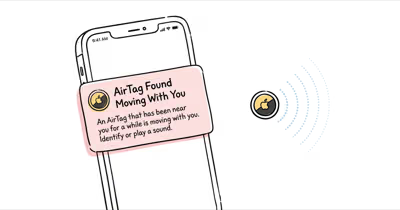
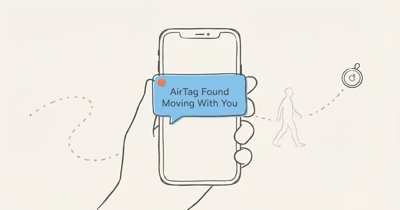
According to Apple’s current unwanted-tracker guidance, a safety alert can involve a borrowed item, while an owner-separated tracker seen moving with you over time still warrants the official locate-and-check flow.
| What you know | What the sound may mean | Next action |
|---|---|---|
| It’s your AirTag and you tapped Play Sound | Find My is helping locate your item | Tap Stop Sound, or let it end automatically |
| It’s your AirTag and you just installed the battery | The battery has made contact | Finish closing the cover and check the item in Find My |
| It’s your AirTag but the sound is unexplained | The sound alone is not a diagnosis | Check Find My, battery contact, and account ownership |
| It’s unknown, or your phone says it moved with you | It may be borrowed, lost, or involved in unwanted tracking | Use the official alert workflow and prioritize safety |
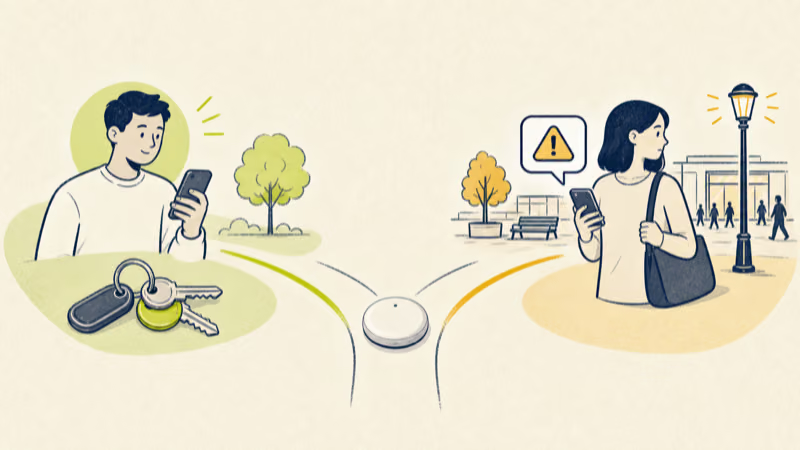
Sound alone can’t prove ownership or intent. Check the item context.
For Your Own AirTag, Check These Documented Sounds
Apple’s current iPhone guide states that a nearby item can Play Sound after you select it in Find My. The sound stops automatically, or you can tap Stop Sound. Apple doesn’t document pressing the AirTag itself as the way to stop this action.
Apple’s battery guide confirms that a correctly installed CR2032 makes a battery connection sound, so one sound immediately after a battery change is expected. If you’re intentionally resetting the AirTag, follow the generation-specific sequence. The official reset guide states that both generations use five battery-connection sounds, with a different fifth sound indicating readiness to pair. This deliberate procedure isn’t a random five-beep diagnosis.
| Context | What Apple documents | What to do |
|---|---|---|
| Play Sound | A nearby item sounds to help you find it | Tap Stop Sound or let it end |
| Battery installation | A sound indicates the battery is connected | Close the cover and confirm the item in Find My |
| Official reset | Repeated connection sounds and a different final sound are part of the sequence | Follow the correct steps for your AirTag generation |
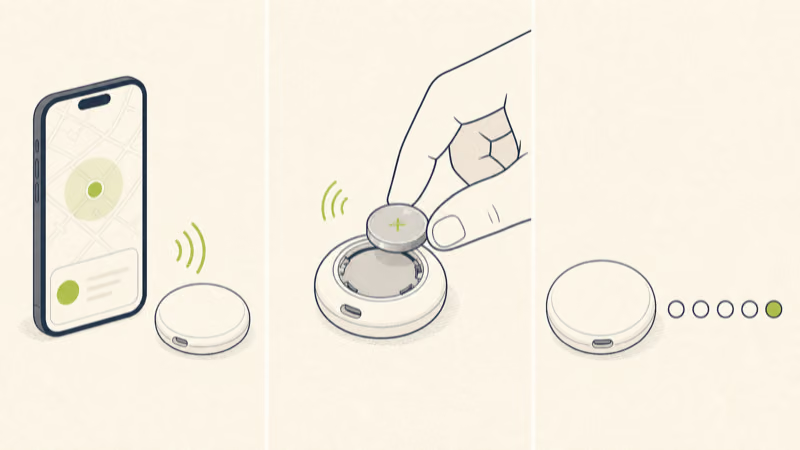
If you did none of these things, don’t jump to a firmware or speaker diagnosis. Check the item card in Find My, make sure the AirTag is still linked to your Apple Account, and ask anyone with legitimate access whether they used Play Sound.
If the AirTag Is Unknown, Use the Safety Workflow
Owner-separated AirTags can make a safety sound when moved.
Apple and Google announced cross-platform support for unwanted-tracking notifications in iOS 17.5 and Android 6.0 or later. Current phone software and notification settings still matter, so use the instructions shown on the device you have.
An alert does not automatically prove malicious intent. The tag could be attached to borrowed keys, luggage, or another shared item. It still deserves a careful check.
- Tap the unwanted-tracking notification and continue to the details.
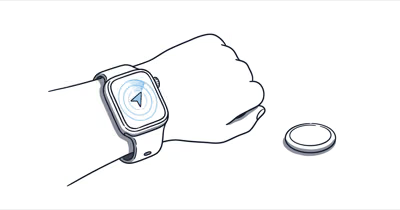
- Use Play Sound or, when available, Find Nearby to locate the item.
- If you can’t find it and feel at risk, go to a safe public place and contact local law enforcement.
- Once found, hold an NFC-capable phone near the white side to view the identifier information.
- Take a screenshot of the serial number or device ID and the available registrant information.
- Consider the impact on your safety, then use Instructions to Disable and follow the onscreen steps if disabling is appropriate.

Apple warns that turning off Bluetooth, Location Services, or the Find My network on your phone does not prevent the AirTag owner from receiving its location. Use the official disable instructions for the item itself. If law enforcement becomes involved, keep the AirTag and its serial number available as directed.
AirTag and similar trackers are for belongings you own or have permission to track. Apple states that using them to track people without consent is a crime in many countries and regions.
Why We Avoid a Fixed Beeping Timer
Current Apple guidance describes an AirTag that is separated from its owner for a period of time and then moved. It does not promise one public 8-hour, 24-hour, or other fixed threshold that applies to every device and situation.
That matters for two reasons:
- A quiet AirTag is not proof that no unwanted tracker is present.
- A beeping AirTag is not proof that it has been separated for one exact number of hours.
Use the alert and identifier, not a guessed timer.
Is the Beeping a Low-Battery Warning?
Apple documents low battery as a notification on the iPhone and a Low Battery message under the AirTag name in Find My. Its battery guide separately documents a sound when a newly installed battery connects.
So don’t identify a random sound as a dedicated low-battery alarm. Check the item in Find My. If it reports Low Battery, replace the CR2032 using Apple’s procedure, positive side up, and listen for the connection sound.
Keep loose coin cells and AirTag parts away from children.
When Does Your Own AirTag Need More Help?
For your own AirTag, use a short evidence-based sequence:
- Open Find My and confirm that you selected the correct item.
- Check whether Play Sound is active and tap Stop Sound if needed.
- If you recently touched the battery, reinstall a compatible CR2032 positive-side up and confirm the connection sound.
- If you were resetting the tag, compare your steps with Apple’s instructions for the correct generation.
- If unexplained sounds continue, contact Apple Support rather than opening or modifying the speaker.
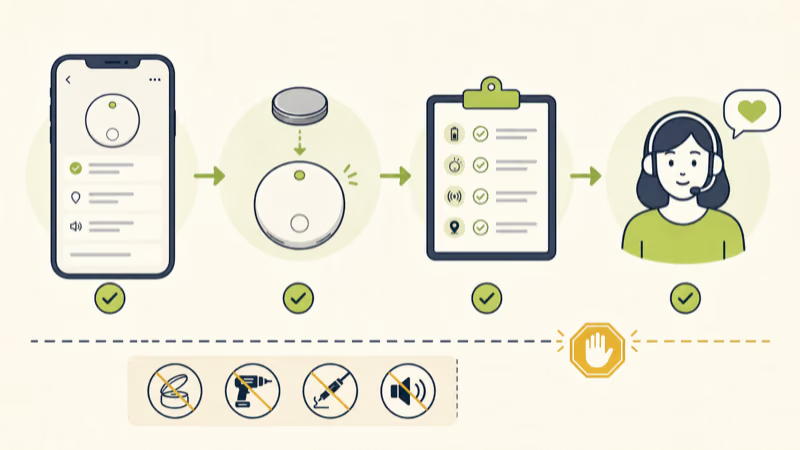
Don’t drill, cut, desolder, muffle, or remove the speaker. Besides damaging the tracker, defeating the audible safety feature can put other people at risk.
If your issue is that the AirTag won’t make a requested sound, use the AirTag not playing sound guide. If its location is stale, use the location update guide instead.
Bottom Line
There is no reliable six-beep decoder. For your own AirTag, compare the sound with a recent Play Sound action, battery change, or official reset, then check Find My. For an unknown AirTag or an item-moving-with-you alert, use the phone’s locate and identifier tools, document the details, consider your safety, and follow the official disable instructions.
Avoid fixed alert timers and improvised speaker work. Current Apple guidance and the context around the tag are more useful than trying to name a beep from memory.
FAQ
Why is my AirTag beeping randomly?
First confirm whether the AirTag is yours. For your own tag, check Find My for a Play Sound action and consider whether the battery was recently installed or the tag was reset. For an unknown tag, use the unwanted-tracking alert and Apple’s safety workflow.
How do I stop Play Sound on my own AirTag?
Open Find My, select the item, and tap Stop Sound. Apple says the sound also ends automatically. Its current guide does not instruct you to press the AirTag itself to stop Play Sound.
Does AirTag beep when the battery is low?
Apple documents low battery as an iPhone notification and a Low Battery message in Find My. It separately documents a connection sound when a battery is installed, so check Find My instead of treating a random beep as a dedicated low-battery alarm.
How long is an AirTag separated before it makes a safety sound?
Apple’s current public guidance doesn’t give one fixed consumer threshold. It says an AirTag separated from its owner for a period of time emits a sound when moved. Don’t rely on an 8-hour or 24-hour timer as a safety test.
What should I do if an unknown AirTag is moving with me?
Tap the alert, use Play Sound or Find Nearby to locate the item, and document its identifier information. If you feel at risk, go to a safe public place and contact local law enforcement. Follow the onscreen Instructions to Disable when appropriate.
Will turning off Bluetooth stop an unknown AirTag from tracking?
No. Apple says turning off Bluetooth, Location Services, or the Find My network on your phone does not stop the owner from seeing the AirTag’s location. Follow the official instructions to disable the item itself.
Can I permanently disable the AirTag speaker?
Don’t modify or remove the speaker. It’s part of the unwanted-tracking safety system, and defeating it can put people at risk. For unexplained sounds from your own AirTag, use Find My, check the battery, and contact Apple Support.