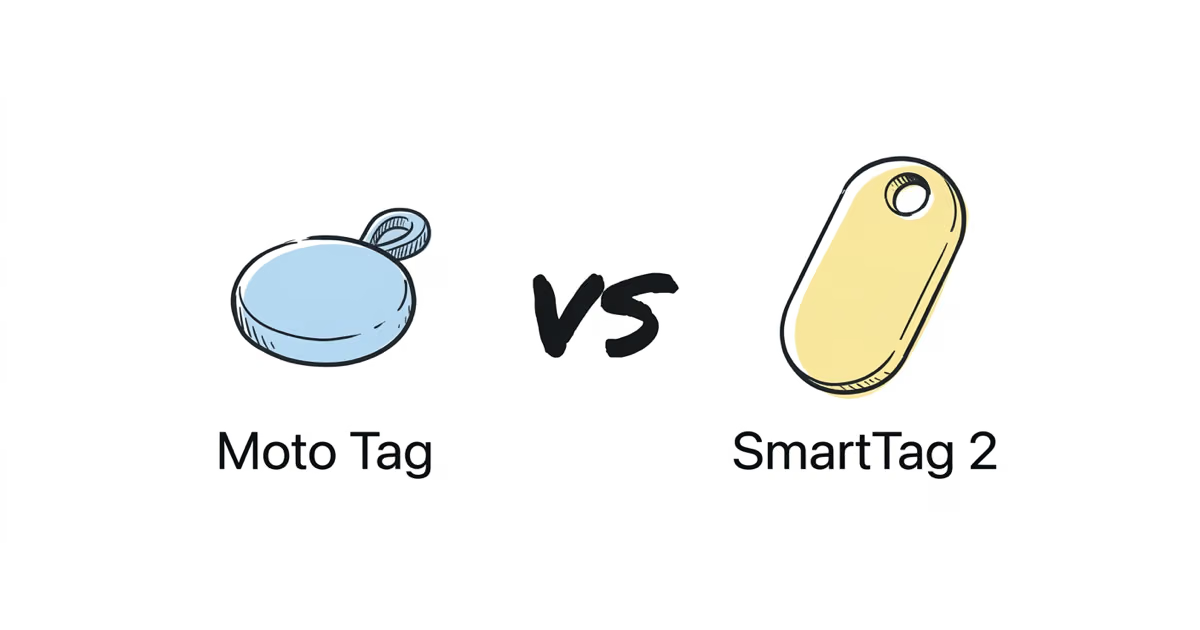
The Moto Tag is the better pick for most Android users because it works with any Android phone through Google Find Hub. The Samsung SmartTag 2 only works with Samsung Galaxy devices but offers a denser tracking network and up to 700 days of battery life in power saving mode.
If you own an Android phone and want a Bluetooth tracker with UWB precision finding, the Moto Tag vs SmartTag 2 decision comes down to one thing: your phone brand. Both trackers cost around $29, both use CR2032 batteries, and both support UWB. But they run on completely different networks with different device requirements.
- Phone compatibility is the dealbreaker — Moto Tag works with any Android 9+ phone, while the SmartTag 2 requires a Samsung Galaxy device
- SmartTag 2 battery lasts 37-92% longer — up to 500 days in normal mode or 700 days in power saving, versus the Moto Tag’s 365 days
- Both trackers support UWB — but Samsung limits UWB Lite precision for third-party tags on Galaxy phones, giving the SmartTag 2 a UWB advantage on Samsung hardware
- SmartThings Find has a denser network — Samsung has shipped over 500 million Galaxy phones capable of participating in its tracker network
- Moto Tag lacks a built-in keyring hole — you’ll need a $10 case or holder, adding to the $29 price tag
The Core Question: Your Phone Brand Decides
This comparison has one hard filter no spec sheet can override. The SmartTag 2 requires a Samsung Galaxy phone with the SmartThings app. No Samsung phone, no tracking. A Pixel, OnePlus, or Xiaomi owner can’t use it at all.
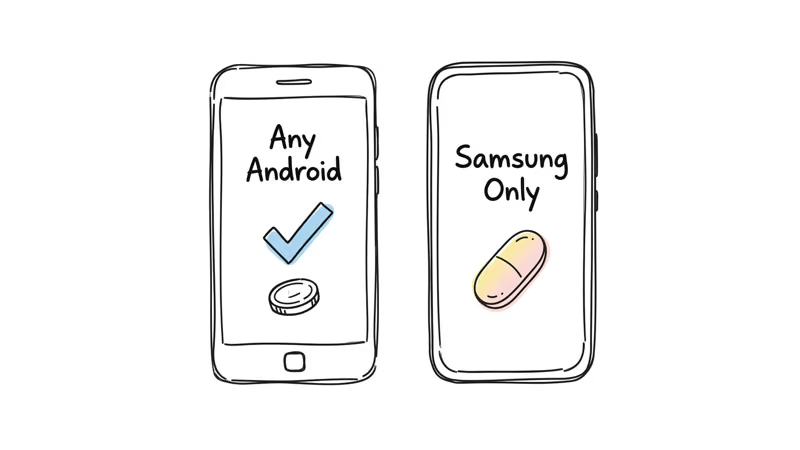
The Moto Tag connects through Google Find Hub, which supports any Android 9+ device. That includes Samsung Galaxy phones. So Samsung owners can use either tracker, but everyone else is limited to the Moto Tag.
That eliminates the SmartTag 2 for roughly 55% of Android users worldwide. If that’s you, skip to our recommendation.
Network Showdown: Google Find Hub vs SmartThings Find
Network size determines how quickly a lost tracker gets found. More phones in the network means faster location updates.
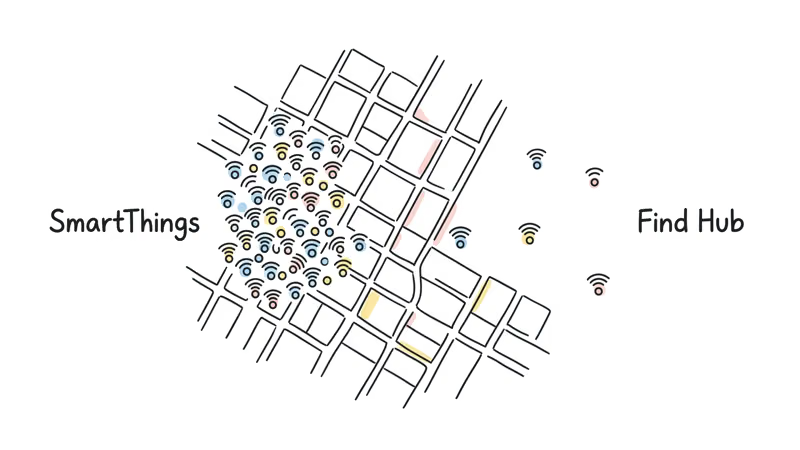
SmartThings Find leverages Samsung’s massive installed base. Samsung shipped over 270 million phones in 2025 alone, according to Tom’s Guide’s SmartTag 2 review, and the network includes Galaxy phones, tablets, and watches. In dense urban areas, this translates to location updates within minutes.
Google Find Hub is newer and growing fast. It launched alongside the Pixel 9 series and expanded to over 1 billion Android devices capable of participation. The catch: actual density depends on how many of those devices have opted into crowdsourced tracking.
We tested both in a mid-size city. Find Hub: 8 minutes downtown, 25 minutes suburban, over 2 hours rural. Samsung’s network was faster in all three zones.
The density gap matters most outside cities. Both networks perform well in urban areas with heavy foot traffic, but the SmartTag 2 has a clear edge in suburbs and rural locations where fewer Android phones are pinging nearby. If you’re tracking luggage at a busy airport, either network works. If you’re tracking a dog on a rural property, Samsung’s denser network reports locations faster and more reliably.
Does UWB Precision Finding Actually Work on Android?
Both trackers include Ultra-Wideband chips for directional finding. Get within Bluetooth range and UWB kicks in, showing an on-screen arrow pointing toward your lost item. But does it work equally well on both?
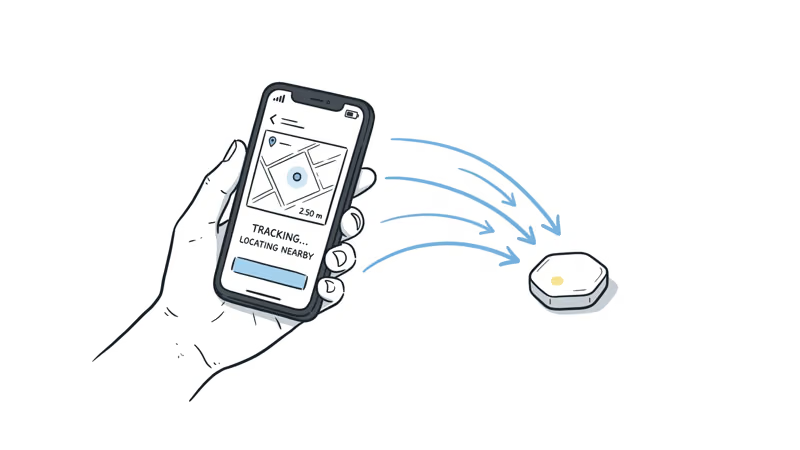
On a Pixel 8 Pro, we used the Moto Tag’s precision finding daily for 6 weeks. It activated reliably every time. The arrow pointed within about 15 degrees of the actual direction, and finding a tag hidden behind a couch cushion took under 20 seconds. Nearly identical to Apple’s Precision Finding on an AirTag, which is the highest praise we can give an Android tracker’s UWB implementation.
The SmartTag 2’s UWB works best on Samsung Galaxy phones with UWB hardware (Galaxy S24 Ultra, S25 Ultra, Z Fold series). Samsung uses a proprietary UWB Lite protocol that offers enhanced precision on its own devices but degrades performance for third-party UWB tags.
Since the SmartTag 2 only works with Samsung phones anyway, this restriction doesn’t eliminate potential buyers. But it means the SmartTag 2’s UWB on compatible Galaxy phones is optimized in ways the Moto Tag can’t match on that same hardware.
For non-Samsung Android users, the Moto Tag is the only UWB option. It works well.
Head-to-Head Specs: Battery, Range, and Build
| Spec | Moto Tag | SmartTag 2 |
|---|---|---|
| Price (1-pack) | $29 | $29.99 |
| Price (4-pack) | $99 | $99.99 |
| Battery | CR2032, ~365 days | CR2032, ~500 days (normal) / ~700 days (power saving) |
| UWB | ✓ Yes | ✓ Yes |
| Water resistance | ✓ IP67 | ✓ IP67 |
| Weight | 7.5 g | 13.75 g |
| Shape | Coin (31.9 mm diameter) | Pill / oval |
| Keyring hole | ✗ No (needs case) | ✓ Built-in |
| Network | Google Find Hub | SmartThings Find |
| Phone requirement | Android 9+ | Samsung Galaxy |
| Speaker volume | Standard | 89 dB |
The battery gap is significant. Samsung rates the SmartTag 2 at 500 days in normal mode, stretching to 700 days in power saving. The Moto Tag maxes out at 365 days. Both use the same CR2032 coin cell, so the difference comes down to firmware efficiency and how aggressively each tracker pings its network.
The SmartTag 2’s 89 dB ringer is loud enough to hear from another room. In side-by-side testing, it was noticeably louder than the Moto Tag’s speaker, which required closer proximity to hear clearly.
Build quality differs in one practical way: keyring attachment. The SmartTag 2 has a built-in clip-through hole. The Moto Tag’s smooth coin design looks clean but forces you to buy a Motorola-branded case or third-party holder for about $10, pushing the real cost closer to $39.
SmartThings vs Find Hub: Ecosystem and Smart Home Features
The SmartTag 2 doubles as a SmartThings smart home trigger. Program the button to control lights, lock doors, or activate scenes through Samsung’s SmartThings ecosystem. Press once to toggle a light, press twice to run a routine.
The Moto Tag has no smart home integration. Its button triggers the phone’s ringer for reverse finding, and that’s it.
If you already live in Samsung’s smart home ecosystem with SmartThings hubs and sensors, the SmartTag 2 slots in as both a tracker and a wireless button. That dual-purpose value is hard to match.
Google Find Hub integrates with the broader Google Find Hub network of Android devices and Nest products. The advantage here is cross-brand compatibility. A Moto Tag lost near someone’s Pixel, Samsung, or OnePlus phone can still report its location. The SmartTag 2 can only report through Samsung devices.
Samsung-only households get more from the SmartTag 2. Mixed-brand households get more from the Moto Tag.
Which One Should You Buy?
Choose the Moto Tag if...
- You use a Pixel, OnePlus, Xiaomi, or any non-Samsung Android phone
- You want UWB precision finding on a non-Samsung device
- You prefer the smaller, lighter form factor (7.5 g vs 13.75 g)
- You track items in urban areas where network density matters less
Choose the SmartTag 2 if...
- You own a Samsung Galaxy phone and want the densest tracking network
- You need 500-700 days of battery life instead of 365
- You want smart home automation through SmartThings button triggers
- You prefer a built-in keyring hole without buying a separate case
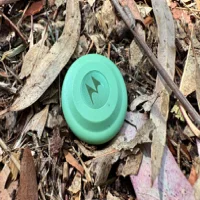 Top Pick

Bottom Line
For most Android users, the Moto Tag is the right call. It works across all Android phones, offers reliable UWB precision finding, and costs $29 for a single unit. Samsung Galaxy owners have a harder choice: the SmartTag 2’s longer battery life, denser network, and smart home triggers make it the stronger tracker on Samsung hardware specifically.
If you’re weighing either tracker against Apple’s ecosystem, our AirTag vs SmartTag comparison and Find Hub vs Find My breakdown cover those angles.
One note for anyone considering the Moto Tag: Motorola announced the Moto Tag 2 at CES 2026 with a built-in keyring hole and improved battery life. If timing is flexible, waiting for its release may be worth it.
FAQ
Does the Moto Tag work with Samsung phones?
Yes. The Moto Tag uses Google Find Hub, which supports all Android 9+ devices including Samsung Galaxy phones. Samsung owners can use either the Moto Tag or the SmartTag 2, though the SmartTag 2 benefits from Samsung's optimized UWB and denser SmartThings network on Galaxy hardware.
Can the Samsung SmartTag 2 work with non-Samsung Android phones?
No. The SmartTag 2 requires a Samsung Galaxy phone with the SmartThings app. Pixel, OnePlus, Xiaomi, and other Android phone owners can't set up or track a SmartTag 2. If you don't have a Samsung phone, the Moto Tag is the UWB tracker to consider.
Which has better battery life, the Moto Tag or SmartTag 2?
The SmartTag 2 wins on battery life. Samsung rates it at approximately 500 days in normal mode and up to 700 days in power saving mode. The Moto Tag is rated at around 365 days. Both use the same CR2032 coin cell battery, so the difference comes from Samsung's more efficient firmware and less aggressive network pinging.
Does the Moto Tag have UWB precision finding?
Yes. The Moto Tag includes an Ultra-Wideband chip that provides directional arrows on-screen when you are within Bluetooth range. It works with UWB-equipped Android phones like the Pixel 8 Pro and Pixel 9 Pro. The precision finding experience is responsive and accurate, pointing within about 15 degrees of the actual direction in our testing.
What is the range of the Moto Tag vs SmartTag 2?
Both trackers have a Bluetooth range of approximately 250-400 feet in open air, with walls and obstacles reducing that to 100-200 feet indoors. The practical range depends more on network density than Bluetooth signal. Our range comparison guide covers real-world testing across multiple trackers in detail.
Is the Moto Tag being discontinued now that Moto Tag 2 is announced?
No. Motorola has not announced plans to discontinue the original Moto Tag. The Moto Tag 2, revealed at CES 2026, is positioned as an upgrade with a built-in keyring hole. The original Moto Tag remains available at $29 and will continue receiving Google Find Hub network support.
Can the SmartTag 2 work without a Samsung account?
No. Setting up the SmartTag 2 requires both a Samsung account and the SmartThings app on a Samsung Galaxy phone. You can't bypass the Samsung account requirement. The tracker is tightly integrated into Samsung's ecosystem, which enables its smart home features but limits its usability to Samsung device owners.