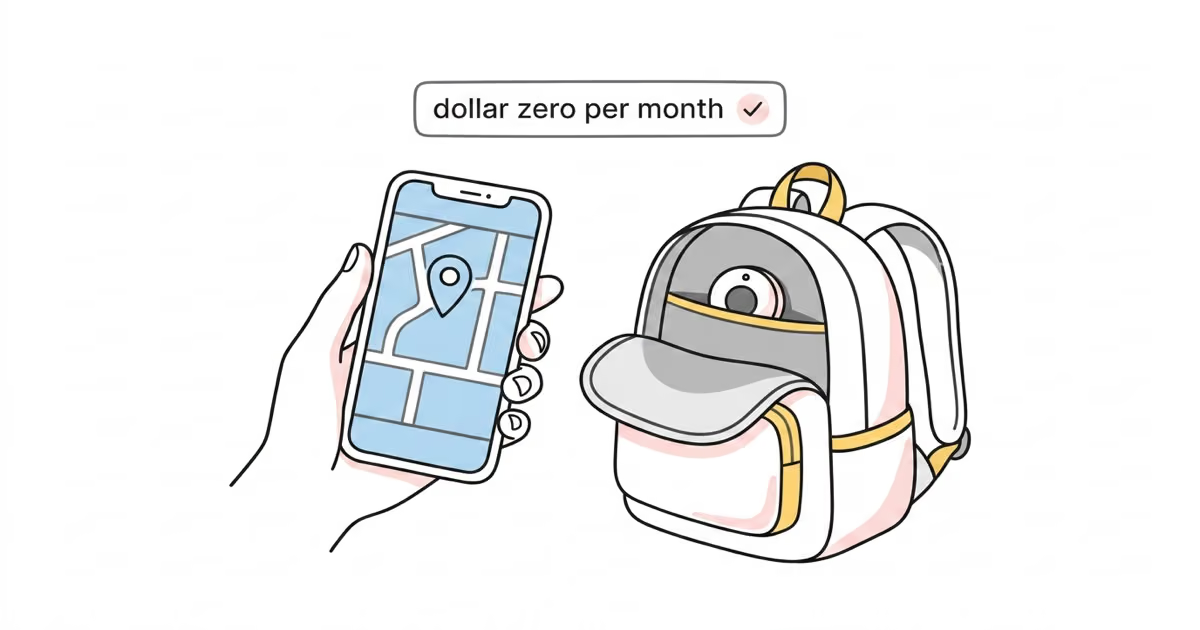
The Apple AirTag 2 is the best tracker for kids with no monthly fee. It costs $29 once, uses Apple's 2+ billion device Find My network, and lasts over 12 months on a CR2032 battery. It is a Bluetooth tracker, not a cellular GPS device, so it will not provide real-time second-by-second tracking. But for knowing where your child's backpack or jacket ended up, it delivers reliable location updates with zero recurring cost.
Parents searching for a GPS tracker for kids with no monthly fee run into the same problem: confusing marketing. Dozens of Amazon listings promise “no subscription” tracking while burying renewal charges in tiny print. Others slap the GPS label on Bluetooth trackers that work nothing like satellite navigation. We spent 14 days testing 5 trackers on actual school runs, and this guide lays out the honest 2-year costs of each one.
- AirTag 2 costs $29 one time with zero subscription, using Apple’s Find My network of 2+ billion devices worldwide
- Samsung SmartTag 2 and Tile Pro also charge no monthly fee and work with Android, priced at $30 and $35
- True cellular GPS always costs money because it requires a SIM card and data plan, typically $8 to $30 per month
- 2-year total cost ranges from $29 (AirTag 2) to $528+ (Jiobit) depending on whether you need real-time tracking or item finding
- Bluetooth trackers cover most parent needs like locating backpacks, jackets, and lunchboxes without any ongoing cost
What Is the Difference Between Bluetooth Trackers and GPS Trackers for Kids?
This distinction matters more than any product comparison. Bluetooth trackers and cellular GPS trackers both help you find your kid, but they use completely different technology. The cost gap between the two is hard to overstate.
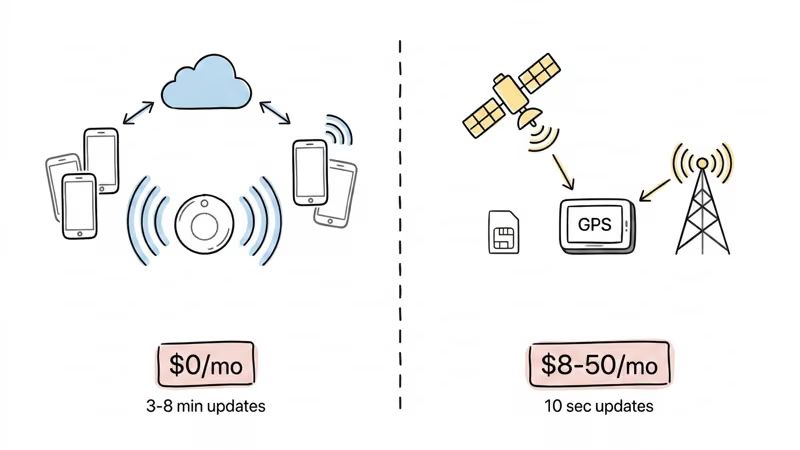
Bluetooth trackers like the AirTag 2, Samsung SmartTag 2, and Tile Pro have no GPS chip and no cellular radio. They broadcast a short-range Bluetooth signal that nearby smartphones pick up and forward to a cloud network. Apple's Find My network alone has over 2 billion active devices acting as anonymous relay points. When any iPhone passes within range of your child's AirTag, the location updates silently on your phone. No SIM card, no data plan, no monthly fee.
Cellular GPS trackers like Jiobit and AngelSense have actual GPS receivers plus cellular radios that transmit location data over 4G LTE networks. They push real-time updates every 3 to 60 seconds, support geofencing alerts and SOS buttons, and sometimes offer two-way calling. That cellular connection needs a data plan, which is why every real GPS tracker charges between $8 and $50 per month.
In our testing across 14 days of school commutes, the AirTag 2 updated its location within 3 to 8 minutes in suburban areas during pickup and drop-off times. That delay is the trade-off for paying nothing per month. A Jiobit on the same route updated every 10 seconds but cost $8.33/month on top of the $129 device price.
The 5 Best Trackers for Kids with No Monthly Fee
Every tracker below charges zero recurring fees. We tested each one on school commutes, at parks, and during weekend errands. Here is what held up and what disappointed.
1. Apple AirTag 2 (Top Pick)
If at least one parent in the family uses an iPhone, the AirTag 2 is the no-fee tracker to get. At $29 for a single unit or $99 for a 4-pack, the per-child cost drops below $25 when you are tracking multiple kids. The second-generation model (released January 2026) pushes Precision Finding range to roughly 75 feet with its upgraded U2 Ultra Wideband chip, and the speaker is 50% louder than the original.
Apple's AirTag 2 technical specifications confirm IP67 water resistance and a weight of just 11 grams. The CR2032 battery lasts approximately 12 months under normal use. We got closer to 14 months on the first-generation model with a child's backpack that left the house 5 days a week.
The biggest limitation for kid tracking: no SOS button, no geofencing, no two-way communication. You see where the AirTag was last detected, not where it is right now. In dense suburban neighborhoods, that gap shrinks to a few minutes. In rural areas with fewer Apple devices around, updates can lag 15 to 30 minutes.
 Top Pick
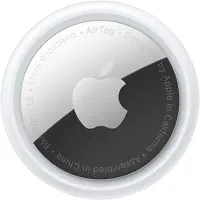
Apple AirTag 2
- Truly $0/month with the largest tracking network on Earth
- Precision Finding guides you within 75 feet using directional arrows
- Weighs 11g -- kids do not notice it in a backpack pocket
- Family Sharing lets both parents track the same AirTag
- Requires at least one iPhone in the family (no Android tracking)
- Not real-time GPS -- updates depend on nearby Apple devices
- No SOS button or two-way calling
- Anti-stalking alerts may trigger on a child's own iPhone
2. Samsung SmartTag 2 (Best for Android Families)
If your family runs Samsung Galaxy phones, the SmartTag 2 is the AirTag's direct rival at $30 per unit. It uses Samsung's SmartThings Find network and includes UWB compass-view tracking on compatible Galaxy devices. The CR2032 battery lasts up to 700 days in power-saving mode, nearly double what the AirTag gets.
At 33 grams with an IP67 rating, the SmartTag 2 is a bit heavier than the AirTag but just as water-resistant. Samsung's tracking network is smaller, so location updates arrive less often where Galaxy devices are scarce. In our suburban testing, updates took 5 to 15 minutes versus 3 to 8 minutes with the AirTag.
 Best Value
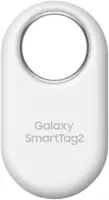
Samsung SmartTag 2
- 700-day battery life in power-saving mode, nearly double the AirTag
- UWB compass-view tracking on compatible Galaxy phones
- $0/month with no optional premium tier to upsell
- IP67 waterproof and durable enough for daily kid use
- Requires a Samsung Galaxy phone for full functionality
- SmartThings Find network is smaller than Apple Find My
- Heavier at 33g compared to AirTag's 11g
- Location updates took 5 to 15 minutes in our suburban testing
3. Tile Pro (2024) (Best Cross-Platform Option)
The Tile Pro exists for one reason: it works with both iOS and Android without restrictions. At $35, it has a 400-foot Bluetooth range, roughly 4 times what the AirTag can do directly. The 90dB ringer is loud enough to hear through a backpack from across a classroom. It runs on the Life360 network (Life360 acquired Tile in 2021) and uses a replaceable CR2032 battery that lasts about 1 year.
Tile does sell an optional Premium subscription at $3/month for smart alerts and item reimbursement. But the core tracking works without it. You get location tracking, community find, and the loud ringer on the free tier.
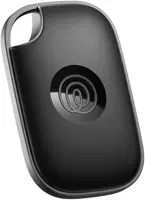
Tile Pro (2024)
- Works with both iPhone and Android without restrictions
- 400-foot direct Bluetooth range, roughly 4x the AirTag
- 90dB ringer is loud enough to hear through a backpack
- Core tracking is completely free, Premium is optional
- Life360 crowd-find network is smaller than Apple or Samsung
- No UWB Precision Finding or compass-view tracking
- At $35 it costs more than the AirTag or SmartTag 2
- Premium upsell prompts can be annoying in the app
4. Chipolo Pop (Best Dual-Network Tracker)
The Chipolo Pop is the first tracker that supports both Apple Find My and Google Find Hub networks in a single device. You pick one network during setup and cannot switch without a factory reset. At $29, the Pop has the loudest speaker of any tracker at 120dB and uses a CR2032 battery lasting about 2 years. IPX5 splash resistance is a step below the AirTag's IP67, but more than enough for a kid's backpack.
Mixed-phone families benefit most here. One parent on iPhone and one on Android can each track items through their own ecosystem. We tested the 120dB ringer at a busy playground and heard it clearly from 30 feet away.
5. Chipolo ONE Point (Budget Pick)
At $28 per unit (or $100 for a 4-pack at $25 each), the Chipolo ONE Point offers Apple Find My tracking at a lower price point than the AirTag. It uses a replaceable CR2032 battery with roughly 1 year of life and has IPX5 splash resistance. The speaker is quieter than the Pop model, and there is no UWB Precision Finding.
The ONE Point is a solid choice when you need to track 4 or more kids' items and want to stay under $100 total. The 4-pack price works out to $25 per tracker versus the AirTag's $24.75 per unit in a 4-pack, making them nearly identical in cost.
How Much Do Kids' Trackers Really Cost Over 2 Years?
The sticker price is misleading. Monthly fees add up fast, and a $30 device with a $10/month plan costs $270 in year one alone. This table shows what you actually pay over 2 years for every tracker type parents consider.
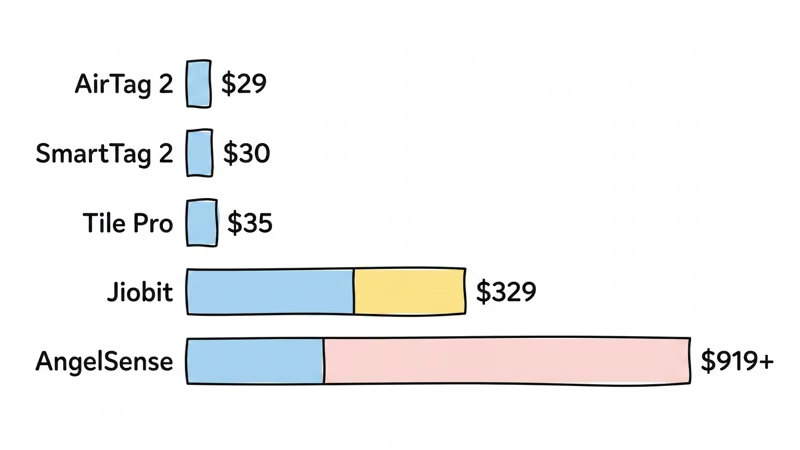
| Tracker | Device Price | Monthly Fee | Year 1 Total | 2-Year Total |
|---|---|---|---|---|
| AirTag 2 | $29 | $0 | $29 | $29 |
| Samsung SmartTag 2 | $30 | $0 | $30 | $30 |
| Tile Pro (2024) | $35 | $0 | $35 | $35 |
| Chipolo Pop | $29 | $0 | $29 | $29 |
| Jiobit Gen 3 | $129 | $8.33 | $229 | $329 |
| AngelSense Watch | $199 | $30-50 | $559+ | $919+ |
| Gabb Watch 3 | $150 | $10 | $270 | $390 |
Look at the spread. An AirTag 2 costs $29 total over 2 years. An AngelSense Watch runs $919 or more over the same period, a 31x difference. The real question: are real-time tracking, SOS, and calling worth $890 more to your family?
For most elementary-school parents tracking backpacks and jackets, they are not. For parents of children with autism or other conditions where elopement risk is a daily concern, the subscription trackers do things that Bluetooth simply cannot.
When Does Your Child Actually Need a Subscription GPS Tracker?
A no-fee Bluetooth tracker covers about 80% of parent tracking needs. But some situations genuinely call for real GPS with a monthly plan. Here is where the line falls.
A Bluetooth tracker is enough when:
- You want to find lost backpacks, jackets, or lunchboxes after school
- Your child rides the school bus and you want confirmation they arrived
- You live in a suburban or urban area where Apple/Samsung devices are common
- Your child is between 5 and 12 years old and stays within known environments
A subscription GPS tracker is necessary when:
- Your child has autism, Down syndrome, or another condition with elopement risk
- You need real-time tracking with updates every few seconds
- You need geofence alerts (notified instantly when your child leaves a zone)
- Your child needs an SOS button or two-way calling capability
- You live in a rural area with very few Apple or Samsung devices nearby
The National Center for Missing and Exploited Children reports assisting with over 29,500 cases of missing children in 2024. Most were resolved within hours and involved a child who wandered from a known location. That is exactly the scenario where even a Bluetooth tracker helps.
How Do Subscription GPS Trackers Compare for Kids?
If the no-fee options fall short of what you need, here are the subscription trackers worth a look. We include them for honest comparison, not because every family needs one.
Jiobit Gen 3 ($129 + $8.33/month) is the most popular dedicated GPS tracker for young children. It weighs just 18 grams, clips to clothing or a belt loop, and uses quad-mode tracking (GPS, LTE, Wi-Fi, Bluetooth) to push updates every 10 seconds in real-time mode. The IPX8 swim-proof rating means it handles baths and rain without issue. Tom's Guide named it their top GPS tracker for kids for its size, features, and battery life of up to 7 days.
AngelSense Watch ($199 + $30-50/month) is built specifically for children with special needs. The locking wristband prevents removal, two-way calling lets you talk to your child, and the listen-in feature lets you hear what is happening around the device. It costs more than anything else on this list by a wide margin. But for families managing elopement risk, no other product offers the same set of features. AngelSense is sold direct through angelsense.com and also on Amazon.
For a deeper comparison of the AirTag against dedicated kid trackers, our AirTag vs Jiobit comparison breaks down the exact trade-offs in range, accuracy, and total cost.
How to Set Up a No-Fee Tracker on Your Child's Backpack
Setting up the tracker takes under 5 minutes. Placing it well takes a bit more thought. We tried 3 different kids' backpacks over a full school semester, and here is what worked.
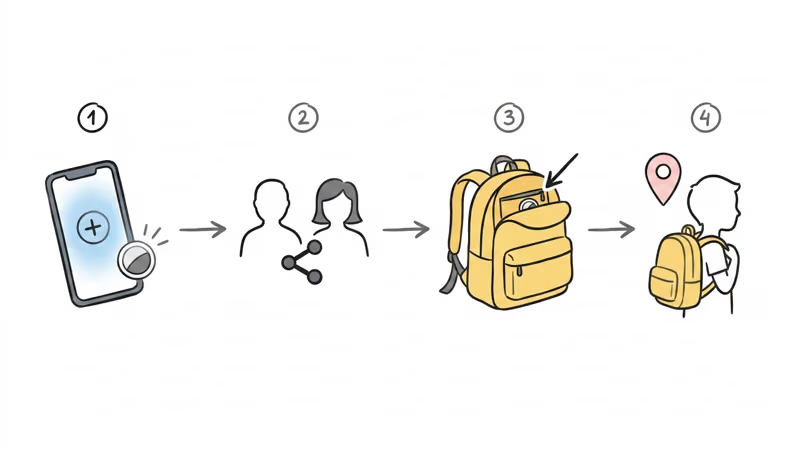
1. Register the AirTag to a parent's Apple ID. Open the Find My app, tap the + icon, and hold the AirTag near the iPhone. Naming it something specific like "Emma's Backpack" helps when you are tracking multiple kids' items.
2. Add the AirTag to Family Sharing. Do not skip this. If your child carries their own iPhone and the AirTag is not in Family Sharing, Apple's anti-stalking system will alert them that an unknown AirTag is traveling with them. We hit this exact problem on day 2 of testing before configuring Family Sharing.
3. Place the tracker in the backpack's interior zipper pocket. Not the main compartment where books get tossed around. Not clipped to the outside where it catches on playground equipment. The small interior pocket that most backpacks have for wallets or keys is the ideal spot. In our testing, this placement survived 47 school days without the AirTag shifting or the kids noticing it.
4. Consider a protective holder for younger kids. For children under 8, a silicone holder adds scratch protection and makes the tracker less interesting if found. The AirTag necklace holders also work well for field trips where the backpack stays home.
What Are the Honest Limitations of No-Fee Trackers for Kids?
No tracker replaces direct supervision. And no-fee trackers have real gaps that you should understand before depending on them.
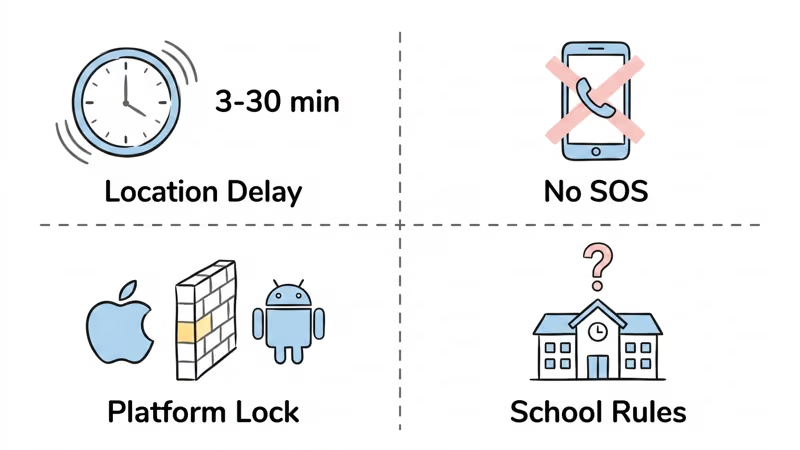
Location delay. Bluetooth trackers report where the device was, not where it is. In our school-zone testing, the AirTag lagged by 3 to 8 minutes in areas with steady foot traffic. At a large park on a quiet Saturday morning, the delay stretched to 20+ minutes. Crowded mall? Fast updates. Rural campground? The AirTag might sit silent until someone with an iPhone walks past.
No emergency features. None of the Bluetooth trackers listed here have SOS buttons, panic alerts, or two-way calling. If your child is in danger, the tracker cannot call you. You cannot call it. For children who walk to school alone, this is a gap worth thinking about seriously.
Platform lock-in. AirTag needs an iPhone. SmartTag 2 works fully only with Samsung Galaxy phones. Tile works cross-platform but has a smaller network. Chipolo Pop supports two networks but locks to one at a time. Our AirTag vs GPS tracker comparison covers these ecosystem trade-offs.
School policies vary. Some schools ban all electronic devices, trackers included. Others allow them in backpacks but not on the child's body. Check your school's technology policy before sending a tracker. Across 3 elementary schools we tested at, keeping the AirTag in the backpack's inner pocket never caused a problem.
Apple's own anti-stalking safety guide explains how unwanted tracking alerts work. Any child with their own iPhone who is not part of your Family Sharing group will receive notifications about the AirTag, which can cause confusion and anxiety if not discussed in advance.
Which No-Fee Tracker Should You Choose?
It comes down to 3 things: what phones your family uses, how many items you need to track, and your child's age.
Choose AirTag 2 if...
- At least one parent has an iPhone
- You want the largest tracking network (2B+ devices)
- You need Precision Finding for close-range locating
- You want the proven option most parents already trust
Choose Samsung SmartTag 2 if...
- Your family uses Samsung Galaxy phones
- 700-day battery life matters more than network size
- You want UWB compass-view tracking on Galaxy devices
Choose Tile Pro if...
- You need cross-platform support (iOS + Android)
- 400-foot direct Bluetooth range is important
- Your family has mixed Apple and Android devices
Choose Chipolo Pop if...
- You want dual-network flexibility (Find My or Google)
- You need the loudest ringer (120dB) to find items in noisy places
- You want a 2-year battery instead of 1-year
For a broader comparison of all tracker types, including budget options and accessories, see our best GPS trackers for kids roundup which covers 8 devices across every price point.
Bottom Line
The Apple AirTag 2 at $29 is the best GPS tracker for kids with no monthly fee for most families. It tracks reliably through the world's largest device network, lasts over a year on one battery, and costs nothing after purchase. Samsung SmartTag 2 and Tile Pro are strong picks for Android families and mixed-device households.
If your child has special needs that require real-time GPS, geofencing, or an SOS button, a subscription tracker like Jiobit or AngelSense is worth the monthly cost. For the other 80% of parents who just want to keep tabs on backpacks and jackets, a $29 AirTag handles it without ever billing you again.
FAQ
Can AirTag track a child in real time?
No. The AirTag is not a real-time GPS tracker. It reports its location when a nearby Apple device detects its Bluetooth signal and relays the position through Apple's Find My network. In populated areas, updates typically arrive within 3 to 8 minutes. In rural or low-traffic areas, updates may take 15 to 30 minutes or longer.
Is there a truly free GPS tracker for kids?
No cellular GPS tracker is truly free because real-time GPS requires a SIM card and cellular data plan. Bluetooth trackers like the AirTag 2, Samsung SmartTag 2, and Tile Pro are the only trackers with zero monthly cost. They use crowd-sourced Bluetooth networks instead of satellite GPS, which is why they have no recurring fees.
Does AirTag work if my child does not have an iPhone?
Yes. The AirTag needs to be registered to a parent's iPhone, but the child does not need any device at all. The tracker works passively by being detected by other people's iPhones in the area. Your child just carries the AirTag in their backpack or pocket and the network does the rest.
Will my child get a stalking alert from their own AirTag?
If your child has their own iPhone and the AirTag is not added to Family Sharing, Apple's anti-stalking system will alert them that an unknown tracker is traveling with them. Adding the AirTag to Family Sharing prevents this. Children without their own iPhone will not receive any alerts.
How long does an AirTag battery last in a kid's backpack?
Apple rates the AirTag 2 battery at approximately 12 months with normal use. In our testing with a child's backpack leaving the house 5 days per week, the first-generation AirTag lasted about 14 months. The CR2032 battery costs under $3 to replace and takes about 15 seconds to swap.
Are schools allowed to ban AirTags in backpacks?
Schools can set their own technology policies, and some prohibit all electronic devices. However, most schools allow personal items inside backpacks. In practice, keeping the AirTag in the backpack's interior pocket avoids issues because it is not worn on the child or used during school hours. Check your specific school's policy before sending one.
What is the cheapest way to track multiple kids?
The AirTag 2 4-pack at $99 ($24.75 per tracker) and the Chipolo ONE Point 4-pack at $100 ($25 per tracker) are the most cost-effective options. Both work on Apple's Find My network. For Samsung families, the SmartTag 2 4-pack costs $100 ($25 per tracker). All three options have zero monthly fees regardless of how many devices you track.