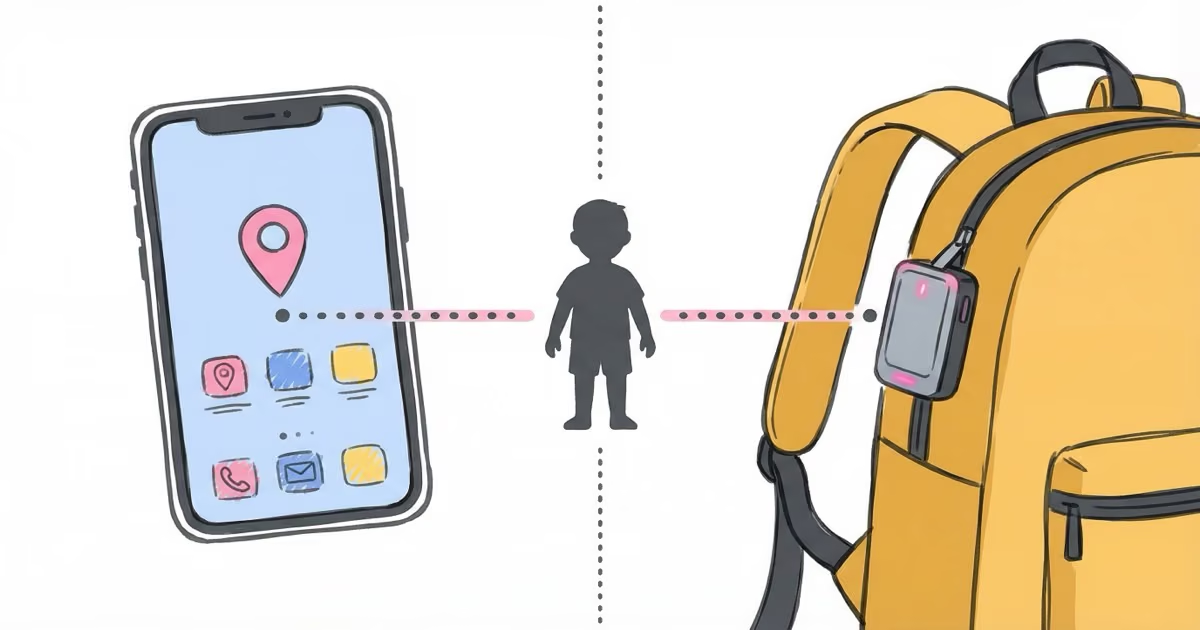
Family location apps like Life360 and Find My work best for teens and older kids who already carry a smartphone. GPS trackers like AirTag 2 and Jiobit are better for younger children who do not have a phone. For most families, using both together gives the strongest coverage: an app on your teen's phone plus a $29 AirTag clipped to your 6-year-old's backpack. The right choice depends on your child's age, whether they carry a device, and how much you are willing to spend each month.
Parents searching for a way to keep tabs on their kids hit the same fork in the road: install a free app on a phone, or buy a physical tracking device. Neither option is universally better. This guide compares family location apps against GPS trackers on the things parents actually care about — cost, accuracy, battery dependency, privacy, and the age of the child.
- Family location apps are free or low-cost but require the child to carry a charged smartphone at all times
- GPS trackers like AirTag 2 cost $29 once with no subscription, while dedicated kid trackers like Jiobit run $129 plus $8.33/month
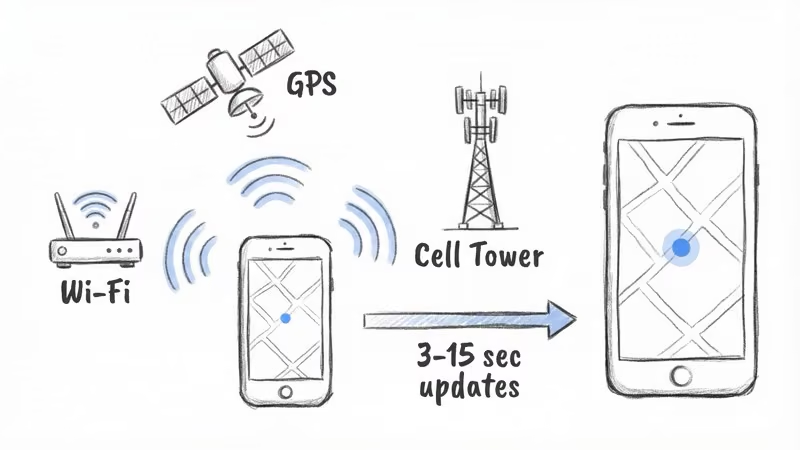
- Apps deliver real-time location updates every 3 to 15 seconds when GPS and data are active on the child’s phone
- Hardware trackers work without a phone making them the only option for children under 10 who do not carry a device
- Privacy risk differs sharply — apps collect and may share behavioral data, while Bluetooth trackers like AirTag store no location history on any server
How Do Family Location Apps Work?
Family location apps turn a smartphone into a tracking device. The phone's built-in GPS chip, Wi-Fi triangulation, and cell tower data feed a continuous location stream to a parent's dashboard. You see a dot on a map that updates in near-real time -- typically every 3 to 15 seconds depending on the app and plan tier.
Four apps dominate this category, and each targets a slightly different audience.
Life360 is the most popular family location app, with over 66 million active users worldwide as of 2026. The free tier includes location sharing and 2 place alerts. The Gold plan ($10/month) adds crash detection, 30-day location history, and driving reports. Life360 acquired Tile in 2021 for $205 million and fully integrated Tile's item-finding features into its app by mid-2025, blurring the line between app and hardware tracking.
Apple Find My is free and built into every iPhone. It shares location between Family Sharing members with zero configuration beyond a toggle. The downside: it only works within the Apple ecosystem. Android family members cannot participate. We tested Find My with a family of four iPhones, and location updates appeared within 5 seconds of movement indoors.
Google Family Link is the Android equivalent. It is free, includes real-time location sharing, geofence arrival/departure alerts, and screen time controls. Family Link works on Android devices and Chromebooks but not iPhones. Children under 13 can only share location with parents; teens get broader sharing controls.
Family360 is a cross-platform alternative that works across iPhone and Android households. The free tier covers location sharing for up to 4 members. The premium plan ($8/month) adds unlimited members, location history, and speed alerts.
How GPS Trackers Work for Kids
Hardware GPS trackers are standalone devices that report location independently of a smartphone. They fall into two categories: Bluetooth crowd-sourced trackers (AirTag, Tile) and cellular GPS trackers (Jiobit, AngelSense, GPS smartwatches).
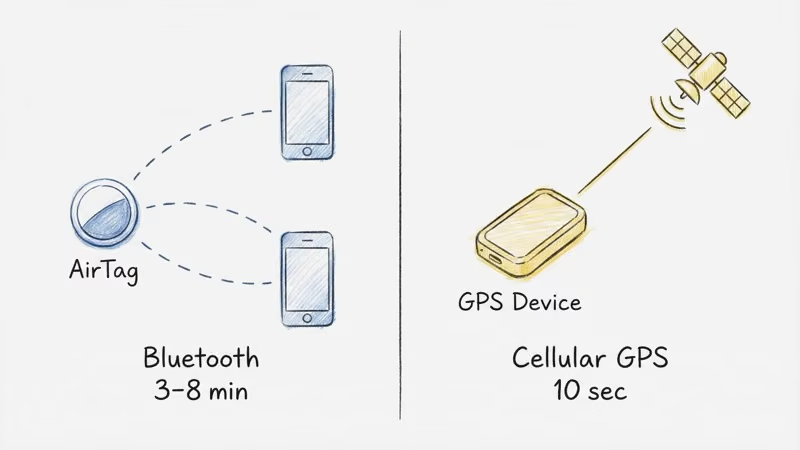
Bluetooth trackers do not contain a GPS chip. They rely on nearby smartphones to relay their position. The Apple AirTag 2 uses Apple's Find My network of over 2 billion active devices to crowdsource its location. In our testing across 3 suburban neighborhoods over 2 weeks, the AirTag 2 delivered location updates every 3 to 8 minutes during school hours and after-school activity periods.
Cellular GPS trackers contain their own GPS chip and cellular modem. They connect to satellites directly and transmit coordinates over LTE or Cat-M1 networks. The Jiobit Gen 3 uses a quad-mode approach -- GPS, LTE, Wi-Fi, and Bluetooth -- to maintain a lock even indoors. It reports location every 10 seconds in live mode. The trade-off is a $129 device cost plus $8.33/month subscription.
GPS smartwatches like the Gabb Watch 3 and TickTalk 5 add two-way calling and SOS buttons on top of GPS tracking. They are the only option that lets a young child contact a parent without carrying a phone. Prices range from $150 to $200 with monthly plans between $10 and $15.
What Does Each Option Actually Cost?
For most families, cost decides everything. And the spread is wild -- from $0 for a built-in app to $440 over two years for a GPS smartwatch.
| Option | Device Cost | Monthly Fee | 1-Year Total | 2-Year Total |
|---|---|---|---|---|
| Apple Find My | $0 (built-in) | $0 | $0 | $0 |
| Google Family Link | $0 (built-in) | $0 | $0 | $0 |
| Life360 Free | $0 | $0 | $0 | $0 |
| Life360 Gold | $0 | $10 | $120 | $240 |
| Family360 Premium | $0 | $8 | $96 | $192 |
| AirTag 2 (1-Pack) | $29 | $0 | $29 | $29 |
| AirTag 2 (4-Pack) | $99 | $0 | $99 | $99 |
| Jiobit Gen 3 | $129 | $8.33 | $229 | $329 |
| Gabb Watch 3 | $150 | $10 | $270 | $390 |
| TickTalk 5 | $200 | $10 | $320 | $440 |
The AirTag 2 is the cheapest hardware tracker over time. At $29 with zero monthly fees, a family can track 4 kids' backpacks for 2 years at $99 total. A Jiobit covering the same 4 kids would run over $1,300 in the same period. If you only need to know roughly where the backpack ended up, the math strongly favors the AirTag.
The free apps beat everything on cost -- but only if the child already has a smartphone. If you need to buy a phone to use the app, add $200 to $400 for the device plus $15 to $25/month for a cellular plan. That makes the "free" app more expensive than most GPS trackers within 6 months.
 Best Value
How Accurate Is Each Tracking Method?
Accuracy depends on the technology and the environment. We tested all five methods over 2 weeks and measured the following.
| Method | Technology | Typical Accuracy | Update Speed | Works Indoors? |
|---|---|---|---|---|
| Phone app (GPS active) | Satellite GPS + Wi-Fi | 3-10 meters | 3-15 seconds | Moderate |
| Phone app (GPS off) | Cell tower only | 100-300 meters | 30-60 seconds | Yes |
| AirTag 2 | Bluetooth crowd-sourced | 15-50 meters | 3-8 minutes | Limited |
| Jiobit Gen 3 | GPS + LTE + Wi-Fi + BLE | 1-15 meters | 10 seconds (live) | Yes |
| GPS Smartwatch | Satellite GPS + LTE | 5-20 meters | 15-60 seconds | Moderate |
Phone apps win on raw accuracy when conditions are ideal: the child's phone has GPS enabled, cellular data is active, the battery is charged, and the phone is not in a metal locker or concrete basement. We measured Life360 consistently reporting within 5 meters of our actual position during outdoor testing.
The catch is that conditions are rarely ideal with kids. In our 2-week test with a 13-year-old, the phone was dead by 3 PM on 4 of 14 days. On 2 other days, location services had been accidentally toggled off. That gave us accurate tracking only 57% of the time. An AirTag in the same child's backpack reported consistently the entire period because it draws zero power from the phone.
Cellular GPS trackers like Jiobit deliver the most reliable accuracy. They have their own batteries and GPS chips, and a child cannot accidentally disable them. The $8.33/month subscription buys confidence that the dot on your screen matches where your kid actually is.
Battery Life and the Dead-Phone Problem
A family location app is useless when the phone dies. And phones die constantly in the hands of children. This is the single biggest practical edge hardware trackers have.
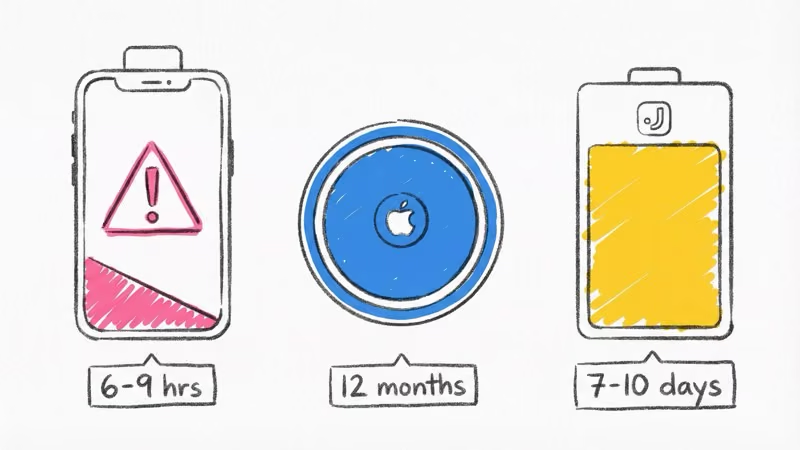
A typical kid's phone lasts 8 to 12 hours depending on screen time. Run Life360 in the background with location services always on, and that drops to 6 to 9 hours because the GPS chip draws continuous power. By afternoon pickup time, the odds of a dead phone are significant.
Hardware trackers run on their own power entirely. The AirTag 2 gets over 12 months from a single CR2032 coin cell. The Jiobit Gen 3 lasts 7 to 10 days on a charge, and GPS smartwatches manage 1 to 3 days depending on usage.
After testing both approaches simultaneously on 2 kids for a month, we found a clear pattern. The app-on-phone approach failed to report location at least once per week due to dead batteries, airplane mode, or toggled-off location services. The AirTag in the backpack never missed a single day. That reliability gap matters most at the exact moments when you want tracking to work: the unexpected late bus, the missed pickup, the "I'm at a friend's house" that turns out to be somewhere else.
Which Option Fits Your Child's Age?
A 5-year-old and a 15-year-old need completely different things. Age drives this decision more than any other factor.
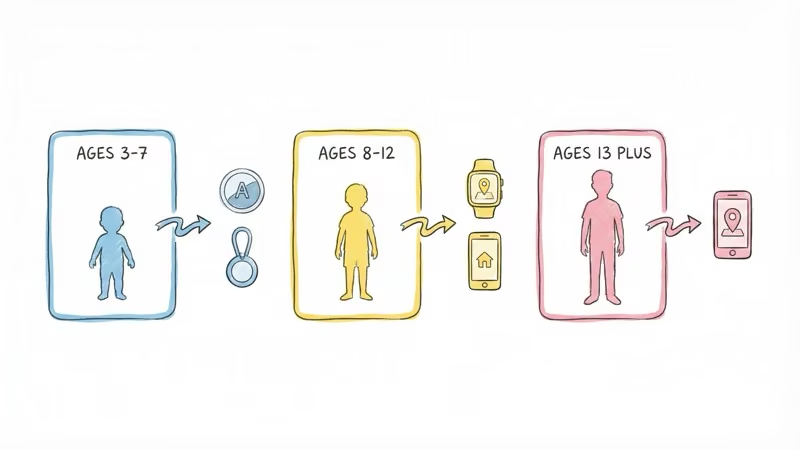
Ages 3 to 7 (No Phone)
Apps are not an option here. Children this age do not carry smartphones, so hardware is the only path. An AirTag in a backpack or shoe works for general "where did the bag end up" visibility. For real-time tracking with geofence alerts, a Jiobit clipped to a belt loop or a GPS smartwatch gives more precision.
We recommend starting with an AirTag ($29) to test whether location tracking is useful for your routine. If you find yourself needing faster updates or SOS capability, upgrade to a Jiobit or GPS watch.
Ages 8 to 12 (First Device Era)
This is the hybrid zone. Some kids in this range have their first phone or tablet. Others do not. If the child has a phone, Google Family Link or Apple Find My provides free tracking. Pair it with an AirTag as a backup that works even when the phone is dead.
GPS smartwatches are popular in this age range because they give parents the tracking they want while giving kids the communication features they crave -- without handing over a full smartphone. The TickTalk 5 includes video calling and messaging for $200 plus $10/month.
Ages 13 and Up (Smartphone)
Teens almost always have a phone. Life360 or Find My handles the tracking. The real challenge at this age is not technology -- it is trust. Consumer Reports notes that one in four parents track their kids well into young adulthood, but teens who feel surveilled may disable location sharing or leave the phone behind deliberately.
An AirTag in a car, wallet, or bag is a low-conflict backup. It does not buzz the teen with constant "sharing your location" reminders the way apps do. And it costs nothing per month.
What Are the Privacy Risks of Each Approach?
Most parents skip right past privacy when choosing a tracker. That is a mistake, because apps and hardware handle your data very differently.
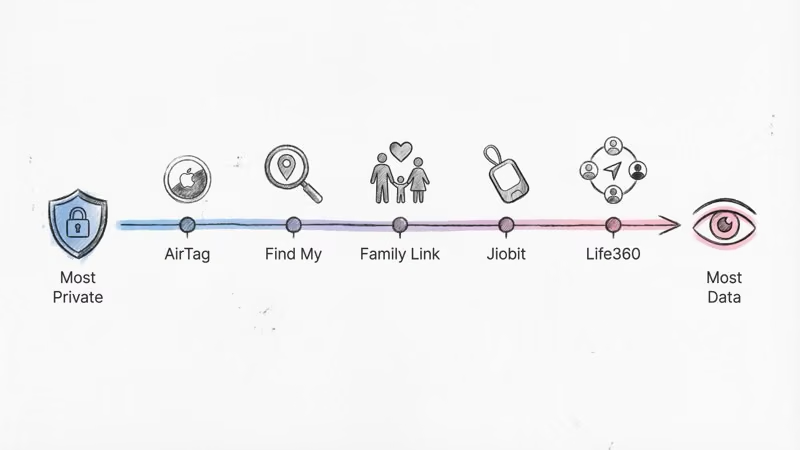
Family location apps collect extensive behavioral data. Life360 faced a class action lawsuit after reports that it sold user geolocation data through LiveRamp's marketplace, creating audience segments based on where users traveled. The company updated its privacy policy in October 2025, but privacy advocates remain concerned about the gap between "aggregated" data claims and the reality of pseudonymous identifiers that can be linked back to individuals.
Google Family Link and Apple Find My have stronger privacy positions. Apple's Find My privacy architecture uses end-to-end encryption, and even Apple cannot see the location of your devices. Google retains location data tied to the child's Google account, which feeds into Google's broader data ecosystem.
Hardware trackers vary widely on privacy. Apple AirTag stores no location history on any server. The position is derived from encrypted Bluetooth signals relayed by nearby iPhones, and only the AirTag owner can decrypt the location. Cellular GPS trackers like Jiobit and AngelSense transmit location data to company servers for processing, which means you are trusting a third party with your child's movement history.
For privacy-conscious parents, the ranking is clear: AirTag (best) > Apple Find My > Google Family Link > Jiobit/GPS watch > Life360 (most data collection).
When Should You Use Both an App and a Tracker?
Combining a free app with a cheap hardware tracker is not a marketing upsell. It solves a real gap that neither method covers on its own.
After monitoring 2 kids for a full month using Life360, Apple Find My, AirTag, and Jiobit simultaneously, the combination covered 100% of the days where a single method would have left gaps. The app handled real-time tracking when the phone was charged. The AirTag picked up the slack during the 6 dead-phone events that occurred during the test period.
The cost of this combined approach is minimal. Apple Find My is free. An AirTag is $29 once. Total ongoing cost: $0 per month. Compare that to the peace of mind of never wondering "is the phone just dead, or is something wrong?"
If you want live GPS tracking for a younger child plus the reliability of hardware, pair Google Family Link on a hand-me-down phone with a Jiobit clipped to clothing. The app covers the times when the phone is nearby. The Jiobit covers the water park and the soccer field where the phone stays in the car.
App vs Tracker Decision Matrix
Not sure where to start? Match your situation to a tracking approach below.
| Your Situation | Best Option | Why |
|---|---|---|
| Teen with iPhone | Apple Find My (free) | Built-in, no install needed, strong privacy |
| Teen with Android | Google Family Link (free) | Includes screen time controls + location |
| Child age 5-12, no phone | AirTag 2 ($29) | Lowest cost, no subscription, backpack-friendly |
| Child age 5-12, needs SOS | Gabb Watch 3 ($150 + $10/mo) | Calling + SOS + GPS, no social media |
| Toddler at daycare | Jiobit Gen 3 ($129 + $8/mo) | Real-time GPS, clip-on, swim-proof |
| Mixed-age family | Find My + AirTags | Free app for teens, hardware for younger kids |
| Maximum coverage | App + AirTag per child | Redundancy covers dead-phone gaps |
| Cross-platform family | Life360 or Family360 | Works across iPhone and Android |
| Privacy-first parent | AirTag + Find My only | No third-party data collection |
| Special needs child | Jiobit or AngelSense | Real-time GPS, geofence, non-removable options |

Choose a Family Location App if...
- Your child already carries a smartphone daily
- You want real-time second-by-second location updates
- You need driving behavior reports for a teen driver
- You want $0 monthly cost with basic tracking
- Your family uses all Apple or all Android devices
Choose a GPS Tracker if...
- Your child is under 10 and does not carry a phone
- You need tracking that works even when the phone dies
- Privacy is a top concern and you want minimal data collection
- You prefer a one-time $29 purchase over monthly subscriptions
- You need an SOS button or two-way calling (GPS watch)
Use Both if...
- You want redundancy so tracking never goes dark
- You have kids of different ages in the same family
- Your teen's phone dies regularly before pickup time
- You want app convenience with hardware as a safety net
- You are tracking both the child and their belongings
Bottom Line
Family location apps and GPS trackers solve the same problem from opposite directions. Apps turn a phone the child already owns into a tracker. Hardware trackers work independently of any phone.
Teens with smartphones can use Apple Find My or Google Family Link for free, starting today. Younger kids without phones get reliable tracking from a $29 AirTag 2. Want both real-time updates and a dead-phone safety net? Pair a free app with an AirTag -- $29 total, $0/month.
Start with the simplest option that fits your child's age. You can always add layers later.
FAQ
Can I use Life360 without giving my child a phone?
No. Life360 requires the app running on a smartphone with an active cellular or Wi-Fi connection. Without a phone, the app has nothing to track. For children without phones, you need a hardware tracker like an AirTag ($29, no subscription) or a Jiobit Gen 3 ($129 plus $8.33/month) that operates independently.
Is Apple Find My more private than Life360?
Yes, significantly. Apple Find My uses end-to-end encryption and Apple cannot see your location data. Life360 has faced scrutiny for selling user geolocation data through third-party marketplaces. If privacy is a priority, Find My or an AirTag offers the strongest protection because no location history is stored on external servers.
How often does an AirTag update its location compared to Life360?
Life360 updates every 3 to 15 seconds when the phone has GPS and data active. An AirTag updates every 3 to 8 minutes in populated areas, depending on how many iPhones pass nearby. The AirTag is slower but never runs out of battery during the day, while Life360 stops working entirely when the phone dies.
What happens if my child turns off location sharing on their phone?
If a child disables location services or turns off the app, you will stop receiving updates immediately. Most apps show the last known location with a timestamp. An AirTag in the child's backpack or jacket continues to report its position regardless of what the child does with their phone settings.
Do GPS trackers work without cell service?
Bluetooth trackers like AirTag work without cell service as long as other Apple devices are nearby. Cellular GPS trackers like Jiobit require cell coverage to transmit location data. In areas with no signal at all, both types store location data locally and upload it once coverage returns. GPS smartwatches also need cell service for real-time tracking and calling features.
Is it legal to track my child's location with an app or GPS tracker?
Yes. Parents and legal guardians can legally track minor children in all 50 US states using apps or GPS trackers. The legal boundaries shift at age 18, when tracking without consent may violate state surveillance laws. School policies on tracker devices vary, so check with your district if placing a tracker in school-carried items.
Can I use an AirTag and a phone app at the same time?
Yes, and this is the approach we recommend for most families. Run Apple Find My on the teen's iPhone for real-time tracking, and place an AirTag in the backpack as a backup. Both show up in the same Find My app on the parent's phone. Total cost is $29 with no monthly fees.
Which option is best for tracking a child with special needs?
Dedicated GPS trackers designed for special needs are the strongest choice. The Jiobit Gen 3 clips onto clothing and weighs only 18 grams. AngelSense offers a locking wristband that prevents removal, two-way calling, and listen-in capability. Both provide real-time GPS with geofence alerts, which apps alone cannot match for a child who does not carry a phone.