Quick Answer: No car GPS tracker is truly free forever — real-time GPS requires a cellular data connection, which has ongoing costs. What most “no monthly fee” trackers actually offer is 1 year of data included in the purchase price, followed by an annual renewal fee. The closest thing to a free option for car tracking is an AirTag 2 ($29, no subscription) — but it’s Bluetooth crowd-sourced, not real-time GPS.
The “no monthly fee” label gets applied loosely in this market. Some trackers cost nothing after purchase; others include a year of service in the sticker price and charge you annually after that. This article breaks down exactly what each type offers and what you’ll actually pay over two years.
What “Car GPS Tracker No Monthly Fee” Actually Means
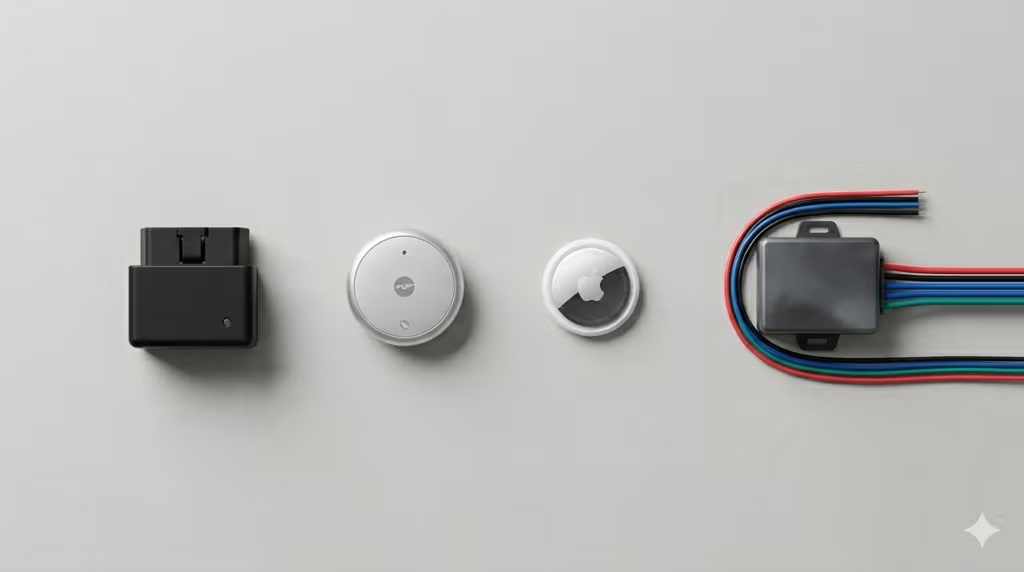
There are three categories, and the marketing rarely makes the distinction clear:
| Category | What You Pay After Year 1 | Real-Time GPS? | Examples |
|---|---|---|---|
| 1-year included | Annual renewal (~$25–50/yr) | ✅ Yes | LandAirSea 54, Optimus 2.0 |
| Annual upfront | ~$40/yr (no monthly billing) | ✅ Yes | Vyncs Pro 4G |
| Monthly subscription | $8–10/month | ✅ Yes | Bouncie, Tracki |
| Truly free (Bluetooth) | $0 after purchase | ❌ Not real-time GPS | AirTag 2 |
The bottom line: if you need a tracker that reports your car’s location in real time — useful for theft recovery, teen driver monitoring, or fleet management — there is no way around a data cost. The question is how it’s structured, not whether it exists.
The 4 Best Options, Ranked by 2-Year Total Cost
Here is what two years of car tracking actually costs across the most popular options. Device prices are approximate as of early 2026.
| Tracker | Device Cost | Yr 1 Extra | Yr 2 Cost | 2-Year Total |
|---|---|---|---|---|
| AirTag 2 | $29 | $0 | $0 | $29 |
| Vyncs Pro 4G | ~$30 | $40 (yr 1 plan) | $40 | ~$110 |
| LandAirSea 54 | ~$36 | Yr 1 included | ~$25–36 | ~$61–72 |
| Bouncie | ~$79 | $96 ($8/mo) | $96 | ~$271 |
LandAirSea 54: Best “No Monthly Fee” GPS for Most Cars
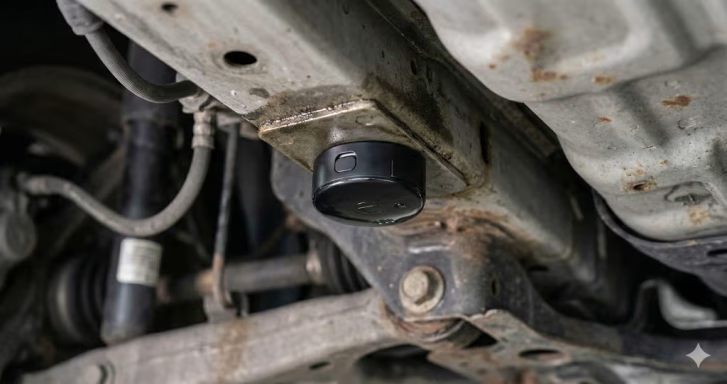
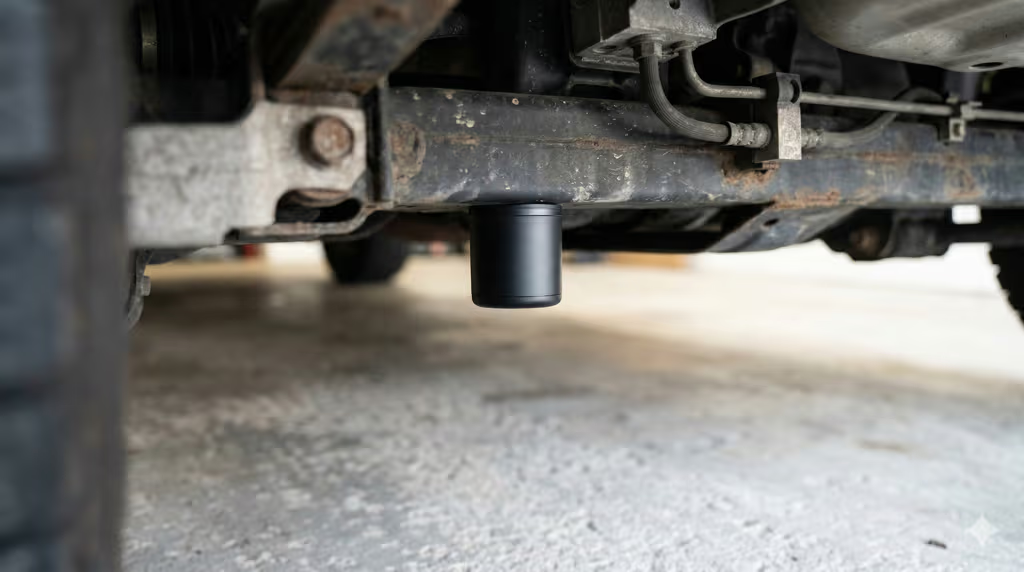
LandAirSea 54 is the most recommended magnetic GPS tracker in this category. The device costs around $36 and comes with one full year of unlimited real-time tracking included — no activation fee, no extra step. After that first year, renewal runs $25–36 annually depending on the plan you choose. There’s no monthly billing; you pay once a year.
Key specs: 4G LTE, real-time updates every 3 seconds, IP67 waterproof, strong internal magnet (no mount needed). Battery lasts 2–4 weeks on a charge, or you can wire it to the car’s 12V power for continuous operation. Size is about the width of a deck of cards.
The tracker is not OBD-II — it doesn’t plug into your car’s diagnostic port, which means it doesn’t read speed, engine codes, or fuel data. It’s purely a location tracker. If you need driver behavior data or vehicle diagnostics, that’s Vyncs’ territory.
LandAirSea 54 GPS Tracker
Best for: Theft recovery, asset tracking, keeping tabs on a second vehicle — anywhere you need real GPS without monthly billing
- 1 year of service included — no activation fee
- 4G LTE real-time updates, IP67 waterproof
- Strong internal magnet — hides under car with no mount
- ~$25–36/yr renewal after year 1
- No OBD required — works with any vehicle, including motorcycles and trailers
Vyncs Pro 4G: Best OBD Option With No Monthly Billing
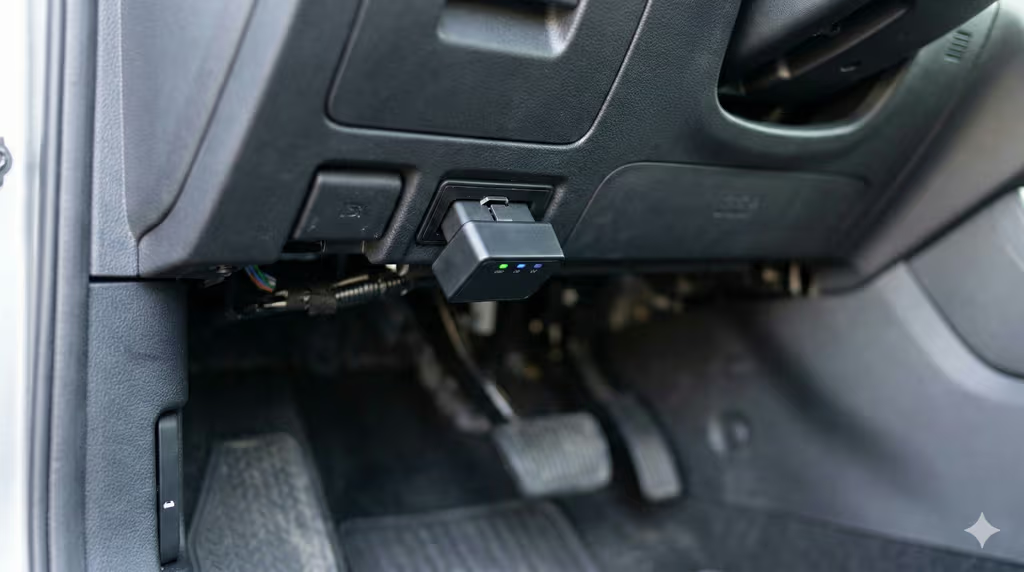
Vyncs plugs into your car’s OBD-II port (under the dashboard, standard in all cars made after 1996) and reads engine data in addition to location. The annual plan costs around $40 per year — billed once annually, no monthly fees. The first year of service is included in the activation fee.
Because it draws power from the OBD port, there’s no battery to charge. It reports location every 15 seconds, tracks speed and trip history, sends geofencing alerts, and reads diagnostic fault codes. For parents monitoring teenage drivers or anyone who wants driver behavior data alongside location, Vyncs offers more than a pure GPS tracker does.
The downside: it has to stay in the OBD port to work, so it’s visible to anyone who looks under the dashboard. You can’t hide it the way you can a magnetic tracker under the chassis. For a vehicle you own and monitor, that’s fine. For covert recovery tracking on a shared or high-theft-risk vehicle, a magnetic tracker under the car is harder to find.
AirTag 2: The Only Truly Free Option (With Limitations)
AirTag 2 costs $29 with no subscription, ever. For iPhone users who primarily want theft recovery in a populated area, it covers the basic use case: if someone steals your car, it relays its location anonymously through nearby iPhones on the Find My network.
What it can’t do: AirTag doesn’t report continuously. It doesn’t update in real time. There’s no geofencing, no speed alerts, no trip history, no diagnostic data. If your car is in a rural area with few iPhones nearby, location updates may be infrequent or nonexistent. It’s not a replacement for a real GPS tracker — it’s a supplemental layer for iPhone users who want something cheap and passive. For the full comparison, see AirTag vs GPS tracker.
For placement tips, the best places to hide AirTag in a car guide covers this in detail — some spots give better signal coverage than others. And for a dedicated AirTag car tracking setup, using AirTag for car tracking has the complete setup.
Bouncie: Best Monthly Option If You Need Driver Data
Bouncie doesn’t pretend to be free — it charges $8 per month ($96/yr) on top of a ~$79 device cost. Over two years that comes to around $271, which is the most expensive option in this list. But it’s also the most informative: real-time location every 15 seconds, full trip history, speed alerts, geofencing, and engine diagnostics. If you’re monitoring a teenager or managing a small fleet, the data density makes it competitive despite the cost.
For a full breakdown, our Bouncie GPS tracker review covers accuracy, app experience, and who it’s best for.
Which Should You Get?
The right choice depends almost entirely on what you need to do with the data.
- Theft recovery only, iPhone user, urban area: AirTag 2 ($29, no ongoing cost). It won’t win a comparison with real GPS but there’s nothing cheaper.
- Real GPS, lowest annual cost, any vehicle: LandAirSea 54 (~$61–72 over 2 years). Magnetic, flexible placement, no OBD required.
- Real GPS + driver behavior data, no monthly billing: Vyncs Pro 4G (~$110 over 2 years). OBD-II, must stay plugged in, works with car diagnostics.
- Most complete data, willing to pay monthly: Bouncie (~$271 over 2 years). Best app, most granular trip data.
For a broader comparison that includes non-car GPS trackers, the GPS tracker no monthly fee guide covers the full landscape including asset trackers and pet trackers.
FAQ: Car GPS Tracker No Monthly Fee
Is there a car GPS tracker that is truly free with no fees ever?
Not if you need real-time GPS. Real-time GPS tracking requires a cellular data connection, which has an ongoing cost. The only no-fee option is AirTag 2 ($29), which uses Bluetooth crowd-sourcing through Apple’s Find My network — not real-time cellular GPS. It provides last-known location when another iPhone passes nearby, which is useful for theft recovery in urban areas but not for continuous tracking.
What does “no monthly fee” actually mean for GPS trackers?
Usually it means the first year of cellular data service is included in the device purchase price. After year 1, you pay an annual renewal fee — typically $25–50 per year. Some trackers (like Vyncs) charge the annual fee upfront from the start with no monthly billing cycle. Neither structure has a true monthly fee, but both have ongoing annual costs.
How long does LandAirSea 54 battery last?
LandAirSea 54 battery lasts roughly 2–4 weeks depending on how frequently it reports. If you set it to update every 3 seconds continuously, battery drains faster than if you set longer intervals. You can also hardwire it to the vehicle’s 12V system for unlimited operation without recharging.
Can I use an AirTag to track my car?
Yes, and many people do. AirTag works by anonymously relaying its location through any nearby iPhone running Find My. In cities where iPhones are common, you can get frequent location updates at no ongoing cost. The main limitation: AirTag doesn’t update in real time, has no geofencing, and relies on other iPhones being nearby — unreliable in rural or low-iPhone-density areas. See our full guide on using AirTag for car tracking for placement tips.
Is Vyncs truly no monthly fee?
Yes, but it requires an annual payment — not monthly. The base plan runs around $40 per year. There are no month-to-month billing cycles; you pay once annually. The first year’s service is included in the upfront activation fee. After year 1, you renew annually.
What’s the difference between an OBD GPS tracker and a magnetic one?
An OBD tracker (Vyncs, Bouncie) plugs into the diagnostic port under the dashboard. It draws power from the car so battery life is unlimited, and it can read vehicle data like speed and engine codes. A magnetic tracker (LandAirSea 54) hides anywhere on the vehicle’s metal body, runs on an internal battery, and tracks location only — no vehicle diagnostics. OBD trackers are visible; magnetic trackers can be hidden under the car.
Do car GPS trackers work if the car is in a parking garage?
GPS signal is weak or absent underground and in enclosed concrete structures. Most modern 4G LTE GPS trackers use assisted GPS and Wi-Fi positioning to maintain approximate location even without a direct satellite signal, but accuracy degrades significantly in deep parking structures. LandAirSea 54 and Vyncs both use assisted positioning, though updates may lag or show the garage entrance rather than the exact parking spot.
Is it legal to put a GPS tracker in a car?
In your own vehicle: yes, in all 50 US states. Tracking someone else’s vehicle without their consent is illegal in most states and has been further restricted by new legislation in Texas, Florida, and Pennsylvania (2025). Always verify local laws if you’re tracking a vehicle you don’t own or before placing a tracker in a shared vehicle without the other person’s knowledge.
Which is better for car theft recovery: AirTag or a GPS tracker?
A GPS tracker is more reliable for theft recovery because it reports continuously with cellular data, independent of whether iPhones are nearby. AirTag depends on the Find My crowd network — if the stolen car ends up in a warehouse or rural area with few iPhones, updates may stop entirely. For serious theft recovery, a cellular GPS tracker (LandAirSea 54 or Vyncs) provides more consistent reporting, even in low-traffic areas.