The best wallet tracker for travel is the one that still works when you are 5,000 miles from home, surrounded by strangers carrying unfamiliar phones. A wallet card tracker on a trip lives or dies by network density: the more devices that can silently relay its location, the faster you find a wallet left in a taxi or a hotel lobby.
Use a tracker only in a wallet or item you own or manage, or when everyone involved has given informed consent. Never place one in another person’s belongings without their knowledge.
This guide ranks four wallet trackers on what actually matters when you are far from home: the network each one reaches, how thin it sits in a bifold, and how long it runs between charges. Three are credit-card cards; the fourth is a disc that needs a wallet holder.
- Rolling Square AirCard Pro Dual is the most travel-proof pick — one 2.2mm card works on both Apple Find My and Google Find Hub, so you set it to whichever network dominates the region
- Apple AirTag 2 finds the wallet fastest at close range — UWB Precision Finding gives a directional arrow for the final few feet of the search
- UGREEN FineTrack is the budget travel pick at $20 — a 2-year CR2032 battery means no charger to pack
- Chipolo CARD Spot is the set-and-forget pick — a sealed 2-year battery means nothing to recharge, and its 2.4mm card adds no bulge
- All four trackers are carry-on legal — their coin and rechargeable cells sit far under the 100 watt-hour airline limit
Which Wallet Tracker Is Best for Travel?
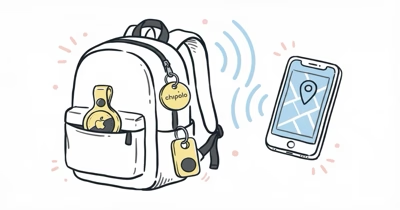
For travel, network reach beats every other spec. A wallet tracker has no GPS of its own; it borrows location from nearby phones running a compatible tracking app. The FAA’s lithium battery guidance states that “spare (uninstalled) lithium ion and lithium metal batteries…must be carried in carry-on baggage only.” A wallet tracker dodges that rule entirely because its cell is installed inside the card, so it can ride in checked or carry-on bags without a second thought.
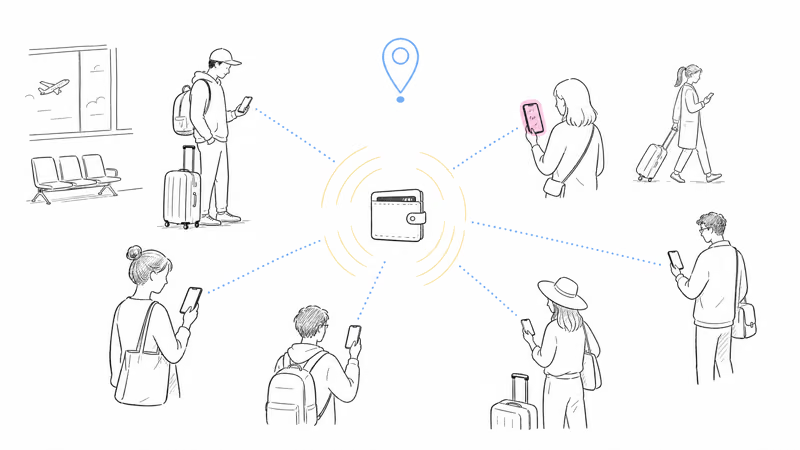
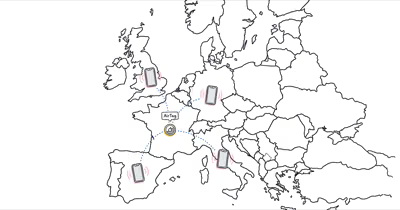
Apple confirms in its Find My network documentation that location relays travel through “end-to-end encrypted” pings, so a hotel guest who walks past your lost wallet never sees its location. That privacy model is what makes crowdsourced finding usable abroad. Tom’s Guide’s key finder testing found that cross-platform trackers reach a wider pool of relay phones, which matters most in airports where iPhone and Android users mix evenly.
Here is how the four picks split by traveler type. Choose a dual-network card if your trips cross regions where Android dominates, like much of Asia and Eastern Europe. Choose AirTag 2 if you travel inside heavily iPhone-saturated areas and want the fastest close-range search. The table below ranks them on the specs that matter most for travel.
| Tracker | Network | Thickness | Battery | Best for |
|---|---|---|---|---|
| Rolling Square AirCard Pro Dual | Find My + Find Hub | 2.2mm | 12 mo, Qi rechargeable | Multi-region travel |
| Apple AirTag 2 | Find My | 8mm (disc) | ~12 mo, CR2032 | Close-range search |
| UGREEN FineTrack | Find My | Card, ~3mm | ~2 yr, CR2032 | Budget iPhone travelers |
| Chipolo CARD Spot | Find My | 2.4mm | 2 yr, sealed | Set-and-forget trips |
How Wallet Trackers Perform on the Road
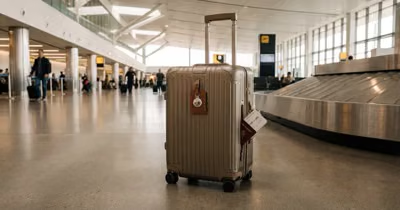
A wallet most often goes missing in four places on a trip: an airport gate, a rideshare back seat, a hotel room, and a train platform. How well a tracker handles each one comes down to a single factor — how many compatible phones happen to be passing by to relay its signal.
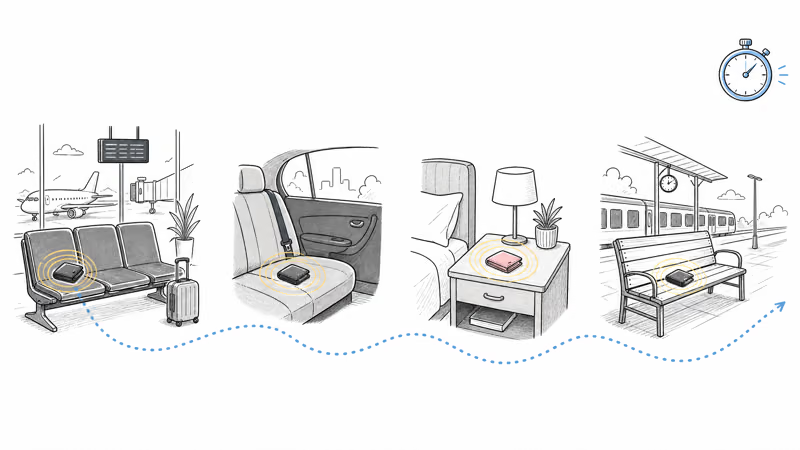
Relay speed is the spec that varies most between cards. A wallet marked as lost in a busy airport or train station tends to report quickly, because dozens of compatible phones pass within Bluetooth range every minute. The same card in a quiet rural area can stay dark far longer, since fewer phones come close enough to relay it.
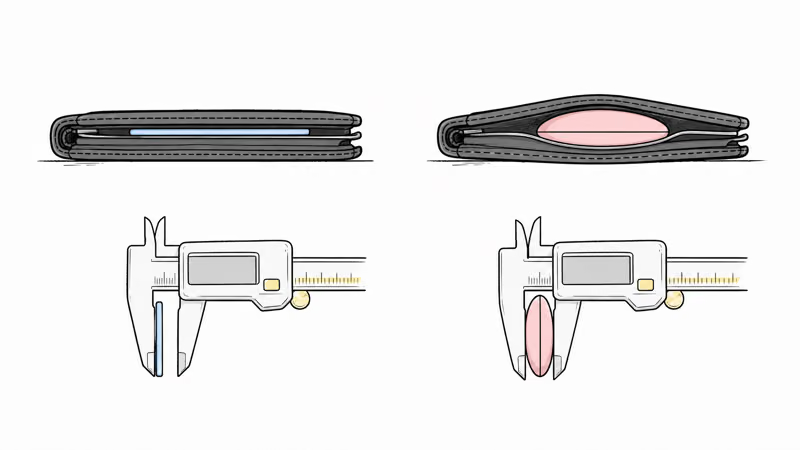
Thickness matters too. A sub-3mm card disappears into a slim cardholder, a leather bifold, or a passport organizer, while a thicker disc forces a visible bulge that a slim travel wallet can’t hide.
A dual-network card has the edge in mixed-phone crowds like an Asian train station, simply because both iPhone and Android phones can relay it, where a Find My-only card waits for a passing iPhone. PCMag’s Bluetooth tracker testing reported that effective range stretches to about 800 feet in crowded areas, far beyond the 200-foot direct Bluetooth limit.
Rolling Square AirCard Pro Dual: Best Overall for Travel
The AirCard Pro Dual is the only card here that works with both major networks from a single card. You set it to Apple Find My or Google Find Hub and can switch between them without swapping trackers, so you match it to whichever network is dense around you. On a trip that crosses from an iPhone-heavy US airport to an Android-heavy market in Southeast Asia, that adaptability is the whole game.
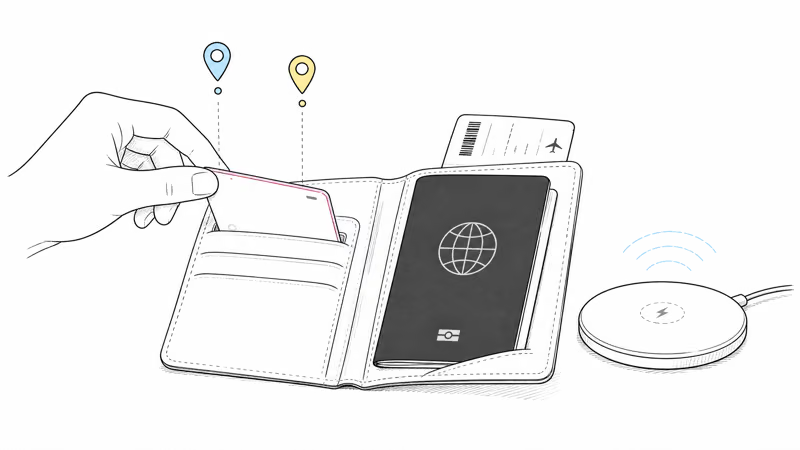
At 2.2mm it slips into a passport organizer without bowing the leather, and the CNC-anodized aluminum frame is built to take rough baggage handling. It charges on any Qi pad, so you never pack a proprietary cable. The 20mm speaker is built for room-level finding.
The honest tradeoff is price. At $45 it costs more than two AirTags, and you still have to charge it roughly once a year. But for a traveler whose trips really do cross platform borders, no other card matches its reach. Apple’s cross-platform tracker detection standard recommends that compliant trackers alert users on either platform to unwanted tracking, and Rolling Square confirms that the AirCard Pro Dual meets that standard on whichever network you activate.
§ Review summary
Rolling Square AirCard Pro Dual
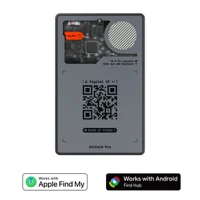
≡ Specs
- Network
- Apple Find My + Google Find Hub
- Thickness
- 2.2mm
- Battery
- 12 months, Qi wireless rechargeable
- Speaker
- 20mm, audible across a hotel room
- Frame
- Aluminum, IP-rated splash resistance
- Price
- $45 single / $80 two-pack
✓ Pros
- +Single card works on Apple Find My and Google Find Hub
- +2.2mm CNC-anodized aluminum frame built for rough handling
- +Qi wireless charging means no proprietary cable to pack
- +20mm speaker is audible across a hotel room
- +Carry-on legal with no spare-battery restrictions
✗ Cons
- −$45 costs more than two AirTags
- −Needs a wireless recharge roughly once a year
- −Runs one network at a time, so you switch it to match each region
§ Buy if
- ·Your trips cross between iPhone-heavy and Android-heavy regions
- ·You want one card to cover every airport crowd you walk through
- ·You can recharge it on a hotel Qi pad once a year
- ·You value an aluminum frame that survives rough baggage handling
Apple AirTag 2: Fastest Close-Range Search for iPhone Travelers
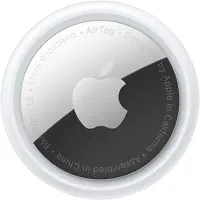
The AirTag 2 isn’t a card; it’s an 8mm disc you slip into a wallet sleeve or a card-slot holder. We include it because no card tracker matches its close-range search. Ultra Wideband Precision Finding turns your iPhone into a directional arrow, and that’s the difference between “the wallet is somewhere in this hotel room” and “the wallet is in that drawer.”
In a cluttered hotel room, Ultra Wideband Precision Finding points an iPhone straight at a hidden wallet, down to the drawer rather than just the room. The Find My network is the densest tracking network in the world, so in any US, European, or Japanese city the relay pings tend to arrive quickly. It draws on the more than a billion active Apple devices in circulation, which is why an AirTag rarely goes dark in a populated area.
Two travel caveats keep it out of the top spot. First, it’s iPhone-only for relay, so it loses reach in Android-dominant regions. Second, the disc shape adds a small bump to a slim wallet. Apple’s unwanted tracking guidance states that AirTag is “designed to discourage unwanted tracking,” and an unknown AirTag traveling with an Android user triggers a tracker alert on their phone, which is reassuring for shared-luggage trips.
§ Review summary
Apple AirTag 2
≡ Specs
- Network
- Apple Find My
- Form factor
- 8mm disc, needs wallet holder
- Battery
- CR2032 coin cell, ~12 months, replaceable
- Precision Finding
- Ultra Wideband, directional
- Water rating
- IP67 waterproof
- Price
- $29 single / $99 four-pack
✓ Pros
- +UWB Precision Finding gives a directional arrow at close range
- +Relays off the densest tracking network of any tracker
- +Replaceable CR2032 battery, swappable mid-trip with no tools
- +IP67 rating shrugs off rain on a train platform
- +Carry-on legal with the coin cell installed
✗ Cons
- −Disc shape adds a small bump to a slim wallet
- −iPhone-only relay loses reach in Android-heavy regions
- −Needs a card-slot holder to sit flat in a wallet
§ Buy if
- ·You travel mostly in iPhone-saturated cities
- ·You want the fastest possible last-100-feet search
- ·You already live inside the Apple Find My app
- ·You don't mind a holder to keep the disc flat
UGREEN FineTrack: Best Budget Wallet Tracker for Travel
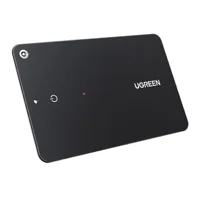
At $20 the UGREEN FineTrack is the cheapest credible Find My tracker for a traveler, and its biggest travel advantage is what it does not need: a charger. The CR2032 coin-cell design removes the charging routine from short trips, which is the point of choosing it over a rechargeable card.
UGREEN confirms the FineTrack is MFi-certified for Apple Find My, so it relays off the same Find My network as an AirTag. In a busy terminal, that shared network is its strongest use case, since a crowd of passing iPhones can report a wallet left at the gate. Its 80dB speaker is among the loudest of any Find My card, easily cutting through a noisy lobby.
The compromises are real and worth knowing before you buy. The FineTrack has no water resistance, so a rain-soaked jacket pocket is a genuine risk, and it has no UWB, so there is no directional arrow for the final search. It’s the right call for a budget-minded iPhone traveler who wants tracking insurance without a charging routine, not for someone who needs a weatherproof card.
§ Review summary
UGREEN FineTrack
≡ Specs
- Network
- Apple Find My, MFi certified
- Battery
- CR2032 coin cell, ~2 years
- Speaker
- 80dB rated speaker
- Water rating
- None, keep it dry
- Precision Finding
- No UWB
- Price
- $20 single / $35 four-pack
✓ Pros
- +$20 single, the cheapest credible Find My tracker for travel
- +2-year CR2032 battery, no charger to pack
- +MFi-certified for the full Apple Find My network
- +80dB speaker, among the loudest Find My cards
- +Relays off the same Find My network as an AirTag
✗ Cons
- −No water resistance, a rain-soaked pocket is a risk
- −No UWB, so no directional arrow for the final search
- −Apple Find My only, no Android relay coverage
§ Buy if
- ·You want tracking insurance for under $20
- ·You travel with an iPhone and short trips
- ·You'd rather never think about charging a tracker
- ·You can keep the card dry in a sheltered wallet slot
Chipolo CARD Spot: Best Set-and-Forget Card for Long Trips
Cross-shopping a Nomad? Our Nomad Tracking Card Pro vs Chipolo Card comparison weighs both.
The Chipolo CARD Spot is the card to bring on a long, multi-stop trip where charging logistics are a hassle — with one caveat: Chipolo has discontinued it in favor of the rechargeable Chipolo CARD, so this is a while-stock-lasts pick.
Its sealed battery is rated for two years with nothing to plug in, and at 2.4mm it sits flat in a standard card slot without a visible bulge. Over a long trip, a sealed design like this removes charger planning from the packing list.
Chipolo built the CARD Spot around Apple Find My, and the company recommends it specifically for wallets because the credit-card footprint sits flat where a disc tracker bumps. Its IPX5 splash rating handles rain but not submersion, so a rained-on jacket pocket is fine while a soaked bag is not. The speaker is quieter than the UGREEN FineTrack, but still loud enough to find across a room.
What you give up is repairability and Android reach. When the sealed battery dies in two years, the whole card is done; Chipolo runs a discounted renewal program, but you still replace the hardware. And like the other Find My cards, it goes quiet in regions where few iPhones pass by. For a traveler who wants a card that simply works for years with zero maintenance, that is a fair trade.
If stock has dried up, the rechargeable Chipolo CARD is the current-production fallback: Qi charging replaces the Spot’s sealed-battery replacement cycle.
§ Review summary
Chipolo CARD Spot
≡ Specs
- Network
- Apple Find My
- Thickness
- 2.4mm credit-card profile
- Battery
- Sealed, ~2 years, non-replaceable
- Water rating
- IPX5 splash resistant
- Renewal
- Discounted card replacement program
- Price
- $35
✓ Pros
- +Sealed 2-year battery, nothing to charge on a long trip
- +2.4mm card sits flat in a standard wallet slot
- +IPX5 splash rating handles rain but not submersion
- +Relays off the full Apple Find My network
- +Sealed coin cell holds a steady relay with no maintenance
✗ Cons
- −Sealed battery means the whole card is replaced in two years
- −Quieter speaker than the UGREEN FineTrack
- −Apple Find My only, no Android relay
§ Buy if
- ·You take long, multi-stop trips and hate charging gear
- ·You want a card that sits flat in a slim wallet
- ·You travel with an iPhone in iPhone-common regions
- ·You're fine replacing the card when the battery ends
What to Look for in a Travel Wallet Tracker
Three specs decide whether a wallet tracker earns its place in your luggage, and they’re not the ones marketing pages lead with.
Network reach comes first. A wallet tracker is only as good as the phones around it, and a Find My card thins out fast in Android-heavy markets while a dual-network tracker hedges that bet. If your itinerary crosses regions, pay the premium for dual coverage. For more on this tradeoff, see our guide to the best wallet tracker options across networks.
Battery strategy comes second. Sealed and coin-cell cards win for short trips because there is nothing to charge. Rechargeable cards win for travelers who take many trips a year, because a quick Qi top-up beats buying replacement hardware. Match the battery type to how often you travel, not to the spec sheet’s headline number.
Form factor comes third. A 2.2mm card disappears into a passport organizer, while an 8mm disc needs a holder. Every card in this guide fits a standard slot, but a disc tracker like the AirTag 2 only sits flat with a dedicated AirTag wallet holder.
For a deeper look at the sub-3mm card market, our wallet tracker card guide ranks seven options on thickness. If you also track a bag, pair the wallet card with one of the best luggage trackers so a single app shows both.
Wallet trackers are a recovery tool, not a theft deterrent. They show a wallet’s last location; they can’t stop a pickpocket. Treat the tracker as insurance and still keep your wallet in a front pocket or zipped bag in crowded transit hubs.
Are Wallet Trackers Allowed Through Airport Security?
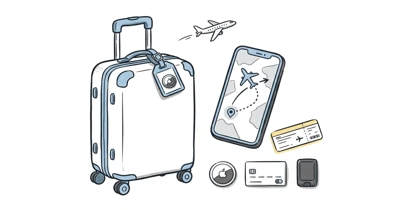
Yes. Every wallet tracker in this guide is legal in both carry-on and checked bags because the battery is installed inside the device. The TSA lithium battery rules place the strict carry-on-only requirement on spare, uninstalled batteries, not on batteries sealed into a working device.
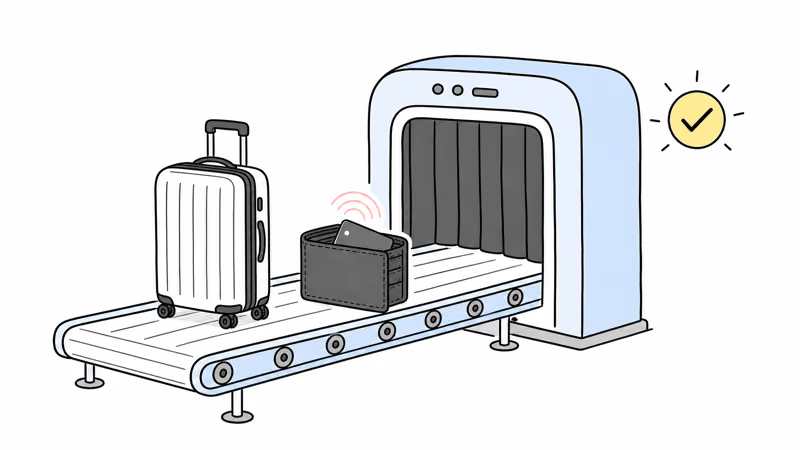
A CR2032 coin cell holds well under one watt-hour, and the rechargeable cell in the AirCard Pro Dual sits far beneath the 100 watt-hour airline cap. Because the battery is installed rather than loose, a tracker card travels under the same rules as a phone or a key fob, with no spare-battery restriction to flag.
The one habit worth keeping is leaving the tracker active rather than in a deep sleep mode. A live tracker keeps relaying through the airport, so if a wallet slips out at the gate you see it move while you can still act on it. For broader item-tracking strategy beyond wallets, our item tracker guide covers keys, bags, and electronics.
Bottom Line
For most travelers, the Rolling Square AirCard Pro Dual is the wallet tracker to pack. It’s the only card here that works with both Apple Find My and Google Find Hub, so you set it to whichever network is dense in the region you’re traveling through.
If your trips stay inside iPhone-dense cities and you want the quickest hotel-room search, the AirTag 2 with a wallet holder is the sharper tool. Budget iPhone travelers should grab the $20 UGREEN FineTrack for its two-year, no-charger battery. Anyone who hates packing cables on a long trip will be happy with the sealed Chipolo CARD Spot.
FAQ
What is the best wallet tracker for international travel?
The Rolling Square AirCard Pro Dual is the strongest pick for international travel because one card works with both Apple Find My and Google Find Hub, so you switch it to match the region you’re in. That adaptability matters where Android phones outnumber iPhones, since a Find My-only card depends entirely on passing iPhones to report a wallet’s location.
Do wallet trackers use GPS or Bluetooth?
Wallet trackers use Bluetooth, not GPS. They have no satellite receiver of their own. Instead, the card broadcasts a low-energy Bluetooth signal that nearby phones detect and relay to a tracking network. The location you see is borrowed from whatever phone last passed close to your wallet.
Can I bring a wallet tracker through airport security?
Yes. Wallet trackers are allowed in both carry-on and checked bags because their batteries are installed inside the device. The TSA’s strict carry-on-only rule applies to spare, uninstalled lithium batteries, not to a battery sealed inside a working tracker.
How long does a wallet tracker battery last on a trip?
It depends on the battery type. Coin-cell cards like the UGREEN FineTrack run about two years, and the sealed Chipolo CARD Spot also lasts roughly two years. Rechargeable cards like the AirCard Pro Dual last about a year per charge, so for long trips a coin cell or sealed battery removes the need to pack a charger.
Will a wallet tracker help if my wallet is stolen abroad?
A wallet tracker shows the wallet’s last reported location, which can help you recover a wallet left behind or dropped. It’s not a theft deterrent and can’t stop a pickpocket. If a thief discards the wallet, the tracker can lead you to it, but treat the device as a recovery aid and still guard your wallet in crowds.
Is a wallet tracker card better than an AirTag in my wallet?
For travel, a card and an AirTag solve different problems. A card sits flat in a slot and adds no bulge, which suits slim travel wallets. An AirTag 2 adds Ultra Wideband Precision Finding for a fast directional search at close range, but its disc shape needs a holder. Choose the card for comfort and the AirTag for the quickest final search.
Do wallet trackers work in hotels and airports with weak signal?
Wallet trackers don’t rely on cellular signal or Wi-Fi at all. They relay through the Bluetooth radios of nearby phones, so as long as people are walking past your wallet, it keeps reporting. Airports and hotels are dense with phones, which is exactly where these trackers work best.