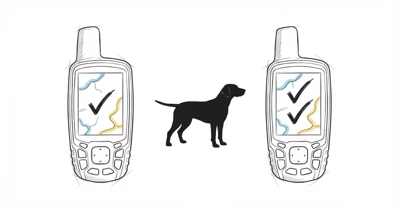
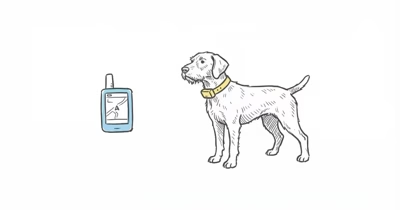
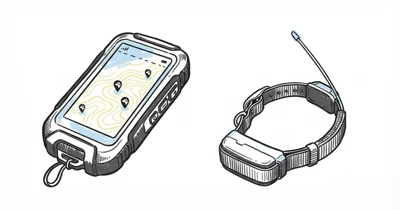
Garmin’s Astro and Alpha names describe two long-running approaches to satellite dog tracking: Astro for tracking and Alpha for tracking plus training. This article compares the older Astro 430 and Alpha 100 generations.
These archived specifications describe existing or used systems.
- Garmin’s Astro 430 launch material documented up to 20 dogs, up to 9 miles and updates as often as every 2.5 seconds.
- Historical collar battery specifications vary by the exact collar paired with each handheld.
- The Alpha 100 generation added integrated e-collar controls; Astro 430 remained tracking-only.
- The core handheld-to-collar tracking function did not require a cellular subscription.
- Current retail price and availability for these exact legacy generations are not established here.
How Do the Astro and Alpha GPS Systems Differ?
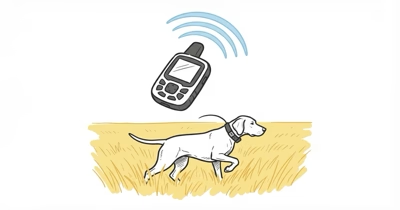
Garmin launched the Astro line for hunters and field sport handlers. The Astro 430 and Alpha 100 generations used satellite positioning to show a dog’s location on a handheld receiver without relying on cell towers or Wi-Fi for the core tracking link.
The Alpha arrived in 2014 and added something the Astro never had: built-in electronic training. The Alpha 100 pairs GPS tracking with a programmable e-collar, giving handlers one device for both location monitoring and behavior correction.
Here is the core distinction:
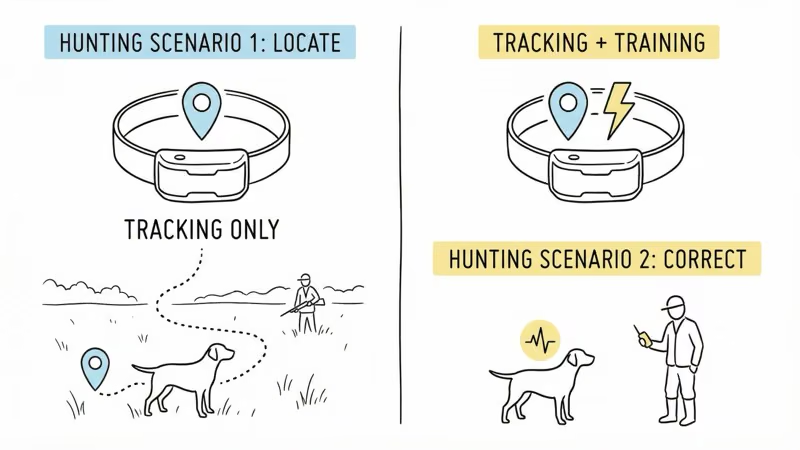
- Garmin Astro tracks your dog’s location. That is all it does, and it does it well.
- Garmin Alpha tracks your dog’s location and lets you deliver tone, vibration, or stimulation commands remotely.
For existing hardware, Astro’s simpler role can suit a handler who already owns a separate training collar. A used Alpha 100 can combine both functions, but the exact collar compatibility, battery condition and seller’s included kit should be checked before purchase.
Spec-by-Spec Comparison Table
| Feature | Astro 430 | Alpha 100 |
|---|---|---|
| Primary function | GPS tracking only | GPS tracking + e-collar training |
| Display | 2.6” color, button-operated | 3.0” color touchscreen |
| Max dogs tracked | 20 | 20 |
| Tracking range | Up to 9 miles | Up to 9 miles |
| Update interval | Every 2.5 seconds | Every 2.5 seconds |
| Satellite systems | GPS + GLONASS | GPS + GLONASS |
| Handheld battery | 15-20 hours | 10-20 hours |
| Collar battery | Up to 26 hours | Up to 20 hours |
| Training stimulation | None | 18 levels (continuous + momentary) |
| Bark detection | Collar-based | Collar or handheld |
| Maps | Preloaded TOPO 100K | Preloaded TOPO 100K |
| Water resistance | IPX7 | IPX7 |
| Monthly subscription | None | None |
The numbers that matter most are collar battery life and training capability. Everything else is functionally identical between the two platforms.
Tracking Capabilities: Nearly Identical Performance
Both systems deliver the same core GPS dog tracking performance:
- 9-mile maximum range under open-terrain conditions, with terrain and canopy reducing usable range
- 2.5-second update intervals for near-real-time position data
- GPS + GLONASS dual-satellite reception for faster lock and better accuracy in tree canopy
- On-screen mapping showing dog direction, distance, speed, and status (moving, treed, on point)
- Bark detection alerts when dogs vocalize out of hearing range
The historical systems combined GPS and GLONASS reception, but field accuracy still varies. GPS.gov’s accuracy guide states that signal blockage, atmospheric conditions and receiver design all affect the result a user receives.
Garmin’s 2016 launch announcement confirms that Astro 430 could follow up to 20 dogs, reach up to 9 miles and update as often as every 2.5 seconds. Those are published maxima, not guaranteed field results. Our guide to restoring a dropped handheld-to-collar link covers an Alpha reconnect sequence.
Training Features: The Alpha’s Defining Advantage
This is where the two systems split completely.
The Astro 430 has zero training functionality. It shows you where your dog is, and that is all.
The Alpha 100 includes a full remote training system built into the same collar that handles GPS tracking:
- 18 levels of stimulation in both continuous and momentary modes
- Tone and vibration options for low-intensity correction
- Stimulation level lockout to prevent accidental over-correction
- Two progression modes: Traditional (low/medium/high) and Linear (levels 1-18)
- Dedicated training button on the handheld for one-handed operation
For upland bird hunters and retriever handlers, the Alpha lets you reinforce commands at distances where your voice can’t carry. You see the dog on the map, confirm its location relative to game birds, and deliver a tone or stimulation to redirect behavior. All from one device.
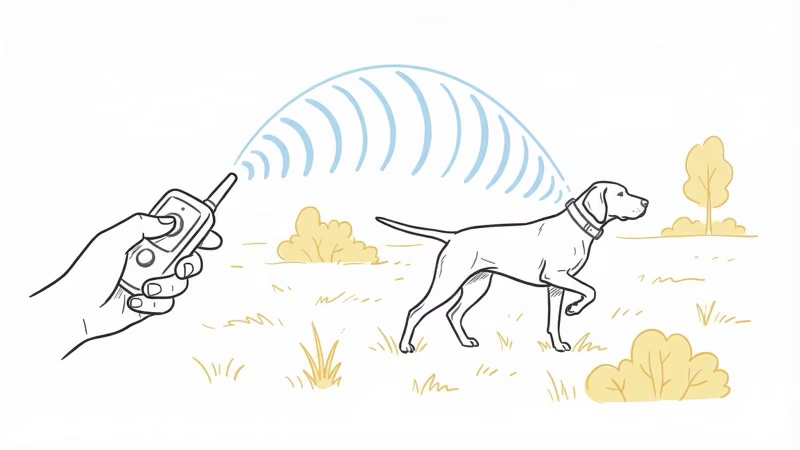
The Alpha’s integrated e-collar system lets handlers combine location awareness with tone, vibration, or stimulation from the same handheld. If you already own and prefer a separate e-collar brand (like the Dogtra Pathfinder or SportDOG), the Astro keeps things simpler.
The Alpha’s integrated approach means fewer devices to charge, fewer collars on your dog’s neck, and faster response times in the field.
Mapping and Navigation
According to Garmin, 20-foot contour intervals are part of the TOPO 100K outdoor maps used for terrain detail. Both handhelds come preloaded with Garmin TOPO 100K maps that show terrain contours, roads, waterways, and landmarks. You can expand coverage with:
- BirdsEye satellite imagery for aerial views of hunting grounds
- Premium TOPO layers with higher contour resolution
- Garmin BaseCamp trip planning software for pre-loading GPX routes and waypoints
The Alpha 100’s 3-inch touchscreen makes map interaction faster. Pinch-to-zoom and tap-to-select are more intuitive than the Astro’s button-driven menu system. In cold weather with heavy gloves, though, the Astro’s physical buttons can be easier to operate than a touchscreen — a tradeoff Outdoor Life’s GPS dog collar roundup recommends considering for late-season hunters.
Battery Life and Field Endurance
Collar battery life matters more than handheld battery life in practice. You can swap handheld batteries in the truck. A dead collar means a lost dog.
- Astro 430 collar: up to 26 hours on a full charge
- Alpha 100 collar: up to 20 hours on a full charge
- Astro handheld: 15-20 hours
- Alpha handheld: 10-20 hours
The Astro’s 6-hour collar advantage makes a real difference on multi-day hunts. Both collars support Rescue Mode, which slows the update rate to conserve battery when a dog goes missing overnight.
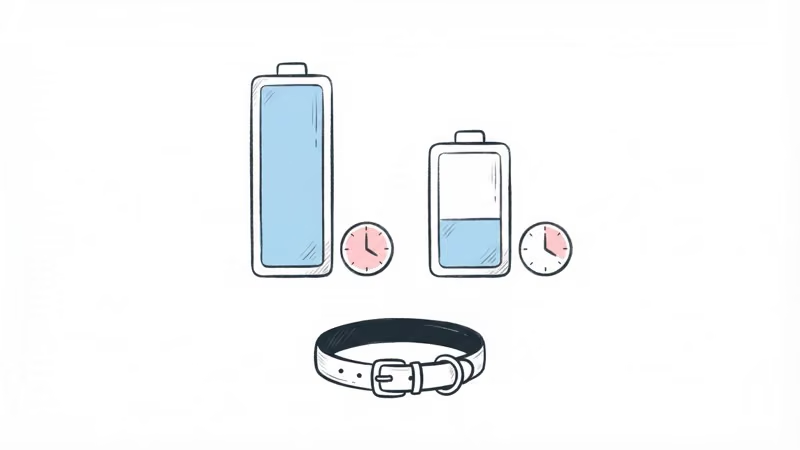
For weekend hunts, either system lasts a full day without worry.
For extended backcountry trips lasting two or three days, the Astro gives you more margin before you need to pull collars for recharging.
Pricing and Total Cost of Ownership
The core Astro 430 and Alpha 100 handheld-to-collar tracking function didn’t require a cellular tracking plan. That historical subscription distinction remains useful, but it doesn’t provide a current total cost for an archived system.
Current retail price and availability for these exact generations are unverified. Used listings also differ in collar model, battery condition, maps, chargers and accessories, so an old bundle range can’t be treated as a current comparison price.
| Cost factor | Astro 430 | Alpha 100 |
|---|---|---|
| Current price | Unverified | Unverified |
| Current availability | Unverified; treat as legacy | Unverified; treat as legacy |
| Core tracking subscription | None historically | None historically |
| Used-system cost | Check exact handheld, collar and accessories | Check exact handheld, collar and accessories |
Used bundles need item-by-item pricing and compatibility checks.
Which System Fits Your Use Case?
⇄ Head-to-head
Garmin Astro 430 vs Alpha 100
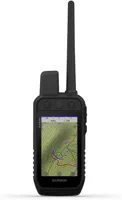
- +26-hour collar battery, 6 hours longer than Alpha
- +Tracking-only controls avoid unused training features
- +Physical buttons work better with cold-weather gloves
- +Same 9-mile tracking range and 20-dog capacity
- +No subscription, ever
- +GPS tracking + 18-level e-collar training in one system
- +3" color touchscreen, faster map interaction
- +Pairs with TT 15 / TT 15 mini training collars
- +Bark-detection alerts on both collar and handheld
- +One collar on each dog instead of GPS + e-collar separately
- −No e-collar training, tone, or vibration
- −2.6" button-driven display only
- −Pairs only with T 5 / T 5 mini collars
- −No handheld bark-detection alerts
- −Collar battery 20 hours vs Astro's 26
- −Used-system price and condition vary
- −Touchscreen harder to operate with thick gloves
- −Handheld battery range narrower (10-20 hours)
Legacy option for an owner with compatible Astro hardware; verify the exact collar, condition and included accessories.
Legacy option when a clearly identified used kit provides the required tracking and training controls.
Newer Models Worth Comparing
Garmin has released later generations since the Astro 430 and Alpha 100. These related guides can help identify the product families, but availability must still be verified on Garmin’s current regional catalog:
- Garmin Astro 900 — a later tracking-only generation covered as legacy context
- Garmin Alpha 300 — a later tracking-plus-training generation
- Garmin Alpha 200i — an Alpha generation with inReach-related capabilities
The Alpha 300 vs 200 comparison covers differences between those later Alpha generations.
Bottom Line
Historically, Astro 430 was the tracking-only side of this comparison and Alpha 100 added remote training controls. Garmin documented Astro 430 support for up to 20 dogs, up to 9 miles and updates as often as every 2.5 seconds, but those launch specifications don’t prove current stock or pricing.
Use this page to assess an existing or clearly identified used system. For a new purchase, compare Garmin’s current regional catalog and exact collar compatibility instead of treating either legacy generation as the automatic pick.
Frequently Asked Questions
How accurate are the Garmin Astro and Alpha GPS systems?
Both systems use GPS and GLONASS dual-satellite positioning, which improves lock reliability compared with GPS-only receivers. Tree canopy, ridge lines, and handheld position can still reduce accuracy, but both platforms share the same tracking engine and 2.5-second update interval.
Can I use the Alpha 100 as a tracker without the training features?
Yes. The Alpha 100 doesn’t require you to use the stimulation, tone, or vibration functions. You can run it as a GPS-only tracker if preferred. The training features are always available but never activate unless you press the training button on the handheld.
Do the Garmin dog tracking systems require a phone or cell service?
No. Both the Astro and Alpha operate entirely on satellite GPS signals. They don’t need cellular coverage, Wi-Fi, or a smartphone connection to track dogs. The handheld receiver communicates directly with the dog collar via radio frequency. This makes them reliable in remote backcountry where cell service doesn’t exist.
What is the realistic tracking range in the field?
Garmin rates both systems at up to 9 miles under ideal line-of-sight conditions. Dense forest, steep terrain, valleys, and the dog’s position relative to the handheld reduce usable range. Positioning the handheld on higher ground improves reception significantly.
Can I mix Astro and Alpha collars on the same handheld?
Not directly. The Astro handheld works with T 5 and T 5 mini tracking collars. The Alpha handheld works with TT 15 and TT 15 mini tracking-and-training collars. However, the Alpha handheld can also pair with T 5 collars for tracking-only dogs in a mixed pack, giving it more collar flexibility than the Astro.
Is a monthly subscription required for either system?
The core Astro 430 and Alpha 100 handheld-to-collar tracking link did not require a cellular subscription. Optional maps, accessories or other services are separate, and a used seller’s bundle contents should be checked.
How do these compare to Bluetooth trackers like AirTag for dogs?
Garmin Astro and Alpha are true GPS systems with 9-mile range and real-time tracking. An AirTag on a dog collar relies on nearby iPhones to relay location, which works in urban areas but fails in rural hunting terrain. For field sport and hunting dogs, satellite GPS is the only reliable technology. Bluetooth trackers are designed for lost keys, not working dogs in remote areas.