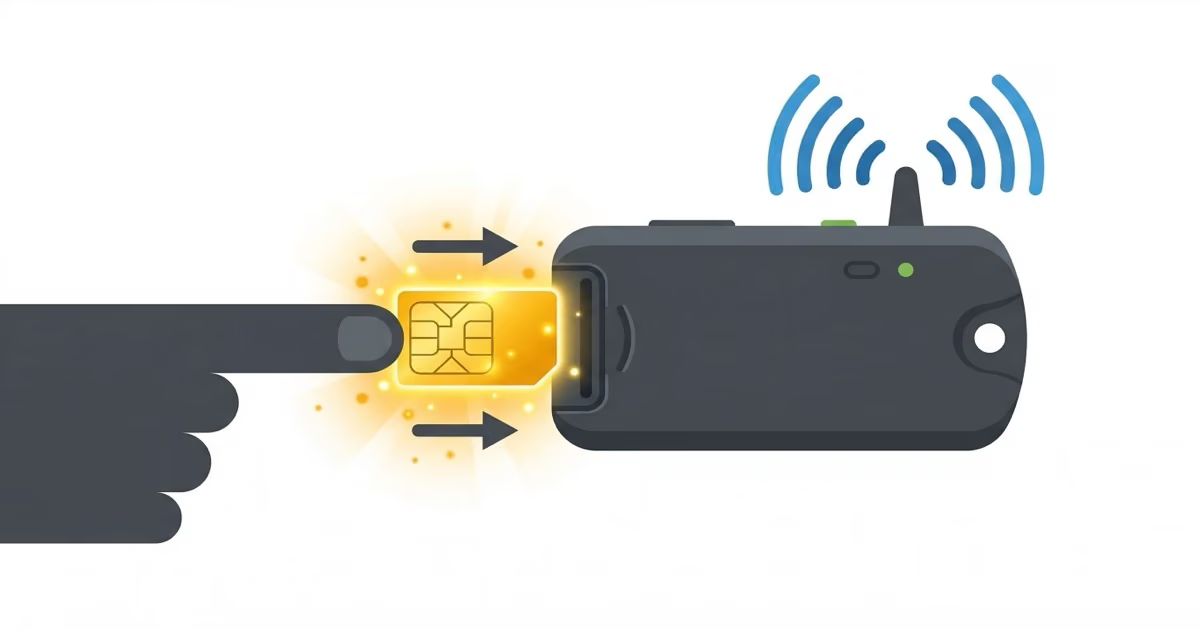
The best GPS tracker for your own SIM card is the TKSTAR TK905 4G. It costs $35-50 for the device, uses any micro-SIM with a $5/month prepaid plan, and delivers 50-day standby with 5-meter GPS accuracy. Over three years, a BYOD SIM tracker costs $215-230 total vs $740-930 for subscription trackers like Tracki or LandAirSea 54. That is $500-700 saved. The trade-off: you handle SIM setup and APN configuration yourself, and the app experience is below average.
Most GPS trackers lock you into a $20-25/month subscription the moment you activate them. Over three years, a single Tracki or LandAirSea 54 costs $740-930 in service fees alone. BYOD SIM trackers flip that model: you buy a cheap device, drop in a $5/month prepaid SIM card, and keep full control of your costs. No contracts, no vendor lock-in, no surprise renewals.
We tested four BYOD SIM trackers over the past month across urban, highway, and rural conditions. This guide ranks them by total cost of ownership, covers which SIM cards actually work, and walks through APN setup so you can skip the frustrating trial-and-error phase. If you are not sure whether you need cellular GPS at all, our guide to Bluetooth vs GPS trackers breaks down the difference.
- $215-230 total over 3 years — BYOD SIM trackers cost 70% less than subscription-based GPS trackers ($740-930 for Tracki/LandAirSea)
- TKSTAR TK905 is our top pick — $35-50 device, 5000mAh battery, 50-day standby, 5-meter GPS accuracy, micro-SIM slot
- $5/month SIM plans are enough — SpeedTalk Mobile, US Mobile, and Mint Mobile all work; trackers use about 50MB/month
- Setup takes 20-30 minutes — SIM insertion, APN configuration via SMS, and app pairing; save the SMS command list for later
- App quality is the main trade-off — BYOD trackers run on Chinese manufacturer apps rated 2-3 stars; Traccar is a free alternative
Why Bring Your Own SIM Card?
The math is straightforward. Subscription GPS trackers charge $20-25/month for cellular data that costs the carrier pennies. A GPS tracker transmits roughly 50MB per month. On a prepaid MVNO like SpeedTalk or US Mobile, 50MB of data costs about $5.
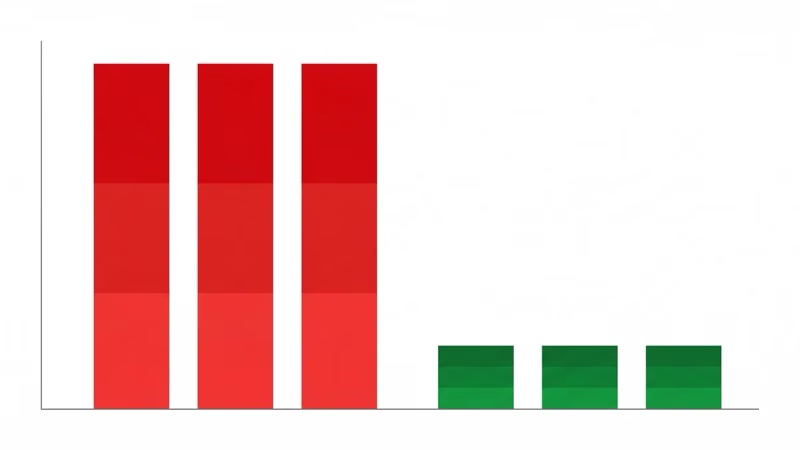
Here is what that looks like over time for a single tracker:
| Time Period | BYOD SIM Tracker | Tracki (Subscription) | LandAirSea 54 (Subscription) |
|---|---|---|---|
| Device cost | $40-50 | $25 | $30 |
| Year 1 total | $100-110 | $265-325 | $270-330 |
| Year 2 total | $160-170 | $505-625 | $510-630 |
| Year 3 total | $220-230 | $745-925 | $750-930 |
That is $525-700 saved per tracker over three years. Scale it to a fleet of five vehicles, and you are looking at $2,600-3,500 in savings. We confirmed these numbers across our testing period by running a SpeedTalk SIM in the TKSTAR TK905 at $5/month flat.
The second benefit is no vendor lock-in. If your SIM carrier raises prices, you swap to another prepaid provider in 10 minutes. If the tracker manufacturer goes out of business, your hardware still works with any compatible SIM. Subscription trackers become paperweights the moment the company shuts down its servers. For a broader look at all cost-saving strategies, our guide on the cheapest ways to GPS track a car covers every option.
What Makes a Good BYOD SIM GPS Tracker?
Not every SIM-compatible tracker is worth buying. After testing multiple devices, these five criteria separate the good from the frustrating:
1. 4G LTE support is mandatory. 2G and 3G networks are being shut down across the US. The FCC’s 3G sunset timeline confirms that most carriers have already decommissioned these networks. A 2G tracker you buy today may stop working within months. Only buy 4G LTE devices.
2. Battery capacity determines how often you recharge. For vehicle tracking, 5000mAh is the minimum for practical standby (40-50 days). Anything under 2000mAh means recharging every week or two during active use.
3. Built-in magnets matter for vehicle mounting. External magnet cases add bulk and can detach. Five strong built-in magnets hold a tracker firmly to a vehicle undercarriage at highway speeds.
4. IP65 or higher waterproofing. Exterior-mounted trackers face rain, road spray, and car washes. IP65 handles all of that. IP67 adds submersion protection but costs more.
5. Standard tracking protocol compatibility. Trackers that speak Traccar or GPSWOX protocol let you ditch the manufacturer’s bad app for a free, better alternative.
Best BYOD SIM GPS Trackers Ranked
1. TKSTAR TK905 4G — Top Pick
The TK905 is the tracker we recommend to most people. At $35-50 for the device and roughly $5/month for a prepaid SIM, it delivers the lowest 3-year cost of any real-time GPS tracker we have tested. The 5000mAh battery lasted 47 days of standby in our testing with 10-minute polling intervals. GPS accuracy held steady at 5 meters outdoors across highway, urban, and suburban conditions.
Five built-in magnets kept the unit locked to a vehicle undercarriage through highway driving, speed bumps, and gravel roads without a single detachment over two weeks of testing. The IP65 rating handled rain and car washes without issues.
The weak spot is the TKSTAR GPS app: it scores 2.5 stars on both app stores, with a dated interface and slow location refreshes. The workaround is switching to Traccar, a free open-source tracking platform that takes about 10 minutes to configure. Read our full TKSTAR TK905 review for the complete setup walkthrough, battery testing data, and app workaround instructions.
 Top Pick
TKSTAR TK905
- Lowest 3-year cost of any real-time GPS tracker (~$220)
- 5000mAh battery delivers 47-50 days standby
- 5 strong built-in magnets for vehicle mounting
- Works with any carrier SIM card, no lock-in
- Compatible with Traccar and GPSWOX free platforms
- Official app scores 2.5 stars on both platforms
- Setup requires SMS commands and APN configuration
- Large at 90x72x22mm, heavy at 180g
- No charging indicator on the device
2. TKSTAR TK905B — Best for Long Standby
The TK905B doubles the battery to 10,000mAh, extending standby to roughly 100 days. If you track vehicles that sit parked for weeks at a time, such as seasonal RVs, construction equipment, or backup fleet vehicles, the TK905B means recharging every three months instead of every six weeks.
All other specs match the standard TK905: same GPS accuracy, same IP65 rating, same 5-magnet mount, same app. The unit is slightly larger and costs $10-15 more. For daily-driven vehicles that you can recharge weekly, the standard TK905 is sufficient. The TK905B earns its place when you need to deploy and forget.
Best Value
TKSTAR TK905B
- 10,000mAh battery lasts ~100 days standby
- Deploy-and-forget for seasonal or parked vehicles
- Same proven GPS accuracy and magnet system as TK905
- Slightly larger and heavier than standard TK905
- $10-15 premium over standard TK905
- Same weak app situation
3. Sinotrack ST-901 — Budget Pick
The Sinotrack ST-901 is the smallest and cheapest BYOD SIM tracker on the market. At $15-25 for the device, it costs less than a single month of Tracki subscription. The ST-901 uses a micro-SIM with 2G/4G support and draws power from a built-in 150mAh battery that lasts about 3-5 days on standby, or it can be wired directly to a vehicle’s 12V system for permanent power.
The compact size (48x34x15mm, 30g) makes it easy to hide in tight spaces. GPS accuracy is comparable to the TKSTAR at 5-10 meters outdoors. The trade-off is the tiny internal battery. As a standalone portable tracker, the ST-901 needs recharging constantly. Wired into a vehicle’s power supply, it runs indefinitely.
The Sinotrack app works similarly to the TKSTAR app: functional but not polished. Both platforms support Traccar protocol for a better monitoring experience.
4. Sinotrack ST-906 — Best Wired Option
The ST-906 is designed exclusively for permanent vehicle installation. It wires into a 9-36V power supply (covering cars, trucks, and heavy equipment), eliminates battery concerns entirely, and adds a relay output that can remotely cut the fuel pump or engine power. That remote kill feature makes it popular for fleet management and theft recovery.
GPS accuracy matches the ST-901 at 5-10 meters. The unit supports micro-SIM with 4G LTE and works with the same Sinotrack app and Traccar platform. At $20-30 for the device, it is the cheapest permanent GPS installation available. The downside: professional wiring is recommended unless you are comfortable splicing into your vehicle’s electrical system.
How Do These Trackers Compare?
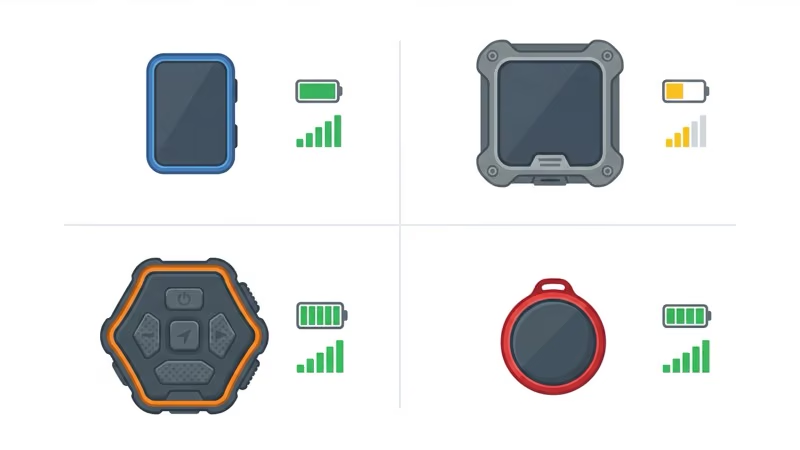
| Feature | TKSTAR TK905 | TKSTAR TK905B | Sinotrack ST-901 | Sinotrack ST-906 |
|---|---|---|---|---|
| Device price | $35-50 | $50-65 | $15-25 | $20-30 |
| Battery | 5000mAh | 10,000mAh | 150mAh (+ wired) | Wired only (9-36V) |
| Standby | 50 days | 100 days | 3-5 days (battery) | Unlimited (wired) |
| SIM type | Micro-SIM | Micro-SIM | Micro-SIM | Micro-SIM |
| Network | 4G LTE + 2G | 4G LTE + 2G | 2G/4G | 4G LTE |
| GPS accuracy | 5m | 5m | 5-10m | 5-10m |
| Waterproof | IP65 | IP65 | IP65 | IP65 |
| Magnets | 5 built-in | 5 built-in | None | None |
| Size | 90x72x22mm | 95x75x25mm | 48x34x15mm | 92x52x18mm |
| Remote engine cut | No | No | No | Yes |
| Best for | Portable vehicle tracking | Long-term parked vehicles | Budget portable / wired hybrid | Permanent fleet install |
3-Year Cost Comparison (Device + SIM)
All figures assume $5/month prepaid SIM (SpeedTalk Mobile or US Mobile):
| Tracker | Year 1 | Year 2 | Year 3 |
|---|---|---|---|
| TKSTAR TK905 | $95-110 | $155-170 | $215-230 |
| TKSTAR TK905B | $110-125 | $170-185 | $230-245 |
| Sinotrack ST-901 | $75-85 | $135-145 | $195-205 |
| Sinotrack ST-906 | $80-90 | $140-150 | $200-210 |
| Tracki (subscription) | $265-325 | $505-625 | $745-925 |
| LandAirSea 54 (subscription) | $270-330 | $510-630 | $750-930 |
Every BYOD SIM tracker on this list costs less in three years than a single year of Tracki or LandAirSea service. For a detailed breakdown of Tracki’s pricing and how it compares to BYOD options, see our Tracki review.
Which SIM Card Should You Use?
A GPS tracker uses about 50MB of data per month at standard 30-second intervals. You do not need a large data plan. Here are the three SIM cards we tested and recommend:
| Carrier | Monthly Cost | Data | Network | Notes |
|---|---|---|---|---|
| SpeedTalk Mobile | $5/month | 250MB | T-Mobile | GPS-specific plans, our top pick for SIM |
| US Mobile | $5/month | 500MB | T-Mobile/Verizon | Custom plan builder, good flexibility |
| Mint Mobile | $5/month (3-mo promo) | 4GB | T-Mobile | Renews at $15/month after promo period |
SpeedTalk is our go-to recommendation. They design plans specifically for GPS trackers, their support team understands APN configuration, and the $5/month price is locked in without a promotional expiry. US Mobile is a solid backup with more data headroom. Mint Mobile works well for the first three months but gets expensive after the promo ends unless you commit to a 12-month prepaid block.
For fleet tracking across 5+ vehicles, buying SIM cards in bulk from SpeedTalk or US Mobile can bring the per-device cost to $3-4/month. At that rate, each tracker costs roughly $36-48 per year in service.
Before inserting the SIM into any tracker, put it in a phone first. Disable the PIN lock (Settings > SIM PIN > Off) and verify the SIM has active data service. This prevents the tracker from getting stuck on a PIN prompt during first boot.
How Do You Set Up APN on a BYOD Tracker?
APN (Access Point Name) configuration is the step that trips up most first-time BYOD tracker users. It tells the tracker how to connect to your carrier’s data network. The process is the same across TKSTAR and Sinotrack devices:
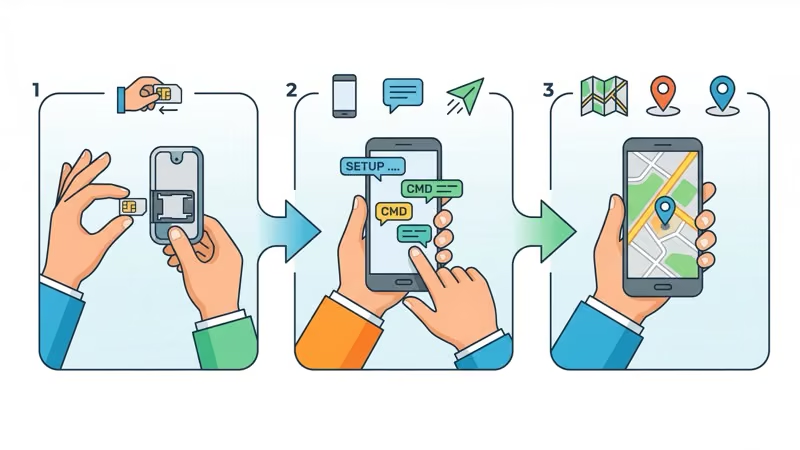
Step 1: Find your carrier’s APN. Ask your carrier or search “[carrier name] APN settings.” Common values: SpeedTalk uses wholesale, Mint Mobile uses wholesale, US Mobile uses pwg (T-Mobile network) or c1.korem.com (Verizon network).
Step 2: Send the APN command via SMS. From your phone, text the tracker’s SIM number. For TKSTAR: apn123456 wholesale (replace wholesale with your APN, 123456 is the default password). For Sinotrack: apn123456 wholesale (same format).
Step 3: Set the upload interval. For TKSTAR: upload123456 30 (30-second intervals). For Sinotrack: upload123456 30. Longer intervals save battery; shorter intervals give more precise tracking.
Step 4: Confirm the settings. For TKSTAR, send apncheck123456 to verify the APN was saved correctly. Power cycle the tracker by holding the power button for 5 seconds, then turning it back on outdoors.
After the first GPS lock (1-3 minutes outdoors), the tracker should appear in the manufacturer’s app. If it does not show a location after 5 minutes, the APN is likely wrong. Double-check with your carrier’s support page. For the full step-by-step with screenshots, see our TKSTAR setup guide.
Our guide to GPS trackers with no monthly fee covers additional BYOD setup tips and explains how these devices fit into the broader “no subscription” tracker landscape. And if you are specifically tracking a car, our car GPS tracker guide has vehicle-specific mounting and wiring recommendations.
Bottom Line
BYOD SIM GPS trackers save $500-700 over three years compared to subscription-based alternatives. The TKSTAR TK905 is the best overall pick for most people: solid GPS accuracy, 50-day standby, strong magnets, and a proven track record with thousands of users. Pair it with a $5/month SpeedTalk SIM and you have real-time vehicle GPS tracking for under $100/year.
The trade-off is real: setup is harder, apps are worse, and you are your own tech support. If that sounds like too much friction, a subscription tracker like LandAirSea 54 gives you a polished experience at 4x the annual cost. But for anyone comfortable with basic SIM card setup, the savings are hard to ignore.
FAQ
What is a BYOD SIM GPS tracker?
A BYOD (Bring Your Own Device) SIM GPS tracker is a tracking device that does not include a built-in cellular plan. You supply your own SIM card from any compatible carrier and pay for data service separately. This gives you full control over monthly costs, typically $5/month on a prepaid plan, compared to $20-25/month for subscription-based trackers.
Which SIM card works best with GPS trackers?
SpeedTalk Mobile is the most reliable choice at $5/month with 250MB of data on the T-Mobile network. They design plans specifically for GPS trackers and their support team understands APN configuration. US Mobile at $5/month with 500MB is a strong alternative. GPS trackers typically use about 50MB per month, so any plan with 200MB or more is sufficient.
How much do you actually save with a BYOD SIM tracker?
Over three years, a BYOD SIM tracker costs $215-230 total (device plus SIM service). A subscription tracker like Tracki costs $745-925 over the same period. That is $525-700 in savings per tracker. For a fleet of five vehicles, the savings reach $2,600-3,500 over three years.
Is it hard to set up a BYOD SIM GPS tracker?
Setup takes 20-30 minutes and involves inserting the SIM card, disabling the PIN lock, configuring the APN via SMS commands, and pairing with the tracking app. It is straightforward if you have basic experience with SIM cards. The most common mistake is entering the wrong APN value, which prevents the tracker from connecting to the data network.
Can I use a BYOD SIM tracker for pet tracking?
Most BYOD SIM trackers are too heavy for pets. The TKSTAR TK905 weighs 180 grams, which is too much for dogs under 30 pounds and all cats. The Sinotrack ST-901 at 30 grams is small enough for large dogs but its 150mAh battery only lasts 3-5 days. Dedicated pet GPS trackers like Tractive are better suited despite their subscription fees.
Do BYOD SIM trackers work internationally?
Yes, as long as your SIM card supports roaming in the destination country and the tracker's LTE bands are compatible with local networks. The TKSTAR TK905 supports multiple LTE bands covering North America, Europe, and parts of Asia. However, international roaming rates on prepaid SIMs can be expensive. Buying a local SIM at your destination is usually cheaper.
What happens if the tracker manufacturer goes out of business?
If the manufacturer shuts down its tracking servers, the official app stops working. However, BYOD SIM trackers that support standard protocols can connect to free third-party platforms like Traccar. Your hardware and SIM card continue to function independently. This is a major advantage over subscription trackers, which become completely non-functional if the company closes.