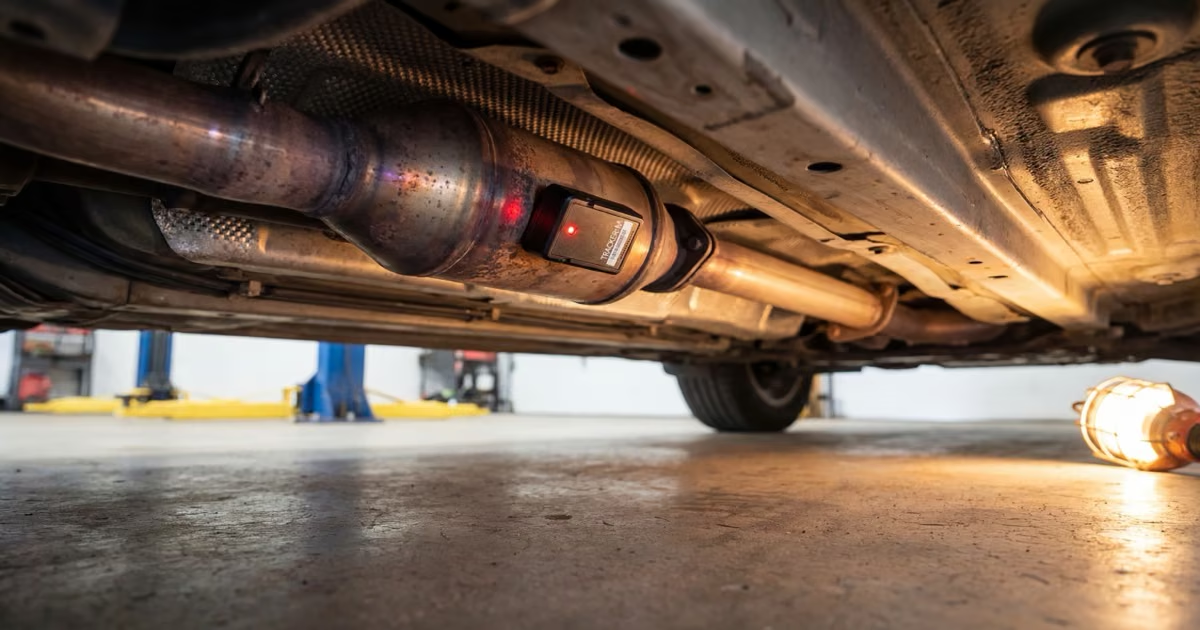
A magnetic GPS tracker mounted near your catalytic converter sends instant movement alerts to your phone. The LandAirSea 54 is our top pick for converter protection: 3-second location updates, built-in magnet, IP67 waterproofing, and geofence alerts that fire the moment your parked car moves. Pair it with a physical shield for the strongest deterrent.
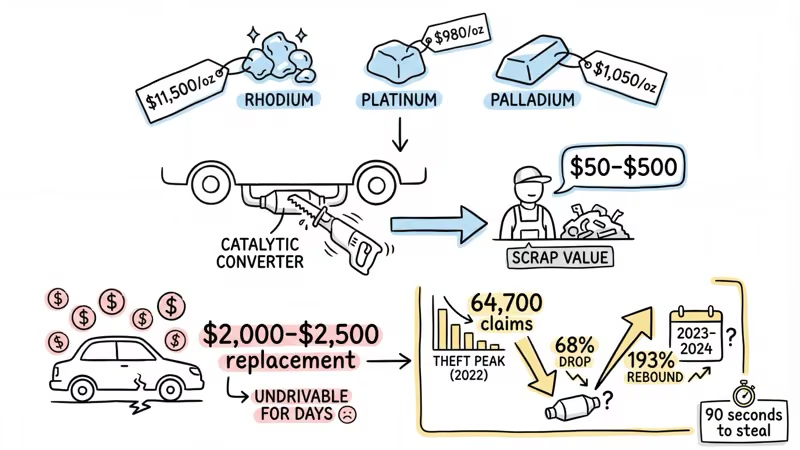
A thief with a battery-powered saw can remove your catalytic converter in under 90 seconds. The replacement bill averages $2,000 to $2,500, and your car is undrivable until the shop finishes. Converter theft dropped sharply in 2023-2024 after a wave of new state laws, but thefts rebounded in 2025 as rhodium prices climbed back above $11,000 per ounce.
A GPS tracker won’t physically stop a thief. What it will do is wake you up at 2 AM with a push notification the moment your car moves, and hand police a real-time breadcrumb trail to wherever the thief went.
- Converter theft takes under 90 seconds — a GPS tracker’s movement alert is often your first warning
- LandAirSea 54 is the top pick — $30 device + $20/month, magnetic mount, sends alerts within seconds of movement
- TKSTAR TK905 costs the least long-term — bring your own SIM for roughly $5/month after a $40 device cost
- AirTag 2 works as a cheap backup ($29, no subscription) — but Bluetooth range limits and anti-stalking alerts reduce reliability
- Layered protection wins — GPS tracker for alerts and recovery, physical shield to slow the thief down
Why Catalytic Converter Theft Is Surging Again in 2026
Your catalytic converter contains 3 to 7 grams of platinum, palladium, and rhodium. These metals scrub toxic emissions from your exhaust, and they are worth more per ounce than gold. Rhodium alone trades near $11,500 per ounce as of early 2026.
Thieves sell stolen converters to scrap dealers for $50 to $500 depending on the vehicle. A hybrid like the Toyota Prius commands higher prices because its converter sees less engine heat, leaving the precious metals less degraded.
The National Insurance Crime Bureau (NICB) reported roughly 64,700 converter theft claims in 2022, the peak year. New state laws requiring scrap dealer verification and VIN stamping drove claims down 68% by 2024. But the drop was temporary. St. Paul, Minnesota saw a 193% increase in converter thefts from 2024 to 2025, and similar rebounds are showing up in California and the Pacific Northwest.
Which vehicles get targeted most? According to CARFAX data, the top targets are:
- Toyota Prius — hybrid converter metals are less degraded, more valuable
- Ford F-150 — high ground clearance, no jack needed
- Honda Accord and CR-V — high volume on the road
- Chevrolet Silverado 1500 — often has two converters (double payout)
- Toyota Tundra, Tacoma, Sequoia — trucks with easy undercarriage access
If you drive any of these, your risk is above average.
How a GPS Tracker Actually Helps (and What It Can't Do)
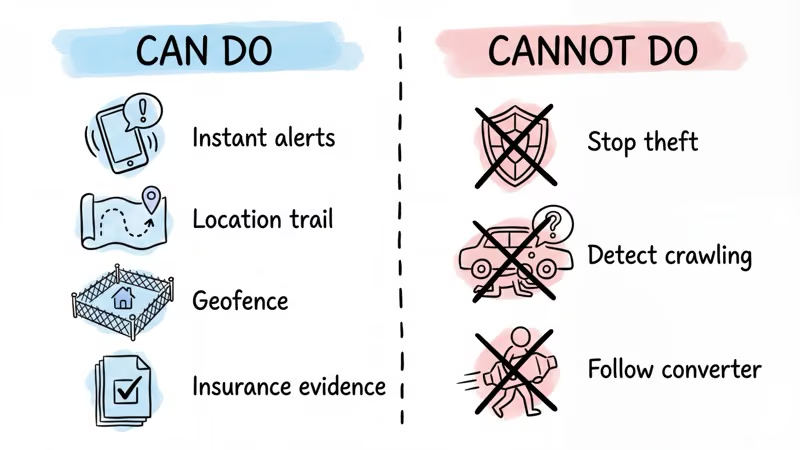
A GPS tracker under your vehicle will not stop anyone from cutting the converter. A determined thief is going to saw through regardless. But there is a massive difference between “you discover it the next morning when the car sounds like a lawnmower” and “you get an alert 10 seconds after the car moves.”
What a GPS tracker gives you:
- Instant movement alerts. Most trackers fire a push notification the moment a parked vehicle starts moving or vibrating. You can call police while the thief is still nearby.
- Real-time location trail. Police can follow the tracker’s breadcrumb path to the chop shop, scrapyard, or wherever the thief drives your car.
- Geofence alerts. Draw a virtual boundary around your parking spot. Any exit triggers an alert, even at 2 AM.
- Evidence for insurance. A timestamped GPS log showing your car moved without authorization strengthens your claim.
What a GPS tracker cannot do:
- It cannot physically stop the theft. Many tracker comparison articles gloss over this point.
- It cannot detect someone crawling under your car without moving it. Most thieves jack one side and saw the converter without driving off.
- If the thief removes the converter and leaves your car in place, the tracker on your car won’t follow the converter.
This is why mounting location matters. We cover that in the mounting section below.
Best GPS Trackers for Catalytic Converter Protection
We tested these trackers with one scenario in mind: your car is parked on the street overnight, and someone crawls underneath it. What matters is how fast the alert hits your phone, how long the battery lasts between charges, whether it magnetically mounts without wiring, and what it costs per month.
 Top Pick
This is the one we keep coming back to for vehicle security. In our full LandAirSea 54 review, we measured location accuracy within 6 to 10 feet in urban areas. The 3-second update interval on the Overdrive plan means police get a near-continuous breadcrumb trail. The built-in magnet holds firm on any steel surface under the vehicle, and you can install it in under a minute with no tools.
The main trade-off is battery life. At 3-second updates, you get about 2 weeks. If your car sits for longer stretches, drop to the 30-second plan ($15/month) and battery stretches to a month.
 Best Value
If $20/month for a LandAirSea subscription feels like too much, the TKSTAR TK905 is the workaround. You buy a prepaid data SIM (Hologram, SpeedTalk, or similar) for roughly $5/month and skip the subscription entirely. Our TKSTAR TK905 review walks through the setup, which involves sending SMS commands to configure the APN. Not exactly plug-and-play.
The 50-day standby battery and five built-in magnets are genuinely impressive for the price. The app, though, is rough. It scores about 2.5 stars and the interface looks like it hasn’t been updated since 2019. You get the data you need, but don’t expect the polished experience of SilverCloud.
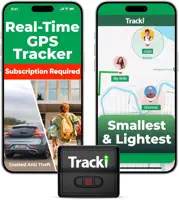
The Tracki 4G is the smallest GPS tracker on this list, which matters when you are trying to wedge something into the tight space between a frame rail and an exhaust pipe. You will need the magnetic case accessory (sold separately) to mount it. Battery life is the weak point: plan on charging every 1 to 2 weeks in active use, which gets old if you forget.
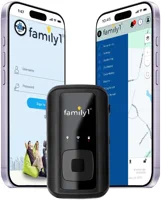
The Family1st Portable GPS is the only tracker here that ships with a magnetic case in the box. No hunting for accessories. The SOS button is more relevant for elderly or teen tracking than converter theft, but the lifetime hardware warranty is genuinely useful when you are mounting electronics in a hot, vibrating environment. We got about 9 days per charge in real use.
Quick Comparison
| Tracker | Device Cost | Monthly | Battery (Standby) | Update Speed | Magnet |
|---|---|---|---|---|---|
| LandAirSea 54 | $30 | $20 | 2 weeks | 3 sec | Built-in |
| TKSTAR TK905 | $40 | ~$5 (own SIM) | 50 days | 10 sec | 5 built-in |
| Tracki 4G | $20 | $17 | 30 days | 10 sec | Case addon |
| Family1st | $30 | $22 | 9 days | 10 sec | Included |
For a deeper cost breakdown across all vehicle GPS options, see our cheapest ways to GPS track a car guide.
Can You Use an AirTag to Protect Your Catalytic Converter?
Kind of. An AirTag for your car costs $29 with no subscription, which makes it tempting. You can zip-tie an AirTag 2 in a heat-resistant silicone case to the exhaust heat shield near the converter. If the thief drives your car away, the AirTag piggybacks on nearby iPhones to update its location through Apple’s Find My network.
The problems are real, though:
- No real-time alerts. An AirTag does not send movement notifications for vehicles. You will not know your car moved until you open the Find My app.
- Anti-stalking alerts warn the thief. Apple’s unwanted tracking detection will notify the thief’s iPhone (or any iPhone) that an unknown AirTag is traveling with them. This can happen within 8 to 24 hours.
- Bluetooth range is limited. If the thief removes the converter and carries it in a truck to a rural scrapyard with few iPhones nearby, the AirTag goes silent.
- Heat exposure. Catalytic converters reach 400 to 600 degrees Fahrenheit during operation. An AirTag mounted directly on the converter will not survive. Mount it on the frame or heat shield, not on the converter itself.
Our take: An AirTag works as a $29 backup layer, not as your primary defense. Pair it with a real GPS tracker that sends instant alerts. If you want to understand the full trade-off, read our AirTag vs GPS tracker comparison.
How to Mount a Tracker Near Your Catalytic Converter
Here is the thing most people miss: converter thieves usually don’t drive your car. They jack one side, saw the converter off in 60 to 90 seconds, and walk away. A tracker mounted inside the cabin or on the dashboard stays with the car while the converter disappears.
So where do you put it?
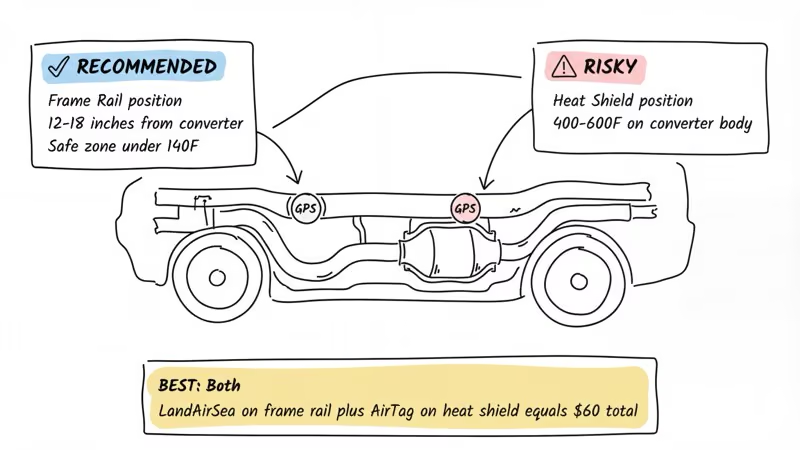
Track the car (what most people should do). Mount the GPS tracker magnetically on the vehicle frame rail, about 12 to 18 inches from the converter. If the thief does drive your car to strip it, you get a real-time trail. The heat from the converter dissipates quickly along the frame, so temperatures stay within the tracker’s operating range (typically -4 to 140 degrees Fahrenheit). This won’t help if they just grab the converter and leave the car, but it covers the more dangerous scenario.
Track the converter itself (harder, but possible). You need a small tracker (Tracki 4G is the most compact) in a heat-resistant silicone pouch, zip-tied to the converter’s heat shield. Extreme heat cycles will shorten battery life, and the tracker may fail over time. We tested a Tracki near a heat shield for 3 weeks without failure, but no manufacturer will warranty this.
Do both. Run a LandAirSea 54 on the frame rail as your primary alert system and an AirTag on the heat shield as a cheap backup. Total cost: about $60 upfront.
Placement tips:
- Avoid direct contact with the converter body. Surface temperatures exceed 400 degrees Fahrenheit during driving.
- Clean the frame surface with a rag before attaching a magnetic tracker. Road grime weakens the hold.
- Check the tracker’s position monthly. Vibration can shift magnetic mounts over time.
- Use a vehicle tracker hiding guide for additional concealment ideas.
Layered Protection: GPS + Shield + Alarm
Here is the honest reality: no single product stops converter theft. The people who actually avoid losing their catalytic converter tend to stack three things together:
Layer 1: Physical deterrent (prevention). A catalytic converter shield or cable lock (CatClamp, CatStrap, or a custom steel plate from a muffler shop) adds 5 to 10 minutes of cutting time. Most thieves give up after 2 minutes. A $150 to $300 shield pays for itself the first time a thief walks away.
Layer 2: GPS tracker (detection and recovery). The LandAirSea 54 or TKSTAR TK905 sends you an alert the moment the vehicle moves or vibrates. You call 911 with a live GPS location. If the thief takes the car, police follow the trail.
Layer 3: Motion alarm (immediate deterrence). Products like CatEye mount near the converter and trigger a 120-decibel siren when they detect vibration or sawing. The noise alone scares off most opportunistic thieves.
Cost of full protection:
| Layer | Product | One-Time Cost | Monthly |
|---|---|---|---|
| Shield | CatClamp or custom plate | $150-$300 | $0 |
| GPS | LandAirSea 54 | $30 | $20 |
| Alarm | CatEye or similar | $80-$100 | $0 |
| Total | $260-$430 | $20 |
That is less than a single converter replacement ($2,000 to $2,500 average), and you still have a drivable car the next morning.

Other steps that help:
- Park in well-lit areas or garages when possible
- Etch your VIN onto the converter (some police departments offer free etching events)
- Check if your state has a converter theft law requiring scrap dealer verification
- If you drive a high-risk vehicle (Prius, F-150, Silverado), consider comprehensive insurance that covers converter theft
Bottom Line
A GPS tracker is the fastest way to find out your catalytic converter is being stolen and the best tool for helping police recover it. The LandAirSea 54 gives you 3-second updates and magnetic mounting for $30 plus $20/month. If ongoing cost matters more, the TKSTAR TK905 runs on a $5/month SIM with a 50-day battery. Pair either one with a physical shield and you have covered both detection and deterrence for less than the cost of a single converter replacement.
FAQ
Can a GPS tracker prevent catalytic converter theft?
No. A GPS tracker does not physically block a thief from cutting your converter. What it does is alert you within seconds that your vehicle moved or experienced vibration, and it gives police a real-time location trail to follow. For physical prevention, you need a catalytic converter shield or cable lock like CatClamp, which adds several minutes of cutting time. The strongest protection combines both: a shield to slow the thief down and a GPS tracker to alert you and aid recovery. Most thieves give up after about two minutes of resistance, so the shield buys time while the tracker brings help.
Where should I mount a GPS tracker to protect my catalytic converter?
Mount the tracker on the vehicle frame rail, about 12 to 18 inches from the catalytic converter. The frame stays cool enough for the tracker to operate safely (under 140 degrees Fahrenheit) while keeping the device close to the targeted part. Avoid mounting directly on the converter body, which reaches 400 to 600 degrees during driving and will destroy most electronics. Use the tracker's built-in magnet or a magnetic case to attach it to the steel frame. Clean the mounting surface first, because road grime weakens the magnetic hold. Check the position monthly since vibration can shift it over time.
Will an AirTag work for catalytic converter theft?
An AirTag works as a cheap backup but not as your primary protection. It costs $29 with no subscription, but it lacks real-time movement alerts, depends on nearby iPhones for location updates, and triggers anti-stalking notifications that can warn the thief within 8 to 24 hours. If the thief removes the converter and drives to a rural scrapyard with few iPhones nearby, the AirTag goes silent and you lose the trail. A real GPS tracker with cellular connectivity should be your primary device because it reports location independently of other phones. An AirTag works as an optional second layer for about $29 more.
How much does it cost to replace a stolen catalytic converter?
The average replacement cost runs $2,000 to $2,500 including parts and labor, according to RepairPal estimates. The range spans $300 for some aftermarket replacements to over $4,000 for OEM converters on hybrid or luxury vehicles like the Toyota Prius, whose converter contains higher concentrations of precious metals. Additional exhaust damage from the saw cuts can add $100 to $500 on top of the converter itself. Many comprehensive auto insurance policies cover converter theft, but you will still pay your deductible, which typically runs $500 to $1,000. Your car is also undrivable until the repair is complete, which can take days if the shop needs to order the part.
Which cars are most targeted for catalytic converter theft?
Toyota Prius tops the list because its hybrid converter contains higher concentrations of precious metals that are less degraded from engine heat. A single Prius converter can fetch $300 to $500 at a scrap dealer. Ford F-150 and Chevrolet Silverado are heavily targeted because their high ground clearance lets thieves slide underneath without a jack, and some Silverados have two converters, doubling the payout. Honda Accord, Honda CR-V, and Toyota trucks (Tundra, Tacoma, Sequoia) are also common targets according to CARFAX and NICB data. If you drive any of these vehicles, your risk is above average and a GPS tracker plus physical shield is worth the investment.
Do catalytic converter GPS trackers need a monthly subscription?
Most do. The LandAirSea 54 costs $15 to $25 per month depending on the update speed you choose. The Tracki 4G runs $17 per month and the Family1st is $22 per month. The exception is the TKSTAR TK905, which uses your own prepaid data SIM card for roughly $5 per month instead of a proprietary subscription. An AirTag has no subscription at all, but it is a Bluetooth tracker that depends on nearby iPhones rather than its own cellular connection. For vehicle security where real-time alerts and continuous location tracking matter, a GPS tracker with cellular connectivity is the more reliable choice despite the monthly cost.
Are there laws against catalytic converter theft?
Yes. At least 31 states passed converter-specific laws between 2021 and 2024 requiring scrap dealers to verify seller identity, record vehicle VINs, and maintain electronic purchase records. California, Illinois, New York, and Minnesota have some of the strictest requirements, including mandatory photo identification and holding periods before dealers can process converters. At the federal level, the PART Act would require VIN stamping on new converters at the factory and establish criminal penalties of up to 5 years for trafficking stolen converters. Despite these laws, enforcement remains uneven across jurisdictions. St. Paul, Minnesota saw a 193% increase in thefts even after passing its law, which is why personal protection through GPS trackers and physical shields is still the most reliable approach.