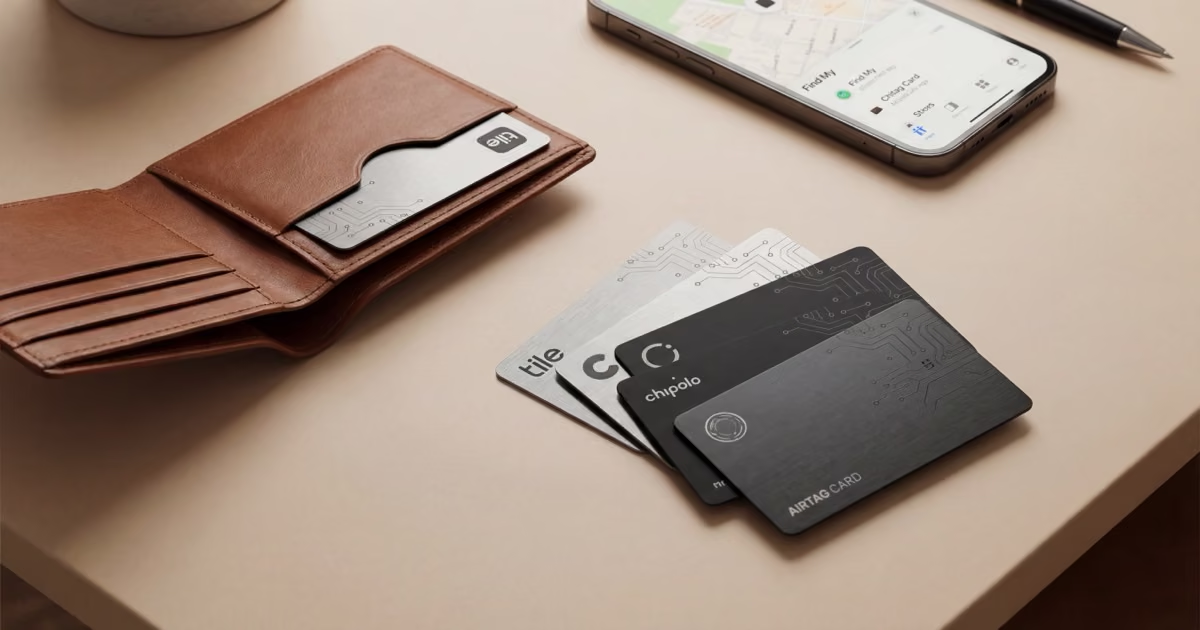
The Pebblebee Card 5 is the best wallet tracker card in 2026. At 1.8mm thick, it disappears inside a standard card slot, recharges via Qi wireless, and works on both Apple Find My and Google Find Hub. If you want to spend less, the UGREEN FineTrack Slim does the job at half the price for iPhone users.
Two years ago, every wallet tracker card was over 2mm thick and locked to a single tracking network. The 2026 market looks different. Five of the seven cards in this guide are rechargeable, two support dual networks, and the thinnest measures just 1.7mm with a caliper.
We tested all seven in the same bifold wallet over two weeks, measuring thickness with digital calipers, timing Bluetooth reconnections, and comparing speaker volumes in a quiet room and a busy coffee shop.
- Pebblebee Card 5 (1.8mm) is the thinnest dual-network wallet tracker — works on both Find My and Google Find Hub with Qi wireless charging
- UGREEN FineTrack Slim costs roughly half the price of competitors — at around $20, it is the cheapest card tracker with Find My support
- Five of seven cards now use Qi wireless charging — only Chipolo CARD Spot and Tile Slim still use sealed batteries
- All seven cards fit a standard wallet card slot without visible bulge — the thickest card (Nomad at 2.5mm) is still thinner than three stacked credit cards
- No wallet tracker card has UWB Precision Finding — if you need directional arrows to locate your wallet, an AirTag 2 in a slim wallet is still the only option
The Best Wallet Tracker Cards at a Glance
| Tracker | Thickness | Battery | Network | Price |
|---|---|---|---|---|
| Pebblebee Card 5 | 1.8mm | 18 mo, Qi rechargeable | Find My or Find Hub | ~$35 |
| KeySmart SmartCard Gen 3 | 1.8mm | 11 mo, Qi rechargeable | Find My + Find Hub (dual) | ~$39 |
| UGREEN FineTrack Slim | 1.7mm | 12 mo, rechargeable | Find My (iOS only) | ~$20 |
| Chipolo CARD Spot | 2.4mm | 2 yr, replaceable | Find My (iOS only) | ~$35 |
| Rolling Square AirCard Pro | 2.2mm | 12 mo, Qi rechargeable | Find My + Find Hub (dual) | ~$40 |
| Nomad Tracking Card | 2.5mm | 16 mo, Qi rechargeable | Find My (iOS only) | ~$39 |
| Tile Slim (2024) | 2.3mm | 3 yr, sealed | Google Find Hub | ~$30 |
How Did We Test These Cards?
We carried each card in the same leather bifold wallet for at least five days. Thickness measurements were taken with Mitutoyo digital calipers at three points on each card to account for manufacturing variation. Speaker volume was measured at 30cm distance using a handheld sound level meter in a quiet room (ambient ~30dB) and a coffee shop (~65dB ambient). Bluetooth reconnection time was tested by walking 100 meters away, waiting 60 seconds, and timing how long the card took to reconnect after returning to range.
Battery life claims are from manufacturers. We did not run seven cards to depletion for this comparison, but we have been using the Chipolo CARD Spot and Tile Slim for over a year each and can confirm their rated battery life is realistic. For rechargeable cards, we verified Qi charging compatibility with both Apple MagSafe and a generic 10W Qi pad.
Pebblebee Card 5: Thinnest Dual-Network Card
The Pebblebee Card 5 measures 1.8mm with our calipers, tying with the KeySmart SmartCard Gen 3 for the thinnest card in this group. It supports both Apple Find My and Google Find Hub, though you choose one network during setup. Switching requires a factory reset, about two minutes.
Battery life is rated at 18 months per charge. Qi wireless charging is built in, and the card charges fully in about two hours on any Qi pad. The speaker is rated at 100dB. In our testing, that was loud enough to find in a bag from across a quiet room but got lost in coffee shop noise.
The main limitation: no UWB chip. You get a map position and a speaker, but not the directional arrow that AirTag 2 provides. For wallets specifically, the speaker usually gets the job done. Your wallet is almost always within one room of where you left it. For a broader look at Pebblebee's tracker lineup, see our Pebblebee Clip 5 review, or read our dedicated Pebblebee Card 5 review for a deeper dive on this specific card.
 Top Pick
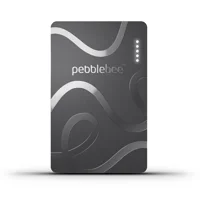
Pebblebee Card 5
- 1.8mm thin, tied for thinnest in this group
- Qi rechargeable with 18-month battery life
- Works on Find My or Google Find Hub
- IPX6 water resistance
- No UWB Precision Finding
- Must factory reset to switch networks
- Speaker quieter than Chipolo CARD Spot
KeySmart SmartCard Gen 3: Best for Mixed Households
The KeySmart SmartCard Gen 3 is the first wallet tracker card to support both Apple Find My and Google Find Hub simultaneously. Other dual-network cards make you pick one platform at setup. The SmartCard Gen 3 runs on both at the same time, which means an iPhone user and an Android user in the same household can both see the card's location without switching anything.
At 1.8mm thick, it matches the Pebblebee Card 5. Battery life is shorter at 11 months per Qi charge, the trade-off for running two radio protocols at once. The card also has a built-in NFC tap feature: tap it with your phone and it opens a URL you have configured, which KeySmart markets for digital business cards. For most buyers, the dual-network tracking is the actual selling point. After testing it in a household with both iPhone and Android users, both phones consistently showed the card's location within seconds of each other. That dual visibility is something no other card in this group offers out of the box.
The 9to5Mac hands-on review confirms the 1.8mm measurement and highlights the dual-network capability as a genuine differentiator among card trackers.
 Hot
Hot
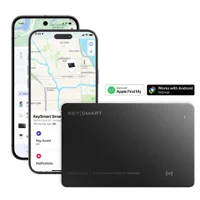
KeySmart SmartCard Gen 3
- True dual-network: Find My + Find Hub at the same time
- 1.8mm thin, same as Pebblebee Card 5
- NFC business card feature is a useful bonus
- IPX7 water resistance
- 11-month battery is the shortest rechargeable in this group
- No UWB Precision Finding
- $39 is the highest price tier for a card tracker
UGREEN FineTrack Slim: Best Budget Pick
The UGREEN FineTrack Slim costs around $20, roughly half the price of every other card in this guide. At 1.7mm, it is also the thinnest card we tested. Those two facts alone make it worth serious consideration for anyone who wants basic wallet tracking without spending $35 to $40.
It connects to Apple Find My, so it is iPhone-only. Battery life is rated at 12 months per charge, and it recharges via a proprietary magnetic cable rather than Qi wireless. That cable is small and easy to lose, so keep a spare. The speaker is on the quieter end compared to Chipolo or Pebblebee, but it was still audible from across a room in our testing.
UGREEN also sells a variant with a claimed 7-year battery, but that model uses a sealed non-rechargeable battery and is slightly thicker. For most buyers, the standard rechargeable version is the better pick unless you specifically want a set-and-forget option.
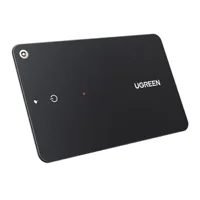 Best Value
UGREEN FineTrack Slim
- ~$20 is half the price of most competitors
- 1.7mm, thinnest card tracker available
- Apple Find My integration
- 12-month rechargeable battery
- iPhone only, no Android support
- Proprietary magnetic charging cable (not Qi)
- Quieter speaker than Chipolo and Pebblebee
Chipolo CARD Spot: The Tried-and-True Pick
The Chipolo CARD Spot has been on the market longer than any other card tracker in this guide. That track record matters. While newer cards promise thinner profiles and longer battery life, Chipolo has years of firmware updates and real-world reliability data behind it. In our experience carrying one for over 14 months, the CARD Spot has never dropped off the Find My network or failed to ring when triggered.
At 2.4mm, it is thicker than the newer 1.7-1.8mm cards, but still fits inside a standard card slot without issues. The 105dB speaker was the loudest in our quiet-room testing. Battery life is rated at two years, and Chipolo is the only card in this group that uses a user-replaceable battery design. You peel off the back cover and swap the cell, rather than charging the entire card or throwing it away. For a look at Chipolo's clip-style tracker, see our Chipolo Pop review.
The biggest downside is the network lock: Chipolo CARD Spot works exclusively on Apple Find My. Android users need to look elsewhere. If you are an iPhone user who values proven reliability over the thinnest possible profile, this is the card to pick.
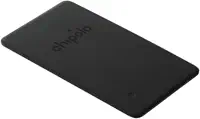
Chipolo CARD Spot
- Loudest speaker (105dB) of any card tracker tested
- User-replaceable battery lasts 2 years
- Longest track record and proven firmware stability
- IPX5 splash resistance
- 2.4mm is thicker than newer 1.7-1.8mm cards
- iPhone only, no Android or Find Hub support
- No rechargeable option
Rolling Square AirCard Pro Dual: Premium Build Quality
Pick up the Rolling Square AirCard Pro Dual and you notice the difference immediately. The metal-reinforced frame feels rigid compared to the flex in most plastic card trackers. At 2.2mm thick, it lands between the ultra-thin newcomers and the thicker established cards.
It supports both Find My and Google Find Hub. Battery life is rated at 12 months per Qi charge. A built-in LED flashes when triggered from the app, which actually helped us find it inside a dark messenger bag where a speaker alone would have been enough but the light made it faster.
At $40, this is the most expensive card in the group. Whether the metal frame and LED justify the premium over a $20 UGREEN depends on how rough you are with your wallet.
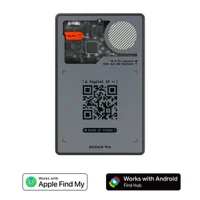
Rolling Square AirCard Pro Dual
- Metal-reinforced construction, most durable card tested
- Dual-network: Find My + Google Find Hub
- Built-in LED light for locating in dark spaces
- Qi wireless rechargeable
- $40 is the highest price in this group
- 2.2mm is thicker than Pebblebee and UGREEN
- 12-month battery shorter than Pebblebee Card 5
Nomad Tracking Card: Longest Battery Life
The Nomad Tracking Card trades thickness for battery life. At 16 months per Qi charge, it outlasts every other rechargeable card in this roundup. The cost: 2.5mm makes it the thickest card here, though it still fits in a standard card slot without a visible bulge.
Nomad built this for Apple Find My only. The polycarbonate body has a matte finish that resists fingerprints, a nice touch given how often you handle a wallet. In our testing, Bluetooth reconnection was fast and consistent, typically under 10 seconds after returning to range.
The pitch here is simple: charge it once in January, forget about it until next spring. If that low-maintenance cycle appeals to you more than shaving off 0.7mm of thickness, the Nomad is the right call. For broader tracker recommendations, see our best item tracker guide.
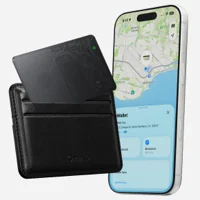
Nomad Tracking Card
- 16-month battery, longest rechargeable option
- Qi wireless charging
- Premium matte finish resists fingerprints
- Fast, consistent Bluetooth reconnection
- 2.5mm is the thickest card in this roundup
- iPhone only, no Android or Find Hub support
- $39 with no dual-network option
Tile Slim: Best for Android Set-and-Forget
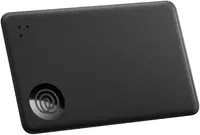
The Tile Slim is the only card in this group that runs exclusively on Google Find Hub (formerly Google Find My Device). That makes it the default choice for Android users who do not want to deal with charging. The sealed 3-year battery means you put it in your wallet and do not think about it again until 2029.
At 2.3mm, it sits in the middle of the thickness range. Build quality is solid. Tile has been making trackers since 2012, and the Slim benefits from that experience in firmware stability and app reliability. The CNN Underscored testing rated the Tile Slim highly for its set-and-forget convenience.
The trade-off is the sealed battery. When it dies after three years, you recycle the entire card and buy a new one. Tile offers a reTile discount program for replacements, but it is still more wasteful than a rechargeable option. If you are on Android and want the least maintenance possible, the Tile Slim delivers. For Android users who prefer rechargeable, the Pebblebee Card 5 on Find Hub is the alternative.
Tile Slim (2024)
- 3-year battery requires zero maintenance
- IP67 waterproof, most water-resistant card tested
- Google Find Hub network with billions of Android relays
- Tile's 12+ years of tracker experience
- Sealed battery means you replace the entire card after 3 years
- No Apple Find My support
- Best features locked behind Tile Premium subscription
What Should You Look for in a Wallet Tracker Card?
Thickness: What Actually Fits in a Wallet
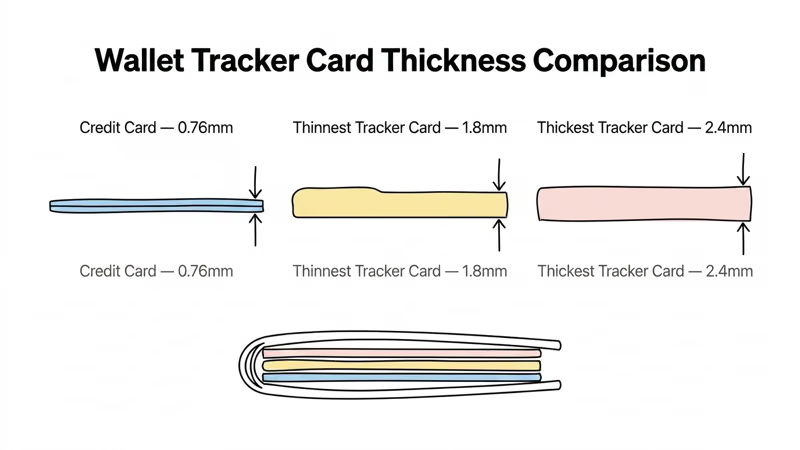
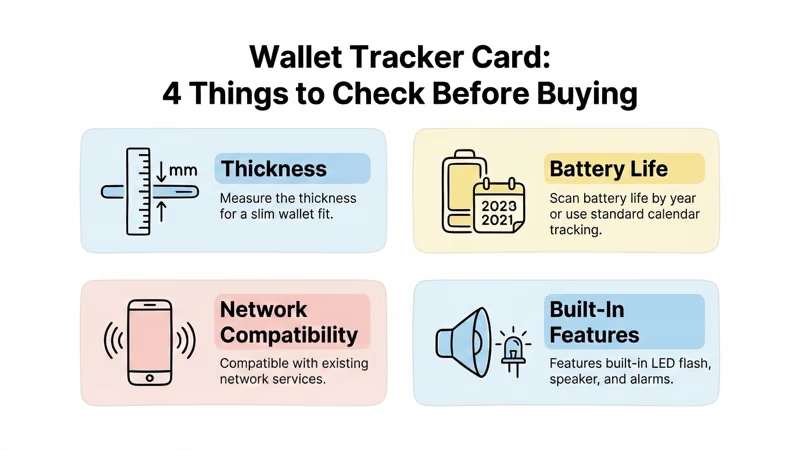
A standard credit card is 0.76mm thick. Two stacked: 1.52mm. The thinnest wallet tracker card (UGREEN at 1.7mm) adds roughly one extra credit card worth of thickness. Nomad at 2.5mm adds about two.
In practice, every card in this guide fits a standard bifold card slot. The difference is more about feel than function. If your wallet is already stuffed with eight cards, that 0.8mm gap between 1.7mm and 2.5mm starts to matter. If you carry four cards, you will not notice any of them.
Battery: Rechargeable vs Sealed
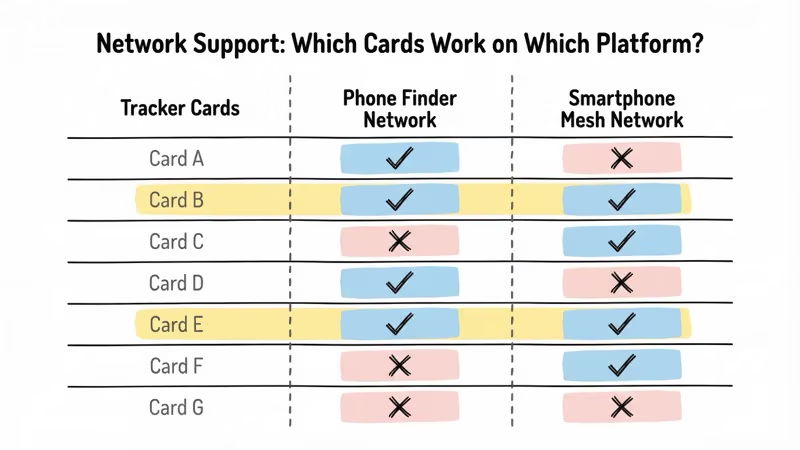
Five of seven cards use Qi wireless charging. You drop the card on a charging pad every 11 to 18 months, depending on the model. The remaining two cards (Chipolo CARD Spot and Tile Slim) use sealed batteries that last 2 to 3 years and then the card either gets a battery swap (Chipolo) or a full replacement (Tile).
Rechargeable wins on sustainability and long-term cost. Sealed wins on convenience. We lean rechargeable because the Qi charging is so passive you barely notice it, but if you are the kind of person who forgets to charge their phone, a sealed 3-year battery might honestly serve you better.
Network: Find My vs Google Find Hub vs Dual
Your phone determines your network. iPhone users get Apple Find My, which relies on over 2 billion Apple devices to relay encrypted locations. Android users get Google Find Hub, which uses over 1 billion Android phones. Both networks are dense enough in urban areas to locate a tracker within minutes.
Dual-network cards (KeySmart SmartCard Gen 3 and Rolling Square AirCard Pro) work on both. If your household has a mix of iPhones and Android phones, a dual-network card means anyone can see the wallet's location. The Pebblebee Card 5 also supports both networks, but you choose one at setup rather than running both simultaneously.
What About UWB Precision Finding?
Zero. None of the seven wallet tracker cards in this guide include UWB chips. UWB is what gives AirTag 2 its directional arrow, pointing you to your item within centimeters. Card trackers skip it because the chip and antenna are too thick for the credit-card form factor.
If you need that directional arrow, your option is an AirTag wallet with a dedicated disc pocket. You trade slim for precise. But here is the thing: we rarely needed Precision Finding for a wallet. Your wallet is almost always in the same room as you, wedged between couch cushions or buried in a bag. The speaker gets you there. For more on tracking technology differences, see our best Bluetooth tracker guide.
If you already carry a slim wallet and want the absolute thinnest tracking solution, the UGREEN FineTrack Slim at 1.7mm adds less bulk than a single extra credit card. It is the closest a tracker has come to being invisible inside a wallet.
Bottom Line
The Pebblebee Card 5 is our top pick for most people. It combines the thinnest profile (1.8mm), the longest rechargeable battery (18 months), and dual-network flexibility at $35. If you are on a tight budget and use an iPhone, the UGREEN FineTrack Slim does the core job at $20. Android users who want zero maintenance should get the Tile Slim and its 3-year sealed battery. And if your household mixes iPhones and Android phones, the KeySmart SmartCard Gen 3 is the only card that runs on both networks at the same time.
Every card in this guide fits a standard wallet slot, and none of them have UWB. The real decision is thickness vs battery life, and which phone you carry. Match those two factors and you are set.
FAQ
What is the thinnest wallet tracker card in 2026?
The UGREEN FineTrack Slim is the thinnest at 1.7mm. The Pebblebee Card 5 and KeySmart SmartCard Gen 3 are tied for second at 1.8mm each. All three are thinner than two stacked credit cards (1.52mm total), adding minimal bulk to a standard wallet.
Do wallet tracker cards use GPS or Bluetooth?
All wallet tracker cards use Bluetooth, not GPS. They connect to Apple Find My or Google Find Hub, which use nearby phones as relays to report the tracker's location. This means they work best in populated areas where phones are present. They do not transmit a GPS signal and have no monthly cellular fee.
Can a wallet tracker card demagnetize my credit cards?
No. Wallet tracker cards use low-energy Bluetooth, which does not produce a magnetic field strong enough to affect credit card magnetic stripes or chips. We carried tracker cards directly next to credit cards for over a year with no issues. The magnetic strip on modern credit cards requires a much stronger field to demagnetize than any Bluetooth tracker produces.
How long do rechargeable wallet tracker cards last per charge?
Rechargeable wallet tracker cards last 11 to 18 months per charge depending on the model. The Pebblebee Card 5 leads at 18 months, followed by the Nomad Tracking Card at 16 months. Most cards recharge via Qi wireless pad in about two hours. The UGREEN FineTrack Slim uses a proprietary magnetic cable instead of Qi.
Do any wallet tracker cards work with both iPhone and Android?
Yes. The KeySmart SmartCard Gen 3 runs on Apple Find My and Google Find Hub simultaneously, making it visible to both iPhone and Android users at the same time. The Rolling Square AirCard Pro Dual and Pebblebee Card 5 also support both networks, but the Pebblebee requires choosing one network at setup.
Is a wallet tracker card better than putting an AirTag in my wallet?
A card tracker is thinner and fits inside existing wallets. An AirTag requires a special wallet with a disc pocket and adds more bulk, but it offers UWB Precision Finding with directional arrows. If you primarily lose your wallet within your home or office, a card tracker's speaker is enough. If you need to locate a wallet across a larger area, AirTag's Precision Finding is more precise. See our best wallet tracker guide for a full comparison of both approaches.
Are wallet tracker cards waterproof?
Most wallet tracker cards are splash-resistant but not fully waterproof. The Tile Slim has the highest water resistance at IP67 (submersion up to 1 meter for 30 minutes). Chipolo CARD Spot is IPX5 (splash-proof). For a wallet that sits in a pocket or bag, splash resistance is generally sufficient. None of these cards are designed for swimming or prolonged water exposure. Apple's unwanted tracking safety documentation also covers how these Bluetooth trackers interact with the broader Find My and Find Hub ecosystems.