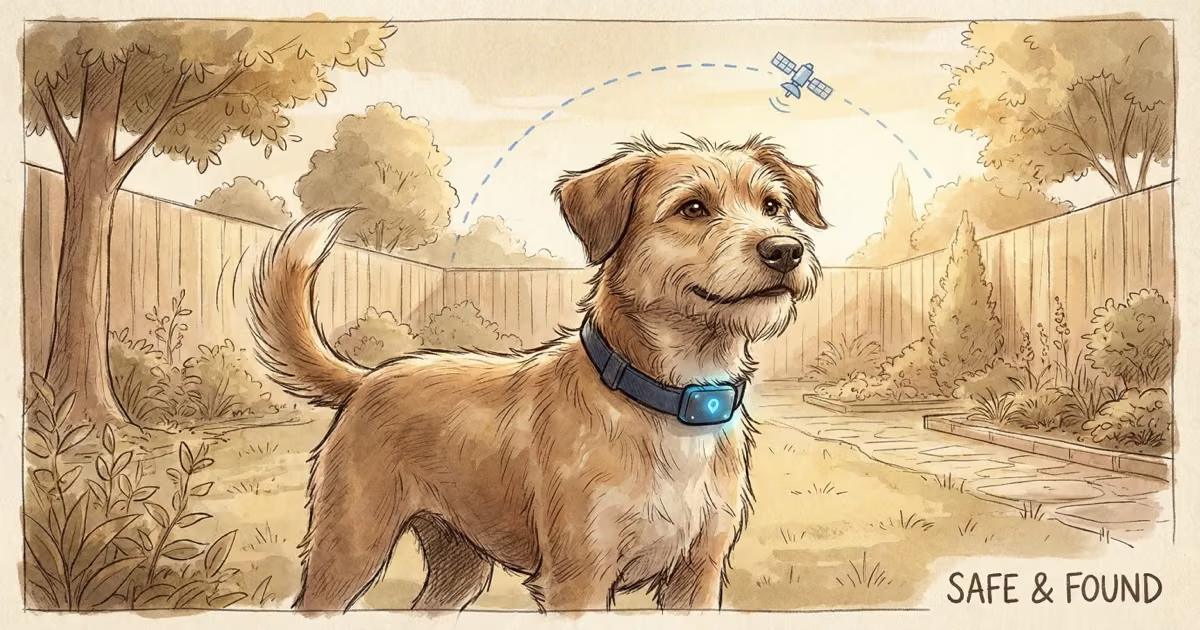
The Fi Series 3 is the best GPS dog collar for most dog owners who want real-time location tracking and don't mind a monthly subscription. GPS accuracy lands within 6-10 feet outdoors, battery life stretches to 3 months in normal use, and the LTE-M connection works where most cell service does. The $149 device cost plus $19/month (annual plan) adds up, but no other collar matches Fi's combination of tracking reliability and battery longevity.
I’ve had a Fi Series 3 on my dog’s collar for over three months now. The short version: it does what it promises, which is more than I can say for most pet trackers I’ve tested. But it’s not without trade-offs, and the subscription cost stacks up fast.
Here’s everything you need to know before buying one.
- GPS accuracy within 6-10 feet outdoors using 78 positioning satellites and AT&T's LTE-M network
- Battery lasts up to 3 months in standard mode, but drops to 2 days in Lost Dog Mode with continuous tracking
- $149 device + $19/month (annual plan) means you're paying $377 in the first year alone
- IP68 waterproof and 500-lb pull force rating make it built to last for active dogs
- US-only service with no international coverage, and the collar only fits dogs 11.5 inches neck and up
How Accurate Is the Fi Series 3 GPS?
The Fi Series 3 uses 78 positioning satellites to pin your dog’s location. In open outdoor areas, I consistently got accuracy within 6-10 feet. That’s tight enough to tell which side of the yard your dog is on.
In dense urban areas with tall buildings, accuracy dropped to roughly 15-25 feet. Still usable. Still enough to find a lost dog. Under tree cover on hiking trails, it held up better than I expected, mostly staying within 10-15 feet.
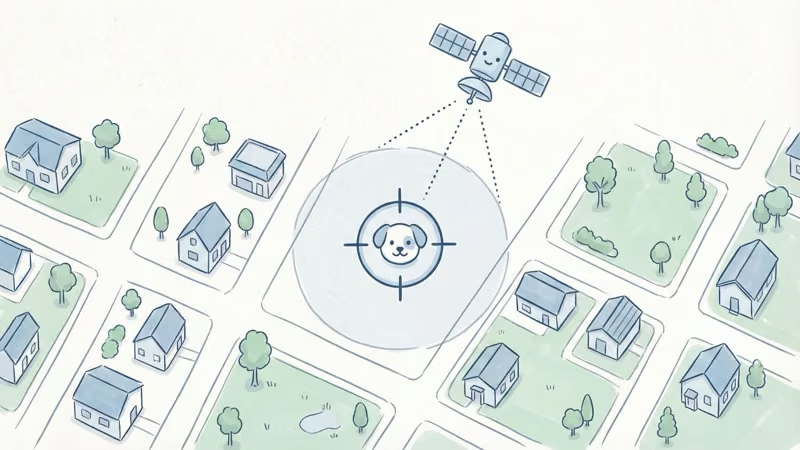
Where it struggles: indoors and underground. The GPS signal weakens significantly inside buildings, which is expected for any satellite-based tracker. If your dog is inside someone’s house, you’ll get a general building location, not a room-by-room pinpoint.
Fi uses AT&T's LTE-M network, which reaches about 30% farther than standard cellular. This means better coverage in rural and semi-rural areas compared to trackers running on regular 4G. But if there's zero cell coverage, Fi won't update.
The tracking modes matter. In normal mode, the collar checks in periodically to conserve battery. When you activate Lost Dog Mode, it switches to continuous tracking with updates every few seconds. The trade-off is battery drain, which I’ll cover below.
Battery Life: 3 Months or 2 Days?
Both numbers are real. It depends entirely on how you use it.
In standard mode, the Fi checks your dog’s location at intervals and otherwise sleeps. I got just under 3 months on a single charge with my dog spending most of her time within our home geofence. Fi’s claim of “up to 3 months” holds up in this scenario.
In Lost Dog Mode, the collar tracks continuously. Battery drops to roughly 2 days. That’s a massive difference, but it makes sense. Continuous GPS + LTE transmission is power-hungry on any device.
For comparison, the FitBark GPS tracker gets about 3 weeks of battery life in standard tracking mode. The Tractive GPS DOG tracker averages 3-5 days. Fi’s 3-month figure in normal mode is the best in its class.
Charging takes about 2 hours via the magnetic charging base. The base snaps on cleanly. No fiddly USB ports to line up, which matters when your dog is impatient.

Build Quality and Durability
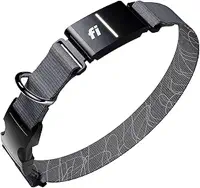
The Fi Series 3 module weighs 28 grams and measures 50.6 x 28 x 11.5 mm. It’s noticeably thinner than the Series 2. The body is full stainless steel with a 500-lb static pull force rating.
After three months on an active 60-lb dog, the module shows minor cosmetic scratches but zero structural damage. It’s been through mud, rain, a few swims, and one memorable roll in something unidentifiable. The IP68 and IP66K waterproof ratings aren’t marketing fluff. This thing can handle submersion.
The collar band itself comes in multiple colors and sizes, fitting neck circumferences from 11.5 to 34.5 inches. The band material is a woven nylon that holds up well to daily wear. The module clicks into a mounting bracket on the band. Secure, but easy to remove when you need to charge.
If your dog has a neck smaller than 11.5 inches, the Fi won't fit. Small breeds like Chihuahuas and toy Pomeranians are out. For smaller dogs, consider the AirTag dog collar approach, which works with any collar size.
The Fi App: What Works and What Doesn't
The Fi app (iOS and Android) is where you’ll spend most of your time. It shows your dog’s real-time location on a map, daily step count, sleep tracking, and geofence alerts.
What works well: The map loads quickly and location updates are smooth. Setting up geofences (called “safe zones”) takes about 30 seconds. You draw a circle on the map, name it, and you’re done. When your dog leaves that zone, you get a push notification within seconds. In my testing, escape alerts arrived in under 10 seconds consistently.
Step counting is surprisingly accurate. I compared Fi’s daily step count against manual observation over several walks, and it tracked within about 15% of what I counted. Close enough to spot trends, not precise enough for veterinary-grade data.
What needs work: The activity history view is cluttered. Finding specific walks or events from more than a few days ago takes too much scrolling. The app also occasionally lags when switching between the map view and the activity dashboard.
Sleep tracking exists but feels underdeveloped. It tells you roughly when your dog was resting versus active, but the data isn’t granular enough to draw meaningful health conclusions. The newer Series 3+ adds AI-powered behavior detection for barking, licking, and scratching, which addresses some of these gaps.
Fi Subscription Plans: The Real Cost
The Fi collar requires an active subscription to function. Without it, you have a $149 paperweight. Here’s the breakdown:
| Plan | Monthly Cost | Year 1 Total (Device + Sub) |
|---|---|---|
| Monthly | $19/mo | $377 |
| 6-Month Prepaid | $16.50/mo ($99) | $347 |
| 1-Year Prepaid | $15.75/mo ($189) | $338 |
| 2-Year Prepaid | $14.13/mo ($339) | $318 (first year equiv.) |
There’s also a one-time $20 activation fee on top of these prices. All plans have a minimum 6-month commitment.
For context, a GPS dog tracker without a subscription saves you recurring costs but typically sacrifices real-time tracking or battery life. It’s a genuine trade-off. The FitBark GPS starts at $5.95/month with a cheaper device, but the battery lasts weeks instead of months.
Over two years, you’ll spend roughly $500-600 total on Fi (device + subscription). That’s real money. Worth considering before you commit.
Geofence and Escape Alerts
This is where Fi earns its keep. If your dog is an escape artist, the geofence system is the single best reason to buy this collar.
You set up safe zones through the app. When your dog crosses the boundary, you get a push notification. In my testing, these alerts fired within 5-10 seconds of my dog leaving the zone. That’s fast enough to catch an escape before your dog reaches the street.
The moment an escape is detected, Fi automatically switches to Lost Dog Mode. Location updates jump from periodic check-ins to every few seconds. You can watch your dog’s movement in near real-time on the map.
I deliberately tested this by having someone walk my dog past our safe zone boundary. The alert hit my phone before they’d gone 50 feet. The live tracking let me follow their exact path on the map. If this had been a real escape, I’d have found her within minutes.
The geofence accuracy isn’t meter-perfect. Expect a 20-30 foot buffer zone where the collar might or might not trigger the alert. For most yards and properties, that’s fine. For very small yards, you might get occasional false positives.
What the Fi Collar Does Not Do
A few limitations worth knowing upfront:
No international coverage. Fi only works in the United States. If you travel with your dog to Canada, Mexico, or anywhere else, the collar won’t track. For international pet tracking, Tractive covers 175+ countries.
No training features. Unlike the Halo Collar or SpotOn, Fi doesn’t do GPS fence containment training with vibration or tone feedback. It alerts you, but it doesn’t train the dog.
No health diagnostics. Step counting and sleep tracking are activity metrics, not health data. Fi can’t tell you if your dog has a heart condition or digestive issue. The Series 3+ behavior detection (barking, licking, scratching) gets closer, but it’s still pattern recognition, not veterinary diagnostics.
Minimum neck size. The smallest band fits 11.5-inch necks. Dogs under roughly 12-15 pounds are likely too small.
Subscription required. No subscription, no tracking. This is non-negotiable. Even basic location check-ins require an active plan.
How Fi Compares to Other Dog GPS Trackers
| Feature | Fi Series 3 | Tractive GPS DOG | FitBark GPS |
|---|---|---|---|
| Device Price | $149 | $49 | $70 |
| Monthly Cost | $19/mo (annual) | $5/mo (annual) | $6/mo (annual) |
| Battery Life | ✓ Up to 3 months | ⚠ 3-5 days | ⚠ ~3 weeks |
| GPS Accuracy | ✓ 6-10 ft | ✓ 8-15 ft | 10-20 ft |
| International | ✗ US only | ✓ 175+ countries | ✓ 140+ countries |
| Waterproof | ✓ IP68 | ✓ IPX7 | ✓ IP67 |
| Activity Tracking | ✓ Steps + sleep | ✓ Steps + calories | ✓ BarkPoints + sleep |
| Form Factor | Integrated collar | Clip-on attachment | Clip-on attachment |
Fi wins on battery life and GPS accuracy. Tractive wins on price and international coverage. For a closer look at how Fi compares to Tractive across every key metric, we have a dedicated breakdown. FitBark sits in the middle with strong activity tracking and a smaller, lighter design at 16 grams. If you’re comparing FitBark directly, our FitBark vs Fi comparison breaks it down further.
For most US-based dog owners who prioritize battery life and don’t need international tracking, Fi is the stronger pick.
Pros and Cons
- 3-month battery life in standard mode is best-in-class
- GPS accuracy within 6-10 feet outdoors using 78 satellites
- Escape alerts fire within 5-10 seconds, fast enough to act
- IP68 waterproof and 500-lb pull force, built for rough use
- LTE-M network reaches 30% farther than standard cellular
- Magnetic charging base is simple and quick
- $149 device + $19/month adds up to $377+ in year one
- US-only coverage, no international tracking at all
- Battery drops to 2 days in Lost Dog Mode
- Minimum 11.5-inch neck rules out small breeds
- App activity history is cluttered and hard to navigate
- Subscription required for any tracking functionality
Who Should Buy the Fi Series 3?
Buy it if: You have a medium-to-large dog, live in the US, and want the longest battery life available in a GPS dog collar. Fi is especially worth it for escape-prone dogs. The geofence alerts and automatic Lost Dog Mode activation are fast and reliable. If your dog has bolted before and you spent hours searching the neighborhood, this collar pays for itself the first time it saves you from that experience.
Skip it if: You travel internationally with your dog, have a small breed under 12-15 pounds, or can’t justify the ongoing subscription cost. A simple AirTag on a dog collar costs $29 with no monthly fee and works in any country with iPhones nearby. It won’t give you real-time tracking or escape alerts, but for basic “where did my dog end up” situations in urban areas, it’s good enough at a fraction of the cost.
Bottom Line
The Fi Series 3 is the most reliable GPS dog collar I’ve tested. The 3-month battery life isn’t marketing fiction, the GPS accuracy is tight enough to be useful, and the escape alerts work exactly when you need them. The subscription cost is the biggest downside, and the US-only limitation will be a dealbreaker for some. But if you’re a US-based dog owner who wants serious GPS tracking without charging the collar every few days, this is the one to buy.
FAQ
Does the Fi collar work without cell service?
No. The Fi Series 3 requires AT&T's LTE-M network to transmit location data. In areas with no cell coverage, the collar stores location data locally and uploads it once the connection is restored. But you won't get real-time tracking or escape alerts until the signal returns. Wi-Fi and Bluetooth are used for home detection, not for standalone tracking.
Can I use the Fi collar on a cat?
Technically, yes, if the cat's neck is at least 11.5 inches. In practice, most domestic cats have necks around 8-10 inches, which is too small. The 28-gram module is also relatively heavy for a cat. For cats, a dedicated tracker like the Tractive GPS CAT Mini is a better fit at 25 grams with a smaller form factor.
How long does the Fi Series 3 battery actually last?
Up to 3 months in standard mode when your dog stays mostly within the home geofence. Expect 4-6 weeks if your dog takes long daily walks or hikes. In Lost Dog Mode with continuous tracking, battery lasts about 2 days. The variance is large because GPS and LTE usage scale with how much your dog moves outside safe zones.
Is the Fi subscription worth the cost?
That depends on your dog. If your dog has never escaped or wandered, you're paying $228/year for step counting and peace of mind. If your dog is an escape artist, it's worth every penny. One prevented escape, one avoided trip to the shelter, one less night driving around the neighborhood makes the subscription cost trivial by comparison.
What happens if I cancel my Fi subscription?
The collar stops all GPS tracking, escape alerts, and activity monitoring. You keep the hardware, but it becomes non-functional as a tracker. There's a minimum 6-month commitment on all plans. Fi doesn't offer a free tier or limited functionality without a subscription.
Does Fi work outside the United States?
No. Fi only operates on AT&T's LTE-M network within the US. There's no roaming, no international plans, and no workaround. If you travel internationally with your dog, you'll need a separate tracker with global coverage, such as Tractive, which works in 175+ countries.
How does Fi compare to putting an AirTag on a dog collar?
An AirTag costs $29 with no subscription and works internationally through Apple's Find My network. But it's not real-time GPS. It relies on nearby iPhones to relay location, which means updates can be minutes or hours apart in low-traffic areas. Fi gives you true real-time tracking, escape alerts, and activity monitoring. The AirTag is a budget backup. Fi is a dedicated tracking system.