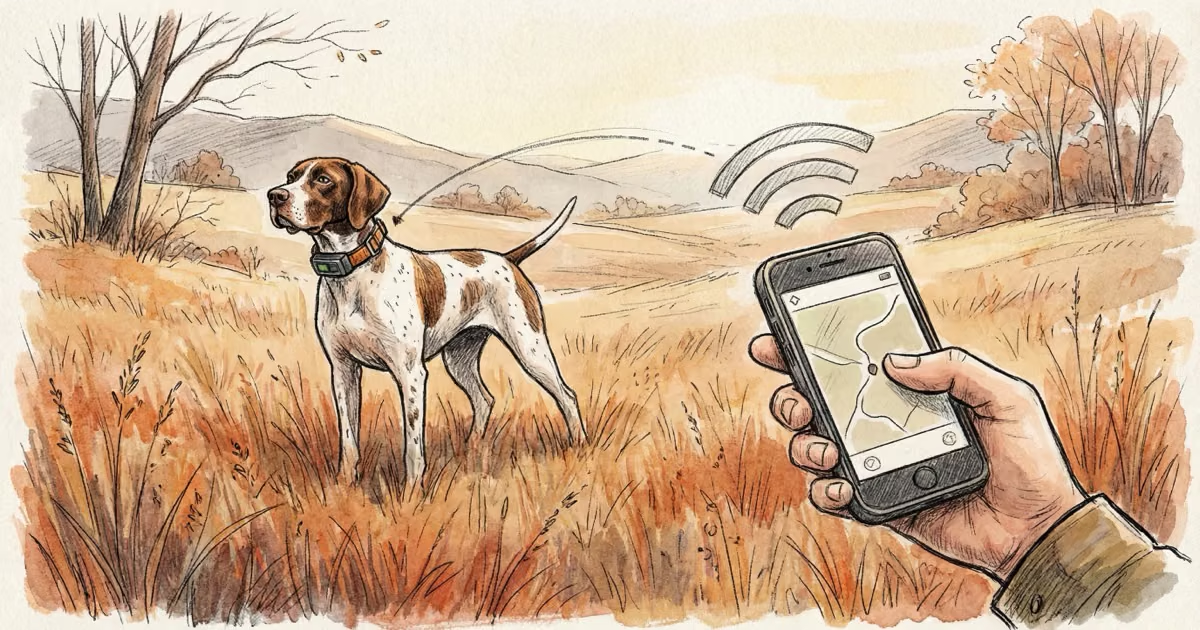
The Dogtra Pathfinder 2 is the best GPS tracking and e-collar combo for hunters who don't want to spend $800+ on a Garmin system. It tracks up to 21 dogs from 9 miles, updates every 2 seconds, includes 100 stimulation levels, and costs $429.99 with no monthly fees. The trade-off: it uses your smartphone as the display instead of a dedicated handheld, which means your phone's battery and durability become part of the equation.
The Dogtra Pathfinder 2 does two things at once: it tracks your dog’s GPS position and delivers e-collar training commands. That combination used to mean spending $700-900 on a Garmin Alpha. Dogtra cuts that roughly in half by replacing the dedicated handheld with your smartphone.
I ran the Pathfinder 2 across two hunting seasons alongside a Garmin Alpha TT 25. The short version: it matches Garmin on paper specs and comes close in the field. But there are real trade-offs that matter depending on how and where you hunt.
- The Dogtra Pathfinder 2 costs $429.99 with zero monthly fees, roughly half the price of a comparable Garmin Alpha system.
- GPS range is rated at 9 miles with 2-second updates, but expect 4-6 miles in heavy timber and hilly terrain.
- 100 stimulation levels plus tone and vibration give finer training control than Garmin's 18 levels.
- Your smartphone is the display, which means phone battery drain, weather exposure, and no backup if your phone dies.
- Tracks up to 21 dogs simultaneously with no subscription, and the app supports offline Google Maps-based satellite imagery.
Dogtra Pathfinder 2: What You Get for $429.99
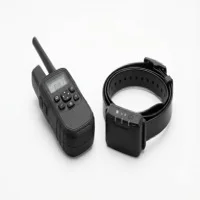
The box includes a transmitter (3.7 oz), a receiver collar (6.6 oz), a charging cradle, test light, and contact points. The receiver measures 3.4" x 1.5" x 1.7" and fits dogs 25 lbs and up. The Pathfinder 2 system connects to your phone via Bluetooth 5.0 and uses the free Dogtra Pathfinder app (iOS 12.1+ or Android 6.0+) for all mapping and training controls.
One detail worth knowing upfront: the Pathfinder 2 is not backward-compatible with the original Pathfinder series. If you're upgrading, your old collars won't work with the new transmitter.
GPS Tracking Performance in the Field
The headline spec is 9-mile range with 2-second position updates. In open country -- flat fields, minimal tree cover -- I verified close to that. The collar held a solid GPS lock past 7 miles on a straight county road test.
In real hunting conditions, the numbers come down. Running dogs through Appalachian hardwood ridges with 200-foot elevation changes, reliable tracking held at 4-6 miles. That's still more than enough for most hunting scenarios. I rarely needed to track a dog past 3 miles in practice.
The 2-second update rate matters more than you'd expect. On a hot track, a bird dog covers 200 yards in 30 seconds. At 2-second intervals, you get 15 position pings in that window -- enough to see direction changes and figure out whether the dog is casting or committed. The Garmin Alpha updates at 2.5 seconds, which sounds trivial until you're watching a screen trying to read a running dog.
The Pathfinder 2 includes a Sleep Mode that reduces the GPS refresh rate and LED flash rate to extend battery during downtime. Turn it on when you're driving between spots or stopped for lunch.
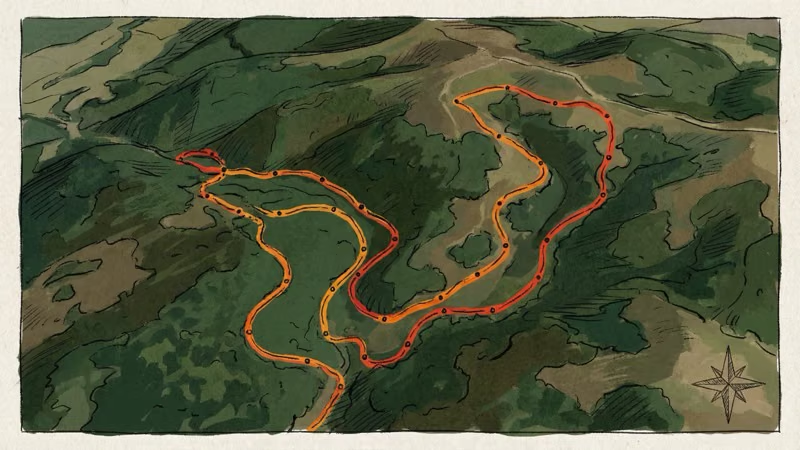
GPS accuracy itself is solid. In side-by-side testing with my Garmin, the Pathfinder placed the dog within 10-15 feet of the Garmin's position in most conditions. I noticed slightly more drift in heavy canopy, but nothing that affected my ability to locate the dog.
The Smartphone Dependency Problem
This is the biggest trade-off. The Pathfinder 2 does not have a standalone handheld unit. Your phone is the screen, the map, and the training controller.
That matters in three ways:
Battery drain. Running the Pathfinder app with GPS active and the screen on drains a modern iPhone at roughly 15-20% per hour. A full day of hunting means carrying a battery pack. I used an Anker 10,000mAh pack clipped to my vest, which added weight but kept the phone alive through 8-hour days.
Weather exposure. Garmin's Alpha handheld is built for rain, mud, and cold. Your iPhone is not. I used a LifeProof case and kept the phone in a chest pocket, but pulling it out in freezing rain to check a dog's position is not the same experience as glancing at a ruggedized handheld strapped to your vest. In below-freezing temperatures, my phone's touchscreen responsiveness dropped noticeably.
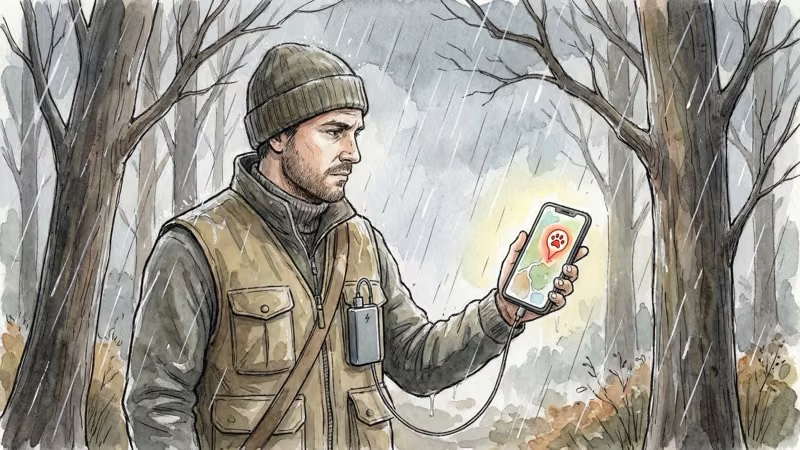
Single point of failure. If your phone dies, locks up, or takes a bad fall, you lose both your map and your training controls. With Garmin, the handheld is a dedicated device -- your phone is irrelevant. After my phone screen cracked on a fence crossing in November, I hunted the rest of that afternoon without tracking capability. Lesson learned.
Dogtra added smartwatch compatibility (Apple Watch and Samsung Galaxy Watch) that lets you send basic training commands from your wrist. It's a nice backup for stimulation and tone, but it doesn't display the full map view.
E-Collar Training: 100 Levels vs. Garmin's 18
The Pathfinder 2 offers 100 stimulation levels in nick and continuous modes, plus pager vibration and audible tone. That's significantly more granular than Garmin's 18 levels.
Does that matter? It depends on the dog. I train pointing breeds with soft temperaments. The difference between Garmin's level 3 and level 4 can be the gap between a subtle reminder and an overcorrection. With Dogtra's 100-point scale, I found the right working level for each dog more precisely. My English Setter responded to level 12. My Brittany needed level 28. That kind of fine-tuning is harder with only 18 steps.
The stimulation quality feels different from Garmin's, too. Dogtra uses what they call a low-to-high output range -- you can set the collar to low/medium output for sensitive dogs or low/high for more stubborn breeds. In practice, even at moderate levels, the Dogtra stimulation felt cleaner and more consistent than my Garmin's at comparable intensity.
One downside: adjusting stimulation levels requires the app. With Garmin, I can bump the level up or down on the handheld without looking at a screen. With Dogtra, I'm reaching for my phone. In a fast-moving training scenario, that delay matters. The smartwatch helps here, but it's still not as fast as physical buttons on a dedicated remote.
Dogtra Pathfinder 2 vs. Garmin Alpha: Honest Comparison
| Feature | Dogtra Pathfinder 2 | Garmin Alpha 300 + TT 25 |
|---|---|---|
| Price | ✓ $429.99 | $799.99+ |
| Monthly fee | ✓ None | ✓ None |
| GPS range | 9 miles | 9+ miles |
| Update rate | ✓ 2 seconds | 2.5 seconds |
| Dogs tracked | ✓ 21 | 20 |
| Stimulation levels | ✓ 100 | 18 |
| Display | ✗ Smartphone required | ✓ 3.5" dedicated handheld |
| Maps | Google Maps satellite (offline available) | ✓ Preloaded TOPO + satellite |
| Waterproof | IPX9K (collar) | IPX7 (collar + handheld) |
| Handheld battery | N/A (phone dependent) | ✓ 55 hours |
| Additional collars | ~$260-280 each | ~$200-300 each |
The comparison comes down to one question: do you trust your smartphone in the field?
If you hunt in moderate conditions -- October upland in the Midwest, weekend quail trips, training sessions on private land -- the Dogtra saves you $350+ and gives you faster updates and finer stimulation control. The Pathfinder 2 vs Garmin comparison consistently shows that for most hunters, the Dogtra delivers comparable tracking performance.
If you hunt hard in remote backcountry -- multi-day trips, January weather, thick cover where you can't afford a dead screen -- the Garmin's dedicated handheld with 55 hours of battery life, preloaded topo maps, and ruggedized construction is worth the premium. Our best GPS collars for hunting dogs guide breaks down the full lineup.
The App: What Works and What Doesn't
The Dogtra Pathfinder app is the entire control center. Mapping, training commands, collar settings, geofence setup -- everything runs through it.
What works well: The Pathfinder app uses Google Maps as its base layer, which means satellite imagery is high-quality and familiar. You can download offline maps before heading to an area without cell coverage. Dog tracks show as colored lines on the map, and you can replay a dog's path after a hunt. The interface for sending stimulation, tone, or vibration is simple once you learn the layout.
What doesn't: The app occasionally drops Bluetooth connection to the transmitter. In my testing, this happened maybe once every 3-4 hours and reconnected within 15-30 seconds, but those 30 seconds with no dog position are uncomfortable. The app also lacks the property boundary overlays and landowner data that Garmin offers through its Explore integration. If you hunt public land and need to know exactly where property lines fall, you'll miss that feature.
No topographic map layer is available. Garmin's preloaded TOPO maps show terrain contours, which help with reading where a dog might be heading based on ridgelines and draws. The Pathfinder's satellite view gives you some terrain sense, but it's not the same as seeing contour lines.
Battery Life and Charging
Dogtra rates the collar battery at up to 60 hours depending on GPS update frequency and stimulation use. That sounded optimistic, so I tested it.
With the GPS set to 2-second updates and moderate training use, I got 8-10 hours consistently. That's a full day of hard hunting with margin. Dropping to the 5-second update rate pushed it past 14 hours. Sleep Mode, which slows the GPS refresh when the dog is stationary, extended standby time significantly during breaks.
Charging takes 2-3 hours via the included cradle. The lithium polymer battery holds up well over time -- after two seasons of regular use, I haven't noticed meaningful capacity loss.
The transmitter runs on its own battery and lasted a full day in every session I tested. It charges independently from the collar.
Carry a second collar if you're running multi-day trips. Charge one overnight while the other runs. Additional Pathfinder 2 collars cost $260-280 each.
Multi-Dog Tracking: 21 Dogs, One App
The Pathfinder 2 supports up to 21 dogs on a single transmitter. Each dog gets a unique color on the map. You can send individual training commands to any collar without affecting the others.
I've run 3 dogs simultaneously and the app handled it without issue. Each dog's track displays independently, and switching between collars for training is a two-tap process. For larger hunting parties tracking 6-8 dogs, the system should handle it -- but I haven't personally tested above 4 dogs at once.
Adding dogs requires purchasing additional receiver collars and pairing them to the transmitter through the app. The process takes about 5 minutes per collar. Compared to consumer pet GPS trackers that typically track one dog per subscription, the Pathfinder's multi-dog capability with no per-collar fees is a significant advantage.
Build Quality and Durability
The collar receiver is built from reinforced polycarbonate with an IPX9K waterproof rating -- the highest waterproof rating in its class. That's higher than Garmin's IPX7 -- it handles full submersion and high-pressure water jets. After two seasons of creek crossings, rain, and one memorable swim retrieve, the collar shows wear marks but functions perfectly.
The contact points are stainless steel and adjustable. Dogtra includes both short and long contact points to accommodate different coat types. For thick-coated breeds like Labradors, the longer points make consistent contact. For short-coated pointers, the standard points work fine.
The transmitter is the weak link in the build quality equation -- but only because it's your phone. Dogtra's transmitter unit itself is solid. It clips to a belt or vest and hasn't given me problems. But the system's overall durability depends on how well you protect your smartphone.
Who Should Buy the Dogtra Pathfinder 2
Buy it if: You want GPS tracking and e-collar training in one system without spending Garmin money. You hunt in moderate conditions where your phone can survive the day. You value fine stimulation control (100 levels) for training sensitive dogs. You track 2-4 dogs and want a GPS system with no monthly fees.
Skip it if: You hunt remote backcountry in extreme weather and need a ruggedized dedicated handheld. You need preloaded topo maps with contour lines and property boundaries. You can't tolerate the risk of losing tracking capability if your phone fails. In those cases, spend the extra money on the Garmin Alpha 300.
- $429.99 with no subscription -- half the cost of Garmin Alpha
- 9-mile range with 2-second GPS updates (faster than Garmin's 2.5s)
- 100 stimulation levels for precise training control
- Tracks 21 dogs from one transmitter
- IPX9K waterproof collar rating
- Google Maps satellite imagery with offline download
- Smartwatch compatible (Apple Watch, Samsung Galaxy Watch)
- Smartphone required as display -- drains phone battery, weather exposure risk
- No standalone handheld backup if phone dies
- No topographic map layer or property boundary data
- Bluetooth connection drops occasionally (reconnects in 15-30 seconds)
- Training adjustments require phone interaction, slower than Garmin's physical buttons
- Not compatible with original Pathfinder collars
Bottom Line
The Dogtra Pathfinder 2 delivers 90% of Garmin Alpha performance for roughly half the price. The GPS tracking is accurate, the e-collar training is precise, and the no-subscription model means your only cost is the hardware. The smartphone dependency is a real limitation, not a dealbreaker -- it just means you need to plan for it with a case, a battery pack, and the understanding that your phone is now a piece of hunting gear.
For weekend hunters, training sessions, and moderate-weather upland work, this is the system to buy. For serious backcountry work in bad weather, save up for the Garmin.
Frequently Asked Questions
Does the Dogtra Pathfinder 2 require a monthly subscription?
No. The $429.99 purchase price covers everything. The app, GPS tracking, and training features all work without any recurring fees. This is one of its biggest advantages over cellular pet trackers like Tractive and Fi, which charge $5-19 per month.
Can I use the Dogtra Pathfinder 2 without cell service?
Yes, but with a caveat. The GPS tracking between the collar and transmitter works without cell service -- it's a direct radio link. However, the map display on your phone requires either pre-downloaded offline maps or cell/Wi-Fi data. Download your hunting area maps before you leave home and you're covered.
How does the Pathfinder 2 compare to the Garmin Alpha for hunting?
The Pathfinder 2 matches the Garmin on range (9 miles), beats it on update speed (2 vs 2.5 seconds) and stimulation levels (100 vs 18), and costs half as much. Garmin wins on having a dedicated weatherproof handheld, preloaded topo maps, and not depending on your smartphone. For most weekend hunters, the Dogtra is the smarter buy. For hard-core backcountry use, Garmin's standalone system is safer.
What size dogs can wear the Pathfinder 2 collar?
The standard Pathfinder 2 collar fits dogs 25 lbs and up. The receiver weighs 6.6 oz, which is manageable for medium and large hunting breeds like pointers, setters, and hounds. For smaller dogs under 25 lbs, Dogtra makes the Pathfinder 2 Mini with a lighter, more compact collar and a 4-mile range.
How long does the Pathfinder 2 collar battery last?
With 2-second GPS updates and moderate training use, expect 8-10 hours per charge. Dropping to 5-second updates stretches it past 14 hours. Dogtra's rated 60-hour figure applies only at the slowest update settings with minimal use. Charging takes 2-3 hours. Bring a spare collar for multi-day trips.
Is the Pathfinder 2 compatible with the original Dogtra Pathfinder?
No. The Pathfinder 2 uses a completely new platform. Original Pathfinder collars will not pair with the Pathfinder 2 transmitter. If you're upgrading, you'll need to buy new receiver collars. Additional Pathfinder 2 receivers cost $260-280 each.
Can I track my dog with an AirTag instead of the Pathfinder 2?
Not for hunting. AirTag uses Bluetooth and depends on nearby iPhones to relay location. In remote hunting areas, there are no iPhones within range. I tested an AirTag on a dog collar during a training run on public land -- it updated exactly once in 4 hours. For everyday neighborhood tracking, an AirTag dog collar works. For hunting, you need a dedicated GPS system like the Pathfinder 2 or Garmin Alpha.