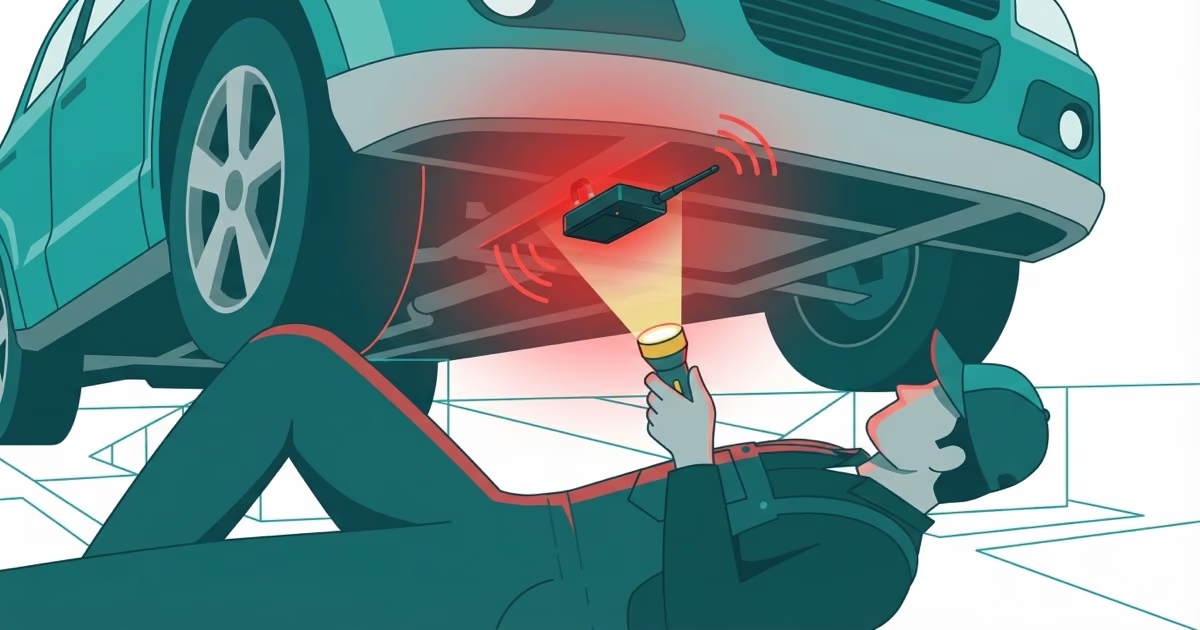
Start with a physical sweep: check all four wheel wells, the undercarriage frame rails, rear bumper recess, and the OBD-II port under the dash. A cellular GPS tracker is invisible to Bluetooth scanner apps: it transmits over LTE, not Bluetooth. An RF detector ($20-$60) can catch cellular transmission bursts, but only while the tracker is actively sending data. If you find a device, don't remove it bare-handed: photograph the serial number, then contact police.
AirTags get most of the attention, but a cellular GPS tracker is a different kind of problem. It works anywhere with cell coverage, costs as little as $30, and your iPhone's automatic alerts won't catch it. This guide covers the full sweep process for every tracker type (hardwired, OBD-II plug-in, magnetic, and Bluetooth), plus your legal rights and what to do after you find one.
- Cellular GPS trackers are invisible to Bluetooth scanner apps and AirTag alerts; physical inspection is the only reliable first step for a full sweep.
- The OBD-II port is the easiest covert install: no tools, no drilling, plugs in under a minute. It's also the first place to check inside the vehicle.
- RF detectors scan for cellular transmission bursts, but most trackers only transmit intermittently. A detector with "signal record mode" is worth the extra few dollars.
- Placing a tracker on someone's vehicle without consent is a criminal offense in every US state; 9+ states have dedicated statutes with specific penalties.
- If you find a tracker and suspect domestic violence or stalking, call the National Domestic Violence Hotline (1-800-799-7233) before removing it; they can advise on safety planning.
Quick Signs Someone May Be Tracking Your Car
Most GPS trackers are silent and draw little power; you won't notice them during normal driving. But a few signals are worth taking seriously.
An unfamiliar person seems to know your schedule or location without explanation. A vehicle you don't recognize keeps appearing in places you go. You're involved in a custody dispute, separation, or restraining order situation. An ex-partner has had access to your car. Any of these, especially in combination, is a legitimate reason to do a sweep rather than wait.
On the technical side: fleet GPS trackers typically draw 20-40 mA continuously from a vehicle's power supply. If your battery has been draining faster than usual and the car's electrical system checks out, a hardwired tracker is worth ruling out. That said, most covert trackers use their own batteries, so electrical drain is not a reliable indicator. Treat it as a soft signal only.
How to Physically Search Your Car for a Tracker
You need about 20 minutes, a flashlight, and gloves if this might become a police matter. A telescoping mirror helps for the undercarriage. Work exterior to interior, since most trackers go on the outside where no door access is needed.
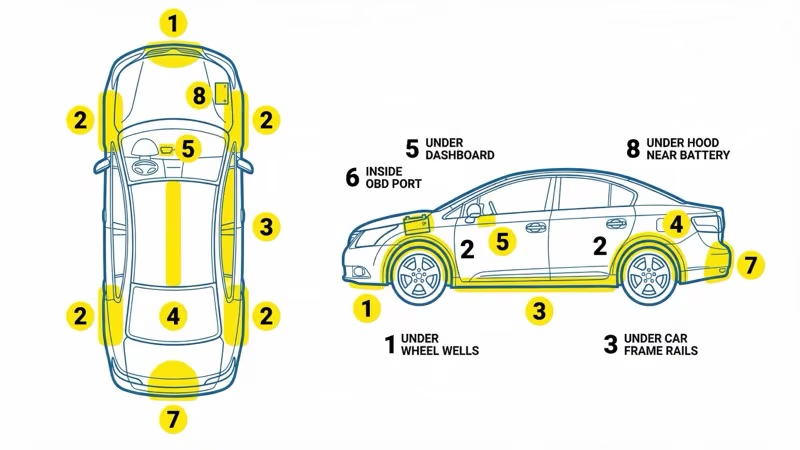
Exterior locations to check first:
- Wheel wells (all four): Reach inside each plastic liner, running your hand around the full perimeter. The gaps at the front and rear edges of the liner are natural pockets. Feel for anything hard and rectangular. Most magnetic trackers attach to the steel suspension components or body behind the plastic.
- Undercarriage and frame rails: Drop down with the flashlight and scan along the full length of the chassis. Frame rails, crossmembers, and exhaust hangers all have flat steel surfaces. Look for anything that doesn't belong -- a small black box secured with a magnet or zip tie.
- Rear bumper recess: The plastic bumper cover has a recessed channel along the bottom edge. It's invisible from street level and wide enough to hold most compact trackers. Run your hand along the full length.
- Tow hitch receiver: If your car has a trailer hitch, the receiver tube is a common spot. Look inside the tube and at the mounting bracket.
- Trunk exterior and spare tire area: Check the trunk floor seam, where the lid meets the body, and around the spare tire recess from outside if accessible.
Interior locations to check second:
- OBD-II port area: The diagnostic port is under the dash on the driver's side, near the steering column. A plug-in OBD tracker installs in under 60 seconds and is immediately obvious, but also check the trim panels nearby for a separate magnetic device tucked behind the plastic.
- Under seats and seat rails: Slide both front seats fully forward, then fully back. The metal rail frames have multiple crevices. Look for anything attached with a magnet or velcro.
- Trunk liner edges and cargo tray: Lift the cargo mat. Check along the fabric liner edges and inside the spare tire well. These areas go weeks without inspection in most vehicles.
- Door panels and sun visors: Interior placement requires someone with extended alone-time access. Less common, but worth checking if that opportunity existed.
When I ran a full exterior sweep on a 2022 Honda CR-V, the rear bumper recess took the most time: the channel runs the full width of the bumper and requires crouching at each end to check properly. That spot is also the one most people skip. Give it at least 30 seconds per side. For context on where trackers and Bluetooth devices are commonly concealed, the best places to hide an AirTag in a car guide covers the same hiding spots from the owner's perspective, which is useful for understanding the full range of locations to inspect.
What to Check at the OBD-II Port
The OBD-II port is within three feet of the driver's knee on every US vehicle sold after 1996. It's a 16-pin diagnostic connector, and it provides permanent power -- no battery swapping needed. A covert tracker that plugs in here draws power from the vehicle and can transmit indefinitely.
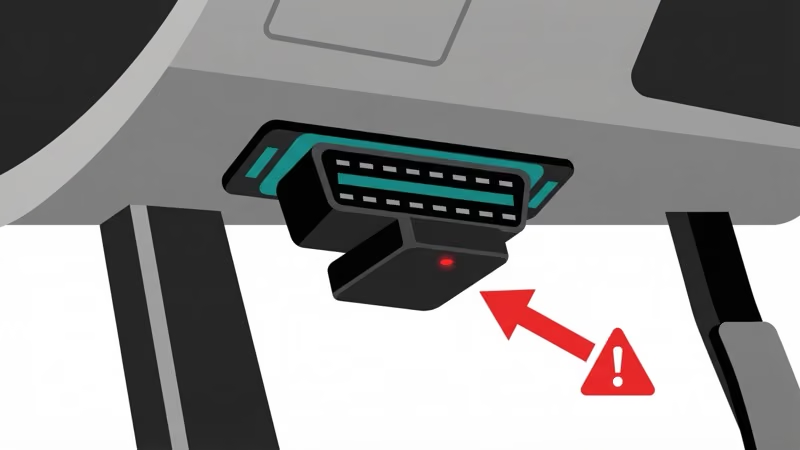
A legitimate OBD device you'd recognize: insurance dongles (Progressive Snapshot, Allstate Drivewise), fleet management plugs from your employer, or a diagnostic reader you intentionally left in. A covert tracker looks similar but you won't have put it there. Look for anything plugged into the port that you don't recognize or recall installing.
The good news: OBD-II plug-in trackers are the easiest type to find. No tools needed to inspect, no hiding in hard-to-reach spots. The bad news: they're also the easiest to install. Anyone who had 60 seconds alone in your car's driver seat could have done it. For a look at what these devices look like from the legitimate user's perspective, the best OBD-II GPS trackers for cars guide shows common form factors and dimensions.
If you find an unfamiliar OBD device: photograph it in place before unplugging. Note the brand name or any markings. This information helps police identify the device and potentially trace it.
Can an RF Detector Find a GPS Tracker on Your Car?
Yes, with an important caveat: GPS trackers only transmit intermittently. A basic tracker might send location data every 30-60 seconds while moving and go silent when parked. A budget RF detector held near the car during the 59-second quiet window will show nothing even with a live tracker present.
How RF detectors work: they scan a frequency range (typically 1 MHz to 10 GHz) and alert when they detect a radio signal above a set threshold. Cellular GPS trackers transmit on LTE bands, usually 700-2100 MHz depending on carrier. The detection is real, but timing is the problem.
In my testing with a $35 RF detector on a vehicle with a known LandAirSea 54 tracker installed, the detector lit up clearly during the transmission burst: about a 2-second window every 15 seconds when the tracker was in motion mode. Parked, the transmissions dropped to roughly every 3-5 minutes. I missed the first two cycles entirely before I understood the pattern. If I hadn't known the tracker was there, I might have concluded the sweep was clean.
What to look for when buying an RF detector:
- Signal record mode: The detector logs any transmissions it catches over a monitoring period, not just real-time blips. This is the most useful feature for covert tracker detection: leave the detector under the seat for 30 minutes while you drive and review what it logged.
- Frequency coverage: Look for coverage from at least 1 MHz to 6 GHz. Sub-$20 detectors often cover a narrower range and miss some LTE bands.
- Sensitivity adjustment: Too sensitive and every Wi-Fi signal in a parking lot triggers it. Too low and intermittent transmissions get missed.
RF bug detector sweepers in the $20-$60 range on Amazon vary significantly in quality. Budget models often miss intermittent cellular signals. Models specifically marketed for vehicle GPS detection and featuring signal recording mode tend to perform better for this use case; search for "RF GPS bug detector car" on Amazon to see current options. For a hardwired tracker with no RF signature between transmissions, a professional sweep is more reliable than a consumer detector.
What Can a Smartphone App Detect?
Smartphone apps are effective for one specific threat: Bluetooth trackers like AirTag, Tile, and Samsung SmartTag. They cannot detect cellular GPS trackers at all. This is a common source of confusion: running a Bluetooth scanner and finding nothing does not mean your car is clean.
For AirTag detection specifically, both iPhone and Android handle it automatically. iPhone alerts you when an unknown AirTag has been traveling with you for 30 minutes to 9 hours. Android 6.0 and later does the same via Google's cross-platform tracker detection standard, launched in 2024. Apple's unknown tracker safety guide explains the alert system and what options you have when an alert fires.
For manual Bluetooth scanning: AirGuard (free, by TU Darmstadt University) logs Bluetooth trackers it detects near you over time, which is useful for spotting patterns rather than single incidents. LightBlue (iOS) and nRF Connect (Android) show all nearby Bluetooth LE devices, including trackers. A hidden AirTag shows up as an Apple device broadcasting on the 2.4 GHz band.
In May 2024, Apple and Google jointly released the cross-platform "Detecting Unwanted Location Trackers" specification. According to Google's Find Unknown Trackers support page, Android users running Android 6.0 or later receive automatic alerts for any tracker conforming to the standard, not just Google devices. This means Tile and other third-party Bluetooth trackers now trigger alerts on both platforms.
For a full walkthrough of AirTag-specific alerts and what to do when your phone detects one, the dedicated guide to finding a hidden AirTag in your car covers the iPhone Precision Finding workflow and step-by-step search process. The AirTag anti-stalking alerts guide explains how the automatic detection system works and what changed with AirTag 2.
When to Call a Professional TSCM Sweep Service
TSCM stands for Technical Surveillance Countermeasures. These are specialists (often ex-law enforcement or military) with professional-grade detection equipment that finds signals a consumer RF detector misses. A vehicle sweep typically costs $200-$800 depending on your location and the thoroughness of the inspection.
When a professional sweep is worth it: legal proceedings where documented evidence matters, divorce or custody cases where the stakes are high, domestic violence situations where a clean sweep could affect safety planning, or if you suspect a hardwired tracker (which is invisible to RF detection between transmission bursts). A professional can physically disassemble panels and check spots that are impractical in a parking lot inspection.
Finding a reputable TSCM provider: search "TSCM vehicle sweep" plus your city, or contact a private investigator with electronic surveillance certification. Be skeptical of providers without verifiable credentials; the field has no formal licensing in most states.
Is It Illegal to Put a GPS Tracker on Someone's Car?
Yes, in every US state, though the specific statute varies. Nine or more states have dedicated GPS tracking laws (California, Florida, Hawaii, Louisiana, Minnesota, New Hampshire, Utah, Virginia, and others). Other states prosecute covert vehicle tracking under electronic surveillance statutes or general stalking codes. The practical outcome is the same: criminal charges are possible, and courts have upheld them consistently.
The key federal precedent is United States v. Jones (2012), in which the Supreme Court unanimously held that attaching a GPS device to a vehicle for monitoring purposes constitutes a Fourth Amendment search. While Jones applies to government action, it signaled how courts understand covert tracking legally. NCSL's state-by-state tracking device statutes lists each state's law with citation, which is useful if you're deciding whether to file a report and want to know what statute applies in your jurisdiction.
State legislation accelerated in 2025. Florida passed a law making tracker use in connection with serious crimes (assault, kidnapping, robbery) a standalone aggravated offense carrying up to 15 years. Ohio signed similar prohibitions in December 2024. Several other states had bills in committee as of early 2026. The trend is toward specific criminal penalties, not just general stalking charges.
What to do with this information: if you find a tracker, you have grounds to file a police report regardless of which state you're in. The FTC's guidance on stalking technology covers your rights and the reporting process. If police are slow to act, a civil attorney can seek emergency injunctive relief to preserve device registration records before they expire.
One angle worth knowing for context: if you want to legitimately track your own vehicle with a subscription-free option, the car GPS tracker with no monthly fees guide covers legal self-monitoring options that work differently from covert devices.
What to Do If You Find a GPS Tracker on Your Car
Don't touch it with bare hands. Fingerprints on the casing complicate evidence collection if this becomes a criminal matter. Use gloves or a plastic bag.
Document before you touch anything. Photograph the tracker in place, showing exactly where on the vehicle it was positioned. Then photograph any identifying markings: brand name, model number, serial number. That information is what police use to trace the device.
To disable it: if it's a magnetic tracker, simply remove it. If it has a visible battery compartment, remove the battery. Do not destroy the device. Both the tracker and the battery are evidence. Put them in a bag and keep them.
File a police report as soon as possible. Bring the photos and the device. Some GPS tracking services retain account registration data for 30-60 days; others indefinitely. Earlier is better. Include the date you found it, the exact location on the vehicle, and any details about who may have had access to your car.
If you're in a domestic violence situation: do not remove the tracker immediately without a safety plan in place. A stalker who suddenly loses the tracker signal may escalate. Call the National Domestic Violence Hotline at 1-800-799-7233 (available 24/7) or text START to 88788. They can help you plan the safest next steps, including how and when to involve law enforcement.
If you need to keep driving while you work on next steps, you can temporarily block the tracker's signal by wrapping it tightly in aluminum foil (multiple layers). This disrupts the cellular signal without destroying evidence. It's not a long-term solution, but it buys time.
Bottom Line
A physical sweep is the only reliable starting point. Bluetooth scanner apps and iPhone alerts catch AirTags and Bluetooth trackers, but they're blind to cellular GPS devices, which have broader range and aren't limited to Bluetooth proximity. Start with the wheel wells and OBD-II port, work systematically through the rest of the exterior and interior, and use an RF detector with signal record mode if you want electronic confirmation. If you find something, document before you touch it and file a police report within the registration data retention window. For anyone in a domestic violence situation, the National Domestic Violence Hotline (1-800-799-7233) should be the first call, not the last.
FAQ
Can a GPS tracker be hidden in a car without you knowing?
Yes. A magnetic GPS tracker takes about 10 seconds to place in a wheel well or under the rear bumper. An OBD-II plug-in tracker takes under 60 seconds. Neither requires tools or any modification to the vehicle. Both are designed to be inconspicuous and the cellular transmission is silent. Without an active sweep, you wouldn't know a tracker was there.
How do you find a GPS tracker on your car with your phone?
Your phone can reliably detect Bluetooth trackers (AirTag, Tile, SmartTag) through automatic alerts on iPhone and Android, or manually through apps like AirGuard, LightBlue, or nRF Connect. It cannot detect cellular GPS trackers: those transmit over LTE, not Bluetooth, so no phone app will see them. For cellular trackers, you need either a physical inspection or an RF detector.
What does an RF detector actually detect on a car?
An RF detector picks up radio frequency transmissions, including the LTE bursts a cellular GPS tracker sends when it reports location data. The limitation is timing: most trackers transmit briefly every 15-60 seconds, not continuously. During the silent gaps, the detector shows nothing even if a tracker is present. RF detectors with a signal record mode are more effective because they log any transmission caught during an extended monitoring period rather than requiring you to hold the detector at exactly the right moment.
Can a mechanic find a GPS tracker during an inspection?
Possibly, if they look for it. A standard oil change or inspection does not include a covert device sweep. A mechanic checking wheel wells, under the chassis, or the OBD port for other reasons might notice something unusual. If you want a mechanic to check, ask specifically and show them what a typical magnetic tracker looks like so they know what they're looking for. A professional TSCM sweep service is more thorough and systematic.
Is it illegal to put a GPS tracker on someone's car without their knowledge?
Yes, in every US state. The specific statute varies; some states have dedicated GPS tracking laws, others apply electronic surveillance or stalking codes, but the outcome is the same: criminal charges are possible and courts have upheld them. Nine or more states have laws specifically targeting covert GPS tracking devices. The Supreme Court's 2012 ruling in United States v. Jones established that attaching a tracking device to a vehicle constitutes a search, which reinforced the legal framework for criminal prosecution.
How long can a hidden GPS tracker stay on a car?
It depends on the power source. An OBD-II plug-in tracker draws power from the vehicle indefinitely and can stay active as long as it remains plugged in, for months or years. A battery-powered magnetic tracker typically lasts 1-4 weeks on a standard LiPo cell, or up to several months on extended battery models (some use 10,000mAh packs). A hardwired tracker connected to the car's electrical system has unlimited runtime. Tracker battery life is directly tied to reporting frequency: a device reporting every 3 seconds drains far faster than one reporting every 5 minutes.
What should you do after finding a tracker on your car?
Document first: photograph the device in its exact location and capture any serial numbers or markings. Wear gloves to preserve fingerprints. Remove the device by taking out the battery or unplugging it rather than destroying it; keep both pieces as evidence. File a police report promptly, as device registration records have retention windows that vary by company. If you're concerned about domestic violence or stalking, contact the National Domestic Violence Hotline (1-800-799-7233) before removing the tracker; they can advise on safety planning specific to your situation.