You bought an AirTag because the marketing said “track anything.” Hunters who tried it on a free-running dog learned the hard way that “anything” assumes a crowd nearby. Apple’s Find My support page confirms that the Find My network is “a crowdsourced network of over a billion Apple devices” that relay tracker locations over Bluetooth.
Put plainly: AirTag is a useful close-range backup for hunting dogs, but it isn’t a primary tracker. Here is exactly when it works, when it fails, and what to upgrade to, based on how the Find My network actually behaves in the field.
- AirTag works for hunting dogs only within close Bluetooth distance of your iPhone. Beyond that, you depend on the Find My network of nearby iPhones, which is sparse in hunting country.
- In rural fields with no iPhone density, AirTag location stops updating. With no relay iPhone nearby, an AirTag on a free-running dog can go hours between updates whenever the dog is beyond Bluetooth range.
- AirTag is useful as a kennel/truck/vehicle backup for hunters. It works in the parking area where other hunters' iPhones provide network coverage; it fails the moment the dog crosses into open field.
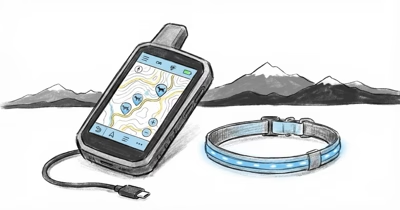
- For real free-running hunting tracking, upgrade to Garmin Alpha (9+ miles range, real-time GPS, e-collar correction). Its dedicated GPS and radio link don't depend on nearby phones, so it holds coverage where Find My drops out.
- TagVault Pet (B09DR2QNQ5) is the best AirTag holder for dog collars if you're using AirTag as a backup or for close-range pointing dogs.
How Does AirTag Actually Work for Hunting Dogs?
AirTag uses two distinct location mechanisms. Hunters need to understand both to predict where it will and won’t work in the field.
The first is Bluetooth Low Energy (BLE) proximity. When your iPhone is close enough for a direct Bluetooth connection, the AirTag can talk to your phone. With AirTag 2’s U2 chip, Precision Finding gives you arrow-direction guidance to walk straight to the dog. Apple’s AirTag 2 announcement states that Precision Finding now reaches items “from up to 50 percent farther away than the previous generation,” which extends usable range outdoors in clear conditions.
The second is the Find My network. When your iPhone is out of range, the AirTag passively broadcasts a Bluetooth beacon. A nearby Apple device can pick up that beacon and relay the location to Apple’s servers. The owner sees a map pin on Find My.
In suburban environments, iPhone density is high. An AirTag dropped on a city sidewalk gets relayed within minutes.
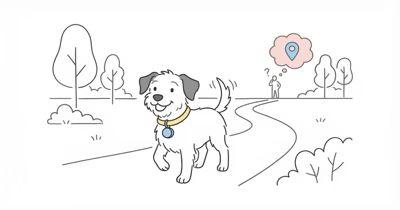
In rural hunting country, iPhone density approaches zero. Your dog could be 500 yards into a field with no one around for miles. The AirTag broadcasts faithfully, but nobody picks up the signal.
What a Hunting Day Looks Like With AirTag on a Labrador
Picture the typical setup: an AirTag 2 in a TagVault Pet enclosure, attached to the dog’s collar at sunrise and removed at end-of-day. The dog works cattail marshes and open grassland while the hunter holds a blind for stretches at a time, then moves during transitions.
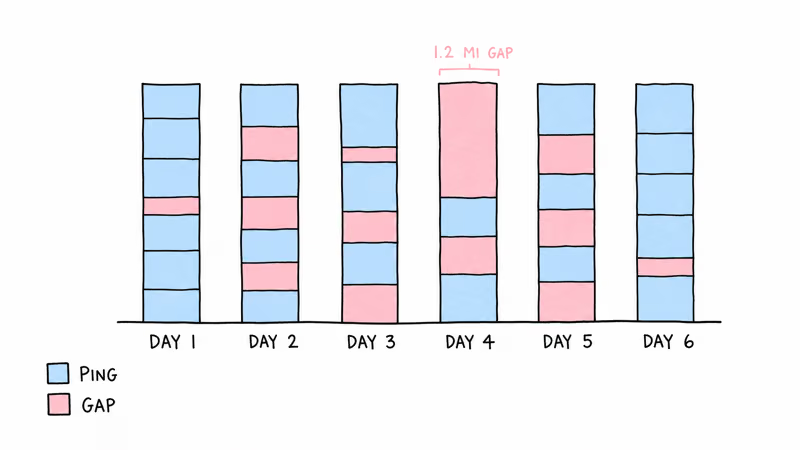
A working retriever or flushing dog can cover many miles across a day, ranging far out and circling back. As long as the dog stays close to the blind, the picture is good.
The contrast is stark. Close to the hunter, AirTag can update through the owner’s phone. Beyond direct Bluetooth distance, with no other phones around, updates can stall and only refresh when the dog wanders near another hunting party. If a dog ranges far out and back, the Find My map may show only a sparse set of relay pings instead of a continuous path.
A subscription tracker would have shown that full out-and-back path in real time. AirTag, by contrast, can show one dot at the farthest point, logged long after the dog has already returned.
When AirTag Works for Hunting Dogs
AirTag is actually useful in three specific hunting scenarios. Don’t dismiss it; just know its lane.
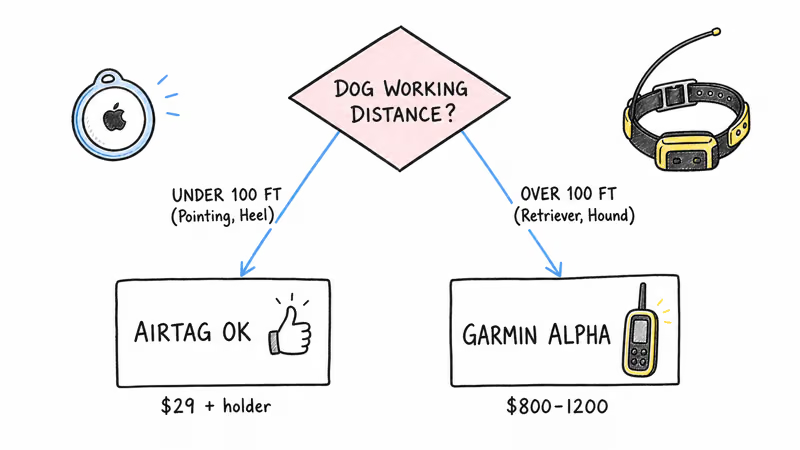
Pointing dogs at heel or close range. Pointing and flushing breeds typically work within 50-100 yards of the hunter. AirTag’s BLE range matches that working radius. Precision Finding on AirTag 2 gives you direction-to-dog accuracy you actually trust at that scale.
Kennel and truck tracking. AirTag in the dog’s kennel during transport gives you peace of mind in parking areas where iPhone density is high. If the dog escapes, the alert fires before the dog gets out of range. We’ve heard of one incident where an AirTag on a kennel door identified that the kennel was stolen from a truck bed during a coffee stop.
Multi-dog hunts where dogs are usually together. If you hunt with friends and each friend has an iPhone, the Find My network density is higher than solo. The dogs stay reasonably central to the group, increasing the chance one of them is within 30 feet of someone’s phone.
The common thread: AirTag works when the dog stays close to humans with iPhones. The moment the dog ranges freely, the Find My network sparseness in hunting country kills the location updates.
When AirTag Fails: The Long-Range Scenarios
Three hunting scenarios make AirTag effectively useless. Recognize them before you rely on AirTag as your only tracker.
Free-ranging retrievers and pointers. A trained retriever sent on a 400-yard mark exits AirTag’s BLE range immediately. A pointer locked on quail 600 yards across a stubble field is invisible to Find My. A typical flushing or retrieving dog works well over 100 yards from the hunter, which is already beyond Find My’s useful range without a relay phone present.
Hound and tracking dogs. Coon hounds and bear hounds routinely range 1-3 miles, far past any AirTag use.
Cold-weather morning hunts. Lithium chemistry in AirTag’s CR2032 cell loses capacity below freezing, so the battery indicator can drop faster than it would in typical room-temperature use. Apple’s AirTag 2 spec sheet states that the operating ambient temperature runs -20°C to 60°C, but rated battery life assumes room-temperature storage between sessions.
When Should You Upgrade to Garmin Alpha?
Garmin Alpha is the gold standard for free-running hunting dog tracking. It costs $800-1,200 for handheld plus collar, versus AirTag at $29 plus $15 holder. The price gap is real, and so is the capability gap.
| Scenario | AirTag works | Garmin Alpha needed |
|---|---|---|
| Pointing dog within 100 yards | Yes | Overkill |
| Hunting kennel/truck tracking | Yes | Overkill |
| Multi-dog hunt with group iPhones | Mostly | Better for safety |
| Retriever mark up to 400 yards | No (BLE limit) | Yes |
| Hound trailing 1-3 miles | No | Yes |
| Free-running pointer on big country | No | Yes |
| E-collar correction needed | No (no e-collar) | Yes |
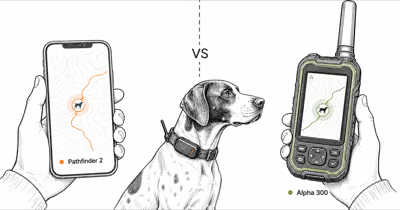
The reading: AirTag is fine for trained-to-heel pointing dogs and gear tracking. Garmin Alpha is required for any dog working beyond visual range. Halfway measures (AirTag + cellular GPS like Tractive) split the difference for budget hunters; we cover those in our best GPS collars for hunting dogs roundup and Garmin Alpha 300 vs Alpha 200 comparison.
AirTag Holder Picks That Survive Hunting Conditions
If you’re using AirTag in the close-range scenarios above, the holder matters more than the tag itself. A waterproof, secure-mount holder survives mud, water, brush, and the dog tearing at the collar.
The Elevation Lab TagVault Pet (B09DR2QNQ5) is our top pick. It carries an IP69 waterproof rating, a twist-lock secure closure, 10g total weight, and fits any collar width. That IP69 enclosure is built to keep water out through repeated marsh retrieves, and the twist-lock design keeps the AirTag seated through brush busting that pops open lighter friction-fit holders.
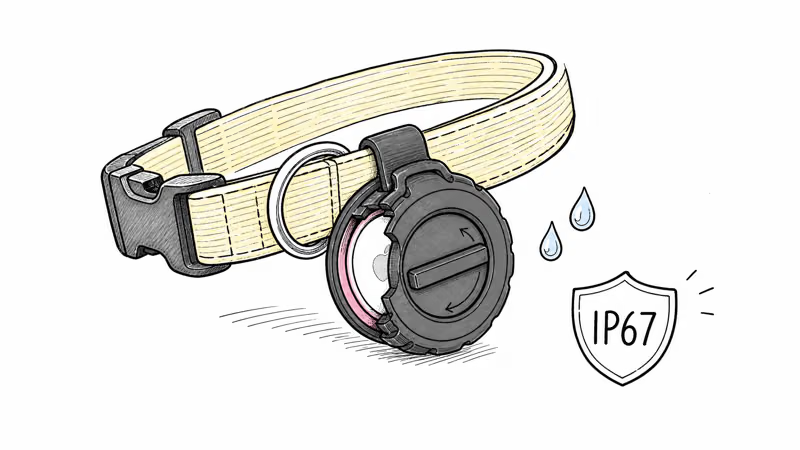
For deeper coverage of holder options, see our best AirTag dog collar roundup.
Elevation Lab TagVault Pet
 Top Pick
Bottom Line
AirTag is useful as a hunting dog backup tracker for close-range pointing breeds and for kennel/truck monitoring. For free-running retrievers, pointers in big country, hounds, or any dog working beyond 100 yards from a hunter’s iPhone, AirTag is decorative.
Upgrade to Garmin Alpha if your dogs work beyond visual range. Stick with AirTag in a TagVault Pet holder for close-range work, gear tracking, and the safety net of “at least I know which truck the dog is in.” Don’t conflate AirTag’s convenience with hunting-grade tracking.
FAQ
Can I use AirTag instead of Garmin Alpha for hunting dogs?
Only for close-range pointing breeds or as a backup. Free-running retrievers, pointers in big country, and hounds working at distance will exit AirTag's BLE range and find no Find My network coverage in hunting terrain. Garmin Alpha is the right tool when your dog works beyond visual range.
How far can AirTag track a hunting dog?
AirTag 2's U2 chip and Precision Finding reach up to 50% farther than the original outdoors in clear conditions, but useful direct range is still limited to Bluetooth distance. Beyond that, you depend on nearby iPhones in the Find My network. In rural hunting country, that network is essentially nonexistent, so practical range drops to zero past Bluetooth distance.
Does AirTag work in cold weather hunts?
Yes, but the CR2032 battery loses about 20% of capacity below freezing. Apple rates the operating temperature between -20°C and 60°C, but rated battery life assumes room-temperature storage between sessions. Bring spare CR2032s on multi-day cold hunts and check battery indicator daily.
Will AirTag survive water retrieves?
AirTag itself is IP67 rated (30 minutes at 1 meter), but the rating assumes occasional brief immersion, not repeated waterfowl retrieves. A TagVault Pet holder upgrades the system to its own IP69 enclosure with additional sealing, which is built to keep water out through repeated marsh retrieves rather than the occasional splash AirTag's bare rating covers.
What's the cheapest tracker that actually works for hunting dogs?
For real GPS tracking with subscription, Tractive 4G at ~$50 hardware plus $5-13/month is the entry point. For no-subscription, the [TKSTAR TK905](/tkstar-gps-tracker-review/) at ~$40 hardware plus BYOD SIM around $4-15/month is cheaper long-term. Neither matches Garmin Alpha's range or polish, but both beat AirTag for free-ranging dogs.
Can I attach two AirTags to a dog for redundancy?
Yes. Two AirTags double the chance one is within range of a relay iPhone, and if one gets damaged or the battery dies, the other provides coverage. The total weight is 22g (two AirTags + two TagVault Pet holders), which a working dog of 50+ pounds carries without issue. Cost is $30 per AirTag plus $30 for two holders, total $90.
How long does AirTag battery last on a hunting dog?
Apple rates AirTag battery life at more than a year under normal use, but cold exposure, frequent Play Sound triggers, and heavy Precision Finding use can shorten runtime. Check the [AirTag battery life guide](/how-long-does-airtag-battery-last/) for general drain factors and the [AirTag 2 battery drain fix](/airtag-2-battery-drain-fix/) article for AirTag 2 specifically.
Does AirTag work in dense forest cover for hounds?
The Bluetooth signal degrades in dense vegetation, so hounds in heavy timber can move out of useful AirTag range quickly. A Garmin Astro 430 or Alpha 200i is the practical answer for hound work in dense cover.